Article Surah 100 · Ayah 1
Iconography and written sources
Iconography and written sources
29The earliest occurrences of horse bones in Arabian archaeozoological assemblages are concomitant with the first representations and epigraphic mentions of horses in the Peninsula.
52⦁ ⦁ Potts⦁ , 1989, p. 74‑75; 1993b; ⦁ Yule⦁ , 2016, p. 44; ⦁ Yule⦁ ⦁ &⦁ ⦁ Weisgerber⦁ , 1988, p. 33.
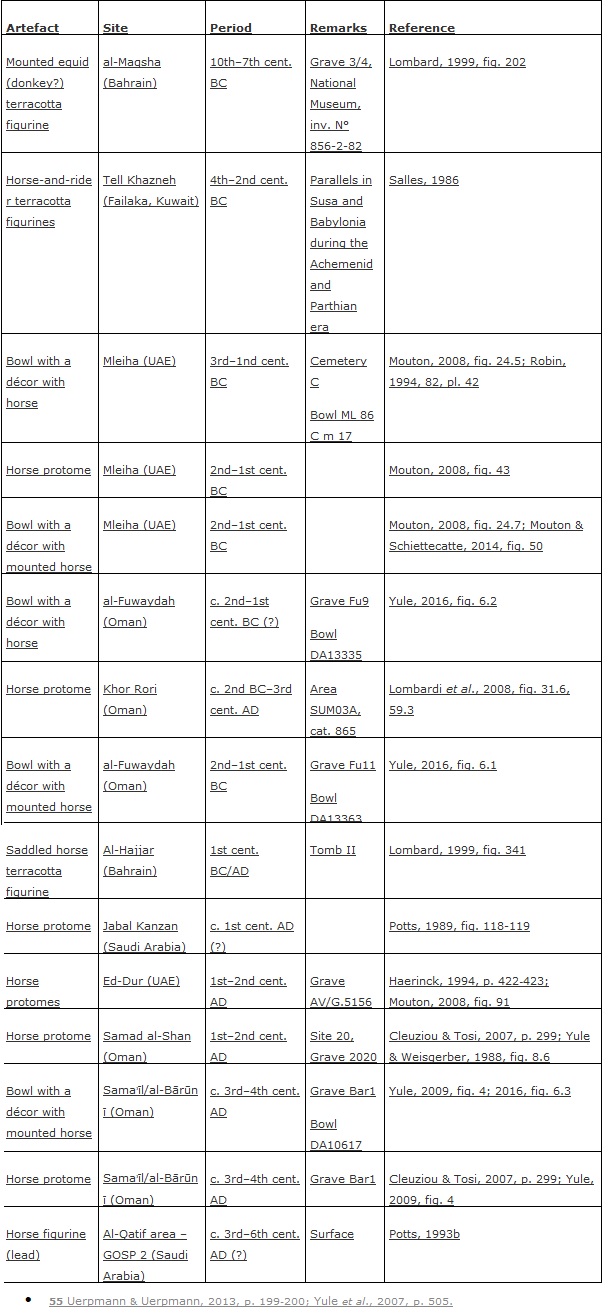
30In Eastern Arabia, horse bones appeared after the mid‑1st millennium BC. A list of the prominent artefacts (vessels, figurines, statues) found in this region representing or displaying horses (Table 2) shows that all of them are posterior to the 4th cent. BC too. Some of these artefacts are influenced by Parthian productions, or even imported from Persia and Southern Mesopotamia52, where the motif of the horse was already in use for centuries. Interestingly, this motif only entered the Arabian repertoire once its inhabitants familiarized with the animal.
53⦁ ⦁ Macdonald⦁ , 2010; ⦁ Robin⦁ , 2016, p. 242.
54⦁ ⦁ Callot⦁ , 2004, p. 90‑95; ⦁ Huth⦁ , 2010, p. 111; ⦁ Robin⦁ , 2016, p. 235.
31This process is clearly marked in Eastern Arabian coinage. From the 4th century BC, the Alexander series (Heracles obverse; enthroned Zeus reverse) were adopted as a model for local coin productions. During the 2nd century BC, on the series of Ḥārithat king of Hagar and Abīʾēl —probably a queen of ʿUmān53— the seated figure of Zeus/Shamash holding an eagle on the reverse of the tetradrachms is replaced with that of a beardless seated figure holding a horse protome54.
Table 2: Pre‑Islamic terracotta figurines, copper alloy vessels, and copper alloy or lead protomes showing horses in Eastern Arabia.
32In Southern Arabia, prior to the 2nd century AD, only donkeys were identified in archaeological contexts (Table 1). The single horse mention we have been able to retrieve comes from Ẓafār (layers from the 2nd–6th cent. AD)55. This is in line with some of the conclusions reached by S. Antonini and Ch. Robin in this issue:
• Epigraphic South Arabian mentions and iconographic representations of horses are dated after the turn of the Christian era;
• From the 1st century AD onwards, classical sources started to mention the delivery of horses to the kings of Ḥimyar and Ḥaḍramawt (Periplus Maris Erythraei, §24, 28; Philostorgius Eccl. Hist. III.4).
33In Northern Arabia, the only archaeozoological evidence published so far were found at Dūmat al‑Jandal and Madāʾin Ṣāliḥ in the early centuries of the Christian era. However, the contribution by S. Olsen in this issue clearly shows that the rock art representations of horses in the region stretching from Taymāʾ to Ḥāʾil and al‑ʿUlā could have originated in the 1st millennium BC. Ch. Robin (in this issue) also argues for an earlier presence of the horse in North Arabia, taking into account that contacts with cavalry and chariotry from the north, e.g. the prominent expedition of Nabonidus in Taymāʾ, were likely to arouse the interest of local leaders. He also shows that the two different ways to depict horses in South Arabian petroglyphs differs from that described by S. Olsen in North Arabia. The absence of the northern “slender horse” in the southern repertoire could be indicative of an earlier iconographic tradition developed at a time horses were absent from South Arabia.
34So far, evidence coalesces to indicate that horses started to be tamed in both Eastern and Northern Arabia in the mid‑1st millennium BC at the latest. They became permanent in South Arabia a few centuries later (c. 1st cent. BC/AD). Therefore, it seems most likely that the horse domestication spread from Southern Mesopotamia and Southern Levant to North‑Eastern Arabia, later reaching South Arabia.
56⦁ ⦁ Robin⦁ ⦁ &⦁ ⦁ Antonini⦁ in this issue; ⦁ Nicolle⦁ , 1996, p. 92; ⦁ Ryckmans⦁ , 1963; ⦁ Robin⦁ , 1996.
35Both the development of mounted contingents among South Arabian, Nabataean and Saracen cavalries in the early centuries of the Christian era56and the mention by Ammianus Marcellinus (c. 330–395) that the Saracens ranged “widely with the help of swift horses and slender camels in times of peace or of disorder” (Res Gestae 14.4.3), shows that horses soon became a normal mount for both the nomadic and settled peoples of the Peninsula.
57⦁ ⦁ Fedele⦁ , 2009; ⦁ Studer⦁ , 2014.
58⦁ ⦁ Uerpmann⦁ , 1999.
36Be that as it may, horses remained characterized by their relative rarity all along the late pre‑Islamic period: in the faunal remains (Table 1), equid bones never exceed 1% of the number of identified fragments57; in Mleiha, only two graves yielded a horse skeleton against twelve dromedary skeletons58; and finally Robin (this issue) counts thousands of petroglyphs showing horses potentially ascribed to the Islamic period against 10 to 20 assuredly pre‑Islamic.
37All the evidence suggests that this rarity goes hand in hand with the high value granted to horses:
59⦁ ⦁ Al⦁ ‑⦁ Ansary⦁ , 1996, p. 54; ⦁ Macdonald⦁ , 1996, p. 75.
• Horses had a role in raid, fight and hunt scenes, they never appear as burden beasts59;
60⦁ ⦁ Jasim⦁ , 1999.
61⦁ ⦁ Yule⦁ ⦁ et al⦁ ., 2004.
• Harnesses discovered in archaeological contexts were of high quality, including golden pieces60 or silver inlay61;
62⦁ ⦁ Avanzini⦁ , 2016, p. 230.
• Much importance was given to the killing of the enemies’ horses in the Sabaic inscriptions, e.g. that of the Ḥimyarite king Shammar62;
63⦁ ⦁ Frantsouzoff⦁ , 2015, p. 90; ⦁ Robin⦁ , 1996, p. 63, 71 n. 40.
• Horses were given a name in South Arabia63;
• Horses were the main gift of the embassy of Constantius to the Ḥimyarite king as reported by Philostorgius (Church History III.4).
38As emphasized by D. Mahoney (this issue), both the high value of horses and their use in political machinations remained one of its characteristics in the Islamic period.