Article Surah 107 · Ayah 2
HYPOCRISY (AN-NIFAQ)
HYPOCRISY (AN-NIFAQ)
Hypocrisy is the insincerity of a person by virtue of pretending to have qualities or beliefs that one does not really have or Hypocrisy means showing a good face whilst concealing bad intentions, and harbouring ill will whilst appearing good in order to cause harm.
Munafiq (plural munafiqun) is an Arabic term, Islamically it is used to describe a religious hypocrite, who outwardly practices Islam, while inwardly concealing his disbelief (kufr), perhaps even unknowingly.
"Munafiq" is a person or a human who shows Eeman and hides Kufr (disbelief). He was given this name because his action is like the one of the Jerboa, which enters its burrow from a direction and gets out from another one. So he is a Munafiq who has entered Islam through a door in one direction and has got out from Islam through another door in another direction. This word “Munafiq” was not known before Islam. The Arabs did not know it in its specific meaning i.e. the one who hides his kufr and shows his Eeman.
Therefore Nifaq (Hypocrisy) is the character of a person having this quality and Munafiq (Hypocrite) is the person itself who is having the quality of Nifaq. [1]
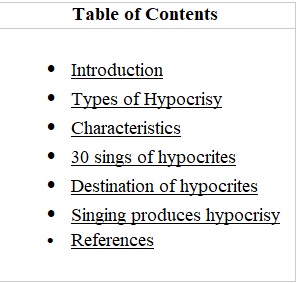
Introduction
The hypocrites are always confused, always planning deceit and plots. Although outwardly they appear to be with the believers, inwardly they are with the kaafireen (disbelievers of Islam). So sometimes they are inclined towards the believers and sometimes they are inclined towards the kaafireen.
“(They are) swaying between this and that, belonging neither to these nor to those; and he whom Allah sends astray, you will not find for him a way (to the truth — Islam)” Qur’an.Surah Nisa 4:143
Because of the corruption of their hearts, the hypocrites are the most aayath of mankind to the religion of Allah (Glory be to Him), as Allah tells us about them (interpretation of the meaning): “And when it is said to them: ‘Come to what Allah has sent down and to the Messenger (Muhammad),’ you (Muhammad) see the hypocrites turn away from you (Muhammad) with aversion” Qur’an.Surah Nisa 4:61
The dealings of the hypocrites revolve around their own interests. When they meet the believers, they make a show of belief and loyalty, in order to deceive the believers and as an action of dissimulation, hoping for whatever good and war-booty they have. But when they meet their masters and chiefs, they say, we are with you in your shirk and kufr. Allah (Glory be to Him) says concerning them (interpretation of the meaning): “And when they meet those who believe, they say: “We believe,” but when they are alone with their Shayaateen (devils — polytheists, hypocrites), they say: “Truly, we are with you; verily, we were but mocking Allah (Glory be to Him) mocks at them and gives them increase in their wrong-doing to wander blindly” Qur’an.Surah Baqarah 2:14-15 [2]
Types of Hypocrisy
There are two categories of hypocrisy:
1. Hypocrisy in Belief.
2. Hypocrisy in deeds and actions.
1. The hypocrisy in Belief
Hypocrisy in Belief is of six types
1. Denial of the Messenger (May Allah honour Him and Grant Him Peace).
2. Denial of the thing with which the Messenger is sent.
3. Hating the Messenger (May Allah honour Him and Grant Him Peace)
4. Hating the thing with which the Messenger (May Allah honour Him and Grant Him peace) is sent.
5. Rejoicing at the disgrace of Islam.
6. Disliking the prevalence of Islam.
Any one of the [above six types] is major Nifaq [Hypocrisy]– disbelief outside of the religion
2. Hypocrisy in deeds and actions
The hypocrisy in deeds and actions is of five types:
1. When he speaks, he lies.
2. When he promises, he breaks it.
3. When he is entrusted, he betrays.
4. When he disputes, he acts immorally.
5. When he makes a contract, he makes acts disloyally.
Hypocrisy from Noble Qur’an by Dr.Muhsin Khan
Characteristics
The hypocrites have many characteristics, the worst and most serious of which is disbelief in Allah (Glory be to Him). Allah says (interpretation of the meaning): “And when it is said to them (hypocrites): ‘Believe as the people (followers of Muhammad (May Allah honour Him and grant Him peace), Al-Ansaar and Al-Muhaajiroon) have believed,’ they say: ‘Shall we believe as the fools have believed?’ Verily, they are the fools, but they know not” Qur’an.Surah Baqarah 2:13
Among their characteristics are enmity and envy (hasad) towards the believers, as Allah says (interpretation of the meaning): “If good befalls you (O Muhammad), it grieves them, but if a calamity overtakes you, they say: ‘We took our precaution beforehand’ and they turn away rejoicing” Qur’an Surah 9:50
Among their characteristics is mockery of Allah (Glory be to Him), His Messenger (May Allah honour Him and Grant Him peace) and His religion. Allah (Glory be to Him) says (interpretation of the meaning): “If you ask them (about this), they declare: ‘We were only talking idly and joking.’ Say: ‘Was it at Allah, and His Ayaat (proofs, evidences, ayaths, lessons, signs, revelations, etc.) and His Messenger that you were mocking?’ Make no excuse; you disbelieved after you had believed” Qur’an.Surah Tawbah 9:65-66
Among their characteristics is that they spread corruption on earth, with disbelief, hypocrisy and sins. Allah (Glory be to Him) says (interpretation of the meaning): “And when it is said to them: ‘Make not mischief on the earth,’ they say: ‘We are only peacemakers.’ Verily, they are the ones who make mischief, but they perceive not” Qur’an.Surah Baqarah 2:11-12
Among their characteristics are slander and lies. Allah (Glory be to Him) tells us about them (interpretation of the meaning): “They swear by Allah that they are truly, of you while they are not of you, but they are a people (hypocrites) who are afraid (that you may kill them)” Qur’an.Surah Tawbah 9:56
Among their characteristics is that they enjoin what is evil and forbid what is good, and they are stingy with their wealth. Allah (Glory be to Him) says concerning them (interpretation of the meaning): “The hypocrites, men and women, are one from another; they enjoin (on the people) Al-Munkar (i.e. disbelief and polytheism of all kinds and all that Islam has forbidden), and forbid (people) from Al-Ma‘roof (i.e. Islamic Monotheism and all that Islam orders one to do), and they close their hands [from giving (spending in Allah’s Cause) alms]. They have forgotten Allah, so He has forgotten them. Verily, the hypocrites are the Faasiqoon (rebellious, disobedient to Allah)” Qur’an.Surah Tawbah 9:67
Among their characteristics are greed and avarice: “And of them are some who accuse you (O Muhammad (May Allah honour Him and grant Him peace)) in the matter of (the distribution of) the alms. If they are given part thereof, they are pleased, but if they are not given thereof, behold! They are enraged! Qur’an.Surah Tawbah 9:58
Among their characteristics are those which were described by the Messenger (May Allah honour Him and Grant Him peace): Narrated 'Abdullah bin 'Amr®: Messenger (May Allah honour Him and Grant Him peace) said, "Whoever has the following four (characteristics) will be a pure hypocrite and whoever has one of the following four characteristics will have one characteristic of hypocrisy unless and until he gives it up.
1. Whenever he is entrusted, he betrays.
2. Whenever he speaks, he tells a lie.
3. Whenever he makes a covenant, he proves treacherous.
4. Whenever he quarrels, he behaves in a very imprudent, evil and insulting manner."
Sahih Al Bukahari Vol 1:33 and Sahih Al Muslim Vol 1: 111. [3]
Among their characteristics is a concern with appearances and fancy speech whilst they are inwardly corrupt. Allah (Glory be to Him) says concerning them (interpretation of the meaning): “And when you look at them, their bodies please you; and when they speak, you listen to their words. They are as blocks of wood propped up. They think that every cry is against them. They are the enemies, so beware of them. May Allah curse them! How are they denying (or deviating from) the Right Path?” Qur’an.Surah Munafiqun 63:4 [4]
30 Signs of the Hypocrites
⦁ Falsehood and Lying
⦁ Treachery
⦁ Showing insolence and licentiousness in argumentation
⦁ Breaking one's promise
⦁ Laziness in worship
⦁ Showing off
⦁ Lack of remembrance of Allah
⦁ Hastiness in prayer
⦁ Slandering those who give themselves freely to good deeds from among the believers and the righteous
⦁ Mocking the ⦁ Qur'an, the ⦁ Sunnah and the ⦁ Messenger (May Allah honour Him and Grant Him peace)
⦁ The protective oath
⦁ Disliking to spend for the sake of Allah
⦁ Desertion and abandonment of the Muslims
⦁ Originating false rumours and causing sedition
⦁ Finding fault with ⦁ Allah's decree
⦁ Bringing down the honour of the righteous
⦁ Remaining away from the congregational prayer
⦁ Causing mischilef while claiming to establish peace
⦁ Outward behaviour contradicting what is in the heart
⦁ Fear of unpleasant events, incidents and happenings
⦁ False excuses
⦁ Commanding the evil and preventing the good
⦁ Tying one's hands back out of stinginess
⦁ Forgetting Allah
⦁ Denial of the promise of ⦁ Allah and His ⦁ Messenger (May Allah honour Him and Grant Him peace)
⦁ Concern for the outward appearance and neglect of the innner condition
⦁ Eloquence, long-winded speech, boasting and bragging
⦁ Lack of understanding of the religion
⦁ Not sinning in front of the people (due to fear of them) but showing boldness to ⦁ Allah by committing sins in secrecy
⦁ Rejoicing at the affliction of the believers with a calamity and being saddened at their being touched by joy and pleasure [5]
Destination of hypocrites
Allah (Glory be to Him) has decreed that the ultimate destiny of the kuffaar and hypocrites will be in Hell: “Surely, Allah will collect the hypocrites and disbelievers all together in Hell” Qur’an.Surah Nisa 4:140
Hypocrisy is a serious sickness and a great crime. It means making an outward display of Islam whilst inwardly concealing kufr. Hypocrisy is more dangerous than kufr (disbelief) and the punishment for it is more severe, because it is kufr mixed with Islam and its harmful effects are greater. Hence Allah (Glory be to Him) will put the hypocrites in the lowest level of Hell, as He says (interpretation of the meaning): “Verily, the hypocrites will be in the lowest depth (grade) of the Fire; no helper will you find for them “ Qur’an.Surah Nisa4:145. [6]
Singing Produces Hypocrisy
Narrated Abdullah ibn Mas’ud: Salam ibn Miskin, quoting an old man who witnessed Abu Wa’il in a wedding feast, said: They began to play, amuse and sing. He united the support of his hand round his knees that were drawn up, and said: I heard Abdullah (ibn Mas’ud®) say: I heard the apostle of Allah (May Allah honour Him and Grant Him Peace) saying: Singing produces hypocrisy in the heart. 'Book of General Behavior (Kitab Al-Adab)' in Abu Dawud 4909.
Allah (Glory be to Him) says in Qur’an: “And of mankind is he who purchases idle talks (i.e. music, singing) to mislead (men) from the path of Allah without knowledge, and takes it (the path of Allah, or the ayah of the Qur'an) by way of mockery. For such there will be a humiliating torment (in the Hell-fire).” Qur’an.Surah Luqman 31:6
Ibn ‘Abbas said: idle talks here means singing. Mujaahid (May Allah have Mercy on Him) said: this means playing the drum (tabla). Tafseer al-Tabari, 21/40
Al-Hasan al-Basri (May Allah have Mercy on Him) said: this aayah was revealed concerning singing and musical instruments (lit. woodwind instruments).Tafseer Ibn Kathir, 3/451
Al-Sa’di (May Allah have Mercy on Him) said: this includes all manner of haraam speech, all idle talk and falsehood, and all nonsense that encourages kufr and disobedience; the words of those who say things to refute the truth and argue in support of falsehood to defeat the truth; and backbiting, slander, lies, insults and curses; the singing and musical instruments of the Shaytaan; and musical instruments which are of no spiritual or worldly benefit. Tafseer al-Sa’di, 6/150
Ibn al-Qayyim (May Allah have Mercy on Him) said: The interpretation of the Sahaabah and Taabi’in, that ‘idle talk’ refers to singing, is sufficient. This was reported with saheeh isnaads from Ibn ‘Abbas and Ibn Mas’ood. Ighaathat al-Lahfaan, 1/258-259
Allah (Glory be to Him) said: While you are Samidun as mentioned in Qur’an.Surah Najm 53:61. Sufyan Ath-Thawri (May Allah have Mercy on Him) reported that his father narrated that Ibn Abbas said about Samidun, "Singing; in Yemenite dialect `Ismid for us'. It means `Sing for us.''' Ikrimah (May Allah have Mercy on Him) said something similar. ‘Ikrimah (May Allah have Mercy on Him) said: it was narrated from Ibn ‘Abbas that al-sumood [verbal noun from saamidoon, translated here as “Wasting your (precious) lifetime in pastime and amusements (singing)”] means “singing”, in the dialect of Himyar; it might be said “Ismidi lanaa” [‘sing for us’ – from the same root as saamidoon/sumood] meaning “ghaniy” [sing]. And Messenger (May Allah honour Him and Grant Him Peace).: When they [the kuffaar] heard the Qur’an, they would sing, then this ayah was revealed. Tafseer ibn Kathir
The Messenger (May Allah honour Him and Grant Him Peace). said: “Among my ummah there will certainly be people who permit zinaa, silk, alcohol and musical instruments…” Sahih Al-Bukhari 5590, narrated as mawsool by al-Tabaraani and al-Bayhaqi, al-Silsilah al-Saheehah by al-Albaani, 91
Ibn al-Qayyim (May Allah have mercy on Him) said: This is a sahih hadeeth narrated by al-Bukhaari in his Saheeh, where he quoted it as evidence and stated that it is mu’allaq and majzoom. He said: Chapter on what was narrated concerning those who permit alcohol and call it by another name. [7]
References
[1]Reference Link
[2]Reference Link
[3]Reference Link
[4] Reference Link
[5] Reference Link
[6]Reference Link
[7]Reference Link
There is no clean place to do wudoo’ and pray – should he delay prayer?
I work for an American company, I am the only Muslim. there is no clean place or
feasible place to perform wadu during the day, and there is no private place to
perform salat.. Is it haram to wait until I get home to perform Duhr and Asr salat.
Praise be to Allah.
The Muslim has to understand the importance of prayer and the necessity of
observing prayer regularly at the appointed times, fulfilling all the conditions and
pillars and essential parts of the prayer. Allah says (interpretation of the
meaning):
“Verily, As-Salaah (the prayer) is enjoined on the believers at fixed hours”
[al-Nisa’ 4:103]
It was narrated that ‘Abd-Allaah ibn Mas’ood said: I asked the Prophet (peace
and blessings of Allah be upon him), “Which deed is most beloved to Allah?” He
said, “Prayer performed on time.” He said, “Then what?” He said, “Honouring
one’s parents.” He said, “Then what?” He said, “Jihad for the sake of Allah.”
Narrated by al-Bukhaari (504) and Muslim (85).
So it is not permissible for the Muslim to delay his prayer beyond the time it is
due. Wudoo’ does not require a clean place. Even if we assume that it does, the
questioner could make sure that he has wudoo’ before coming to work and keep
his wudoo’ so that he can pray on time.
He has to offer prayer on time. Looking for a clean place where he can perform
the prayer is not too difficult. Prayer is valid in any place on earth so long as it is
clean and pure. The Prophet (peace and blessings of Allah be upon him) said:
“The earth has been made for me a place of prayer and purification, so whenever
the time of prayer comes for any man of my ummah, let him pray.” Narrated by
al-Bukhaari, 335; Muslim, 521. Sharee’ah only excludes from that specific places
in which prayer is not valid, which include graveyards and bathrooms. The
Prophet (peace and blessings of Allah be upon him) said: “All the earth is a place
of prostration apart from graveyards and bathrooms.” Narrated by Abu Dawood,
492; classed as Sahih by al-Albaani in Sahih Abi Dawood.
So the workplace may be a place of prayer if it is clean. If it is not easy then he
should look for somewhere else. Asking his bosses to allocate a corner where he
can pray is not something that is difficult.
3
Shaykh al-Islam Ibn Taymiyah said:
If he deliberately delays the prayer until the time is too short to meet all the
conditions and do all the essential parts of the prayer, such as if there is some
impure substance on him, or he is junub and delays the prayer so that if he does
ghusl the time for prayer will be over, then he has to purify himself first, but he is
a sinner because he is doing the prayer at the wrong time. He should have
purified himself before the time became too short and prayed on time. When he
delays it, then he has to do what is required in the right sequence even though
he is a sinner because of his delaying it.
Sharh al-‘Umdah, 4/58.
If he is unable to fulfil one of the conditions of prayer being valid – such as
tahaarah (purity) – then he should pray on time and he is exempted from this
condition. It is not permissible to delay the prayer until its time is over in order to
fulfil that condition.
Shaykh al-Islam Ibn Taymiyah said:
Because those who are obliged to pray when the time for prayer comes, but are
unable to fulfil one of its conditions or essential parts at that moment, but will be
able to do so after the time for prayer is over, it is not permissible for them to
delay the prayer until its time is over. If this were permissible then the one who is
unable to purify himself, cover himself, bow or prostrate, or do any other
condition or essential part of the prayer would be allowed to delay the prayer until
he is able to do that, if he knows or thinks it most likely that he will be able to do
it. This is contrary to the Qur’aan, Sunnah and scholarly consensus, because
sharee’ah’s concern that the prayer be performed on time is greater than its
concern for any other condition or essential part of prayer that cannot be done.
Hence it is not permissible to delay the prayer until its time is over because of
being unable to do some of the essential parts. When the time for the obligatory
prayer is too short and one cannot fulfil the conditions, then doing the prayer on
time takes precedence over the conditions. There is only one time when fulfilling
the conditions takes precedence over the act itself, which is when the act
becomes obligatory towards the end of its time, such as when a sleeper wakes
up at the end of the time, in which case the prayer becomes obligatory when he
wakes up, and he must fulfil the conditions of prayer. The applies if someone
wakes up after the time for prayer is over.
Sharh al-‘Umdah, 4/347, 348.
And Allah knows best.
There is no clean place to do wudoo’ and pray –
should he delay prayer?
I work for an American company, I am the only Muslim. there is no clean place or
feasible place to perform wadu during the day, and there is no private place to
perform salat.. Is it haram to wait until I get home to perform Duhr and Asr salat.
Praise be to Allah.
The Muslim has to understand the importance of prayer and the necessity of
observing prayer regularly at the appointed times, fulfilling all the conditions and
pillars and essential parts of the prayer. Allah says (interpretation of the
meaning):
“Verily, As-Salaah (the prayer) is enjoined on the believers at fixed hours”
[al-Nisa’ 4:103]
It was narrated that ‘Abd-Allaah ibn Mas’ood said: I asked the Prophet (peace
and blessings of Allah be upon him), “Which deed is most beloved to Allah?” He
said, “Prayer performed on time.” He said, “Then what?” He said, “Honouring
one’s parents.” He said, “Then what?” He said, “Jihad for the sake of Allah.”
Narrated by al-Bukhaari (504) and Muslim (85).
So it is not permissible for the Muslim to delay his prayer beyond the time it is
due. Wudoo’ does not require a clean place. Even if we assume that it does, the
questioner could make sure that he has wudoo’ before coming to work and keep
his wudoo’ so that he can pray on time.
He has to offer prayer on time. Looking for a clean place where he can perform
the prayer is not too difficult. Prayer is valid in any place on earth so long as it is
clean and pure. The Prophet (peace and blessings of Allah be upon him) said:
“The earth has been made for me a place of prayer and purification, so whenever
the time of prayer comes for any man of my ummah, let him pray.” Narrated by
al-Bukhaari, 335; Muslim, 521. Sharee’ah only excludes from that specific places
in which prayer is not valid, which include graveyards and bathrooms. The
Prophet (peace and blessings of Allah be upon him) said: “All the earth is a place
of prostration apart from graveyards and bathrooms.” Narrated by Abu Dawood,
492; classed as Sahih by al-Albaani in Sahih Abi Dawood.
So the workplace may be a place of prayer if it is clean. If it is not easy then he
should look for somewhere else. Asking his bosses to allocate a corner where he
can pray is not something that is difficult.
3
Shaykh al-Islam Ibn Taymiyah said:
If he deliberately delays the prayer until the time is too short to meet all the
conditions and do all the essential parts of the prayer, such as if there is some
impure substance on him, or he is junub and delays the prayer so that if he does
ghusl the time for prayer will be over, then he has to purify himself first, but he is
a sinner because he is doing the prayer at the wrong time. He should have
purified himself before the time became too short and prayed on time. When he
delays it, then he has to do what is required in the right sequence even though
he is a sinner because of his delaying it.
Sharh al-‘Umdah, 4/58.
If he is unable to fulfil one of the conditions of prayer being valid – such as
tahaarah (purity) – then he should pray on time and he is exempted from this
condition. It is not permissible to delay the prayer until its time is over in order to
fulfil that condition.
Shaykh al-Islam Ibn Taymiyah said:
Because those who are obliged to pray when the time for prayer comes, but are
unable to fulfil one of its conditions or essential parts at that moment, but will be
able to do so after the time for prayer is over, it is not permissible for them to
delay the prayer until its time is over. If this were permissible then the one who is
unable to purify himself, cover himself, bow or prostrate, or do any other
condition or essential part of the prayer would be allowed to delay the prayer until
he is able to do that, if he knows or thinks it most likely that he will be able to do
it. This is contrary to the Qur’aan, Sunnah and scholarly consensus, because
sharee’ah’s concern that the prayer be performed on time is greater than its
concern for any other condition or essential part of prayer that cannot be done.
Hence it is not permissible to delay the prayer until its time is over because of
being unable to do some of the essential parts. When the time for the obligatory
prayer is too short and one cannot fulfil the conditions, then doing the prayer on
time takes precedence over the conditions. There is only one time when fulfilling
the conditions takes precedence over the act itself, which is when the act
becomes obligatory towards the end of its time, such as when a sleeper wakes
up at the end of the time, in which case the prayer becomes obligatory when he
wakes up, and he must fulfil the conditions of prayer. The applies if someone
wakes up after the time for prayer is over.
Sharh al-‘Umdah, 4/347, 348.
And Allah knows best.
Reference Link
Question:
We have heard about the Westerners making fun of the Prophet (peace and blessings of Allaah be upon him) and mocking him. What should our attitude be towards that? How should we defend the Prophet (peace and blessings of Allaah be upon him)?.
Detailed Description
Question:
We have heard about the Westerners making fun of the Prophet (peace and blessings of Allaah be upon him) and mocking him. What should our attitude be towards that? How should we defend the Prophet (peace and blessings of Allaah be upon him)?
Answer:
Praise be to Allaah.
Firstly: We and every Muslim who feels pride in his religion is grieved by what these fools and criminals have done by mocking our Prophet Muhammad (peace and blessings of Allaah be upon him) who is the best man who ever walked on this earth, and he is the leader of the earlier and later generations, may the blessings and peace of my Lord be upon him.
This insolence is nothing strange on their part, rather it is to be expected of them.
Moreover this crime – although it breaks our hearts and fills them with anger, and we are prepared to sacrifice our lives in defence of the Messenger of Allaah (peace and blessings of Allaah be upon him) – is nevertheless something which brings us glad tidings of their doom, and tells us that the end of their supremacy is at hand. Allaah says (interpretation of the meaning):
“Truly, We will suffice you against the scoffers” [al-Hijr 15:95]
Allaah will suffice His Prophet (peace and blessings of Allaah be upon him) against the criminals who mock him. He says (interpretation of the meaning):
“For he who hates you (O Muhammad ??? ???? ???? ????), he will be cut off (from posterity and every good thing in this world and in the Hereafter)” [al-Kawthar 108:3]
i.e., he is scorned and humiliated and cut off from all that is good.
When the Muslims besieged a stronghold and its people resisted, then they heard them mocking and reviling the Prophet (peace and blessings of Allaah be upon him), they would sense that victory was at hand, and it would only be a short time before Allaah granted them victory, to avenge His Messenger (peace and blessings of Allaah be upon him). Al-Saarim al-Maslool (p. 116-117).
There are many historical cases where those who mocked the Prophet (peace and blessings of Allaah be upon him) were destroyed and finished off.
Moreover, why do they resent the leader of mankind, Muhammad (peace and blessings of Allaah be upon him)?
They resent him because he called people to believe in the Oneness of God (Tawheed), and they do not believe that God is One.
They resent him because he venerated his Lord, may He be blessed and exalted, and declared Him to be far above what these fabricators say, as they attributed a wife and son to Him.
They resent him because he called people to the loftiest of morals and to give up the lowest. He called them to virtue and to block all the means that lead to immorality, but they want moral disorder and unlimited sexual liberty.
They want to indulge in the swamp of evil whims and desires, and they have got what they want!
They resent him because he is the Messenger of Allaah! Allaah, may He be exalted, is the One Who chose him above all mankind to convey His message and receive His revelation.
The signs of his Prophethood are innumerable.
Have they not heard about the splitting of the moon? Have they not heard how water sprang from his fingers time after time?
Have they not heard about his greatest sign, which is the Holy Qur’aan, the words of the Lord of the Worlds, which Allaah has protected so that it has not been tampered with by those who would distort it? Whereas their books which were revealed to their Prophets have been tampered with to a large extent.
“Then woe to those who write the Book with their own hands and then say, “This is from Allaah,” to purchase with it a little price! Woe to them for what their hands have written and woe to them for that they earn thereby” [al-Baqarah 2:79].
The greatest proof of the truth of our Prophet Muhammad (peace and blessings of Allaah be upon him) is the fact that his religion has continued for so many centuries to prevail and be victorious. Throughout his lifetime (peace and blessings of Allaah be upon him) he continued to prevail over his enemies. The wisdom of Allaah dictates that no liar who lies about him and his religion can ever prevail for a long time. Indeed, in their books, which their scholars concealed and distorted, it says that the liar who falsely claims to be a prophet will only survive for thirty years or so, then his message will fade away.
It was narrated from one of their kings that a man who followed the same religion as him (Christian) was brought to him, who used to revile the Prophet (peace and blessings of Allaah be upon him) and accuse him of lying. The king summoned his religious scholars and asked them: How long does a liar remain for? They said: Such and such – thirty years or thereabouts. The king said: This religion of Muhammad has lasted for more than five hundred years or six hundred years [i.e., at the time of that king], and it is prevailing and is accepted and followed. How can he be a liar? Then he had that man beheaded.
Sharh al-‘Aqeedah al-Asfahaaniyyah by Shaykh al-Islam Ibn Taymiyah (may Allaah have mercy on him).
Do they not know that many of their wise men, kings and scholars, when the pure and clear call of Islam reached them, had no choice but to affirm the truth of this religion, and they venerated the Prophet (peace and blessings of Allaah be upon him), and many of them announced their entry into Islam?
The king of Abyssinia, the Najaashi (Negus) affirmed that, and became a Muslim.
When the Prophet (peace and blessings of Allaah be upon him) sent a letter to Heraclius the king of Byzantium, calling him to Islam, Heraclius affirmed that he was indeed a Prophet, and he thought of announcing his Islam, and he wished that he could go to the Messenger (peace and blessings of Allaah be upon him) and be his servant, but he feared that his people would kill him, so he remained a kaafir and died in that state.
Many of their contemporaries are still proclaiming that.
1- Michael Hart said in his book The 100: A Ranking of the Most Influential Persons in History (p. 13), where he put Muhammad (peace and blessings of Allaah be upon him) at the head of his list of one hundred: I chose Muhammad (peace and blessings of Allaah be upon him) to be top of this list … because Muhammad (peace and blessings of Allaah be upon him) was the only man in history who was supremely successful on both the religious and secular levels.
2- The Englishman George Bernard Shaw wrote a book called Muhammad, which was burned by the British authorities. He said: The world is in the utmost need of a man with the mentality of Muhammad.
Medieval ecclesiastics, either through ignorance of bigotry, painted Mohammadanism in the darkest colors. They were in fact; trained to hate both the man Muhammad and his to them was anti-Christ. But I have studied his life, and found him to be extraordinary. I have reached the conclusion that he was never an enemy to Christianity. He must be called the Saviour of Humanity. I believe that if a man like him were to assume the dictatorship of the modern world, he would succeed in solving its problems in a way that would bring it much needed peace and happiness.
3- Annie Besant said: It is impossible for anyone who studies the life and character of the great Prophet of Arabia, who knows how he taught and how he lived, to feel anything but reverence for that mighty Prophet, one of the great messengers of the Supreme.
4- The Austrian Schabrak said: Mankind may be proud of having a man like Muhammad among them, for despite being illiterate he was able more than ten centuries ago to introduce legislation that we Europeans would be the happiest ever if we could produce something of equally high quality.
5- Dr. Zwemer (a Canadian Orientalist): Muhammad was an able reformer, eloquent and well spoken, courageous and daring, a great thinker. We cannot attribute to him anything that contradicts these qualities. This Qur’aan that he brought and his history bear witness to the truth of these claims.
6- The English philosopher Thomas Carlyle, the Nobel Prize winner, says in his book Heroes: It is very shameful for any individual in this era to listen to what is said about the religion of Islam being a fabrication and Muhammad being a treacherous fabricator. Throughout his life we see him holding firm beliefs, sincere in resolve, generous and kind, compassionate, pious, virtuous, very serious. In spite of that, he was easy-going, cheerful, friendly, and even sometimes light-hearted. He was just, sincere in intention, smart, chivalrous, and quick-witted, as if he carried in his heart the lamps of every dark night, filled with light; a naturally great man who never studied in school or at the hand of a teacher, because he had no need of that.
7- Goethe, the German poet, said: We Europeans with all our concepts and ideas have not yet attained that which Muhammad attained, and no one will ever surpass him. I searched in history for the loftiest example for man to follow, and I found it in the Prophet Muhammad. Thus the truth must prevail and become supreme, because Muhammad succeeded in subjugating the whole world by means of the message of Divine Oneness.
--
If that is the case, then the entire world – with no alternative – must regard the greatness of Muhammad (peace and blessings of Allaah be upon him) among all of creation above all greatness, and his virtue above all virtues, and his status as greater than any other. The world must unite in believing in the message of Muhammad (peace and blessings of Allaah be upon him), and that he is the Final Prophet of Allaah.
We would like to make the most of this opportunity to call these people to Islam, for what their sinful hands have fabricated cannot be erased except by Islam. But if they are stubborn and persist in their ways, then let them receive tidings of the punishment of Hell, to abide therein forever. Allaah says (interpretation of the meaning):
“Verily, whosoever sets up partners (in worship) with Allaah, then Allaah has forbidden Paradise to him, and the Fire will be his abode. And for the Zaalimoon (polytheists and wrongdoers) there are no helpers” [al-Maa’idah 5:72]
“And whoever seeks a religion other than Islam, it will never be accepted of him, and in the Hereafter he will be one of the losers” [Aal ‘Imraan 3:85]
The Prophet (peace and blessings of Allaah be upon him) said: “By the One in Whose hand is the soul of Muhammad, no one among this nation, Jew or Christian, hears of me then dies not believing in that with which I was sent, but he will be one of the people of the Fire.” Narrated by Muslim (153).
Secondly:
Allaah is wise and does not decree anything that is pure evil; rather there must be something good in it for His believing slaves, no matter how evil it appears to people. The Messenger (peace and blessings of Allaah be upon him) spoke the truth when he said: “How wonderful is the situation of the believer, for all his affairs are good. If something good happens to him, he gives thanks for it and that is good for him; if something bad happens to him, he bears it with patience, and that is good for him. This does not apply to anyone but the believer.” Narrated by Muslim (2999).
Concerning the incident of the slander (al-ifk) – which is well known – Allaah says (interpretation of the meaning):
“Consider it not a bad thing for you. Nay, it is good for you. Unto every man among them will be paid that which he had earned of the sin, and as for him among them who had the greater share therein, his will be a great torment” [al-Noor 24:11]
There follow some of the good things that have resulted from this sinful crime.
1. What was concealed in the hearts of these criminals, such as resentment and hatred of the Muslims, has been made known, even though they pretend most of the time to be peaceful.
“Hatred has already appeared from their mouths, but what their breasts conceal is far worse” [Aal ‘Imraan 3:118]
2. Exposure of the West’s double standards. Here they cite freedom of opinion, but every wise man knows that this so-called freedom of opinion should stop before violating the sanctity of others and transgressing against them. They are lying in their claims of freedom of opinion. We all remember what happened a few years ago when one government decided to destroy the idols in their country; there was a global outcry! What about this so-called freedom of opinion? Why don’t they regard this also as freedom of opinion?
3. Demonstration of the falseness of what some westernizers in our countries say, “Don’t call the non-Muslims kuffaar, rather call them ‘others’ so as not to fan the flames of trouble between us and them.”
But everyone should understand just who it is that hates the other, and does not respect his sanctity, and declares war against him every time he gets the opportunity.
4. The falseness of their claim with which they have filled the world, namely the dialogue of civilizations that is based on respect for others and not transgressing against them. What kind of dialogue do they want?! What respect do they claim to show? They want us to respect them and honour them, and even to bow and prostrate to them, but all they do is make fun of us and mock us and wrong us even more.
5. Reviving faith in Muslim hearts. We have seen the Muslims’ reaction which is indicative of deeply-rooted faith in their hearts and the extent of their love for the Prophet (peace and blessings of Allaah be upon him); even among those who neglect some religious duties leapt to defend our noble Messenger (peace and blessings of Allaah be upon him).
6. Uniting the Muslims. We have seen – praise be to Allaah – solidarity among the Muslims who have adopted the same stance despite the differences in their countries and languages.
7. It has become apparent that the West is ganging up against Islam. As soon as that country sought the help of their fellow, they all stood up to support that country and the criminals encouraged one another to publish these pictures in their newspaper, so that the Muslims would know that they are all united and that we cannot confront them all.
8. Some Muslims were keen to call these people to Islam and to show them the true image of this religion. We have seen Muslims racing to publish books in the language of these people so that the scales will fall from their eyes and they may see clearly.
9. The effectiveness of Muslim boycotts against the products of those who transgressed against the Messenger of Allaah (peace and blessings of Allaah be upon him) has been proven. Their nation did not respond to any official or political requests, even at the highest levels, but the boycott did not last more than a few days before the newspaper that was in the wrong and its chief editor offered apologies and changed their tone, so the Muslims softened their stance somewhat.
This appears to be the new weapon of the Muslims, that they can use to influence and harm their enemies.
10. A clear message was sent to the West: that we Muslims will never accept to see our religion insulted or humiliated, or any transgression against our Messenger (peace and blessings of Allaah be upon him). We will all sacrifice ourselves for him.
Thirdly:
As for our role in all of this:
1. We must denounce it forcefully, each of us according to his abilities, by sending letters and articles, or making phone calls, to their government, foreign affairs departments and newspapers.
2. We should demand a clear and sincere apology from them, not deception or justification of the crime which they call an apology. We do not want an apology for showing disrespect towards the Muslims; rather we want an admission of error and an apology for that error.
3. We should request them to punish the criminals for their crime.
4. We should also request them to stop their governments’ transgressions against Islam and the Muslims.
5. We should translate books that call to Islam into the language of these people, and books that explain about Islam and its Prophet, and his biography.
6. We should buy time on radio and television programs to defend the Prophet (peace and blessings of Allaah be upon him), which should be hosted by people of ability and well-founded knowledge, who know how to speak convincingly to Westerners, of whom there are many, praise be to Allaah.
7. We should write strongly worded articles to be published in magazines, newspapers and web sites in various languages.
8. With regard to boycotting their products, if the boycott will have an effect on them – which is what actually happens – then why don’t we boycott them and look for other companies that are owned by Muslims?
9. We should resist this malicious attack against Islam and its Prophet; by highlighting the beauty of Islam and the fact that it is in accordance with sound reasoning, and responding to the specious arguments of the criminals.
10. We should adhere to the Sunnah and follow the guidance of the Prophet (peace and blessings of Allaah be upon him) in all things, and be patient in doing so.
“But if you remain patient and become Al-Muttaqoon (the pious), not the least harm will their cunning do to you” [Aal ‘Imraan 3:120]
11. We should strive to call these people, for although we look at them through a lens of hatred and resentment, we also look at them with compassion, for soon they will die and will be among the people of Hell, if they die in this state; so we should call them to Islam and salvation, out of mercy and compassion towards them.
We ask Allah to cause His religion to prevail and to support His close friends, and to humiliate His enemies.
“And Allaah has full power and control over His Affairs, but most of men know not” [Yoosuf 12:21]
May Allah send blessings and peace upon our Prophet Muhammad.
And Allaah knows best.
Referenc Link
uestion: Does falling into sin indicate that there is something wrong with one's 'aqeedah (belief system)? Answer: Praise be to Allah. Good attitudes; which are those that are obedience in and of themselves or lead to obedience, are part of Islam, in fact they are Islam. Allah praised His Prophet Muhammad (peace and blessings of Allah be upon him) for being "on an exalted standard of character" and Ibn 'Abbas interpreted khuluq (translated here as character) as meaning Islam. Allah says: 'Translation' {And verily, you (O Muhammad) are on an exalted (standard of) character} [al-Qalam:4] Ibn 'Abbas (may Allah be pleased with him) said: "You are on an exalted standard of religion, which is Islam" (Narrated by al-Tabarani in his Tafseer [12/179]). The correct view is that character cannot be separated from religion. Al-Fayrooz Abaadi said in his book Bash'ir Dhawi Al-Tamyeez [2/568]: "It should be noted that religion is all character. Whoever excels over you in character will excel over you in religious commitment" (End quote). Undoubtedly 'aqeedah (belief) has a strong connection to one's conduct and character, negative or positive. That is clear from a number of things, including the following: 1. The Muslim who believes that Allah can hear him and see him and knows his secrets, and that belief is very strong in him, will be affected by this and will not do anything that a person whose belief in these matters is weak might do. Among the evidence for this is the following: a. The verse in which Allah says: 'Translation' {But if you do good and keep away from evil, verily, Allah is Ever Well-Acquainted with what you do} [al-Nisa' from the verse:128] b. The verse in which Allah says: 'Translation' {O you who believe! Stand out firmly for justice, as witnesses to Allah, even though it be against yourselves, or your parents, or your kin, be he rich or poor, Allah is a Better Protector to both (than you). So follow not the lusts (of your hearts), lest you avoid justice; and if you distort your witness or refuse to give it, verily, Allah is Ever Well-Acquainted with what you do} [al-Nisa':135] c. The verse in which Allah says: 'Translation' {Verily, Allah commands that you should render back the trusts to those, to whom they are due; and that when you judge between men, you judge with justice. Verily, how excellent is the teaching which He (Allah) gives you! Truly, Allah is Ever All-Hearer, All-Seer} [al-Nisa':58] 2. The Muslim who believes in the promises and warnings of Allah will be motivated by that belief to do that which is beloved to Allah, and to keep away from everything that is hated by Him. It was narrated that Abu Hurayrah said: The Messenger of Allah (peace and blessings of Allah be upon him) said: " «The most perfect of the believers in faith is the one who is best in attitude» (Narrated by al-Tirmidhi [1162] and he said: it is hasan saheeh. Also narrated by Abu Dawood [4682]). Shaykh al-Islam Ibn Taymiyah (may Allah have mercy on him) said: "It is well known that the most beloved of His creation to Him are the believers, and if the most perfect of them in faith are those who are best in attitude, then the most beloved to him are those who are best in attitude, and khuluq (character, attitude) is religion as Allah says: 'Translation' {And verily, you (O Muhammad) are on an exalted (standard of) character} [al-Qalam:4]. Ibn 'Abbas said: On a high standard of religion. It was also interpreted thus by Sufyan ibn 'Uyaynah, Ahmad ibn Hanbal and others, as we have explained elsewhere" (Al-Istiqaamah p. [442]). Al-Mubarakfuri (may Allah have mercy on him) said: He said: "«The most perfect of the believers in faith is the one who is best in attitude» because perfection of faith implies a good character and good treatment towards all people" (Tuhfat al-Ahwadhi [4/273]). 3. Strength of faith motivates one to do righteous deeds, and prevents one from indulging in sin. This is indicated by the following: a. It was narrated from Abu Hurayrah that the Prophet (peace and blessings of Allah be upon him) said: «No adulterer is a believer at the time when he is committing adultery; no thief is a believer at the time when he is stealing; no drinker of wine is a believer at the time when he is drinking it» (Narrated by al-Bukhaari [2334] and Muslim [57]). b. It was narrated from Abu Shurayh that the Prophet (peace and blessings of Allah be upon him) said: «By Allah he does not believe, by Allah he does not believe, by Allah he does not believe», It was said: "Who, O Messenger of Allah?", He said: «The one from whose harm his neighbour is not safe» (Narrated by al-Bukhaari [5670]). c. It was narrated from 'Abd-Allah ibn 'Umar that the Messenger of Allah (peace and blessings of Allah be upon him) passed by an Ansari man who was exhorting his brother to be modest. The Messenger of Allah (peace and blessings of Allah be upon him) said: «Let him be, for modesty is part of faith» (Narrated by al-Bukhaari [24] and Muslim [36]). Maalik ibn Dinar (may Allah have mercy on him) said: "Faith starts in the heart weak and feeble like a plant. If its owner takes care of it and nourishes it with beneficial knowledge and righteous deeds, and keeps away from it weeds and things that will make it weak, then soon it will grow and increase and will develop roots and branches, and will bear fruit and provide shade endlessly, until it becomes like a mountain. But if its owner neglects it and does not take care of it, a goat will come and eat it, or a child will come and take it, and the weeds will grow and overshadow it and destroy it". The same applies to faith. Khaythamah ibn 'Abd al-Rahman said: "Faith grows strong in fertile soil and grows weak in arid soil. Its fertile soil is righteous deeds and its arid soil is sin and disobedience" (Quoted by Ibn Taymiyyah in al-Eemaan p. [213]). 4. By the will and decree of Allah, faith prevents many bad attitudes and sins against which Islam issues stern warnings, such as getting angry, rending one's garment, tearing out one's hair and wailing. Faith also calls a person to acquire the best of attitudes, such as patience, acceptance and seeking reward. It was narrated that Suhayb al-Roomi (may Allah be pleased with him) said: "The Messenger of Allah (peace and blessings of Allah be upon him) said: «How wonderful is the situation of the believer, for all his affairs are good. If something good happens to him, he gives thanks for it and that is good for him; if something bad happens to him, he bears it with patience, and that is good for him. This does not apply to anyone but the believer»" (Narrated by Muslim [2999]). In Sunan Abi Dawood [4700] it says: "'Ubaidah ibn al-Samit said to his son: "You will never taste the reality of faith until you understand that whatever befalls you would never have missed you, and whatever misses you would never have befallen you. I heard the Messenger of Allah (peace and blessings of Allah be upon him) say: «The first thing that Allah created was the Pen, and he said to it: "Write", It said: "O Lord, what should I write?", He said: "Write the decrees of all things until the Hour begins"» O my son, I heard the Messenger of Allah (peace and blessings of Allah be upon him) say: «Whoever dies believing in something other than this does not belong to me» (Classed as sahih (authentic) by al-Albaani). 5. Islam urges us to do a great deal of good deeds, confirming their connection to belief in Allah and the Last Day, and it forbids sins and deeds that incur punishment by reminding us of belief in Allah and the Last Day. This is indicated by the following: a. It was narrated that Abu Hurayrah said: "The Messenger of Allah (peace and blessings of Allah be upon him) said: «Whoever believes in Allah and the Last Day, let him honour his neighbour; whoever believes in Allah and the Last Day, let him honour his guest; whoever believes in Allah and the Last Day, let him speak good or else remain silent»" (Narrated by al-Bukhaari [5672] and Muslim [47]). b. It was narrated from 'Abd-Allah ibn 'Umar that the Prophet (peace and blessings of Allah be upon him) said: «It is not permissible for a woman who believes in Allah and the Last Day to travel for a distance of three nights, unless she has a mahram (close male relative whom she can never marry) with her» (Narrated by al-Bukhaari [1036] and Muslim [1338]). c. It was narrated that Umm Habeebah said: "I heard the Messenger of Allah (peace and blessings of Allah be upon him) say: «It is not permissible for a women who believes in Allah and the Last Day to mourn for more than three days for anyone who dies, except for a husband, four months and ten days»" (Narrated by al-Bukhaari [1221] and Muslim [1486]). 6. The Prophet (peace and blessings of Allah be upon him) explained in his Sunnah (prophetic teachings) that false belief, such as hypocrisy, leads to bad attitudes and bad deeds. It was narrated from Abu Hurayrah that the Prophet (peace and blessings of Allah be upon him) said: «The signs of the hypocrite are three: when he speaks he lies, when he makes a promise he breaks it, and when he is entrusted with something he betrays that trust» (Narrated by al-Bukhaari [33] and Muslim [59]). Shaykh al-Islam Ibn Taymiyah (may Allah have mercy on him) said: "Those who go against the people of hadeeth (ahl al-sunnah-followers of the Prophet) are those who are likely to have bad deeds, either because of corrupt beliefs and hypocrisy, or because of a sickness in the heart and weakness of faith. Among them are those who neglect obligatory duties, transgress the limits, take rights and duties lightly and are hard hearted, as is clear to everyone. Most of their Shaykhs are accused of major sins even if there are among them some who are known for asceticism and worship. The asceticism and worship of some of the common folk of Ahl al-Sunnah are better than what they do. It is well known that knowledge is the basis of action, and sound roots produce sound branches. A man does not do evil actions except for two reasons, either need or ignorance. The one who is aware of the abhorrence of a thing that he has no need of will not do it, unless his whims and desires have overpowered his reason and led him to commit sin, which is another matter altogether" (Majmoo' al-Fataawa [4/53]). We ask Allah to set all our affairs straight and to guide us to the best of words, deeds and attitudes. And Allah knows best.
Post url:
Reference Link
Reference Link
Repentance from Sins Involving the Rights of Others Since 2015-01-02 Question: If the sin involves the rights of another person then what form should repentance take? Answer: Praise be to Allah The basis for the answer is the hadith of the Prophet (peace and blessings of Allah be upon him) who said: " «He upon whom his brother has a right, be it of the nature of money or honor, let him compensate for it before he is made to compensate for it on a day when there will be neither dinar nor dirham to deal with. Instead, if he has a good deed in his account it will be taken away from him and given to the person he had wronged. And if he has no good deeds in his account, sins of the other person will be taken from him and added to his account» (al-Bukhari). Accordingly, the repentant can escape the questioning only by either giving back to the people wronged their due or seeking their forgiveness. If they forgive, he need not worry, but if they do not, then he must return their dues. And Allah knows best. (Excerpts from the book: I would like to repent BUT).
Post url: Reference Link
Reference Link
Repeatedly Committing a Sin and Repenting from it Since 2015-01-02 Question: For how long does Allah forgive a person's sin? If he repents and seeks forgiveness from his sin, then goes and commits the same sin again, then he seeks forgiveness again then commits the same sin again, and so on, does Allah forgive him or does that mean that he is not sincere towards Allah, especially if he repeats that sin after a short while, but he does not stop seeking forgiveness? Answer: Praise be to Allah Allah says: 'Translation' {And those who, when they have committed fahishah (illegal sexual intercourse) or wronged themselves with evil, remember Allah and ask forgiveness for their sins; and none can forgive sins but Allah, and do not persist in what (wrong) they have done, while they know. For such, the reward is forgiveness from their Lord, and Gardens with rivers flowing underneath (Paradise), wherein they shall abide forever. How excellent is this reward for the doers (who do righteous deeds according to Allah’s orders)} [Al-i-Imran:135-136]. Ibn Katheer said: "The words {and do not persist in what (wrong) they have done} mean: they repent from their sins and quickly turn to Allah, and they do not persist in their sin, rather they give it up, and if they do it again they repent to Him" (Tafseer Ibn Katheer). It was narrated that Abu Hurayrah (may Allah be pleased with him) said: "I heard the Prophet (peace and blessings of Allah be upon him) say: «A person committed a sin and said: "My Lord, I have sinned; forgive me". His Lord said: "Is My slave acknowledging that he has a Lord Who forgives sins and punishes for them? I have forgiven My slave". Then as much time passed as Allah willed, then he committed a sin and said: "My Lord, I have sinned; forgive me". His Lord said: "Is My slave acknowledging that he has a Lord Who forgives sins and punishes for them? I have forgiven My slave". Then as much time passed as Allah willed, then he committed a sin and said: "My Lord, I have sinned; forgive me". His Lord said: "Is My slave acknowledging that he has a Lord Who forgives sins and punishes for them? I have forgiven My slave", – three times»" (al-Bukhari and Muslim). Al-Nawawi (may Allah have mercy on him) included this hadith (narration) under the heading: (Acceptance of repentance from sins even if the sins and repentance happen repeatedly). He said in his Sharh (commentary): "We have already discussed this issue at the beginning of the Book of Repentance. These hadiths (narrations) clearly point to that, and even if the sin is repeated a hundred times or a thousand times or more, and he repents each time, his repentance will be accepted and his sin will be erased. And if he repents once from them all, his repentance will be valid" (Sharh Muslim). Ibn Rajab al-Hanbali said: "'Umar ibn 'Abd al-'Aziz said: O people, whoever commits a sin, let him seek the forgiveness of Allah and repent, and if he repeats it, let him seek the forgiveness of Allah and repent, and if he repeats it, let him seek the forgiveness of Allah and repent, for it is like chains around the neck of man, and doom lies in persisting in it. What this means is that a person will inevitably commit the sins that it is decreed he will commit, as the Prophet (peace and blessings of Allah be upon him) said: «The son of Adam's share of zina (fornication/adultery) is decreed for him, and he will inevitably come to that». But Allah has given him a way out from the sins that he falls into and He erases them by means of repentance and seeking forgiveness. If he does this then he will escape from the evil of sin, but if he persists in his sin he will be doomed" (Jam'’ al-'Uloom wal-Hikam). Although Allah hates sin and warns of punishment for it, He does not want His slaves to despair of His mercy. He likes the sinner to seek His forgiveness and repent to Him, but the shaytan (devil) likes it when despair fills a person's heart and prevents him from repenting and turning to Allah. It was said to al-Hasan al-Basri: "Would not any one of us feel ashamed before his Lord to seek forgiveness from his sin then go back to it, then seek forgiveness then go back to it? He said: The shaytan would like you to feel that way; never give up seeking forgiveness". And Allah knows best. Post url: Reference Link Reference Link
Enthusiasm when one first repents, followed by slackening off
Since 2015-01-09 Question: When a person repents, he makes a vigorous start and says: "The Shaytaan is telling me to slow down", so he does more acts of worship. Then his enthusiasm cools down, and he says: "Allah does not burden any person beyond his scope", and his acts of worship become less until he goes back to the way he was. My question: What advice can you give? Should he make a vigorous start, or take a gradual approach until it is established and then add more after a while, or should he follow the saying: "When your wind blows, then make the most of it"?. Answer: Praise be to Allah. The blessing of guidance and repentance is one of the greatest blessings that Allah can bestow upon the Muslim, whereby he changes himself for the better in ways that will bring him closer to Allah, may He be exalted. Usually the person who has repented starts to do acts of worship in an enthusiastic manner, seeking thereby to make up for what he missed out on during the time that he spent in sin and misguidance. This is something natural that happens to everyone who is sincere in his repentance. This was mentioned by our Prophet (peace and blessings of Allah be upon him), who also described the cooling off and reduction of enthusiasm that comes after that. This is also something natural, but the danger in the case of one who has repented is that this loss of enthusiasm may lead to him going back to the way he was. Hence it is essential to pay attention to this matter. If the one who repents finds his enthusiasm waning, he must adopt a moderate approach and adhere to the Sunnah so that he can preserve his capital, then he can start again with energy and strength, because starting from the middle is better than starting from zero. It was narrated that 'Abd-Allah ibn 'Amr (may Allah be pleased with him) said: "The Messenger of Allah (peace and blessings of Allah be upon him) said: «Every deed has a period of enthusiasm, and every period of enthusiasm is followed by a slackening off. If a person's enthusiasm is for my Sunnah, then he has succeeded, but whoever chooses something else when he slackens off is doomed» (Narrated by Ibn Hibban in his Saheeh [1/187]; classed as saheeh by al-Albaani in Saheeh al-Targheeb [56]). It was narrated from Abu Hurayrah (may Allah be pleased with him) that the Prophet (peace and blessings of Allah be upon him) said: «Every deed has a period of enthusiasm, and every period of enthusiasm is followed by a slackening off. If a person is moderate and avoids extremes, then you may have hope for him, but if fingers are pointed at him, then do not count him as anything» (Narrated by al-Tirmidhi [2453]; classed as hasan by al-Albaani in Saheeh al-Targheeb [57]). Al-Mubarakfuri (may Allah have mercy on him) said: "«Every deed has a period of enthusiasm» means enthusiasm and energy for doing a thing, whether it is for good or evil". «and every period of enthusiasm is followed by a slackening off means» one becomes tired, weak and lethargic «If a person is moderate and avoids extremes» means, if he controls his enthusiasm and avoids the extremes of excess and negligence when his enthusiasm wanes. «then you may have hope for him» means, there is the hope that he will succeed, for he can continue to adhere to something moderate, and the most beloved of deeds to Allah are those which are done consistently. «but if fingers are pointed at him» means, he is striving hard in order to become famous for his worship and asceticism, so that he will be famous and people will point at him. «then do not count him as anything» means, do not think of him as special or regard him as one of the righteous, for he is showing off. He did not say: "Do not have any hope for him", because he has already fallen and he cannot catch up with what he has missed" (Tuhfat al-Ahwadhi [7/126]). In order for the Muslim to avoid either extreme, he must be moderate and not go to extremes in doing acts of worship and obedience lest he get bored and give it up, and he should not refrain from doing them out of laziness and carelessness lest he gets used to that and never goes back to worship. Both attitudes are wrong, but the one who follows a middle path is following the right path, and whoever follows the right path will attain that which Allah loves and is pleased with. It was narrated that Abu Hurayrah (may Allah be pleased with him) said: "The Messenger of Allah (peace and blessings of Allah be upon him) said: «No one of you will be saved by his deeds», They said: "Not even you, O Messenger of Allah?", He said: «Not even me, unless Allah bestows mercy upon me. So do good deeds properly, sincerely and moderately, and worship Allah in the forenoon and in the afternoon and during a part of the night, and always adopt a moderate course whereby you will reach your target (Paradise)»" (Narrated by al-Bukhaari [6098]). Al-Haafiz ibn Hajar (may Allah have mercy on him) said: " «So do good deeds» means, strive to do what is right. «moderately» means, do not go to extremes in worship, lest you become tired and give up, and thus fall short. This hadith indicates that we are encouraged to be gentle and moderate in worship; the words used liken worship to walking at various times of day and night, with the aim of reaching one's abode, namely Paradise. «Always adopt a moderate course» means adhere to the middle way. The literal translation would be, "Moderation, moderation"; the word is repeated for emphasis" (Fath al-Bari [11/297]). Conclusion: We invite you to ponder the ahadith quoted above and think about what they mean. Remember that the one who repents should be grateful, and the best way of showing gratitude is to persist in repentance, which means persisting in worship. Remember that «The dearest of actions to Allah is that which is done regularly, even if it is small.» (Narrated by al-Bukhaari and Muslim). So do not start in an over enthusiastic way and then stop completely; rather be moderate in worship. This is something that it is possible for you to do. Whenever you feel more energetic, then focus on obeying and worshipping Allah, and whenever you feel tired than go back to the moderate way. We ask Allah to make things easy for you, and to guide you to the best of words, deeds and attitudes. And Allah knows best.
Post url: Reference Link
Reference Link
What to do With Forbidden Items after Repentance
Since 2015-01-02 Question: I have repented. But in my possession are some forbidden things such as musical instruments, cassettes, films, etc. Is it permissible for me to sell them, particularly since they are worth a large amount? Answer: Praise be to Allah Sale of such banned articles is not permissible in Islam. The Prophet (peace and blessings of Allah be upon him) said: «When Allah forbids a thing, then He forbids its price (as well)» i.e., its sale/purchase/trading (Abu Dawood, and it is authentic). Also, you know well that whomever you sell it to will use it in a forbidden act; thus, it is not permissible for you to sell it to him as Allah has prohibited this in commanding us: 'Translation' {do not cooperate in sin and aggression}[Al-Ma'ida from the verse:2]. And no matter how much you lose in worldly wealth, have faith that what is in store with Allah is worthier and longer lasting. He will compensate you with His grace, and His favor and His generosity. And Allah knows best. (Excerpted from the book: I Want to Repent, But).
Post url: Reference link
Reference link
Sometimes he feels too lazy to pray– what is the remedy?
Since 2015-01-01 Question: I am a young Muslim man who believes in Allah and His Messengers and His Books, praise be to Allah. But sometimes I feel too lazy to pray. I am looking for a solution and a way to make me not be so lazy. Please note that this is what I want but the tricks of the Shaytaan are too strong. Answer: Praise be to Allah. If a person truly believes in Allah, His Messengers and His Books, and believes that prayer is obligatory and is the greatest pillar of Islam after the Shahaadatayn, we cannot imagine that he would neglect to pray or be careless in performing the prayers. Rather he would never feel at ease unless he performs this important ritual regularly. The more a person's faith increases, the more he will be concerned to do that which Allah has enjoined upon him, and this is also because of his strong faith. Hence the way to make you pray more regularly may be summed up as follows: 1. You should believe firmly that prayer is obligatory and that it is the greatest pillar of Islam. You should realize that a stern warning is issued to the one who neglects prayer, and he is a kaafir who is beyond the pale of Islam according to the more correct of the two scholarly opinions, based on a great deal of evidence, such as the hadith in which the Prophet (peace and blessings of Allah be upon him) said: «Between a man and shirk and kufr there stands his giving up prayer» (Narrated by Muslim [82]). And he (peace and blessings of Allah be upon him) said: «The covenant that stands between us and them is prayer; whoever gives it up is a kaafir» (Narrated by al-Tirmidhi [2621]; al-Nasaa'i [463]; Ibn Maajah [1079]; classed as saheeh by al-Albaani in Saheeh al-Tirmidhi). 2. You should understand that delaying prayer beyond the time when it is due is a major sin, because Allah says: 'Transaction' {Then, there has succeeded them a posterity who have given up As-Salaah (the prayers) [i.e. made their Salaah (prayers) to be lost, either by not offering them or by not offering them perfectly or by not offering them in their proper fixed times] and have followed lusts. So they will be thrown in Hell} [Maryam:59]. Ibn Mas'ood said concerning al-Ghayy [translated in the verse quoted above as Hell]: "This is a valley in Hell which is very deep and foul". And Allah says:'Transaction' {So woe unto those performers of Salah (prayers) (hypocrites). Those who delay their Salah (prayer from their stated fixed times)} [al-Ma'un:4-5]. 3. You should strive to offer the prayers in congregation in the mosque, and not neglect any of them, knowing that praying in congregation in the mosque is obligatory according to the more sound of the two scholarly opinions, based on a great deal of evidence, such as the words of the Prophet (peace and blessings of Allaah be upon him): «Whoever hears the call to prayer and does not respond, his prayer is not valid unless he has an excuse» (Narrated by Ibn Maajah [793]; also by al-Daraqutni and al-Haakim, who classed it as saheeh; also classed as saheeh by al-Albaani in Saheeh Ibn Maajah). Muslim [653] narrated that Abu Hurayrah said: "A blind man came to the Prophet (peace and blessings of Allah be upon him) and said: "O Messenger of Allah, I do not have anyone to guide me to the mosque", and he asked the Messenger of Allah (peace and blessings of Allaah be upon him) to give him a dispensation allowing him to pray in his home and he allowed him that, then when he turned away he called him back and said: «Can you hear the call to prayer?» , He said:"Yes, He said: «Then answer it». 4. There is the hope that if you adhere to that, you will be included among the seven whom Allah will shade with His shade (on the Day of Resurrection), among whom is «a young man who grew up worshipping his Lord» and «a man whose heart was attached to the mosque» (Al-Bukhaari [660]; Muslim [1031]). 5. You will earn the great reward for prayer, especially prayer in congregation. In al-Saheehayn it is narrated from Abu Hurayrah that the Messenger of Allah (peace and blessings of Allah be upon him) said: “ «A man's prayer in congregation is twenty-five times better than his praying in his house or marketplace, because when he does wudu' and does it well, then goes out to the mosque, only going there to pray, he does not take a single step but he is raised in status and a sin is erased thereby. When he prays, the angels continue to send blessings upon him so long as he is still in the place where he prayed, (saying), "O Allah, send blessings on him, O Allah have mercy on him". And one of you is still in a state of prayer so long as he is waiting for the prayer» (Al-Bukhaari [647], Muslim [649]). Muslim [232] narrated that 'Uthman ibn 'Affan said: "I heard the Messenger of Allah (peace and blessings of Allah be upon him) say: «Whoever does wudu' for prayer and does wudu' well, then walks to (perform) the prescribed prayer, and offers the prayer with the people or with the congregation or in the mosque, Allah will forgive him his sins» .” 6. You should read about the virtue of prayer, and the sin of those who are careless or too lazy to pray. We advise you in particular to read the book Al-Salaah, limadha (Prayer- why?) by Shaykh Muhammad ibn Ismaa'eel al-Muqaddim; and listen to the lecture "Limadha la tusallit (Why don't you pray?) by Shaykh Muhammad Husayn Ya'qoob, as these will be very beneficial for you in sha Allah. 7. You should choose good friends who are keen to pray and pay attention to that, and keep away from those who are the opposite, because a person is influenced by his friends. 8. Keep away from sin in all aspects of your life, and adhere to the rulings of sharee'ah in your dealings with others, especially with women, because sin is one of the things that most distract a person from doing acts of worship and increase the Shaytaan influence on him. We ask Allah to make us and you among His righteous slaves and those who are close to Him. And Allah knows best.
Post url: Reference Link
Reference Link
Repentance from One Type of Sin While Committing Another Since 2015-01-01 Question: Is repentance from a particular sin acceptable while I am a victim of another? Answer: Praise be to Allah Yes, repentance from a particular sin is acceptable even if the repentant insists on another sin which is of a different nature and not the same as the one from which he has repented. For example, if a man repents from having accepted interest but not from drinking wine, his repentance over accepting interest is acceptable, and vice versa. But if he repents from simple interest but not compound interest then his repentance is invalid. Or if he repents from taking drugs but insists on drinking wine, or vice versa, then the repentance is invalid too. It will also be incorrect and unacceptable if a man repents from adultery with one woman but commits it with another. In all of these cases they have only shifted from one variety of sin to another within the same kind. And Allah knows best. (Excerpts from the book "I would like to repent BUT..).
Post url: Reference Link
Reference Link
Dealing With Children Who are Heedless About Prayer
Since 2014-12-28 Question: I want to make my children keen to pray, because they will pray once then forget about prayer many times. I always advise them and pray to Allah to guide them. How can I encourage them and make them love prayer?. Answer: Praise be to Allah. Firstly: There is no doubt that prayer is very important and is the most important matter in Islam, as it is the foundation of religion, the means of success and a sign of piety (taqwa). It is the first thing for which a person will be brought to account on the Day of Resurrection: if it is sound, then all his deeds will be sound, but if it is lacking, then all his deeds will be lacking. Undoubtedly doing one?s utmost to give a child a sound Islamic upbringing and teach him to establish prayer and fear Allah in word and deed, is a sign of success and being guided. Allah, may He be glorified and exalted, said to His Messenger (blessings and peace of Allah be upon him): 'Translation' {And enjoin As-Salaah (the prayer) on your family, and be patient in offering them [i.e. the Salaah (prayers)]} [Ta-Ha from the verse:132]. i.e., urge your family to pray and encourage them to offer both obligatory and naafil (voluntary) prayers. The command to do something is also a command to do everything without which that thing cannot be done, so it is a command to teach them what makes prayer valid or invalid, and what makes it complete or perfect (Tafsir al-Sa'di, p. [517]). And Allah says of His Prophet Ismaa'eel (peace be upon him): 'Translation' {And he used to enjoin on his family and his people As-Salaah (the prayers) and the Zakât, and his Lord was pleased with him} [Maryam:55]. And Allah says to those who believe: 'Translation' {O you who believe! Ward off yourselves and your families against a Fire (Hell) whose fuel is men and stones, over which are (appointed) angels stern (and) severe} [al-Tahreem from the verse:6]. i.e., enjoin them to do good and forbid them to do evil, and do not neglect them lest they be consumed by the Fire on the Day of Resurrection (Tafseer Ibn Katheer [5/240]). Abu Dawood [495] and Ahmad [6650] narrated from 'Amr ibn Shu'ayb from his father, that his grandfather said: "The Messenger of Allah (blessings and peace of Allah be upon him) said: «Instruct your children to pray when they are seven years old, and smack them if they do not do it when they are ten, and separate them in their beds»" (Classed as saheeh (authentic) by al-Albaani in al-Irwa' [247]). Shaykh Ibn Baaz (may Allah have mercy on him) said: "Pay attention to your family members and do not neglect them, O slave of Allah. You have to strive hard to guide them. Instruct your sons and daughters to pray when they are seven, and smack them if they do not pray when they are ten, a light smack to help them obey Allah and help them get used to praying on time, so that they will adhere to the religion of Allah and know the truth, as it says in the sahih Sunnah of the Messenger of Allah (blessings and peace of Allah be upon him)" (Majmoo' Fataawa Ibn Baaz [6/46]). Secondly: With regard to the means of disciplining children and raising them with the prayer and to respect its importance, it may be summed up as follows: - It is essential that there be a real life example, in the parents' being keen to offer the prayers on time. - The father should be keen to take his sons with him to pray, and the mother should be keen to tell her daughters to pray regularly at home. - Explaining the importance of prayer and that it is an important pillar of Islam, without which one’s religious commitment cannot be complete. - Encouraging them to establish prayer on time, and explaining that Allah has promised Paradise for establishing prayer, as Abu Dawood [425] narrated that 'Ubaidah ibn al-Samit said: "I bear witness that I heard the Messenger of Allah (blessings and peace of Allah be upon him) say: «Allah, may He be exalted, has enjoined the five daily prayers: whoever does wudu' for them properly, prays them on time, bows properly in them and focuses with proper humility (khushoo'), has a promise from Allah that He will forgive him. And whoever does not do that has no such promise from Allah; if He wills He will forgive him and if He wills, He will punish him» (Classed as saheeh by al-Albaani in Saheeh Abi Dawood). Whoever would like to have a promise from Allah, let him pray, and whoever does not care to have a promise from Him and to expose himself to His wrath and punishment, let him forsake prayer! And one may also quote hadiths which mentioned promises and warnings with regard to prayer. - Making the most of all available means to give gentle advice, provide books and audios that speak of prayer and explain how important it is. - Encourage children to keep company with those who pray regularly, whilst instilling positive motives in their minds to compete in establishing prayer and attaining good. - Offering moral and material support, such as giving gifts, offering words of praise and encouragement and so on. - Following the example of the Prophet (blessings and peace of Allah be upon him) in means of dealing with the issue of prayer, as mentioned above in the hadeeth of Abu Dawood, such as instructing them to pray when they reach the age of seven, then smacking them (lightly) if they do not pray when they reach the age of ten, whilst paying attention to wisdom with regard to the matter of smacking: using it if it is thought most likely to be of benefit, and only being strict and harsh at the appropriate time. - Using means such as shunning and forsaking if a child stops praying or neglects prayer; this is a kind of effective punishment that is prescribed in Islam. - Offering a great deal of supplication (du'aa') and beseeching Allah, asking Him to guide them to the straight path and make them pious people who pray regularly. This in fact is one of the greatest means of guiding one's children, although many people neglect it. - The parents should never tire of reminding, advising and disciplining, even if the children neglect prayer repeatedly, and they should never despair of their children's being guided. No one knows when a word will be of benefit or not. And Allah knows best.
Post url: Reference Link
Reference Link
Description of wudu’ Since 2014-04-22 There are two ways to do wudoo', obligatory parts of wudu’ and mustahab parts of wudu’. Question: please oh brothers could you please tell me how a woman could perform wudu for my wife and also could you please tell me how to say ayat al kursi in arabic words but english text as i am yearning to learn the beautiful ayat which the almighty has mentioned so much about himself.please please could you answer this one as my heart is yearning for it. may allah bless our beloved prophet and his family and his companions. Answer: Praise be to Allah. Firstly we praise Allah for having guided you and opened your heart. We ask Allah to make us and you steadfast in obeying Him. We appreciate your efforts to learn about your religion and we advise you to strive to acquire knowledge so that your worship will be correct. Try to learn Arabic so that you will be able to read Quran and understand it properly. We ask Allah to bless you with beneficial knowledge. With regard to how wudu’ is to be done, there are two ways. 1- Obligatory parts of wudu’, which are as follows: (i) Washing the face completely once, which includes rinsing the mouth and nose. (ii) Washing the arms up to the elbows, once. (iii) Wiping the entire head, including the ears. (iv) Washing the feet up to ankles, once. What is meant by once in all the above is that the entire part of the body mentioned must be washed thoroughly. (v) This must be done in order, so one washes the face first, then the arms, then wipes the head, then washes the feet, because the Prophet (peace and blessings of Allaah be upon him) did wudu’ in this order. (vi) This must be done continuously, i.e., the parts of the body must be washed one after the other with no lengthy interruption between washing one part and the next. These are the obligatory parts of wudu’ which must be done in order for wudu’ to be sound. The evidence for these obligatory parts of wudu’ is the ayah in which Allah says (interpretation of the meaning): {O you who believe! When you intend to offer As-Salaah (the prayer), wash your faces and your hands (forearms) up to the elbows, rub (by passing wet hands over) your heads, and (wash) your feet up to the ankles. If you are in a state of Janaba (i.e. after a sexual discharge), purify yourselves (bathe your whole body). But if you are ill or on a journey, or any of you comes after answering the call of nature, or you have been in contact with women (i.e. sexual intercourse), and you find no water, then perform Tayammum with clean earth and rub therewith your faces and hands. Allah does not want to place you in difficulty, but He wants to purify you, and to complete His Favour to you that you may be thankful} [Al-Maa’idah:6] 2- Mustahab parts of wudu’. These were narrated in the Sunnah of the Prophet (peace and blessings of Allaah be upon him), the details of which are as follows: (i) You must have the intention of purifying yourself and removing impurity. The intention should not be spoken out loud for its place is in the heart. This applies to all acts of worship. (ii) You should say Bismillah. (iii) Then you should wash your hands three times (iv) Then you should rinse your mouth three times, swirling the water around inside your mouth, and rinse your nose three times, blowing the water out and using the left hand to remove the water from your nose. (v) You should wash your face three times, from the hairline to the jawbone and chin, and from ear to ear. A man should wash the hair of his beard because it is part of the face. If his beard is thin he has to wash it inside and out, and if it is thick and covers the skin, he should wash the surface of it only and run his wet fingers through it. (vi) Then he should wash his arms up to the elbows three times. The arm extends from the fingertips, including the nails, to the lower part of the upper arm. It is essential to remove anything stuck to the hands before washing them, such as dough, mud, paint, etc, that could prevent the water from reaching the skin. (vii) Then after that he should wipe his head and ears once with fresh water, not the water left over from washing his arms. The way in which the head is to be wiped is that you put your wet hands at the front of your head and bring them to the back of your head, then bring them back to the place where you started. Then put your index fingers in your ears and wipe the back of the ears with your thumbs. With regard to a woman’s hair, she should wipe it whether it is loose or braided from the front of her head to the roots of the hair at the nape of her neck, but she does not have to wipe the entire length of her hair. (viii) Then you should wash your feet three times up to the ankles, namely the bones at the bottom of the leg. The evidence for that is the hadith narrated by Humraan the freed slave of ‘Uthmaan, who said that ‘Uthman ibn ‘Affan (may Allah be pleased with him) called for water to do wudoo’. He washed his hands three times, then he rinsed his mouth and nose, then he washed his face three times, then he washed his right arm up to the elbow three times, then he washed his left arm likewise. Then he wiped his head, then he washed his right foot up to the ankle three times, then he washed his left foot likewise. Then he said, “I saw the Messenger of Allah (peace and blessings of Allaah be upon him) doing wudoo’ as I have done it, then the Messenger of Allah (peace and blessings of Allaah be upon him) said, «Whoever does wudu’ as I have done it, then prays two rak’ahs in which he focuses completely on his prayer, his previous sins will be forgiven»". (Narrated by Muslim, [al-Tahaarah,331]) The conditions of wudu are: being Muslim, being of sound mind, having reached the age of discernment and having the intention of doing wudu’. Wudu’ is not valid on the part of a kaafir, an insane person, a small child who has not yet reached the age of discernment or one who does not have the intention of doing wudu’ because his intention is to cool himself down, for example. The water must also be pure (taahir), for impure (naajis) water cannot be used for wudu’. One must also remove anything that could prevent water from reaching the skin and nails, such as nail polish. It is prescribed to say Bismillah according to the majority of scholars, but they differ as to whether it is obligatory or Sunnah. If one remembers to say it, it may be said either at the beginning of wudu’ or during it. There is no difference between men and women in the way wudoo’ should be done. It is mustahab to say, when one has completed wudu’: Ashhadu an laa ilaaha ill-Allaah wahdahu laa shareeka lah, wa asyhadu anna Muhammadan ‘abduhu wa rasuluhu (I bear witness that there is no god except Allah alone with no partner or associate, and I bear witness that Muhammad is the Messenger of Allah), because the Prophet (peace and blessings of Allaah be upon him) said: «There is no one among you who does wudu’ and does it properly and does it well, then he says, ‘Ashhadu an laa ilaaha ill-Allaah wahdahu laa shareeka lah, wa asyhadu anna Muhammadan ‘abduhu wa rasuluhu,’ but the gates of Paradise will be opened to him and he may enter through whichever of them he wishes». (Narrated by Muslim [al-Tahaarah, 345]). A report narrated by al-Tirmidhi adds: “Allaahumma ij’alni min al-tawwaabeena wa’j’alni min al-mutatahhireen (O Allah, make me one of those who repent and make me one of those who purify themselves).” (al-Tahaarah, [50]; classed as saheeh by al-Albaani in Saheeh Sunan Abi Dawood, [no. 48]) (See al-Mulakhkhas al-Fiqhi by al-Fawzaan, [1/36]) With regard to your saying “may Allah have mercy on the Prophet “, what is prescribed in Islam is to send blessings and peace upon him, as Allah commanded us to do when He said (interpretation of the meaning): {Allah sends His Salaah (Graces, Honours, Blessings, Mercy) on the Prophet (Muhammad), and also His angels (ask Allah to bless and forgive him). O you who believe! Send your Salaah on (ask Allah to bless) him (Muhammad), and (you should) greet (salute) him with the Islamic way of greeting (salutation, i.e. As-Salamu ‘Alaykum)} [Al-Ahzab:56] And Allah knows best.
Post url: Reference Link
Reference Link
Sometimes he feels too lazy to pray– what is the remedy?
Since 2015-01-01 Question: I am a young Muslim man who believes in Allah and His Messengers and His Books, praise be to Allah. But sometimes I feel too lazy to pray. I am looking for a solution and a way to make me not be so lazy. Please note that this is what I want but the tricks of the Shaytaan are too strong. Answer: Praise be to Allah. If a person truly believes in Allah, His Messengers and His Books, and believes that prayer is obligatory and is the greatest pillar of Islam after the Shahaadatayn, we cannot imagine that he would neglect to pray or be careless in performing the prayers. Rather he would never feel at ease unless he performs this important ritual regularly. The more a person's faith increases, the more he will be concerned to do that which Allah has enjoined upon him, and this is also because of his strong faith. Hence the way to make you pray more regularly may be summed up as follows: 1. You should believe firmly that prayer is obligatory and that it is the greatest pillar of Islam. You should realize that a stern warning is issued to the one who neglects prayer, and he is a kaafir who is beyond the pale of Islam according to the more correct of the two scholarly opinions, based on a great deal of evidence, such as the hadith in which the Prophet (peace and blessings of Allah be upon him) said: «Between a man and shirk and kufr there stands his giving up prayer» (Narrated by Muslim [82]). And he (peace and blessings of Allah be upon him) said: «The covenant that stands between us and them is prayer; whoever gives it up is a kaafir» (Narrated by al-Tirmidhi [2621]; al-Nasaa'i [463]; Ibn Maajah [1079]; classed as saheeh by al-Albaani in Saheeh al-Tirmidhi). 2. You should understand that delaying prayer beyond the time when it is due is a major sin, because Allah says: 'Transaction' {Then, there has succeeded them a posterity who have given up As-Salaah (the prayers) [i.e. made their Salaah (prayers) to be lost, either by not offering them or by not offering them perfectly or by not offering them in their proper fixed times] and have followed lusts. So they will be thrown in Hell} [Maryam:59]. Ibn Mas'ood said concerning al-Ghayy [translated in the verse quoted above as Hell]: "This is a valley in Hell which is very deep and foul". And Allah says: 'Transaction' {So woe unto those performers of Salah (prayers) (hypocrites). Those who delay their Salah (prayer from their stated fixed times)} [al-Ma'un:4-5]. 3. You should strive to offer the prayers in congregation in the mosque, and not neglect any of them, knowing that praying in congregation in the mosque is obligatory according to the more sound of the two scholarly opinions, based on a great deal of evidence, such as the words of the Prophet (peace and blessings of Allaah be upon him): «Whoever hears the call to prayer and does not respond, his prayer is not valid unless he has an excuse» (Narrated by Ibn Maajah [793]; also by al-Daraqutni and al-Haakim, who classed it as saheeh; also classed as saheeh by al-Albaani in Saheeh Ibn Maajah). Muslim [653] narrated that Abu Hurayrah said: "A blind man came to the Prophet (peace and blessings of Allah be upon him) and said: "O Messenger of Allah, I do not have anyone to guide me to the mosque", and he asked the Messenger of Allah (peace and blessings of Allaah be upon him) to give him a dispensation allowing him to pray in his home and he allowed him that, then when he turned away he called him back and said: «Can you hear the call to prayer?» , He said:"Yes, He said: «Then answer it». 4. There is the hope that if you adhere to that, you will be included among the seven whom Allah will shade with His shade (on the Day of Resurrection), among whom is «a young man who grew up worshipping his Lord» and «a man whose heart was attached to the mosque» (Al-Bukhaari [660]; Muslim [1031]). 5. You will earn the great reward for prayer, especially prayer in congregation. In al-Saheehayn it is narrated from Abu Hurayrah that the Messenger of Allah (peace and blessings of Allah be upon him) said: “ «A man's prayer in congregation is twenty-five times better than his praying in his house or marketplace, because when he does wudu' and does it well, then goes out to the mosque, only going there to pray, he does not take a single step but he is raised in status and a sin is erased thereby. When he prays, the angels continue to send blessings upon him so long as he is still in the place where he prayed, (saying), "O Allah, send blessings on him, O Allah have mercy on him". And one of you is still in a state of prayer so long as he is waiting for the prayer» (Al-Bukhaari [647], Muslim [649]). Muslim [232] narrated that 'Uthman ibn 'Affan said: "I heard the Messenger of Allah (peace and blessings of Allah be upon him) say: «Whoever does wudu' for prayer and does wudu' well, then walks to (perform) the prescribed prayer, and offers the prayer with the people or with the congregation or in the mosque, Allah will forgive him his sins» .” 6. You should read about the virtue of prayer, and the sin of those who are careless or too lazy to pray. We advise you in particular to read the book Al-Salaah, limadha (Prayer- why?) by Shaykh Muhammad ibn Ismaa'eel al-Muqaddim; and listen to the lecture "Limadha la tusallit (Why don't you pray?) by Shaykh Muhammad Husayn Ya'qoob, as these will be very beneficial for you in sha Allah. 7. You should choose good friends who are keen to pray and pay attention to that, and keep away from those who are the opposite, because a person is influenced by his friends. 8. Keep away from sin in all aspects of your life, and adhere to the rulings of sharee'ah in your dealings with others, especially with women, because sin is one of the things that most distract a person from doing acts of worship and increase the Shaytaan influence on him. We ask Allah to make us and you among His righteous slaves and those who are close to Him. And Allah knows best.
Post url: Reference Link
Reference Link
Sleeping and missing The Fajr prayer (the dawn prayer):
A brother complained: “I miss the Fajr prayer on most days, and I hardly ever pray it at the right time. Usually I do not wake up until after the sun has risen, or at best I wake up after the time for praying Fajr in Jama'ah (congregation). I have tried to wake up at the right time, with no success. What is the solution to this problem?” All praise is for Allah. The solution to this problem, like others, has two aspects: theoretical and practical. The theoretical aspect may be further broken down into two points: (1) The Muslim should know the great status of the Fajr prayer in the sight of Allah, may He be glorified. The Prophet of Allah , sallallahu ‘alayhi wa sallam, said: “Whoever prays the dawn prayer in congregation, it is as if he had prayed the whole night long.” (Reported by Muslim, p. 454, no. 656; At-Tirmidhi, 221) The Prophet of Allah, sallallahu ‘alayhi wa sallam, also said: “The most burdensome prayers for the hypocrites are the 'Isha’ prayer and the Fajr prayer, but if they only knew what they contain, they would come even if they had to crawl.” (Reported by Imam Ahmad, al-Musnad, 2/424; Saheeh al-Jaami’, 133) “Whoever prays Fajr is under the protection of Allah. Do not put yourselves in a situation where Allaah has to call you to account for your negligence.” (Reported by At-Tabarani, 7/267; Saheeh al Jaami’, no. 6344) “Angels come to you in shifts by night and by day. They meet at the Fajr prayer and the ‘Asr prayer, then those who had stayed with you at night ascend, and are asked by the One Who knows better than they: ‘How did you find My servants?’ They say: ‘We left them when they were praying, and we came to them when they were praying.’” (Reported by Al-Bukhaari, al-Fat-h, 2/33) “The best of prayers in the sight of Allah is the dawn prayer on Friday, in congregation.” (Reported by Abu Na’eem in al-Hilyah, 7/207, and in as-Silsilah as-Saheehah, 1566) According to an authentic Hadeeth: “Whoever prays al-Bardayn will enter Paradise.” (Reported by Al-Bukhaari, al-Fat-h, 2/52) Al-Bardayan are Fajr and ‘Asr. (2) The Muslim should understand the seriousness of missing the Fajr prayer. This is explained by the Hadeeth already quoted: “The most burdensome prayers for the hypocrites are the ‘Isha’ prayer and the Fajr prayer …” In as-Saheeh, it is reported that Ibn ‘Umar, may Allah be pleased with them both, said: “If we did not see a person at Fajr and al-Mu’jam al-Kabeer, 12/271. Al-Haythami said that the men of At-Tabarani are Muttaqoon (trustworthy). al-Majma’, 2/40) They thought badly of a person who was absent from these two prayers because regular performance of them is an indication of a person’s faith and a measure of his sincerity. Other prayers may be easier to do because they are more convenient to a person’s circumstances and fit in with his work and his sleep, but only those who are determined and sincere, people whom one hopes are good people, will be able to pray Fajr and ‘Isha’ regularly in congregation. Another Hadith which indicates the seriousness of missing the Fajr prayer is: “Whoever prays Fajr is under the protection of Allah. Do not put yourselves in a situation where Allaah has to call you to account for your negligence, because whoever finds himself in this situation will be sorted out and then thrown on his face in the Fire of Hell.” (Reported by Muslim, p. 454) These two points are sufficient to guarantee that the Muslim’s heart will burn with the concern to ensure that he does not miss Fajr. The first motivates him to strive to earn the reward for Fajr, and the second acts as a warning that will deter him from committing the sin of negligence. The practical aspect of dealing with this problem includes a number of steps which the Muslim can take in order to get used to performing the Fajr prayer regularly in congregation. These steps include: Sleeping early: according to a Saheeh Hadeeth (authentic narration), the Prophet of Allah, sallallahu ‘alayhi wa sallam, used to dislike sleeping before ‘Isha’ and talking afterwards. The Muslim should not sleep before Salat al-‘Isha’ because it is obvious that most of those who sleep before it will spend the rest of the night feeling so tired and heavy that it will be as if they are ill. Also, the Muslim should not talk after ‘Isha’, and the scholars have explained the reason why doing so is disliked: it is because doing so leads to people staying up late, which in turns leads to the fear that they will sleep and miss Qiyaam al-Layl (supererogatory night prayers), or the correct or preferred time for Fajr prayer. The kind of talk that is disliked after ‘Isha’, as the commentators explain, is that in which there is no clear benefit, but if there is some benefit – such as studying and gaining knowledge, learning stories of righteous people, speaking to a guest, spending time with one’s wife and family, speaking to travelers and taking care of them and their luggage, or any other permissible reason – then there is nothing wrong with it. This has no connection with the reasons for which many people stay up late nowadays, to do wrong and commit sin! So the Muslim should sleep early, so that he can wake up refreshed to pray Fajr and avoid the kind of late nights that make him too tired to get up and pray Fajr in congregation. It is a fact that people differ with regard to their need for sleep, so it is not possible to dictate a set number of hours that people should sleep, but each person should stick to the time that will give him enough sleep to wake up refreshed for the Fajr prayer. If a person knows from experience that sleeping after 11 p.m., for example, will mean that he cannot get up for Fajr, then from an Islamic point of view he should not sleep any later than that… and so on. Making sure that one is clean and pure (Taahir) and reciting Adhkar (words of remembrance of Allah) before sleeping. This helps a person to get up for Fajr. Having a sincere intention and being determined, when going to sleep, that one will get up for Fajr. But a person who goes to sleep hoping that the alarm will not go off, and that no one will come and wake him up, will not – with such a corrupt intention – be able to get up to pray Fajr whilst he still has this bad intention. Remembering Allah The Almighty as soon as one wakes up: some people may initially wake up, then they go back to sleep again. But if a person remembers Allah The Almighty straight after waking up, this will loosen one of the knots of Shaytan, and will motivate him to get up. When he performs Wudu’, his determination becomes stronger, and Shaytaan is driven further away, and when he prays, his Satan is defeated, his balance (of good deeds) becomes heavier, and he will feel happy and energetic. Seeking help from one’s family and friends to pray Fajr, and encouraging one another in this regard. This is essential, and is undoubtedly included in the words of Allah (which mean): {… Help you one another in al-Birr and at-Taqwa [virtue, righteousness and piety]…} [Quran 5:2] {By al-‘Asr [time]. Verily! Man is in loss, except those who believe and do righteous good deeds, and recommend one another to the truth and recommend one another to patience.} [Quran 103:1-3] The Muslim should encourage his wife, for example by waking her up to pray Fajr, and she should encourage him, no matter how tired and exhausted he may be. Children should also seek their father’s help to wake up, so he can wake them when it is time for the prayer. No father should say: “They have exams, they are tired, let them sleep, poor children.” It is a mistake to think that be doing this one is being a kind and merciful parent; true parental mercy means that the father wakes them up to worship Allah The Almighty, as He Says (what means): {And enjoin as-Salaah [the prayer] on your family, and be patient in offering them [the prayers]…} [Quran 20:132 ] Just as family members should help and encourage one another to pray Fajr, so brothers in Islam can also help one another. For example, university students living in the same residence or neighbors in the same neighborhood can help one another by knocking on a neighbor's door to wake him for prayer and helping him to worship Allah. Praying to Allah The Almighty to help him to wake up to pray Fajr in congregation: Du’aa’ (supplication) is one of the greatest sources of strength and success in all things. Using various means of being woken up, such as alarm clocks: these should be put in the most appropriate place. Some people put the alarm clock next to their head, and when it rings, they turn if off at once and go straight back to sleep. Such a person should put the clock a little further away, so that he can feel that it is really waking him up. One can also arrange to receive alarm calls from the telephone company, and no Muslim should think that it is too much to pay for this service if he needs it, because this is spending in the way of Allah, and waking up to obey the command of Allah cannot be measured in terms of worldly wealth. Throwing water in the face of the person who is sleeping: the Prophet of Allah, sallallahu ‘alayhi wa sallam, praised the man who gets up at night to pray, and wakes his wife, and when she refuses to get up, he throws water in her face; and he praised the woman who gets up at night to pray, and wakes her husband, and when he refuses to get up, she throws water in his face. (Reported by Imam Ahmad in al-Musnad, 2/250; Saheeh al-Jaami’, 3494) Throwing water in a person’s face is one of the means of waking a person for prayer that is prescribed by the Sharee’ah (Islamic law). In fact it is quite refreshing and energizing. Some people may become enraged when woken in this manner, and they may shout and swear and issue threats, so the person who is seeking to wake another should employ wisdom and patience, and remember that the pens are lifted from the record of one who is sleeping (i.e., his deeds are not being recorded while he is asleep) – so he should put up with any bad treatment, and not let this put him off trying to wake people up for prayer. Not sleeping alone: The Prophet of Allah, sallallahu ‘alayhi wa sallam, forbade any man to sleep alone. (Reported by Imam Ahmad in al-Musnad, 2/91; as-Silsilah as-Saheehah, no. 60) Perhaps the wisdom behind this prohibition is that a person could sleep too long if there is none to wake him up for prayer. Not sleeping in remote places where it would not occur to anyone that someone could be sleeping there, such as a person sleeping on the roof of a house without telling his family where he is, or sleeping in a remote part of the house or student residence, so that no-one will know to wake him for prayer, but everyone will think that he is in the mosque when in fact he is fast asleep. Anyone who needs to sleep in a remote place should tell the people around him where he will be so that they can come and wake him. Being lively and active upon waking: one should get up straightaway, and not wake up in stages, as some people do. A person could be woken up several times, and each time he gets up, but when his friend leaves, he goes back to bed. Waking up in stages usually ends in failure, and the only way to prevent falling asleep again is to get up straight away. Not setting the alarm too early: if a person knows that there is still a long time to go until the time of the prayer, he may think: “I still have time, let me sleep a little more…” Everyone should know how to handle himself and avoid this situation. Lighting a lamp when waking up – or, in our modern times, switching on the light. This has the effect of dispelling sleepiness. Not staying up late, even to pray Qiyaam al-Layl: some people may stay up late to pray Qiyaam al-Layl, then fall asleep a few minutes before Fajr and be unable to wake up for the prayer. This happens a lot in Ramadan – people stay up late and sleep a little while before Fajr, so they miss the prayer. No doubt this is a grave error, because Fardh (obligatory) prayer should take precedence over Naafil (supererogatory) prayer. So what about those who stay up late not to pray but to commit sin, or at best to do permissible things? The Shaytaan may make the idea of staying up late to discuss important matters attractive to some Daaiyah (callers to Islam), then they sleep late and miss the prayer, thus losing much more than they gained. Not eating too much before going to sleep: eating too much makes one sleep deeply. The one who eats a lot gets very tired, and sleeps a lot, thus losing a lot. So one should try to eat lightly in the evening. Warning about the misinterpretation of the Sunnah (Prophetic tradition) to lie down after praying the Sunnah of Fajr: some people may have heard the Hadith in which the Prophet of Allah, sallallahu ‘alayhi wa sallam, said: “When any one of you has prayed, let him lie down on his right side.” (Reported by At-Tirmidhi, no. 420; Saheeh al-Jaami’, 642) It was also reported that when the Prophet of Allah, sallallahu ‘alayhi wa sallam, had prayed the Sunnah of Fajr, he would lie down, then Bilaal, may Allah be pleased with him, would call him to prayer, and he would stand up to pray. People may have heard these Ahaadeeth, and may be keen to follow this proven Sunnah, but they do not understand how to do it properly. So a person may pray the Sunnah of Fajr, then lie down on his right side, and fall fast asleep until the sun rises. This is because of a lack of proper understanding. The lying down is not for the purpose of sleeping, and Bilal, may Allah be pleased with him, used to come and tell the Prophet of Allah, sallallahu ‘alayhi wa sallam, when it was time to pray. Moreover, as was reported by Imam Ahmad and Ibn Hibban, may Allah have mercy on them both, in a Saheeh Hadeeth, if the Prophet of Allah, sallallahu ‘alayhi wa sallam, wanted to rest before Fajr, he would put his head on his right palm, propped up on his elbow. (Reported by Ahmad in al-Musnad, 5/298; Saheeh al-Jaami’, no. 4752) This kind of resting prevents one from falling fast asleep, because in this case one’s head is propped up on one’s palm and elbow, and will drop if one dozes off, thus waking one up again. In addition to this, Bilaal, may Allah be pleased with him, was entrusted with the responsibility of waking the Prophet of Allah, sallallahu ‘alayhi wa sallam, for the Fajr prayer. Praying Qiyaam al-Layl late in the night, just before Fajr, so that when one finishes Witr, the call for Fajr prayer is given, making the worship continuous. The night prayer should be offered during the last third of the night – which is the preferred time – and immediately followed by the Fajr prayer, whilst one is feeling awake and energetic. Following the example of the Prophet of Allah, sallallahu ‘alayhi wa sallam, in lying down to sleep: a person should lie on his right side, placing his right cheek on his right hand. This position makes it easy to wake up. The best guidance is the guidance of Muhammad, sallallahu ‘alayhi wa sallam, and this is better than sleeping in any other position which may make it difficult to wake up. Helping oneself by taking a nap during the day, because this will help a person by making him need less sleep at night. Not sleeping after ‘Asr (the late-afternoon prayer) or Maghrib (the sunset prayer), because this will make a person sleep late, and whoever sleeps late will find it difficult to wake up. Finally, sincere devotion to Allah The Almighty is the best thing to motivate a person to get up for prayer, because Allah is the One Who controls all means of help. If a person has that true sincerity and his heart is burning with devotion to Allah, then Allah will help him to get up to pray Fajr in congregation, even if he goes to sleep only a few moments before Fajr. This sincerity and devotion may cause some very enthusiastic people to find unusual ways to help themselves to wake up to pray, which is a sign of their eagerness and keenness. One of them may set a number of alarm clocks to wake him up, setting each one a few minutes later than the other, so that if he turns the first one off, the next one will wake him a few moments later, and so on. Another may tie a string to his wrist, with the other end dangling from his window, so that when one of his friends passes by on his way to the mosque, he can pull on the string and wake him for Fajr prayer. See what can be achieved with sincerity and determination, may Allah guide you! However, the bitter truth is that weakness of faith and lack of sincerity are widespread among people nowadays, as we can see from the small numbers of people to be found praying in the mosques at Fajr, despite the fact that there are so many people living around the mosques in many neighborhoods. But no doubt there are people who sleep so heavily that it is almost like an illness, and they may be excused, because the matter is beyond their control. People in this situation should turn to Allah for help, and do everything that they possibly can, and visit the doctor, to try to find a cure. Finally, a word about a well known phenomenon: some people claim that there is a Hadith which says that the person who wants to get up for Fajr should recite the last part of chapter al-Kahf before sleeping, and have the intention in his heart to get up at a certain hour, and this will make him get up at that time. They claim that this is a tried and tested method. Our response is that there is no such Saheeh Hadeeth, and this carries no weight whatsoever. The best guidance is the guidance of Muhammad, sallallahu ‘alayhi wa sallam.
Reference Link