Article Surah 108 · Ayah 2
SALAH– THE SECOND PILLAR OF ISLAM
SALAH– THE SECOND PILLAR OF ISLAM
⦁ The Merits of As-Salah
1- Prevents from Al-Fahshaa’ (great sins of every kind, unlawful sexual intercourse, etc.) and Al-Munkar (disbelief, polytheism, and every kind of evil wicked deed, etc.). [see Q:29/45].
2- The best of deeds after the Testimony of Faith (laailaahaillal-laah, Muhammad rasoulul-laah). [hadeeth ‘AbdullaahibnMas’oud (radiyallaahu 'anhu) in Bukhari (v.9; 625) & Muslim].
3- Washes out sins. [hadeeth of Jaabir (radiyallaahu 'anhu) in Muslim (v1;1410)].
4- Expiates sins. [hadeeth of Abu Hurairah (radiyallaahu 'anhu) in Muslim (v1;450)].
5- A light for its adherent in this Life and in the Hereafter. [hadeeth of Ibn ‘Umar (radiyallaahu 'anhuma) in Musnad Ahmad (v2;169) with good chain of narration].
6- Raises in rank and removes sins. [hadeeth of Thawbaan (radiyallaahu 'anhu) in Muslim (v.1; 989)].
7- One of the greatest causes to enter Paradise with the company of the Prophet (sallallaahu 'alayhiwasallam). [hadeeth of Rabee’ah al-Aslami (radiyallaahu 'anhu) in Muslim (v1; 990)].
8- Between each performance of salaat and the next performance, sins are pardoned [hadeeth ‘Uthmaan (radiyallaahu 'anhu) in Muslim (v1;438)].
9- The angels will ask Allaah for Blessings and Forgiveness upon the adherent in his place of prayers. [hadeeth Abu Hurairah (radiyallaahu 'anhu) in Bukhari (v.3; 330) and in Muslim].
10- Waiting for the next prayer after observing a prayer is Ribaat(keeping oneself adhering and firm on acts of obedience).[hadeeth Abu Hurairah (radiyallaahu 'anhu) in Muslim (251)].
11- The one who goes to the Mosque to perform the prayer is in prayer until he returns. [hadeeth Abu Hurairah radiyallaahu 'anhu) in "saheeh" ibnKhuzaimah; authenticated by Al-Albani].
UDHIYAH (ANIMAL SACRIFICE)
Udhiyah is among the great rituals of Islam, which signify the Oneness of Allah, His Blessings, and Bounties. It reminds us the exemplary obedience of our father, Ibraheem (alaihi as-salaam), to His Lord and his great sacrifices to Him. Udhiyah encompasses much goodness and blessings and thus acquires a great deal of importance in the lives of Muslims.
⦁ Meaning and definition:
‘Udhiya’ is an Arabic term which means “sacrificing an animal”, and ‘Qurbani’ is an Urdu and Persian word derived from the Arabic word ‘Qurban’ which literally means an act performed to seek Allah’s pleasure. It is technically used for the sacrifice of an animal slaughtered for the sake of Allah.
Udhiyah refers to the animal (camel, cattle or sheep) that is sacrificed as an act of worship to Allah, during the period from after the Eid prayer on the Day of Nahr (Eid al-Adha) until the last day of Tashreeq (the 13th day of Dhul-Hijjah), with the intention of offering sacrifice.
⦁ Qur’an
Allah says: "And for every nation We have appointed religious ceremonies, that they may mention the Name of Allah over the beast of cattle that He has given them for food. And your God is One God, so you must submit to Him Alone (in Islam)…" [Soorah al-Hajj 22: 34]
Allah says in Qur’an: "Say (O Muhammad (sallalahu alaihi wa-sallam)): 'Verily, my prayer, my sacrifice, my living and my dying are for Allah, the Lord of the Aalameen (mankind, jinns and all that exists)." [Soorah al-An'aam (6): 162]
Allah says: "Turn in prayer to your Lord and sacrifice to Him alone." Soorah al-Kauthar (108): 2
⦁ Is Udhiyah an Obligation?
Scholars differ concerning the ruling of Udhiyah, some are of the opinion that Udhiyah is wajib or obligatory while others hold Udhiyah as a confirmed Sunnah.
Among those who uphold the first opinion (wajib or obligatory) are Imaam al-Awzaa'i, Imaam al-Layth and Imaam Abu Haneefah, and it is one of the two opinions narrated from Imaam Ahmad. It was also the opinion of Shaikh al-Islam Ibn Taymiyyah, and is one of the two opinions in the mathhab of Imaam Maalik. Those who favor this opinion take the following as evidence: Allah says: "Therefore turn in prayer to your Lord and sacrifice (to Him only)." [Soorah al-Kawthar 108:2] This verse is a command and a command implies obligation. Also, it is related in the Saheehayn (i.e. Saheeh al-Bukharee and Saheeh Muslim) from Jundub (radhi allahu anhu), "The Messenger of Allah (sallallahu alaihi wa-sallam) said: "Whoever slaughtered his sacrifice before he prays, let him slaughter another one in its place, and whoever did not slaughter a sacrifice, let him do so in the name of Allah." [Saheeh Muslim vol. 3, no: 4818-21] and: "Whoever can afford to offer a sacrifice but does not do so, let him not approach our place or prayer." [Musnad Ahmad and Ibn Majah. (Saheeh) by al-Haakim (from Abu Hurayrah (radhi allahu anhu)), it is related in Fath al-Baree that its men are thiqaat. This Hadeeth is declared Hasan (Good) by Shaikh al-Albanee in Saheeh Sunan Ibn Majah v: 2, no: 2532-1323]
Those who assert to the second opinion, i.e. Udhiyah is a confirmed Sunnah (meaning Sunnah mu'akkadah) are the better-known opinion of Maalik and Imaam Ahmad, and the mathhab of al-Shaafa'ee. It should be mentioned here that majority of the scholars uphold this view, and they state it Makrooh (disliked) to neglect this act of worship, if one has the capability to perform a sacrifice. [Rasaa'il Fiqhiyyah by Shaykh Ibn 'Uthaymeen, p. 46]
This opinion is based on the following Ahaadeeth. Jaabir (radhi allahu anhu), narrated: "I prayed on Eid al-Adha with the Messenger of Allah (sallallahu alaihi wa-sallam), and when he finished (the prayer), he was brought one ram, and he sacrificed it. He said: "In the Name of Allah, Allah is Most Great. This is on behalf of myself and any member of my Ummah who did not offer a sacrifice." [Awnul M'abood Sharh Sunan Abee Daawood by Muhammad Shams al-Haq 'Adheem Aabaadi, vol. 8, pp. 3-6] and the Hadeeth reported by all the famous Muhadditheen apart from al-Bukharee that the Messenger of Allah (radhi allahu anhu) said: "Whoever among you wants to offer a sacrifice, let him not take anything from his hair or nails." [Saheeh Muslim vol. 3 nos. 4869-73]
Conclusion: Shaikh Ibn Uthaymeen (rahimahullah) following his discussion of those who say it is obligatory and those who say it is a Sunnah said, "Each point of view has its evidence. It is safe for the one who is able to offer a sacrifice should not neglect to do so, because of what is involved in this act of reverence towards Allah, remembering Him, and making sure that one has nothing to be blamed for."
⦁ Animals prescribed for Udhiyah are camels, cattle and sheep
With regards to sharing a sacrifice, then a camel or a cow can be shared by seven people, this is based on the narration of Jabir (radhi allahu anhu), who said: "The Messenger of Allah (sallallahu alaihi wa-sallam) commanded us to share camels and cattle, each seven men sharing one animal." [Saheeh Muslim Vol 2, pg. 662, hadith no. 3024] If a sheep, a goat or a ram is offered for Udhiyah, then sharing is not allowed, since no evidence is found in the Sunnah for it.
It should be mentioned here that the scholars agree that sacrificing an animal and giving its meat in charity is better than giving its value in charity. The Messenger of Allah (sallallahu alaihi wa-sallam) chose to perform sacrifice and he did not do anything but that which is best and most befitting. This is the opinion of Abu Haneefah, al-Shaafa'i and Ahmad. This refutes the saying of those who say that today people need money more than they need food, therefore it is better to give the money rather then sacrifice an animal.
⦁ Condition of animal for Udhiyah
The animal should be completely free of any faults because sacrifice is an act of worship and Allah is Tayyib and He only accepts that which is Tayyib. The Messenger of Allah (sallallahu alaihi wa-sallam) "There are four that will not be accepted for sacrifice: a one-eyed animal whose defect is obvious, a sick animal whose sickness is obvious, a lame animal whose limp is obvious and an emaciated animal that has no marrow in its bones." [(Saheeh) by Shaikh al-Albanee in Saheeh al-Jamee no. 886]
⦁ The Sacrificial animal is not for sale
It is forbidden to sell the animal chosen for sacrifice, except for a better exchange. If it gives birth to an offspring, the offspring must be sacrificed along with it. It is permissible to ride the animal. Narrated Abu Hurayrah (radhi allahu anhu), the Messenger of Allah (sallallahu alaihi wa-sallam) saw a man leading his camel. He (sallallahu alaihi wa-sallam) said: "Ride it." The man replied: "It (the animal) is for sacrifice." The Messenger of Allah (sallallahu alaihi wa-sallam) said: "Ride it." A second or a third time." [Saheeh Muslim vol: 2, no: 3046]
⦁ Slaughtering the animal with one's own hands is better
Slaughtering the animal with one's own hands is better, but if one does not do so, it is Mustahabb (liked, preferable) for him to be present at the time of slaughtering. Anas (radhi allahu anhu) reported that Allah's Messenger (sallallahu alaihi wa-sallam) sacrificed with his own hands, two horned rams with black markings, reciting the name of Allah and glorifying Him (saying Allahu-Akbar). He placed his foot on their sides (while sacrificing). [Saheeh Muslim: vol. 3, p. 1087, no: 4841]
⦁ Eating from one's sacrifice is Mustahabb (liked, preferable)
It is also Mustahabb for him, who performs a Udhiyah, not to eat before he offers his sacrifice; he should break his fast with the meat of his sacrifice the prayer. The Messenger of Allah (sallallahu alaihi wa-sallam): "Let every man eat from his sacrifice." [(Saheeh) by Shaikh al-Albanee in Saheeh a-Jamee no: 5349]
Buraidah (radhi allahu anhu) reported: "The Prophet (sallallahu alaihi wa-sallam) would not go out on the day of breaking the fast (Eid al-Fitr) until he had eaten and on the day of sacrifice (Eid al Adha) he would not eat until he had returned [from Salaat]" This is related by at-Tirmidhee and Ibn Majah and also by Sunan Ad-Daaramee who added: "And he would eat from his sacrifice." [Sharah as-Sunnah, vol. 4, p. 306, Shaikh al-Albane said, its isnaad is Saheeh, al-Mishkaat, vol: 1, p. 452, no: 1440]
⦁ Selling any part of the sacrificed animal is prohibited
Scholars agree that it is not permissible to sell anything from the sacrificed animal's meat, skin or fat. The Messenger of Allah (sallallahu alaihi wa-sallam) said: "Whoever sells the skin of his Udhiyah, there is no Udhiyah for him (i.e. his sacrifice is not counted)." [(Hasan) by Shaikh al-Albanee in Saheeh al-Jamee, no: 6118]
The butcher should not be given anything from the sacrifice, by way of reward or payment. Ali (sallallahu alaihi wa-sallam) said: "The Messenger of Allah (sallallahu alaihi wa-sallam) commanded me to take care of the sacrifice and to give its meat, skin and raiment (covering used for protection) in charity, and not to give anything of it to the butcher as a compensation. He said: 'We will give him something from what we have.'" [(Agreed upon). Saheeh Muslim, vol: 2, no: 3019]
"It was said that it is permissible to give the butcher something as a gift. It is also permissible to give some of it to a Kafir, if he is poor or a relative or a neighbor, in order to open his heart to Islam." [Fatawa Shaikh Abd al-Azeez Ibn Baaz]
⦁ Hairs or nails should not be cut
Umm Salamah (radhi allahu anha) related that the Prophet Muhammad (sallallahu alaihi wa-sallam) said: "If you see the Hilaal (new moon) of Dhul-Hijjah, and any one of you wants to make a sacrifice, then he should not cut (anything) from his hair and his nails." and in one narration he said: "...then he should not take (cut) anything from his hair, nor from his nails, until he performs the sacrifice." [Saheeh Muslim Vol 3: 4869]
Rulings of Udhiyah (Sacrifice)
Praise be to Allah and peace and blessings be upon the Messenger of Allah, Muhammad, and upon his family and companions.Al-Udhiyah (the offering of a blood sacrifice) is one of the great rituals of Islam, in which we remember the Unity of Allah, His blessings upon us and the obedience of our father Ibraaheem to his Lord, and in this act of udhiyah there is great benefit and blessing. So the Muslim must pay attention to its great importance.
The following is a brief look at this important ritual.Al-Udhiyah refers to the animal (whether a camel, cow or sheep) that is sacrificed as an act of worship to Allah, in the country in which the person offering the sacrifice lives, during the period from after the Eid prayer on the Day of Nahr (Eid al-Adhaa) until the last of the Days of Tashreeq (the 11th, 12th and 13th day of Dhu’l-Hijjah), with the intention of offering sacrifice.
Allah says (interpretation of the meaning):
“Therefore turn in prayer to your Lord and sacrifice (to Him only).” [al-Kawthar 108:2]
“Say (O Muhammad): ‘Verily, my prayer, my sacrifice, my living and my dying are for Allah, the Lord of the ‘Aalameen (mankind, jinns and all that exists).” [AlAn’aam 6:162]
“And for every nation We have appointed religious ceremonies, that they may mention the Name of Allah over the beast of cattle that He has given them for food. And your God is One God, so you must submit to Him Alone (in Islam)…” [al-Hajj 22:34]
Al-Udhiyyah is a confirmed Sunnah according to the majority of scholars (some scholars say that it is waajib or obligatory; this will be discussed in more detail below). The basic principle is that it is required at the appointed time from one who is alive on behalf of himself and the members of his household, and he may include in the reward for it whoever he wishes, living or dead. With regard to udhiyah on behalf of one who is dead, if the deceased bequeathed up to one third of his wealth for that purpose, or included it in his waqf (endowment), then these wishes must be carried out, otherwise, if a person wishes to offer a sacrifice on behalf of someone who has died, this is a good deed and is considered to be giving charity on behalf of the dead. But the Sunnah is for a man to include the members of his household, living and deed, in his udhiyah, and when he slaughters it, he should say, “Allaahumma haadha ‘anni wa ‘an aali bayti (O Allah, this is on behalf of myself and the members of my household” – he does not have to make a separate sacrifice on behalf of every deceased person.
The scholars agreed that sacrificing the animal and giving its meat in charity is better than giving its value in charity, because the Messenger (peace and blessings of Allaah be upon him) used to make the sacrifice, and he did not do anything but that which is best and most befitting. This is the opinion of Abu Haneefah, al-Shaafa'i and Ahmad.
The Virtues of al-Udhiyah and the Best Udhiyah
A sheep suffices as a sacrifice for one man and the members of his household and his children, because of the hadeeth of Abu Ayyoob:
“At the time of the Messenger of Allah (peace and blessings of Allaah be upon him), a man would sacrifice a sheep on behalf of himself and the members of his household, and they would eat from it and give some of it to others.” (Reported by Ibn Maajah and al-Tirmidhi, who classed it as saheeh)
The kinds of animals prescribed for sacrifice are camels, cows and sheep. Some of the scholars said that the best sacrifice is camels, then cows, then sheep, then a share in a she-camel or cow, because the Prophet (peace and blessings of Allaah be upon him) said concerning Friday prayers:
“Whoever goes to [Friday prayers] early, it is equivalent to him sacrificing a camel.”
This is the opinion of the three imaams Abu Haneefah, alShaafa'i and Ahmad. On this basis, a sheep is better than one seventh of a camel or cow. Maalik said that the best is a young sheep, then a cow then a camel, because the Prophet (peace and blessings of Allaah be upon him) sacrificed two rams, and he never did anything but that which was the best. The response to that is that he (peace and blessings of Allaah be upon him) always chose what was more appropriate out of kindness towards his ummah, because they would follow his example, and he did not want to make things difficult for them. (Fataawa al-Shaykh ‘Abd al-‘Azeez ibn Baaz).
A camel or cow suffices for seven people, because of the report narrated by Jaabir (may Allah be pleased with him) who said:
“We sacrificed at al-Hudaybiyah with the Prophet (peace and blessings of Allaah be upon him), a camel for seven and a cow for seven.”
According to one version:
“The Messenger of Allah (peace and blessings of Allaah be upon him) commanded us to share camels and cattle, each seven men sharing one animal.”
According to another version:
“So a cow would be sacrificed on behalf of seven men and we would share it.”
(Reported by Muslim)
The Ruling of al-Udhiyah:
Al-Udhiyah is one of the rituals of Islam. It is mentioned in Jawaahir al-Ikleel Sharh Mukhtasar Khaleel that if the people of a city or country neglect al-udhiyah, they should be fought, because it is one of the rituals (through which the Islam of a people is known). (Rasaa’il Fiqhiyyah by Shaykh Ibn ‘Uthaymeen, p. 46). There are two scholarly opinions concerning al- udhiyah:
The first opinion is that it is waajib (obligatory). This is the opinion of al-Oozaa’i, al-Layth and Abu Haneefah, and it is one of the two opinions narrated from Imaam Ahmad. It was also the opinion of Shaykh al-Islam Ibn Taymiyah, and is one of the two opinions in the madhhab of Maalik, or is what seems to be the madhhab of Maalik. Those who favour this opinion take the following as evidence:
The aayah:
“Therefore turn in prayer to your Lord and sacrifice (to Him only).” [al-Kawthar 108:2].
This is a command, and a command implies that something is obligatory.
The hadeeth of Jundub (may Allah be pleased with him), reported in al-Saheehayn and elsewhere, who said:
“The Messenger of Allah (peace and blessings of Allaah be upon him) said: ‘Whoever slaughtered his sacrifice before he prays, let him slaughter another one in its place, and whoever did not slaughter a sacrifice, let him do so in the name of Allah.’” (Reported by Muslim, 3621)
The hadeeth:
“Whoever can afford to offer a sacrifice but does not do so, let him not approach our place of prayer.”
(Reported by Ahmad and Ibn Maajah; classed as saheeh by alHaakim from the hadeeth of Abu Hurayrah (may Allaah be pleased with him). It says in Fath al-Baari that its men are thiqaat).
The second opinion is that it is a confirmed Sunnah (sunnah mu’akkadah). This is the opinion of the majority, and it is the madhhab of al-Shaafa'i and the better-known opinion of Maalik and Ahmad. Most of those who favour this opinion state that it is makrooh (disliked) for the one who is able to offer a sacrifice to neglect to do so. They base their opinion on the following:
The hadeeth of Jaabir (may Allah be pleased with him) in Sunan Abi Dawood, where he said:
“I prayed on Eid al-Adhaa with the Messenger of Allah (peace and blessings of Allaah be upon him), and when he finished (the prayer), he was brought two rams, and he sacrificed them. He said, ‘In the Name of Allah, Allah is Most Great. This is on behalf of myself and any member of my ummah who did not offer a sacrifice.” (Sunan Abi Dawood bi Sharh Muhammad Shams al-Haq Abaadi, 7/486)
Also the hadeeth reported by all the famous muhadditheen apart from al-Bukhaari:
“Whoever among you wants to offer a sacrifice, let him not take anything from his hair or nails.”
Shaykh Ibn ‘Uthaymeen, may Allah preserve him, said, following his discussion of those who say it is obligatory and those who say it is Sunnah, “Each point of view has its evidence, but to be on the safe side, the one who is able to offer a sacrifice should not neglect to do so, because of what is involved in this act of reverence towards Allaah, remembering Him, and making sure that one has nothing to be blamed for.”
Conditions of al-Udhiyah :
The animal should have reached the required age, which is six months for a lamb, one year for a goat, two years for a cow and five years for a camel.
It should be free of any faults, because the Prophet (peace and blessings of Allaah be upon him) said:
“There are four that are unacceptable for sacrifice: a one-eyed animal whose defect is obvious, a sick animal whose sickness is obvious, a lame animal whose limp is obvious and an emaciated animal that has no marrow in its bones.” (Saheeh, Saheeh al-Jaami’, no. 886).
There are milder defects that do not disqualify an animal, but it is makrooh to sacrifice such animals, such as an animal with a horn or ear missing, or an animal with slits in its ears, etc. Udhiyah is an act of worship to Allah, and Allah is Good and accepts only that which is good. Whoever honours the rites of Allah, that is a sign of the piety (taqwa) of the heart.
It is forbidden to sell it. If an animal has been selected for sacrifice, it is not permissible to sell it or give it away, except in exchange for one that is better. If an animal gives birth, its offspring should be sacrificed along with it. It is also permissible to ride it if necessary. The evidence for this is the report narrated by alBukhaari and Muslim from Abu Hurayrah (may Allaah be pleased with him), who said:
“The Messenger of Allaah (peace and blessings of Allaah be upon him) saw a man leading his camel and told him,
“Ride it.” He said, “It is for sacrifice.” He said, “Ride it” a second or third time.”
It should be sacrificed at the specified time, which is from after the prayer and khutbah of Eid – not from when the time for the prayer and khutbah starts – until before sunset on the last of the days of Tashreeq, which is the 13th day of Dhu’l-Hijjah. The Prophet (peace and blessings of Allaah be upon him) said:
“Whoever sacrifices before the prayer, let him repeat it.” (Reported by al-Bukhaari and Muslim).
‘Ali (may Allaah be pleased with him) said:
“The days of Nahr (Sacrifice) are the day of al-Adhaa and the three days following it.”
This is also the opinion of al-Hasan al-Basri, ‘Ata’ ibn Abi Rabaah, al-Oozaa’i, al-Shaafa'i and Ibn al-Mundhir, may Allaah have mercy on them all.
What should be done with the Sacrifice?
It is preferable (mustahabb) for the one who intends to sacrifice not to eat anything on that day before he eats from his sacrificial animal, if this is possible, because of the hadeeth:
“Let every man eat from his sacrifice.” (Classed as saheeh in Saheeh al-Jaami’, 5349).
This eating should be after the Eid prayer and khutbah. This is the opinion of the scholars, including ‘Ali, Ibn ‘Abbaas, Maalik, al-Shaafa'i and others. The evidence for this is the hadeeth of Buraydah (may Allah be pleased with him):
“The Prophet (peace and blessings of Allaah be upon him) would not go out on the day of Fitr until he had eaten, and he would not eat on the day of Adhaa until he had slaughtered (his sacrifice).” (Al-Albaani said: its isnaad is saheeh. Al-Mishkaat, 1/452).
It is better for a person to slaughter the sacrifice himself, but if he does not, it is mustahabb for him to be present when it is slaughtered.
It is mustahaab to divide the meat into three: one third to be eaten, one third to be given as gifts and one third to be given in charity. This was the opinion of Ibn Mas’ood and Ibn ‘Umar (may Allah be pleased with them). The scholars agreed that it is not permissible to sell anything from its meat, fat or skin. In a saheeh hadeeth, the Prophet (peace and blessings of Allaah be upon him) said:
“Whoever sells the skin of his udhiyah, there is no udhiyah for him (i.e., it is not counted as udhiyah).” (Classed as hasan in Saheeh al-Jaami’, 6118).
The butcher should not be given anything of it by way of reward or payment, because ‘Ali (may Allah be pleased with him) said:
“The Messenger of Allah (peace and blessings of Allaah be upon him) commanded me to take care of the sacrifice and to give its meat, skin and raiment (covering used for protection) in charity, and not to give anything of it to the butcher as a compensation. He said, ‘We will give him something from what we have.’” (Agreed upon).
It was said that it is permissible to give the butcher something as a gift, and that it is permissible to give some of it to a kaafir if he is poor or a relative or a neighbour, or in order to open his heart to Islam. (Fataawa al-Shaykh ‘Abd al-‘Azeez ibn Baaz).
SOURCE: Reference Link
THE CONDITIONS FOR THE PRAYER
The conditions for the Prayer are nine:
(1) Islaam;
(2) Sanity;
(3) Reaching the age of Maturity;
(4) Lack of Ritual Impurity (i.e. Ablution);
(5) Removal of Filth;
(6) Covering the ‘Awrah;
(7) The Entrance of the Proper Time;
(8) Facing the Qiblah;
and (9) The Intention.
The First Condition – Islaam: Its opposite is Kufr (disbelief). The actions of a disbeliever are not accepted (by Allah), regardless of what good deed he may perform. The proof for this is Allah’s saying: “It is not for the polytheists to maintain the mosques of Allah while they witness against their own selves of disbelief. The works of such are in vain and in Hell will they abide forever.” [Surah At-Tawbah: 17] And
Allah’s saying: “And We shall turn to whatever deeds they (polytheists) did and make such deeds as scattered floating particles of dust.” [Surah Al-Furqaan: 23]
The Second Condition – ‘Aql (Sanity): Its opposite is Insanity (junoon). As for the insane person, the pen (that records his deeds) is lifted from him until he regains sanity.
The proof for this is the hadeeth: “The pen is lifted from three people: A person sleeping until he wakes up; an insane person until he regains sanity; and a child until he reaches the age of puberty.” {Reported by Ahmad, Abu Dawood, An-Nasaa’ee and Ibn Maajah. Al-Haakim reported it in his Mustadrak (vol 1, pg. 251) with a similar wording, saying: “This is an authentic hadeeth based on the conditions of Al-Bukhaaree and Muslim.” Adh-Dhahabee agreed.}
The Third Condition – As for its obligations (furood), then they are six:
(1) Washing the face, which includes Madmadah (rinsing the mouth) and Istinshaaq (inhaling water in the nose), and its boundaries are from where the hair of the head begins to the chin, lengthwise, and from the right ear to the left ear, widthwise;
(2) Washing the hands up to (and including) the elbows;
(3) Wiping the entire head, which includes the ears (with water);
(4) Washing the feet up to (and including) the ankles;
(5) Maintaining this sequence; and
(6) Muwaalaat. {3 Translator’s Note: Muwaalat refers to when all of the acts of wudoo are done in order without any pause in between them so as to let the previous part of the body that was washed become dry.} The proof for this is Allah’s saying: “O you who believe! When you rise to pray, wash your faces and your hands up to the elbows. Wipe your heads (with water), and (wash) your feet up to the ankles.” [Surah Al-Maa’idah: 6] The proof for maintaining the same sequence (when performing wudoo) is the hadeeth: “Begin with what Allaah has began with.” {An authentic hadeeth reported by Muslim and An-Nasaa’ee} The proof for Muwaalaat is the hadeeth of the man who left a spot unwashed. It was reported that one time the Prophet (sallAllaahu ‘alayhi wa sallam) saw a man who had left a spot on his foot the size of a dirham, which water had not touched (when performing wudoo). So he (sallAllaahu ‘alayhi wa sallam) ordered him to go back and repeat it. { Ibn ‘Umar reported from Abu Bakr and ‘Umar that they said: “A man who had made the ablution once came, and he had a spot the size of a thumb on the top of his feet that wasn’t washed, so the Prophet told him: ‘Go back and complete your ablution.’ So he did it.” [Reported by Ad-Daaraqutnee]} Its requirement (waajib) is the tasmeeyah (mentioning Allaah’s Name) along with the words of remembrance (dhikr).
The things that nullify (nawaaqid) the ablution are eight:
(1) Whatever comes out from the two private parts;
(2) Any foul impure substance that comes out from the body;
(3) Loss of consciousness (i.e. sleep/insanity);
(4) Touching a woman with sexual desire;
(5) Touching one’s private part with the hand, whether it is the frontal or rear (private part);
(6) Eating the meat of camels;
(7) Bathing a deceased person; and
(8) Apostating from Islam, may Allah protect us from that!
The Fifth Condition – Izaalat-un-Najaasah (Removing Filth): This requires removing it from three things: From one’s body, from one’s garments and from the area (he is praying in). The proof for this is Allah’s saying: “And purify your garments.” [Surah Al-Muddathir: 4]
The Sixth Condition – Sitr-ul-‘Awrah (Covering the ‘Awrah): The People of Page 4 Knowledge have unanimously agreed that the prayer of one who prays naked while having the ability (to clothe himself) is invalid. The boundaries of the ‘awrah for a man are from his navel to his knees, { Translator’s Note: A man must cover his shoulders in prayer as well, based on the hadeeth of Abu Hurairah (radyAllaahu ‘anhu) in which the Prophet (sallAllaahu ‘alayhi wa sallam) said: “None of you should pray in a single garment with no part of it being over his shoulders.” [Reported by Al- Bukhaaree and Muslim]} and the same applies to a female slave. As for a free woman, all of her body is ‘awrah except for her face.{ Translator’s Note: In prayer, a woman must cover her whole body, with the exception of her face and hands. Her dress must also be wide enough to cover the upper part of her feet Refer to Ibn Taimiyyah’s book on the Woman’s Dress in Prayer (Hijaab-ul-Mar’ah wa Libaasuhaa fis-Salaat), for a detailed discussion on the limits of what a man and woman must cover while in prayer.} The proof for this is Allaah’s saying: “O Children of Aadam, take your adornment (by covering yourselves with clean clothes) when praying. “ [Surah Al-A’raaf: 31] meaning during every prayer.
The Seventh Condition – Dukhool-ul-Waqt (Entrance of the Proper Time): The proof for this from the Sunnah is the hadeeth of Jibreel, peace be on him, when he lead the Prophet in one prayer during the initial times for it and during the last part of the hour of it, saying to him afterward: “O Muhammad, the prayer is between these two times.” { Reported by Ahmad, An-Nasaa’ee, At-Tirmidhee and Ibn Hibbaan.} And also Allaah’s statement: “Verily, the prayer is enjoined on the believers at fixed hours.” [Surah AnNisaa:103] The proof that the prayers are in fixed times is Allaah’s saying: “Establish the prayer from mid-day till the darkness of the night (i.e. Dhuhr, ‘Asr, Maghrib and ‘Ishaa), and recite the Qur’aan in the early dawn (i.e. Fajr). Verily, the recitation of the Qur’aan in the early dawn is ever witnessed (by the angels).” [Surah Al-Israa: 78] The Eighth Condition – Istiqbaal-ul-Qiblah (Facing the Ka’bah): The proof for this is Allaah’s statement: “Verily, We have seen the turning of your face (O Muhammad) towards the heaven. Surely, We shall turn you to a Qiblah (proper direction) that will please you. So turn your face to the direction of Al-Masjid-ul-Haraam.” [Surah AlBaqarah: 144] The Ninth Condition – An-Niyyah (The Intention): Its place is in the heart, and as for vocalizing it, then this is an innovation. The proof for this is the hadeeth: “Verily actions Page 5 are based on intentions, and verily every man will have what he intends.” {Reported by Al-Bukhaaree and Muslim.
THE PILLARS OF THE PRAYER
The pillars of the prayer are fourteen:
(1) Standing, if one has the ability to do so;
(2) The opening Takbeer;
(3) Reciting Surah Al-Faatihah;
(4) Bowing;
(5) Rising from Bowing;
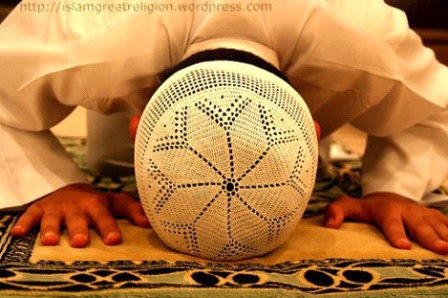
(6) Prostrating on all seven limbs; {Ibn ‘Abbaas reported that Allaah’s Messenger (sallAllaahu ‘alayhi wa sallam) said: “I have been ordered to prostrate on seven limbs: on the forehead – and he pointed to his nose – the (palms of the) hands, the knees and the toes of the feet.” [Reported by Al Bukhaaree and Muslim]}
(7) Erecting oneself from it;
(8) Sitting between the two prostrations; (
9) Remaining tranquil (i.e. not rushing) during all of these pillars;
(10) Maintaining the same sequence;
(11) the Final Tashahhud;
(12) Sitting for it;
(13) Sending Salaat on the Prophet; and
(14) the (final) two Tasleems.
The First Pillar: Standing if one is able to do so. The proof for this is Allaah ’s statement: “Guard strictly the prayers, especially the middle one. And stand before Allaah with full submission.” [Surah Al-Baqarah: 238] .
The Second Pillar: The Opening Takbeer. The proof for this is the hadeeth: “Its opening {Translator’s Note: The word used in the hadeeth is “Tahreem”, which has been translated as opening, but which more specifically means that which makes something forbidden. This is since with the opening Takbeer, the common actions of speaking and eating become forbidden, as one is now in prayer.} is the Takbeer (saying Allaahu Akbar) and its closing {Translator’s Note: The word used in the hadeeth is “Tahleel”, which has been translated as closing, but which more specifically means to make something permissible. This is since with the closing Takbeer, the common actions of speaking and eating become permitted again, as one is now out of prayer.} is the Tasleem (Saying As-Salaam ‘Alaikum).” { Reported by Abu Dawood, At-Tirmidhee, Ahmad and Al-Bazaar} After this occurs the opening supplication, which is supererogatory, and goes: “Subhaanak Allaahumma wa Bi-Hamdika. Wa Tabaarakasmaka wa Ta’aala Jadduka. Wa Laa Ilaaha Ghayruka.” [Free from imperfections are You, O Allaah, and all praise is Yours. Blessed is Your Name and there is no deity worthy of worship besides You] The meaning of “Subhaanak Allaahumma” is: I absolve You from all imperfections in a manner that befits Your majesty. “Wa Bi-Hamdika” i.e. while praising You. “Wa Tabaarakasmaka” i.e. blessing can be attained by mentioning You. “wa Ta’aala Jadduka” i.e. Glorified be Your Greatness. “Wa Laa Ilaaha Ghayruk” i.e. There is nothing that has the right to be worshipped on the earth or in the heaven except You, O Allaah. Then he says: “A’udhoo Billaahi min ash-Shaytaan-ir-Rajeem” (I seek refuge in Allaah from the rejected devil), i.e. “A’udhoo” means I seek refuge and recourse in You and rely on You, O Allaah. “Min ash-Shaytaan-ir-Rajeem” means the outcast, the one who is far removed from Allaah’s mercy. He cannot harm me in my religion or in my worldly affairs.
The Third Pillar: Then there occurs the recitation of Surah Al-Faatihah, which is a pillar, in every rak’ah (unit), as occurs in the hadeeth: “There is no prayer for the one who doesn’t recite the opening (chapter) of the Book.” It is the foundation of the Qur’aan.
“Bismillaah-ir-Rahmaan-ir-Raheem” (In the Name of Allaah, the Most Merciful, Bestower of Mercy) is a request for blessing and assistance.
“Al-Hamdulillaah” (All praise is for Allaah): “Hamd” means praise. The definite article (Al) before Hamd is for including all the commendable acts He does. As for the good thing that one has no role in bringing about, such as beauty and so on, then praising that is called madah and not hamd. “Rabb-il-‘Aalameen” (Lord of all that is created): Rabb means the One who is worshipped, the Creator, the Sustainer, the King, the One who administers and brings up all of the creation through His favors. With regard to ‘Aalameen, everything that is apart from Allaah then that is considered ‘Aalam. He is the Lord of everyone and everything. “Ar-Rahmaan” (The Most Merciful): means He grants a general mercy for all of the created beings. “Ar-Raheem” (The Bestower of Mercy): means He gives a specified mercy for just the believers. The proof for this is Allaah’s statement: “And He is ever an All-Bestower of mercy to the believers.” [Surah Al Ahzaab: 43] “Maaliki-Yawm-id-Deen” (Master of the Day of Judgement): refers to the Day of Reward, Recompense and Accountability, the Day when everyone will be compensated for his deeds – if they are good, then there will be good (for him) and if they were evil, then there will be evil (for him). The proof for this is Allaah ’s statement: “And what will make you know what the Day of Recompense is? Again, what will make you know what the Day of Recompense is? (It will be) The Day when no person shall have power (to do anything) for another, and the decision that Day will be wholly with Allaah.” [Surah Al-Infitaar: 17-19] There is also the hadeeth of the Prophet (sallAllaahu ‘alayhi wa sallam): “The shrewd person is the one who subjects himself and works for what comes after death. And the feeble person is the one who allows his soul to follow its vain desires, while aspiring for Allaah to grant his ambitions.” {Reported by Ahmad, At-Tirmidhee, Ibn Maajah and Al-Haakim} “Iyyaaka Na’budu” (You alone do we worship): meaning we don’t worship anyone except You. This is a covenant between the servant and his Lord that he will not worship anyone besides Him. “Wa Iyyaaka Nasta’een” (And in You alone do we seek assistance): This is a covenant between the servant and his Lord that he will not seek the assistance of anyone besides Allaah. “Ihdinaas-Siraat-al-Mustaqeem” (Guide us to the Straight Path) means direct us, show us the way and keep us firm on as-Siraat (the Path), meaning Islaam. It is also believed that it refers to the Messenger and likewise that it refers the Qur ’aan. All of these meanings are true. What is meant by Mustaqeem (Straight) is that which has no deviations in it. “Siraat-aladheena An’amta ‘alayhim” (The Path of those You bestowed Your Favor on): meaning the way of those who have received your Bounty. The proof for this is Allaah’s saying: “And whoever obeys Allaah and the Messenger, then they will be in the company of those on whom Allaah has bestowed His Favor, such as the prophets, the first to believe (in the prophets), the martyrs and the righteous. And how excellent these companions are!” [Surah An-Nisaa: 69] “Ghayr-il-Maghdoobi ‘alayhim” (Not those who earned Your Anger): They are the Jews since they have knowledge but do not act on it. We ask Allaah to protect you from their way. “Wa laad-Daalleen” {Nor of those who went astray): This refers to the Christians, who worship Allaah based on ignorance and misguidance. We ask Allaah to protect you from their way. The proof for those who went astray is Allaah’s saying: “Say: Shall we inform you of the greatest losers with respect to their deeds? Those whose efforts have been wasted in this life, while they thought they were acquiring good by their deeds.” [Surah Al-Kahf: 103-105] And there is also the hadeeth of the Prophet ( sallAllaahu ‘alayhi wa sallam): “You will indeed follow the ways of those who came before you, in exactly the same manner, to the point that if they were to enter the hole of a lizard, you would also enter it.” They said: “O Messenger of Allaah, do you mean the Jews and the Christians?” He (sallAllaahu ‘alayhi wa sallam) said: “Who else?” Al-Bukhaaree and Muslim reported it. And the second hadeeth is: “The Jews split up into seventy-one sects and the Christians split up into seventy-two sects. And this ummah (of Muslims) will split up into seventy-three sects. All of them will be in the Hellfire except for one. ” They said: “Who are they O Messenger of Allaah?” He (sallAllaahu ‘alayhi wa sallam) said: “Those who are upon the same way that I and my Companions are upon.”
The Fourth Pillar: Bowing
The Fifth Pillar: Rising from the bowing position
The Sixth Pillar: Prostrating on one’s seven limbs.
The Seventh Pillar: Erecting oneself from that The Eighth Pillar: Sitting between the two prostrations. The proof for these (last five) pillars is Allaah’s statement: “O you who believe! Bow and prostrate (in prayer).” [Surah Al-Hajj: 77] And also the hadeeth of the Prophet (sallAllaahu ‘alayhi wa sallam): “I was ordered to prostrate on seven body limbs.” {Reported by Al-Bukhaaree and Muslim}
The Ninth Pillar: Being in a state of tranquility during all of the acts.
The Tenth Pillar: Following a sequential order between these pillars. The proof for these (i.e. last two pillars) is the hadeeth about the man who prayed badly, narrated by Abu Hurairah (radyAllaahu ‘anhu), who said: “One day we were sitting with the Prophet when a man entered and prayed. [Then he rose from prayer] and greeted the Prophet with Salaam. So the Prophet (sallAllaahu ‘alayhi wa sallam) told him: ‘Go back and pray for you have not prayed.’ This occurred three times, and finally the man said: ‘I swear by the One who sent you as a prophet in truth, I cannot do better than this, so teach me (the correct way to pray).’ So the Prophet (sallAllaahu ‘alayhi wa sallam) said: ‘When you get up to pray, say the Takbeer (Allaahu Akbar). Then recite what is easy for you from the Qur’aan. Then bow until you feel tranquility bowing. Then rise until you feel tranquil standing. Then prostrate until you feel tranquility whilst prostrating. Then rise from it until you feel tranquility sitting. Then do this in all of your prayers.’”
The Eleventh and Twelfth Pillar: The final Tashahhud is an obligatory pillar, as is stated in the hadeeth reported by Ibn Mas’ood (radyAllaahu ‘anhu), who said: “Before the tashahhud was made obligatory on us, we would say: ‘As-Salaamu ‘alaaAllaahi min ‘Ibaadihi. As-Salaamu ‘alaa Jibreel wa Mikaa’eel.’ [Peace be on Allaah from His servants. Peace be on Jibreel and Mikaa’eel]. So the Prophet (sallAllaahu ‘alayhi wa sallam) said: ‘Do not say: Peace (Salaam) be on Allaah, for indeed Allaah, He is AsSalaam. Instead say: At-Tahiyyaatu Lillaahi was-Salawaatu wat-Tayyibaat. AsSalaamu ‘alayka ayyuhaan-Nabee wa Rahmatullaahi wa Barakaatuh. AsSalaamu ‘alaynaa wa ‘alaa ‘Ibaadillaahis-Saaliheen. Ash-hadu an Laa Ilaaha IllaaAllaah wa Ash-hadu anna Muhammadan ‘abduhu wa Rasooluh.’ { Translator’s Note: This means “All acts of praise, supplications, and good are for Allaah. Peace be on you O Prophet, and also the mercy and blessings of Allaah. Peace be on us, and on the righteous slaves of Allaah. I bear witness that no one has the right to be worshipped except Allaah and that Muhammad is His slave and Messenger.”}” {Reported by Al-Bukhaaree in his Saheeh}
The meaning of “At-Tahiyyaat” is that all of the glorifications are for Allaah, who possesses and deserves that, such as the acts of inclining, bowing, prostrating, remaining and continuing (in the acts of prayer). Everything for which the Lord of creation is glorified due to, then that belongs to Allaah. So whoever directs any part of that (glorification) to other than Allaah, he is a polytheist, disbeliever. “As-Salawaat” means all of the supplications. It is also held that it refers to the five daily prayers. “wat-Tayyibaat”: Allaah is Tayyib (good), He does not accept any of the sayings or actions except for those that are tayyib (good). “As-Salaamu ‘alayka ayyuhaan-Nabee wa Rahmatullaahi wa Barakaatuh” means that you are supplicating for the Prophet to have safety, mercy and blessing. The one who is supplicated for is not being supplicated to along with Allaah. {Translator’s Note: According to the hadeeth of Ibn Mas’ood (radyAllaahu ‘anhu) reported in Al- Bukhaaree and Muslim, the Companions would say: “As-Salaamu ‘alaan-Nabee” [Peace be on the Prophet] instead of “As-Salaamu ‘alayka ayyuhaan-Nabee” [Peace be on you O Prophet] after the Prophet died, mentioning him (sallAllaahu ‘alayhi wa sallam) in the third person. Refer to “The Prophet’s Prayer Described” by Imam Al-Albaanee for a discussion on this.} “As-Salaamu ‘alaynaa wa ‘alaa ‘Ibaadillaahis-Saaliheen” means you are sending Salaam (peace) upon yourself and to every righteous servant in the heaven and the earth. “Salaam” is for the supplication. “Saaliheen” is for those who are being supplicated for, and they are not being supplicated to along with Allaah. “Ash-hadu an Laa Ilaaha IllaaAllaah wahdahu laa Shareeka Lahu”: You testify with a certain testimony that no one in the heaven and the earth has the right to be worshipped except Allaah. And your testimony that Muhammad is the Messenger of Allaah means that he is a slave (worshipper of Allaah) who is not to be worshipped, and a messenger who is not to be rejected. Rather, he is to be obeyed and followed. Allaah honored him with granting him the station of servitude (i.e. that he worships Allaah).
The proof for this is Allaah’s statement: “Blessed be the One who sent the Criterion to His slave so that He may be a warner for the creation.” [Surah Al-Furqaan: 1]
The Thirteenth and Fourteenth Pillar: “Allaahumma Salli ‘alaa Muhammadin wa ‘alaa Aali Muhammadin kamaa Salayta ‘alaa Ibraaheema wa ‘alaa Aali Ibraaheema Innaka Hameedun Majeed.” The meaning of Salaat from Allaah is His praising of His servant in the greatest of gatherings, as has been reported by AlBukhaaree in his Saheeh from Abul-‘Aaliyah who said: “The Salaat of Allaah means His praise for His servant in the highest of gatherings (i.e. angels).” It is also held that Salaat means mercy. But the first definition is more correct. As for the Salaat when it comes from the angels, then it means: Asking for forgiveness. And from the humans, it means supplication. Asking for blessing of Muhammad and what comes after that are all supererogatory statements and actions.
THE REQUIREMENTS FOR THE PRAYER
Its requirements are eight:
(1) All of the Takbeers except for the Opening Takbeer;
(2) Saying “Subhaana Rabby al-‘Adheem” [Perfect is my Lord, the Most Great] while bowing;
(3) Saying “Sami’a Allaahu Liman Hamidahu” [Allaah hears the one who praises Him] – this applies to the one leading the prayer and the one praying alone;
(4) Saying “Rabbanaa wa Lakal-Hamd” [Our Lord to You belongs the Praise] – this applies to everyone; (5) Saying “Subhaana Rabby al-A’alaa” [Perfect is my Lord, the Most High] while prostrating;
(6) Saying “Rabb Ighfir Lee” [My Lord, forgive me] while in between the two prostrations;
(7) The first Tashahhud; and
(8) Sitting for it. The pillars are that which if one fails to perform any of them out of forgetfulness or intentionally, his prayer is rendered invalid because of his abandoning it. The requirements are that which if one fails to perform any of them intentionally, his prayer is rendered invalid due to his abandoning it, but if he leaves any of them due to forgetfulness, he is obligated to perform the (extra) prostrations for forgetfulness (at the end of the prayer). And Allah knows best. [End of Treatise]