Article Surah 82 · Ayah 7
Great Miracles in your Body
Great Miracles in your Body
As a parent, you probably suspected this already, but you and your children are living miracles.
Some people think they’re not all that special and believe that their life doesn’t have much meaning. But that’s not true. You are pretty amazing, actually.
You and your children are wonderfully made. You are miracles. Remember that every time you interact. Communicate this wonder with your teenagers. Raise your children to appreciate how marvelous it is to be alive. Be a family leader in terms of communicating the wonder of life!
Here, just for starters, are 10 miraculous things about your body that you take for granted:
1. Trillion is a lot when it started with one:
Your body is made up of approximately 100 trillion cells. They all came from the division of one single cell. 300 million cells die every minute, but it’s really just a small fraction of the number we have. We produce 300 billion new cells every day and your body is constantly repairing and rebuilding.
2. Your brain is an amazing super-computer:
The brain can hold five times as much information as the Encyclopedia Britannica. Nerve impulses travel at 170 miles per hour. The brain is comprised of 80% water. Oh, and it does all this on the same amount of power as a 10-watt light bulb.
3. Hair today…:
Every day, the average person loses 60-100 strands of hair. But there’s good news, we have to lose over 50% of our scalp hairs before anyone notices. Also, hair is virtually indestructible. Aside from flammability, human hair decays at such a slow rate that it is practically non-disintegrative.
4. Your heart works its heart out for you:
The human heart creates enough pressure to squirt blood 30 feet. Such pressure is needed to pump blood through 60,000 miles of veins and capillaries. The heart pumps 6 quarts of blood, circulating three times every minute. In one day, your blood travels a total of 12,000 miles.
5. Your skin is the ultimate touch screen:
Each square inch of your skin includes four yards of nerve fibers, 600 pain sensors, 1300 nerve cells, 9000 nerve endings, 36 heat sensors, 75 pressure sensors, 100 sweat glands, 3 million cells, and 3 yards of blood vessels.
6. Your eyes alone are a study in genius:
Our eyes can distinguish up to one million color surfaces and take in more information than the largest telescope known to man. People blink once every four seconds. That’s because eyelashes act as windshield wipers, keeping dust and grime from getting into the eye itself.
7. The liver is a hardworking organ:
Your liver works hard at over 400 functions, including detoxification, protein synthesis, and the production of biochemicals necessary for digestion. However, you could have two-thirds of your liver removed from trauma or surgery, and it would grow back to its original size in four weeks time.
8. Take a deep breath:
Your lungs have a surface area the size of a tennis court. To oxygenate blood, our lungs are filled with thousands of microscopic capillaries. The large amount of surface area makes it easier for this to take place, and get the oxygen where it needs to go.
9. Your disposable stomach lining:
Your stomach gets a brand new lining every four days. Strong digestive acids quickly dissolve the mucus-like cells lining the walls of the stomach. So your body replaces them, routinely, before they are compromised.
10. No hiding from your fingerprints:
Just three months into the pregnancy, an unborn child already has fingerprints. At just 6-13 weeks of development, the distinctive whorls have already developed. Interestingly, those fingerprints will never change throughout a person’s life. And your fingerprints are your own unique bar code indicating the true miracle you are!
Link: https://www.allprodad.com/10-miraculous-things-about-your-body/
How Our Bodies Go To Extraordinary Lengths To Maintain Safe pH Levels
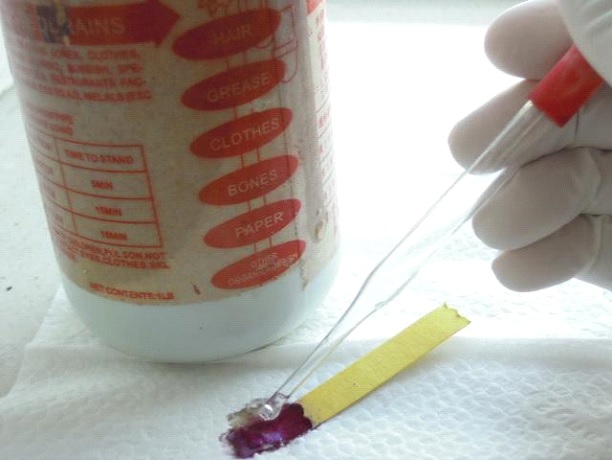
Acidic drain cleaners usually contain sulfuric acid at a high concentration which turns a piece of pH paper red and chars it instantly, demonstrating both the strong acidic nature and dehydrating property. (Image: Creative Commons)
What would happen if the pH level of all the water in my body dropped to 0? originally appeared on Quora - the knowledge sharing network where compelling questions are answered by people with unique insights.
Answer by Kirsten Jacob, skincare formulator and accidental chemistry geek, on Quora:
The human body must keep its pH within a very narrow range in order to survive and function. The 'normal' range is 7.35 - 7.45 for arterial blood (which is where we measure it medically). Even within that, we (medical professionals) tend to get nervous if we see the numbers edging into the lower or higher ends therein.
The definitive 'normal' pH for blood is 7.4. Give or take very, very little. I promise you that if you are walking around, functioning, talking, conscious, your pH is 7.4 or very close to it (meaning maybe 7.38, 7.41, etc.).
Your body is going through constant and incredible lengths to maintain this. It does it via your breathing; the CO2 you breathe out every few seconds rids the body of acid, which is why when you hold your breath you turn red and pass out -- the rise in acidity will, that quickly, dilate your blood vessels and create internal imbalances that make consciousness impossible. When you hyperventilate, the opposite happens; you lose too much acid to balance out the alkaline and the suddenly alkaline (higher) pH is every bit as incompatible with consciousness, which is why you get lightheaded and will soon faint in this case as well. The human body will not tolerate an out-of-line pH in either direction; the cells and metabolic processes cannot function.
Your body also does this metabolically. Its primary way of controlling acid is through breathing, but it will also secrete it through the skin, urine, and any other way it can if it must. In terms of controlling base (alkalinity), it will dump bicarbonate and other acid buffers out via the urine if it needs to and can. Conversely, the kidneys when properly functioning hold onto bicarbonate in the precise proportion required to buffer the body's acid levels. The important thing is the acid-base balance. If you don't have enough acid, your pH can still be normal if you also don't have enough base. If you have the right amount of acid, but not enough base, your pH will be acidic. If you have the right amount of base but not enough acid, your pH will be alkaline, and you will feel horrible. You will know it.
If your pH drops to 6.9 you will be in a coma. At 6.8, you will die (same if your pH rises to 7.8). Just for some perspective. A pH outside those ranges is incompatible with human life. This never fails to fill me with awe. That we are all walking around with our bodies jumping through these amazing hoops ever second to maintain such an incredibly delicate and essential balance, just as part of the natural moment-by-moment routine that is the miracle of life! We are such amazing machines.
Anyway, water is the major component of blood. If anything happened to shift the water in your body towards a pH of 0, the process would kill you long before it got anywhere near that low.
#5
The Human Body: Anatomy, Facts & Functions
The human body is everything that makes up, well, you. The basic parts of the human body are the head, neck, torso, arms and legs.
[Image Gallery: The BioDigital Human]
Body systems
Our bodies consist of a number of biological systems that carry out specific functions necessary for everyday living.
The job of the circulatory system is to move blood, nutrients, oxygen, carbon dioxide, and hormones, around the body. It consists of the heart, blood, blood vessels,arteries and veins.
The digestive system consists of a series of connected organs that together, allow the body to break down and absorb food, and remove waste. It includes the mouth, esophagus, stomach, small intestine, large intestine, rectum, and anus. The liver and pancreas also play a role in the digestive system because they produce digestive juices.
The endocrine system consists of eight major glands that secrete hormones into the blood. These hormones, in turn, travel to different tissues and regulate various bodily functions, such as metabolism, growth and sexual function.
The immune system is the body's defense against bacteria, viruses and other pathogens that may be harmful. It includes lymph nodes, the spleen, bone marrow, lymphocytes (including B-cells and T-cells), the thymus and leukocytes, which are white blood cells.
The lymphatic system includes lymph nodes, lymph ducts and lymph vessels, and also plays a role in the body's defenses. Its main job is to make is to make and move lymph, a clear fluid that contains white blood cells, which help the body fight infection. The lymphatic system also removes excess lymph fluid from bodily tissues, and returns it to the blood.
The nervous system controls both voluntary action (like conscious movement) and involuntary actions (like breathing), and sends signals to different parts of the body. The central nervous system includes the brain and spinal cord. The peripheral nervous system consists of nerves that connect every other part of the body to the central nervous system.
The body's muscular system consists of about 650 muscles that aid in movement, blood flow and other bodily functions. There are three types of muscle: skeletal muscle which is connected to bone and helps with voluntary movement, smooth muscle which is found inside organs and helps to move substances through organs, and cardiac muscle which is found in the heart and helps pump blood.
The reproductive system allows humans to reproduce. The male reproductive system includes the penis and the testes, which produce sperm. The female reproductive system consists of the vagina, the uterus and the ovaries, which produce eggs. During conception, a sperm cell fuses with an egg cell, which creates a fertilized egg that implants and grows in the uterus. [Related: Awkward Anatomy: 10 Odd Facts About the Female Body]
Our bodies are supported by the skeletal system, which consists of 206 bones that are connected by tendons, ligaments and cartilage. The skeleton not only helps us move, but it's also involved in the production of blood cells and the storage of calcium. The teeth are also part of the skeletal system, but they aren't considered bones.
The respiratory system allows us to take in vital oxygen and expel carbon dioxide in a process we call breathing. It consists mainly of the trachea, the diaphragm and the lungs.
The urinary system helps eliminate a waste product called urea from the body, which is produced when certain foods are broken down. The whole system includes two kidneys, two ureters, the bladder, two sphincter muscles and the urethra. Urine produced by the kidneys travels down the ureters to the bladder, and exits the body through the urethra.
The skin, or integumentary system, is the body's largest organ. It protects us from the outside world, and is our first defense against bacteria, viruses and other pathogens. Our skin also helps regulate body temperature and eliminate waste through perspiration. In addition to skin, the integumentary system includes hair and nails.
Vital organs
Humans have five vital organs that are essential for survival. These are the brain, heart, kidneys, liver and lungs.
The human brain is the body's control center, receiving and sending signals to other organs through the nervous system and through secreted hormones. It is responsible for our thoughts, feelings, memory storage and general perception of the world.
The human heart is a responsible for pumping blood throughout our body.
The job of the kidneys is to remove waste and extra fluid from the blood. The kidneys take urea out of the blood and combine it with water and other substances to make urine.
The liver has many functions, including detoxifying of harmful chemicals, breakdown of drugs, filtering of blood, secretion of bile and production of blood-clotting proteins.
The lungs are responsible for removing oxygen from the air we breathe and transferring it to our blood where it can be sent to our cells. The lungs also remove carbon dioxide, which we exhale.
Fun facts
⦁ The human body contains nearly 100 trillion cells.
⦁ There are at least 10 times as many ⦁ bacteria in the human body as cells.
⦁ The average adult takes over 20,000 breaths a day.
⦁ Each day, the kidneys process about 200 quarts (50 gallons) of blood to filter out about 2 quarts of waste and water
⦁ Adults excrete about a quarter and a half (1.42 liters) of urine each day.
⦁ The human brain contains about 100 billion nerve cells
⦁ Water makes up more than 50 percent of the average adult's body weight