Article Surah 89 · Ayah 4
Prophet Moses (Kalimullah)
Prophet Moses (Kalimullah)
Prophet Moses was a major Prophet and a leader who freed the Children of Israel from the oppression of Pharaoh; he is not only referred to in Judaism and Christianity, but also in Islam. There is information about Prophet Moses in the Qur`an as well as in the Old and the New Testaments. 21 FIVE MESSENGERS Prophet Moses is the most frequently mentioned of all Prophets in the Qur`an; 136 times in thirty-four chapters and he is included in the authenticated sayings of Prophet Mohammad. The birth of Moses and his entrance to the Pharaoh’s palace, his trip to Madyan, selection as a Prophet, dispatch to the Pharaoh to save the Children of Israel, struggle with Pharaoh and the exodus of the Children of Israel from Egypt, the revelation of divine commands on Mount Sinai, events in the desert and his leadership of the Children of Israel are all discussed in the Qur`an. In the Qur`an, it is mentioned that Moses was chosen above other men with the mission Allah had entrusted to him. The words that Allah had spoken to him (Qur`an 7, 143), the fact that he was covered with the garment of love from Allah, as well as being reared under Allah’s eye (Qur`an 20, 39); all indicate the preparation of Moses for Allah’s service (Qur`an 20, 41). In the Qur`an, Moses is depicted as a Prophet who gives glad tidings about the coming of Prophet Mohammad; the Qur`an also tells us that the coming of an illiterate Prophet was mentioned in the Old Testament. (Qur`an 7, 157). In Islamic tradition Moses is called (Kalimullah) (Whom the Lord spoke to) because Allah spoke to him and revealed His verses to him directly
The Storu Of Moses
Quran is a book of guidance for all of humankind. It is not a history book; however, it does contain historical information. God asks us to reflect and contemplate on the stories of the Prophets in order that we may learn from their trials, tribulations, and triumphs. Moses’ story contains many lessons for humankind. God says that the account of Moses and Pharaoh in Quran is the truth. It is a story of political intrigue and of oppression that knew no bounds. According to Islamic scholar Ibn Kathir the children of Israel talked vaguely about one of their nation’s sons arsing to wrest the throne of Egypt from Pharaoh. Perhaps it was just a persistent daydream from an oppressed people, or even an ancient prophecy but the story of Moses begins here. A yearning for freedom coupled with a tyrannical king’s dream. The people of Egypt were influenced by dreams and the interpretation of dreams. Dreams featured prominently in the story of prophet Joseph and once again, in the story of Moses the fate of the children of Israel is affected by a dream. Pharaoh dreams that a child from the children of Israel grows to manhood and seizes his throne. True to character, Pharaoh reacts arrogantly and gives the order that all male children born to the children of Israel be killed. His ministers however perceive that this would lead to the complete annihilation of the children of Israel and economic ruin for Egypt. How, they ask, would the empire function without slaves and servants? The order is changed; the male children are killed in one year but spared in the next. Pharaoh becomes so fanatical he sends spies or security agents to seek out pregnant women. If any woman gives birth to a male child, he is immediately put to death. When Moses’ mother 5 becomes pregnant with the child destined to lead the children of Israel out of bondage, she conceals her pregnancy. However, God wished to do a favour to those who were weak and oppressed, and pharaoh’s plans are thwarted. “And We wished to do a favour to those who were weak (and oppressed) in the land, and to make them rulers and to make them the inheritors, And to establish them in the land, and We let Pharaoh and Haman (Egypt’s Chief Minister) and their hosts receive from them that which they feared.” (Quran 28:5&6) The scene is set, and the child is born. The winds of change begin to blow and God demonstrates that humans may plan and scheme but He Alone is the best of planners. There are lessons for humankind throughout the story of Moses, which are not only learnt after his prophethood; rather, they are found even when he was a newborn. His righteous mother’s behavior gives us numerous lessons that are relevant even today. Put your trust in God! Moses was born in a year in which the sons of the Children of Israel were put to death the moment they were born. Imagine the sense of fear that permeated every aspect of life under such conditions. Pregnancy was not an event to be celebrated and cherished but a source of fear and insecurity. Security guards roamed the streets and invaded homes searching for pregnant women, therefore Moses’ mother concealed her pregnancy. Imagine the conditions under which she gave birth: fearful, silent, possibly shrouded in darkness. Was she surrounded by women or alone? Did her husband hold her hand praying that she did not cry out revealing herself to the neighbours or guards? Whatever the conditions, Moses was born. A boy. His parents’ heart must have constricted with joy and fear simultaneously. What were they to do now, how would they 6 conceal a newborn baby? Moses’ mother was a righteous woman, pious and God fearing, therefore in her hour of need she turned to God and He inspired her next actions. “And We inspired the mother of Moses saying, suckle him, but when you fear for him, then cast him into the river and fear not, nor grieve. Verily! We shall bring him back to you, and shall make him one of (Our) Messengers.” (Quran 28:2-7). Moses’ mother has just spent the last months concealing her pregnancy for fear that her child would be put to death, now as she holds him to her breast God inspires her to cast him into the river. Not a gentle stream but the Nile River, a huge powerful river with a strong current. Her initial reaction must have been that such an action would be condemning him to certain death. Moses’ mother put her trust in God. “Do not fear and do not grieve, for We will bring him back to you.” She made a waterproof basket, placed her tiny son inside, and cast him into the river. Ibn Kathir narrates that as the basket touched the water the raging current became calm and gentle, sweeping the basket silently downstream. Moses’ sister was instructed by her mother to slip silently through the reeds and follow the basket on its journey. The basket with its precious cargo courses down the Nile River, passing houses, boats, and people, unnoticed until it stops at Pharaoh’s palace. Moses’ sister watches in fear, as someone from Pharaoh’s household removes the basket from the river. Moses was cast into the river to escape certain death and now his resting place is the palace of Pharaoh. This is surely too much for a mother to bear, however events about to unfold will demonstrate that the promise of God is true. “...And whosoever fears God and keeps his duty to Him, He will make a way for him to get out (from every difficulty). And He will provide him from (sources) he never could imagine. And 7 whosoever puts his trust in God, then He will suffice him. Verily, God will accomplish his purpose. Indeed God has set a measure for all things.” (Quran 65:2-3) Baby Moses was taken to Asiya, the wife of Pharaoh. Asiya, in contrast to her arrogant, proud husband was a righteous, merciful woman. God opened her heart and Asiya looked down up on the tiny baby and felt overcome by her love for him. The royal couple were unable to conceive a child and this tiny baby awakened her maternal instincts. Asiya clutched him to her chest and asked her husband to accept the child into family. Possibly, against his better judgement Pharaoh accepted the child, who was part of God’s plan to bring down the royal house. Far from abandoning him, God set Moses up as a royal son of Egypt, he provided him with the strongest human support in the land. Asiya and Pharaoh now had a son, who was now protected by the very person who had sought to kill him. “Then the household of Pharaoh picked him up, that he might become for them an enemy and a cause of grief. Verily! Pharaoh, Haman, and their hosts were sinners. And the wife of Pharaoh said; ‘A comfort of the eye for me and for you. Kill him not, perhaps he maybe of a benefit to us, or we may adopt him as a son.’ And they perceived not (the result of that).” (Quran 28:8-9) Asiya summoned wet nurses to the palace, but the tiny child refused to suckle. This was a cause of great distress; in those days there were no baby formulas or supplements to offer the child. At this stage the royal palace was in turmoil, the women of the household were fussing over Asiya and her new baby therefore no one noticed the presence of Moses’ sister amongst the servants. She summoned all her courage and stepped forward offering a solution. She said she knew of a woman who would suckle the child affectionately. Why would the royal household take the advice of an unknown child, if not to fulfil God’s plan. Moses’ sister was ordered to rush and fetch the woman. 8 “And We had already forbidden (other) foster suckling mothers for him, until she (his sister came up and) said: "Shall I direct you to a household who will rear him for you, and sincerely they will look after him in a good manner?” (Quran 28:12) Moses’ mother was in her home. Was she pacing, or weeping silently? We do not know, but God tells us that her heart was empty and that she was about to reveal herself. Was she considering dashing down to the river and searching frantically through the reeds? God relieved her of her torment when her daughter rushed into the house breathlessly relating the story of what had happened to Moses. Mother and daughter lost no time returning to the palace. When Moses was handed to his real mother, he settled immediately and began to suckle. According to Ibn Kathir, the household, including Pharaoh himself, was astonished. Pharaoh asked the woman who she was and she replied, "I am a woman of sweet milk and sweet smell, and no child refuses me." Pharaoh accepted this answer, and thus Moses was returned to the arms of his mother and raised in the palace as a prince of Egypt. “So did We restore him to his mother, that she might be delighted, and that she might not grieve, and that she might know that the Promise of God is true. But most of them know not.” (Quran 28:13)
Meaning of ‘Pharaoh, owner of stakes’ in verse 89:10
Question
Assalaamu alaykum. I was just wondering: does 89:8 mean what they used to do, like that Pharaoh killed people on stakes? Or does it mean what they have done, like the pyramids.
Answer
All perfect praise be to Allah, The Lord of the worlds. I testify that there is none worthy of worship except Allah and that Muhammad is His slave and Messenger.
Allah says (what means): {And [with] Pharaoh, owner of the stakes?} [Quran 89:10]
There were several interpretations of the word ‘stakes’; Ibn Al-Jawzi said in Zaad Al-Maseer about the interpretation of Soorah Sad [as the same verse is mentioned in Soorah 38:12]:
“There are six views about the meaning of the verse {And [with] Pharaoh, owner of the stakes?}:
1- He used to torture the people with four stakes to which he would tie them up, then he would lift up a rock and throw it on the person, and it would injure him in his head. This is reported from Ibn Mas’ood and Ibn ‘Abbaas. Al-Hasan and Mujaahid said: ‘He used to torture people with stakes which he put in their hands and feet.’
2- He had well-built structures. This was also reported from Ibn ‘Abbaas. Adh-Dhahhaak and Al-Qurathi said the same thing. Ibn Qutaybah chose the same view, as he said: ‘The Arabs say: They have an honor with firm stakes, and a rule with firm stakes; meaning that it is permanent and strong.’
3- What is meant by stakes are the soldiers; this was reported by ‘Atiyyah from Ibn ‘Abbaas, because the soldiers supported his rule and strengthened him in the same manner that the stakes strengthen something.
4- He used to build a signpost on which he would slaughter the people.
5- He had four cylinders; he would take a man by his arms and legs and tie each limb to a cylinder and torture him in this manner. The fourth and this fifth views were narrated by Sa’eed ibn Jubayr.
6- He had structures and playgrounds where people would play for him; this was said by ‘Ataa’ and Qataadah.”
Allah knows best.
Why Pharaoh's repentance was not accepted
Fatwa No: 309730
Question
I thought that one's repentance was accepted as long as the Day of Judgment has not yet started or the soul reaches the throat. The Pharaoh did it before these two took place, so why was his embracing of the religion not accepted?
Answer
All perfect praise be to Allaah, The Lord of the Worlds. I testify that there is none worthy of worship except Allaah and that Muhammad is His slave and Messenger.
The repentance is accepted before the sun rises from the west and before breathing one’s last, as the Prophet said, “Allaah, the Exalted and Glorious, stretches out His Hand during the night so that the people repent for the sins that they committed during the day [from dawn till dusk], and He stretches out His Hand during the day so that the people may repent for the sins that they committed during the night [from dusk till dawn] until the sun rises from the west (before the Day of Resurrection).” [Muslim]
The Prophet also said, “Allaah accepts the repentance of a person as long as he does not breathe his last.” [Ahmad, At-Tirmithi and Ibn Maajah - Al-Albaani graded it hasan (good)]
As for the Pharaoh, uttering the words of Tawheed (pure monotheism) when he uttered them did not benefit him because he only believed when he saw the punishment and when he was dying and breathing his last, as Ibn Al-Jawzi said in his Tafseer, “Ibn Abbaas said, 'Allaah did not accept his belief when he saw the punishment.'” Ibn al-Anbaari said, “Pharaoh inclined to repentance when its door was closed as (at that time) death came to him and he saw the angels; then it was said to him {Now?}, meaning it is just now that you are repenting while you missed repentance at its due time and were among the corrupters by calling people to worship other than Allaah Almighty...”
Furthermore, Ibn Katheer said in his Tafseer:
“…The waves overtook Pharaoh and he was facing the agony of death, and while in this state (while he was dying), he said {I believe that there is no deity except that in whom the Children of Israel believe, and I am of the Muslims.}, so he believed when it was too late for him to believe, {And when they saw Our punishment, they said, "We believe in Allaah alone and disbelieve in that which we used to associate with Him." But never did their faith benefit them once they saw Our punishment. [It is] the established way of Allaah which has preceded among His servants. And the disbelievers thereupon lost [all].} [Quran 40:84-85]”
Al-Baghawi said in his Tafseer:
“But repentance is not [accepted] of those who [continue to] do evil deeds up until when death comes to one of them, and then he says, 'Indeed, I have repented now;' which is the state when his soul is being taken out of his body (breathing one’s last), as no belief will be accepted from a non-Muslim at this time, and no repentance will be accepted from a sinner at this time; Allaah says (what means): {But never did their faith benefit them once they saw Our punishment.} [Quran 40:85] It is for this reason that the faith of Pharaoh did not benefit him when drowning overtook him.”
Allaah knows best.
Pharaoh's threat to crucify the magicians who believed
Fatwa No: 293167
Question
Salaam Alaikum. I have a question about 20:71 in the Quran, where Pharaoh said he will crucify his men who believed in Moses, on the trunks of palm trees. Did Pharaoh nail them to the trees, or impale them? How did Muslim scholars interpret this verse? Many thanks.
Answer
All perfect praise be to Allaah, The Lord of the Worlds. I testify that there is none worthy of worship except Allaah, and that Muhammad, sallallaahu ‘alayhi wa sallam, is His slave and Messenger.
Some Tafseer scholars said that Pharaoh executed his threat to them; he cut off their hands and their feet and crucified them and they died believing. Ibn ‘Abbaas said: “At the beginning of the day, they were magicians, and at the end of the day, they were honorable martyrs.” At-Tabari reported this in his Tafseer, and Qataadah and as-Suddi said the same.
Ash-Shirbeeni reported a difference of opinion about this in As-Siraaj Al-Muneer fi Al-I’aanah ‘ala Ma’rifat Ba‘dh Ma’aani Kalaam Rabbina Al-Hakeem al-Khabeer (1/503), saying: "Ibn Abbaas said: “At the beginning of the day, they were magicians, and at the end of the day, they were martyrs.” At-Teebi said: “Pharaoh severed their hands and feet and crucified them. Others said, he did not overpower them, as Allaah says (what means): {[It will be] through Our signs; you and those who follow you will be the dominant."} [Quran 28:35]." [End of quote]
Allaah Knows best.

Question:
Assalaamu alaykum. I have two questions; I hope you answer them both.
1. How did Aasiya, the wife of Pharaoh, die? Did Pharaoh kill her when she accepted Islam and became Muslim?
2. Why are camels and horses the great privileges in Islam? What is the reason behind it?
All perfect praise be to Allah, The Lord of the worlds. I testify that there is none worthy of worship except Allah and that Muhammad, sallallahu 'alayhi wa sallam, is His slave and Messenger.
We did not come across any text from revelation about the death of the wife of Pharaoh, but some interpreters of the Quran mentioned some stories about it, and Allah knows best about their authenticity.
For example, the Tafseer (exegesis) of Al-Qurtubi reads:
"Abu Al-'Aaliyah said, 'Pharaoh found out about the belief of his wife, and he went out in public and said to them, 'What do you know about Aasiya bint Muzaahim?' They praised her. He said to them, 'She worships a Lord other than me.' They said to him, 'Kill her.' So he had her arms and legs tied to logs. She said: {My Lord, build for me near You a house in Paradise} [Quran 66:11]; and this coincided with the presence of Pharaoh; so she smiled when she saw her house in Paradise. Then Pharaoh said, 'Are you not astonished at her madness! We are torturing her, and she is smiling.' Then her soul was taken away.' Besides, Salmaan Al-Faarisi said in the narration reported from him by 'Uthmaan An-Nahdi, 'She was tortured by being exposed to the extreme heat of the sun, and when she was harmed by the heat of the sun, angels would spread their wings and shade her.' It was also said, 'She was tied up by her hands and feet in the sun, and stones where put on her back, then Allah showed her her place in Paradise.'"
As regards your second question, please refer to fatwa 310531.
Body of Fir’awn
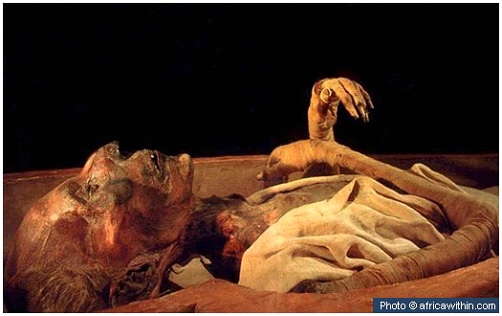
This is the body of Fir’awn (Rameses II), believed to be the Pharoah in the time of Musa (upon him be peace). His mummy is preserved and is currently on display in the Royal Mummies Chamber in Cairo Museum, Egypt.
⦁ Fir’awn was a mighty tyrannical ruler who greatly persecuted the Bani Israil (Children of Israel). Musa (upon him be peace) was sent to invite him towards the truth but he rejected his teachings, considering himself to be God. Musa (upon him be peace), accompanied by his brother Harun (upon him be peace) and Yusha (upon him be peace) led the Bani Israil out of Egypt, Fir’awn and his army pursued them but were drowned in the Red Sea.
⦁ There is great debate as to the identity of the Pharoah in the time of Musa (upon him be peace) with some identifying him as Merneptah. However, most of the evidence backed up by verses of the Holy Quran point towards him being Rameses II. The Quran and the Bible [Exodus 14:21-30 and Exodus 15:19-21] state that the Pharaoh was drowned in the sea. However, the Qur’an differs from the Bible and it makes a very unique statement that the body of the drowned Pharaoh was saved as a sign for future generations. The Quranic statement about rescuing Pharaoh’s body would be in total agreement with the fact that the body of Rameses II has survived in a mummified form. It was discovered in 1881 among a group of royal mummies that had been removed from their original tombs for fear of theft. Priests of the 21st Dynasty had reburied them in a cache at Deir al-Bahari on Luxor’s west bank. Nothing whatsoever was known at the time of the revelation of the Quran about the mummy of Rameses II.
⦁ With regards the end point of his life, Allah (ﷻ) makes mention in the Holy Quran in Surah Yunus:“We brought the tribe of Israel across the sea, and Pharaoh and his troops pursued them out of tyranny and enmity. Then, when he was on the point of drowning, he [Pharaoh] said: “I believe that there is no god but Him in Whom the tribe of Israel believes. I am one of the Muslims.” [10:90]
⦁ However, this last-minute conversion was not accepted, for it was not sincere. According to the Quran, Allah (ﷻ) further exclaimed: “What, now! When previously you rebelled and were one of the corrupters? Today we will preserve your body so you can be a Sign for people who come after you. Surely many people are heedless of Our Signs.” [10:91-92]