Article Surah 90 · Ayah 14
Whoever Spends Something Today Will Benefit From It Tomorrow – Nice Story
⦁ Whoever Spends Something Today Will Benefit From It Tomorrow – Nice Story
Thus whoever spends something today will benefit from it tomorrow and whoever does not spend will come to find nothing, and he will have a great loss in the house of dwelling (in the Hereafter).
Some of the Salaf said,
“O son of Adam, you will only live on the Day of Judgment in what you have built, and you will find on that day what possessions you have prepared in your life.”
A women entered upon ‘A’ishah (radiy Allaahu anha), and her hand was paralysed. She said, “O mother of the Believers, I went to sleep yesterday and my hand was healthy, and I woke up and it was paralysed. ‘A’ishah said, “How is that?” She said, “I had wealthy parents, and my Father used to pay zakat, host guests, and give to beggars, and he did not see any good except that he would do it. As for my mother, she was stingy, and did nothing good with my Father’s wealth. Then my Father died, and my mother died only two months after him. So I saw my Father in a dream last night, and he was wearing two yellow garments and in front of him was a flowing river. I said, “Father, what is this?’ He said, “Whoever does good in this life will see it, this is what Allah has given me.” I said, “What has happened to my mother?” He asked, “Your Mother dies?” I said, “Yes”
He said, “She has been turned away from me, so look for her on your left” So I turned to my left, and I saw my mother standing naked, covering her lower half with a rag and in her hand was a piece of fat. She was calling out, “My sadness, my thirst’ When she became tired she would rub the fat with her hand and then lick it, while in front of her was a flowing river. I said, ‘O mother, why are you crying out of thirst, and there is a flowing river in front of you?’ She said, ‘I am not allowed to drink from it.’ I said, Can I give you some of the water?’ She said, ‘I wish you would do that.’ So I filled my hand with water and let her drink, and when she swallowed it I heard a voice on my right, ‘Whoever has given this woman water, may his hand be paralysed,’ and they repeated it twice. Then I awoke and my hand was paralysed, and I am not able to do anything with it. ‘A’ishah asked: ‘Did you recognise the rag she was wearing?’ I said, ‘Yes, O Mother of the Believers, it was exactly the same one I saw her wearing, for I had never seen my mother give anything as charity, except that one day my Father slaughtered a bull. So a beggar came to ask for some, so my mother gave him a bone that had some fat on it. And I saw one day that a beggar asked her for charity, so she gave him that exact rag.’
A’ishah (radiy Allaahu anha) said, Allah is the Most Great! Allah has told the truth, and the Messenger has delivered the message.
فَمَن يَعْمَلْ مِثْقَالَ ذَرَّةٍ خَيْرًا يَرَهُ
وَمَن يَعْمَلْ مِثْقَالَ ذَرَّةٍ شَرًّا يَرَهُ
“So whoever does an atom’s weight of good will see it,
And whoever does an atom’s weight of evil will see it”
[al-Azalzalah (99): 7-8]
source:https://abdurrahman.org/2016/11/11/whoever-spends-something-today-will-benefit-from-it-tomorrow/
⦁ MISKEEN OR MASAKIN
Literal Meaning
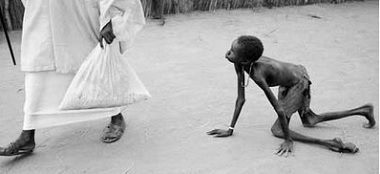
Miskeen (مِسْكِين) means indigent; necessitous; needy; pauper; poor; poor man; poverty-stricken;
Islamic Definition
A miskeen or needy person would be one who might have enough to fulfill theirs and their family’s basic needs; but a situation or desperation has befallen them which they are unable to fulfill. For example, one amongst their family is sick and one cannot afford their treatment, or one is unable to pay ones housing costs, or one is unable to pay their children’s basic education fees, etc [1].
The needy (Miskeen) may be someone whose level of poverty is more than the poor or less than him. However, their ruling is the same in all matters. These poor and needy can have decent houses and clothes and yet be considered poor and needy if they do not possess their basic essential needs. The Messenger of Allah ﷺdefined the Miskeen in some narrations as: "The Miskeen is not the one who goes around among the people (begging) maybe receiving a morsel or two, and a date or two. Rather, the Miskeen is the one who does not have enough wealth to suffice him, however he does not let others know about it in order to be given charity and he does not stand and beg people." SahihMuslim 1039 [2]
Quran and Zakah
Zakath is spent on eight groups of people, as mentioned in the Qur'an (Arabic word As-Sadaqat here it means compulsory charity i.e., Zakath): "Zakath expenditures are only for the poor and for the needy and for those employed to collect [zakah] and for bringing hearts together [for Islam] and for freeing captives [or slaves] and for those in debt and for the cause of Allaah and for the [stranded] traveler - an obligation [imposed] by Allaah . And Allaah is Knowing and Wise.Qur’an Surah Tawbah 9:60
⦁ Poor people -- who have few belongings
⦁ Destitute(Al-Masakin) people -- who have absolutely nothing
⦁ Zakath collectors -- for their work in collecting and distributing the zakath
⦁ Muslim Reverts -- who may be estranged from their families and in need of help
⦁ Slaves -- to free them from slavery in times/places where slavery has existed
⦁ Debtors -- to help free them from insurmountable debts
⦁ Those working in the path of Allah
⦁ Wayfarers -- who are stranded during their travels
Difference between Faqeer and Miskeen
Allaah has mentioned two types of poor people in His Book, miskeen and faqeer. The scholars have different opinions about the difference between them, and the best two definitions are summarized below:
Miskeen: a poor person who barely meets his basic needs, or a poor person who asks others to help fulfill his financial needs.
Faqeer: an impoverished person who cannot meet his basic needs, or a poor person who does not ask for financial help.
So based on both distinctions, the faqeer has more right to be assisted than a miskeen, and thus, Allaah mentions the faqeer first in the ayath about Zakaat, giving him priority over the miskeen. [3]