Article Surah 90 · Ayah 16
Rights of the Poor and Needy in Islam
⦁ Rights of the Poor and Needy in Islam

Allah (Exalted be He) praises those who spend for His cause in order to help the poor and the needy in the Islamic society. This is based on the instructions of the verse in the Qur’an:
And in their wealth is a recognized right. For the (needy) who asks and the one who is deprived. (Al-Ma`arij 70:24,25)
As a matter of fact Islam regards the charity given to the poor and the needy as one of the most virtuous deeds. Moreover, Islam warns those who conceal and save up their wealth and do not spend for the cause of Allah. Allah says in the Qur’an:
It is not righteousness that you turn your faces towards East or West. But the righteousness is to believe in Allah and the Last Day, and the Angels, and the Book, and the Prophets, and to give of your wealth out of love for Him, to your kin and orphans and the needy and the wayfarer and those who ask, and for the ransom of slaves… (Al-Baqarah 2:177)
The ones who accumulate the wealth without giving the due right of the poor and needy as commanded by Allah, are promised by Allah that they will receive a severe punishment on the Day of Requital. Allah says in the Qur’an:
And those who hoard up gold and silver and do not spend in the Path of Allah then warn them of the painful torment. (At-Tawbah 9:34)
For this reason Zakah was prescribed as one of the basic tenets of Islam. Zakah is a set percentage (2.5%) of the accumulated wealth over a period of one year.
On Whom & To Whom?
Muslims willingly offer the due amount in obedience to Allah’s commands. They pay it to the poor and the needy. Zakah is obligatory upon those who possess the appropriate amount on which Zakah is due. Allah states in the Qur’an:
And they were commanded not except to worship Allah, offering Him alone sincere devotion, being true (in faith); to establish regular Prayer; and to give calculated Charity; and that is the right Religion. ( Al-Bayyinah 98:5)
Zakah is prescribed with the following principles and conditions:
1- The person to pay Zakah must possess “nisab” (the appropriate amount as stipulated in the Islamic Shari`ah).
2- A period of one-year must pass while the owner maintains this amount in his possession. If less than a year passes, Zakah will not be required.
Islam defines the types of people who are entitled to receive Zakah. This is based on the verse in the Qur’an:
Verily alms are for the poor and the needy, and those employed to administer (the funds); for those whose hearts have been (recently) reconciled (to the truth); for those in bondage and in debt; in the cause of Allah; and for the wayfarer: (thus is it) ordained by Allah, and Allah is All- Knower and All-Wise. (At-Tawbah 9:60)
Why We Pay It!
Islam imposes Zakah in order to uproot poverty from the Islamic society, treat the resulting problems stemming from poverty such as: theft, murder, attacking people and taking their property unjustly. In addition, it revives the mutual social welfare and support among members of the Islamic society.
Furthermore, Zakah is used to fulfill the needs of the needy, the destitute, and to pay the debts of those who have debts and are not able to pay their debts due to a sound and legitimate reason.
Moreover, the payment of Zakah purifies one’s heart, soul and wealth as well. An owner of a wealth will become less selfish and greedy when he/she pays this charity with a pure heart. The Almighty Allah states in the Qur’an:
And those saved from the covetousness of their own souls; they are the ones that achieve prosperity. (At-Taghabun 64:16)
Zakah purifies the hearts of those who are less affluent since they will have less hatred, jealousy and bitterness against the rich and wealthy class of people of the society because they see that they are paying their just dues and the rights to their poorer brethren.
The Almighty Allah warns those who refuse to pay their due Zakah against a severe punishment:
And let not those who covetously withhold of that which Allah has bestowed on them of His Bounty (wealth) think that it is good for them. Nay, it will be worse for them; soon shall the things which they covetously withheld be tied to their necks like a twisted collar on the Day of Resurrection. To Allah belongs the heritage of the heavens and the earth; and Allah is well-acquainted with all that you do. (Aal `Imran 3:180)
Source:Reference Link
⦁ Charity is Due On Every Joint Bone Of The Body
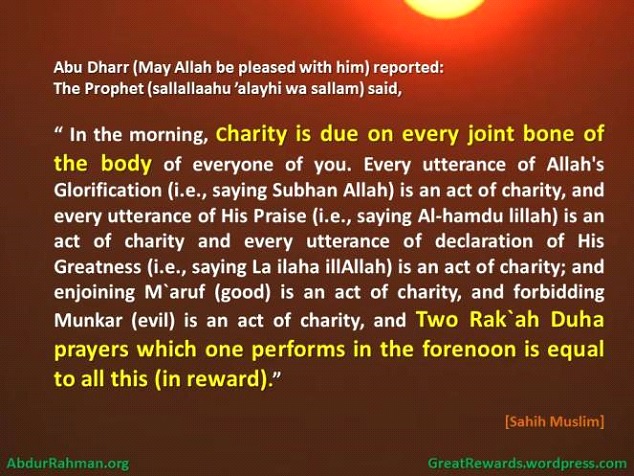
Abu Dharr (May Allah be pleased with him)reported: The Prophet (sallallaahu ’alayhi wa sallam) said, “In the morning, charity is due on every joint bone of the body of everyone of you. Every utterance of Allah’s Glorification (i.e., saying Subhan Allah) is an act of charity, and every utterance of His Praise (i.e., saying Al-hamdu lillah) is an act of charity and every utterance of declaration of His Greatness (i.e., saying La ilaha illAllah) is an act of charity; and enjoining M`aruf (good) is an act of charity, and forbidding Munkar (evil) is an act of charity, and two Rak`ah Duha prayers which one performs in the forenoon is equal to all this (in reward).” [Muslim].
Commentary: “Charity is due from every joint bone” means that when a person gets up in the morning, it is obligatory for him to thank Allah for having every joint of his intact. Therefore, one must praise and glorify Allah. Since a single invocation of the words mentioned in this Hadith is equivalent to one Sadaqah, one must say these words for 360 times – a number which equals the number of joints in man’s body. Moreover, to enjoin someone to do what is good and dissuade somebody from vice constitutes Sadaqah. However, if one performs two Rak`ah of Duha prayer, it will serve for Sadaqah for all the joints of the body. Thus, this Hadith highlights the merits and importance of Duha prayer. We also learn from this Hadith that Sadaqah is not restricted to spending money alone but also has a vast meaning and covers all forms of virtues mentioned here.
Source of the Above:
Reference Link
⦁ ‘… Who is he that will lend a beautiful loan to Allah.’ – Tafsir ibn Kathir
That is a successful trade, O Abu Ad-Dahdah!
Ibn Abi Hatim recorded that `Abdullah bin Mas`ud said, “When this Ayah,
[مَّن ذَا الَّذِى يُقْرِضُ اللَّهَ قَرْضًا حَسَنًا فَيُضَاعِفَهُ لَهُ]
(Who is he that will lend Allah handsome loan: then (Allah) will increase it manifold to his credit (in repaying),) was revealed,
Abu Ad-Dahdah Al-Ansari said, `O Allah’s Messenger! Does Allah ask us for a loan‘
The Prophet said,
«نَعَمْ، يَاأَبَا الدَّحْدَاح» (Yes, O Abu Ad-Dahdah.)
He said, `Give me your hand, O Allah’s Messenger,’ and the Prophet placed his hand in his hand.
Abu Ad-Dahdah said, `Verily, I have given my garden as a loan to my Lord.’ He had a garden that contained six hundred date trees; his wife and children were living in that garden too. Abu Ad-Dahdah went to his wife and called her, `Umm Ad-Dahdah!’ She said, `Here I am.’ He said, `Leave the garden, because I have given it as a loan to my Lord, the Exalted and Most Honored.’ She said, `That is a successful trade, O Abu Ad-Dahdah!‘ She then transferred her goods and children. The Messenger of Allah said,
«كَمْ مِنْ عَذْقٍ رَدَاحٍ فِي الْجَنَّةِ لِأَبِي الدَّحْدَاح»
(How plentiful are the sweet date clusters that Abu Ad-Dahdah has in Paradise!)” In another narration, the Prophet said,
«رُبَّ نَخْلَةٍ مُدَلَّاةٍ، عُرُوقُهَا دُرٌّ وَيَاقُوتٌ، لِأَبِي الدَّحْدَاحِ فِي الْجَنَّة»
(How many a date tree that has lowered down its clusters, which are full of pearls and gems in Paradise for Abu Ad-Dahdah!)
{Tafsir ibn kathir} – The Encouragement to make a Handsome Loan in the Cause ofAllah
Source:Reference Link
⦁ 5 Reasons To Help the Needy From An Islamic Perspective
Did you know that the majority of the world’s population lives in poverty? From a more logical perspective, it is clear that the world system we have set up today is unjust and inhumane. Isn’t it unfair that there are people who cannot even afford one meal a day, while others thrown away food? Back then, the Arabs also had a very terrible system and they would not help the poor and needy. With the advent of Islam, all that changed. Islam gave the poor their rights and as such, Muslims must adhere to these rights. Let’s look closely at why we should help those in need!
#1. To Fulfil the Commandment of Allah
As we know, giving out the Zakat (charity) is one of the pillars of faith, making it obligatory on every capable Muslim. Allah says in the holy Quran: “And establish regular prayers and pay the Zakat and loan to Allah a goodly loan. Whatever good you sent forth before you for your souls, you shall find it in Allah’s presence, better and greater in reward”.
#2. To Extinguish Sins
Charity helps to wipe away sins. Allah says in the holy Quran: “If you give charity openly then what a good thing it is; and if you give to beggars, hiding it is better for you than everything, and He will remove some of your sins. And Allah is Aware of what you do.” (Qur’an 2:271).
And it was narrated that Ka‘b ibn ‘Ajrah (may Allah be pleased with him) said: The Messenger of Allah (blessings and peace of Allah be upon him) said to me: “Charity extinguishes sin as water extinguishes fire.” (Al-Tirmidhi (614); classed as saheeh by al-Albaani in Sunan al-Tirmidhi).
#3. To Represent Islam
As a Muslim, your character and conduct goes a long way in representing the religion. Non-Muslims who may not know much about Islam look at you and judge. It is therefore very vital to always show a very good character. Giving charity could show that Islam is a religion of generosity and kindness and love.
#4. To Strengthen the Ummah
Although we do not have an Islamic state anymore, there are many Muslim organizations, schools and groups that function to benefit the needy Muslims all around the globe. They offer scholarships to Muslim students, help Muslims in places of natural disasters and many other amazing acts. We should all actively contribute to these groups so that we may also benefit immensely from the reward, In Sha Allah. This way, the unity and love amongst Muslims is fostered.
#5. To Touch a Heart
Kindness is one of the best ways to touch someone’s life in a positive way. By this is mean even the non-Muslims. Being kind and generous towards a non-Muslim neighbour might make him/her more inclined towards Islam, even if he does not end up taking the Shahadah.
Wealth is from Allah, and as such we must work hard to earn it honestly and then give out to those who have less than we do. We must be content with what we have and be grateful. Allah does not like the greedy, stingy or boastful.
Source:Reference Link
⦁ Charity in islam
Being caring and compassionate for one’s fellow human beings is a central part of Islam. When reading the Qur’an, one cannot help being struck by the number of times charity is mentioned: Feeding the poor and needy, supporting orphans, relatives and travellers, spending in the way of Allah… All of these references emphasise the importance of charity for every Muslim.
Several ahadith – sayings of the Prophet Muhammad (SAW) – refer to this deep affection and brotherhood:
“You will not believe until you love for your brother what you love for yourself.”
“The believers are like one body in their mutual love and affection: if one limb is injured, the rest responds with sleeplessness and fever.”
If a Muslim feels the pain of his or her fellow human being, and wishes the same comfort and good life for others which he wishes for himself, it is a natural reaction to give in charity, to ease this suffering.
In addition to the indisputable benefits for those receiving charity, Islam also highlights the spiritual to give your wealth away selflessly to remember that every blessing they have in this life comes from Allah (SWT). We must not hoard our wealth and blessings but instead recognise that He wishes for us to be compassionate and share our provisions with others without pride:
“You who believe, do not cancel out your charitable deeds with reminders and hurtful words” (Qur’an, 2:262). The Qur’an reminds us that there is a “recognised right, for the needy and deprived” over our wealth (70:24-5), so by giving for the sake of others, a Muslim is fulfilling a duty to those in need and preventing him or her from becoming proud of their own generosity.
In fact, Allah (SWT) describes those who prevent the supporting of orphans and the feeding of the poor as “those who reject the faith” (107:1-3), as charity should be given in “prosperity or adversity” (3:134), without fear for one’s wealth. We should have faith that a sincere act of giving can only bring abundant reward:
“Those who spend their wealth in Allah’s cause are like grains of corn which produce seven ears, each bearing a hundred grains.” (Qur’an, 2:261)
With Zakat – the obligatory annual tax due on an adult Muslim’s wealth – one of the five pillars of Islam, supporting the poor and needy through charity is an undeniable cornerstone of faith.
Source:Reference Link