Article Surah 90 · Ayah 18
Scale Of Deeds
⦁ Scale Of Deeds
According to verse of Quran and traditions of the Infallibles, it can be concluded that in Qiyamat, a scale would be established in order to weigh the good and bad deeds of people. Weighing of deeds is an Islamic principle and it is a part of accounting.
The Quran says:
وَنَضَعُ الْمَوَزِينَ الْقِسْطَ لِيَوْمِ الْقِيَمَةِ فَلَا تُظْلَمُ نَفْسٌ شَيْئاً وَ إِن كَانَ مِثْقَالَ حَبَّةٍ مِّنْ خَرْدَلٍ أَتَيْنَا بِهَا وَكَفَى بِنَا حَسِبِينَ
And We will set up a just balance on the day of resurrection, so no soul shall be dealt with unjustly in the least; and though there be the weight of a grain of mustard seed, (yet) will We bring it, and sufficient are We to take account. (21:47)
Balance (Mizan) is an instrument of fixing the quantity of goods and commodities. This instrument has been common in different nations and communities in various forms, although mostly it is constructed from tangible materials and bodies are weighed through it, but it is not restricted only to material affairs; on the contrary in reality it is used in other matters as well.
The science of logic used to discriminate between right and wrong judgment, is also called as the ‘science of balance’. In the exposition of the quantum of consciousness, memory, sciences, information, people use the written and oral experiments and name them as ‘balance of exposing the reality’, and other matters of this type. Therefore the implication of ‘balance’ does necessarily have to be something material.
Since the balance of Qayamat is also same, because it is a medium to identify faith and principles of belief, good and bad morals, righteous and evils deeds, it cannot be a worldly and a physical matter.
Can prayer, fasting, sincerity, piety, faith, truthfulness, trustworthiness be weighed on a worldly balance?
A person asked Imam Ja’far Sadiq (as): “Would the deeds of people not be weighed in Qiyamat?”
He replied:
“No, since deeds have no body; that which would be weighed in the balance would be its quality (effect). One who wants to find the weight or quantity of something needs a balance. While the fact is that nothing is hidden from the Almighty Allah.”
So, the person asked: “Then what is the meaning of the weighing of deeds?”
The Imam said:
“That is justice would be observed in accounting and recompense of deeds.”
He asked, “Then what is the meaning of the verse:
فَمَن ثَقُلَتْ مَوَ زِينُهُ
…then as for him whose measure (of good deeds) is heavy… (7:8)
He replied:
“It means that his good deeds would be more.”1
Therefore the balance of deeds in Qiyamat is not like the usual balances, which have a worldly body; on the contrary it should be of another kind. It is possible to choose between two causes in the interpretation of balance in Qiyamat:
First reason: It is that balance consists of correct beliefs, ethical values and laws of the Shariat, which are in fact the straight path, wayfaring on the path of Allah and attainment of the lofty stages of humanity. Therefore, in Qiyamat, the deeds of every man would be weighed on the criterion of Shariat and rewarded accordingly. The same point is indicated in traditions:
The Messenger of Allah (S) said:
“Justice is the balance of God on the earth, one who acts on it would be admitted in Paradise and one who leaves it, would be thrown into Hell.”2
Imam Ja’far Sadiq (as) said:
“One who recites the formula of ‘there is no god except Allah,’ with sincerity would be admitted in Paradise and sincerity lies in the fact that the testimony of ‘there is no god except Allah,’ should prevent him from committing of prohibited acts.”3
The Messenger of Allah (S) said:
“Prayer is the balance; one who fulfills its rights would be recompensed completely.”4
The Messenger of Allah (S) said:
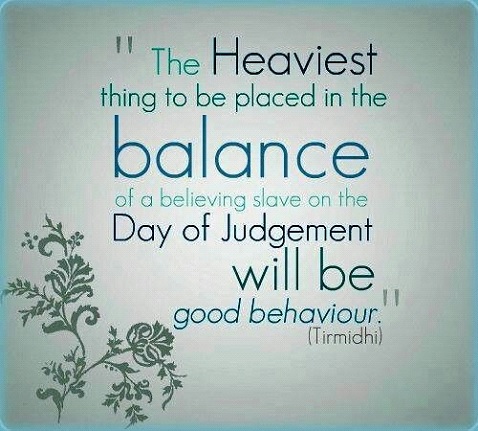
“Nothing is placed in the balance of deeds of the people in Qiyamat, which is superior to good behavior.”5
Imam Ja’far Sadiq (as) said:
“One who meets the Almighty Allah with the following ten things would be admitted to Paradise: Testimony of ‘there is no god but Allah,’; testimony that Muhammad is the Messenger of Allah; confession of all that has come from the Almighty Allah; establishing of prayer; paying of Zakat; fasting in the month of Ramadhan; Hajj of the Holy Kaaba; acceptance of the guardianship (Wilayat) of the holy personalities (Awliya) of Allah; immunity from enemies of Allah and refraining from alcohol.”6
Second reason: It is that balance of deeds is in fact the holy reflection of deeds and views of prophets and infallible Imams. Since these holy personalities are guides of humanity, they themselves acted in accordance to laws of Shariat and practiced the best of morals in such a way that perfections of humanity were personified in them. They also called the people to same beliefs and morals. Hence all beliefs, acts, morals and traits of character can be judged on their criterion; thus they are considered to be the balance of deeds. The same interpretation is mentioned in some traditional reports.
Imam Ja’far Sadiq (as) said in the interpretation of the verse:
وَنَضَعُ الْمَوَزِينَ الْقِسْطَ لِيَوْمِ الْقِيَمَةِ
And We will set up a just balance on the day of resurrection… (21:47)
“They are the prophets and their successors.”7
Imam Sajjad (as) said:
“Ali (as) is the chief of faith and the balance of deeds.”8
Imam Ja’far Sadiq (as) said:
“By Allah, Ali is the straight path and the balance of deeds.”9
The Messenger of Allah (S) said:
“I am the balance of knowledge and Ali is the two pans of balance, Hasan and Husain are its cords and Fatima is the connecting rod between them and the Imams after Hasan and Husain would be the criterion of recognition of their friends and their enemies.”10
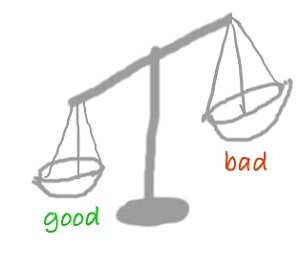
Therefore the holy beings of prophets and their infallible successors can also be interpreted as the balance to weigh the deeds of the people of the community, but think upon it for a moment and you will see that that the second reason also returns to the first cause, since the beings of the prophets and successors are personification of beliefs, morals and good character of religion, they are introduced as balance; thus the balance is in fact a criterion to weigh beliefs and deeds and laws of religion. And the deeds of every person can be weighed in it and he could be rewarded and punished accordingly. In this weighing, beliefs and deeds of a person would be placed in one pan and the other pan contains all beliefs, morals and laws of religion.
From some verses of Quran it can be concluded that man has not one, but many balances.
وَ الْوَزْنُ يَوْمَئِذٍ الْحَقُّ فَمَن ثَقُلَتْ مَوَ زِينُهُ فَأُوْلَئِكَ هُمُ الْمُفْلِحُونَ * وَمَنْ خَفَّتْ مَوَ زِينُهُ فَأُوْلَئِكَ الَّذِينَ خَسِرُواْ أَنفُسَهُم بِمَا كَانُواْ بَِايَتِنَا يَظْلِمُونَ
And the measuring out on that day will be just; then as for him whose measure (of good deeds) is heavy, those are they who shall be successful. And as for him whose measure (of good deeds) is light, those are they who have made their souls suffer loss because they disbelieved in Our communications. (7:8-9)
In this verse, the point mentioned is about the heaviness of the balances of some people and the lightness of the balances of others. It can be concluded that every person would have a number of balances. Perhaps it would be from the aspect that the beliefs would be weighed in one balance, while morals would be weighed in another and deeds would be weighed in yet another balance; thus if each belief is weighed against the correct belief, and every deed is weighed against proper deeds and every moral is weighed against right morals all in different balances, each person would have a number of balances.
Process of Weighing The Deeds
The background of the heaviness and lightness of the pan of balance is obtained in this world through beliefs, morals, character and speech of man: correct beliefs make the self-illuminated, and one who has a stronger faith has more illuminated self. Even though good morals and nice manners are also of the same sort, good deeds, worship and other charitable acts are accidental and they do not endure, but through sincerity and good intention assume the form of a second nature and illuminate and polish the self of man and strengthen his human aspects and make the pan of his deeds heavier.
On the other hand, false beliefs, morals and evil deeds make the soul dark and terrifying; his aspect of humanity is weakened and the aspect of his bestiality is strengthened and so much so that sometimes in his inner being, he assumes the form of a carnivorous beast and the pan of his humanity becomes light.
All these acts, reactions and changes occur in this world and inside the self, but he himself is unaware of them, till on Judgment Day the curtain would be removed from his eyes.
يَوْمَ تُبْلَى السَّرَآئِرُ
On the day when hidden things shall be made manifest. (86:9)
He would see all of them with his own eyes. At that time he would find the pan of balance of his self either light or heavy.
1. Biharul Anwar, Vol. 7, Pg. 248.
2. Mustadrakul Wasail, Vol. 11, Pg. 388.
3. Wasailush Shia, Vol. 15, Pg. 257.
4. Kafi, Vol. 3, Pg. 268.
5. Kafi, Vol. 2, Pg. 100.
6. Wasailush Shia, Vol. 1, Pg. 30.
7. Kafi, Vol. 1, Pg. 420.
8. Mustadrakul Wasail, Vol. 10, Pg. 224.
9. Biharul Anwar, Vol. 35, Pg. 343.
10. Biharul Anwar, Vol. 23, Pg. 107.
⦁
source:Reference Link
⦁ The Wisdom behind the Scales of Deeds
Allah Almighty gives us so many opportunities to gain reward and in His mercy pardons our shortcomings:
“Verily, Allah has recorded good and bad deeds and He made them clear. Whoever intends to perform a good deed but does not do it, then Allah will record it as a complete good deed. If he intends to do it and does so, then Allah the Exalted will record it as ten good deeds up to seven hundred times as much or even more. If he intends to do a bad deed and does not do it, then Allah will record for him one complete good deed. If he does it then Allah will record for him a single bad deed.” (Al-Bukhari)
Thus, death does not have to be a fearful tabooed subject. On the contrary, if seen in the light of the mercy and abundance of reward from Almighty Allah; it is the grand prize of the believer. Then, when the angel of death visits you, you will feel at ease for what is to follow…
⦁ The Scales of Deeds
One of the stages after death is the weighing of our deeds by Almighty Allah. Scales have always been a sign of justice not only in Islam but in different epochs and religions.
⦁ The Weighing of the Heart in Ancient Egypt
The ancient Egyptians believed that, when they died, they would be judged on their behavior during their lifetime before they could be granted a place in the Afterlife. This judgment ceremony was called “Weighing of the Heart” and was recorded in Chapter 125 of the funeral text known as the “Book of the Dead“.
⦁ Lady Justice
Lady Justice is a common sight on courthouses and legal institutions. There is regional variation on her precise depiction, though certain fundamentals are constant: She carries a sword, scales for weighing, and usually (though not always) wears a blindfold. She is garbed in a Greco-Roman toga or tunica, in the tradition of classical goddesses, philosophers and prophets. Images of her can be found across the world.
The concept of a goddess of justice is old indeed, dating to ancient Egyptian and Greek times. The Egyptians had Ma’at, who stood for order and carried both a sword and the Feather of Truth. The Greeks had the goddess Themis, who stood for law, order and justice (and who, incidentally, was mother to the Fates, who themselves were noted for judging humanity). The Roman goddess of justice, Justitia, is the most direct inspiration, since she carried the sword, scales and blindfold we are familiar with today.
⦁ Scales in Judaism
Each and every person has merits and sins. A person whose merits exceed his sins is [termed] righteous. A person whose sins exceed his merits is [termed] wicked. If [his sins and merits] are equal, he is termed a Beinoni.
If a person’s sins exceed his merits, he will immediately die because of his wickedness as [Jeremiah 30:14] states: “[I have smitten you…] for the multitude of your transgressions.”
This reckoning is not calculated [only] on the basis of the number of merits and sins, but also [takes into account] their magnitude. There are some merits which outweigh many sins as implied by [I Kings 14:13]: “Because in him, there was found a good quality.” In contrast, a sin may outweigh many merits as [Ecclesiastes 9:18] states: “One sin may obscure much good.”
The weighing [of sins and merits] is carried out according to the wisdom of the Knowing God. He knows how to measure merits against sins.
⦁ Scales in Christianity
“A just weight and balance are the LORD’s: all the weights of the bag are His Work” (Exodus 21: The Scales of Justice)
While the traditional “scale of justice” is usually regarded as a man-made notion, it actually had its origin in the Holy Scriptures: “16:9 A man’s heart deviseth his way: but the LORD directeth his steps. 16:10 A divine sentence is in the lips of the king: his mouth transgresseth not in judgment. 16:11 A just weight and balance are the LORD’S: all the weights of the bag are his work.”
⦁ Scales in Islam
Allah Almighty shows us the wisdom behind the Scales in the Quran, highlighting how it will be set so that everyone has clear proof that they will be dealt with justly and nothing – not even the weight of a mustard seed- shall be forgotten:
{And We shall set up Balances of justice on the Day of Resurrection, then none will be dealt with unjustly in anything. And if there be the weight of a mustard seed, We will bring it. And Sufficient are We to take account} (21:47)
Glad tidings for those whose scales will weigh heavily.
{And the weighing [of deeds] that Day will be the truth. So those whose scales are heavy – it is they who will be the successful.} (7:8)
{And those whose scales are light – they are the ones who will lose themselves for what injustice they were doing toward Our verses.} (7:9)
Source:Reference Link