Article Surah 95 · Ayah 3
The Superiority of Makkah
⦁ The Superiority of Makkah
There are many hadith which describe the virtues of Makkah and its high status before Allah and His Messenger A. One of these Ahadith is the H adf th of' Abdullah bin 'Adi bin Al-Hamra', who said that he heard Allah's Messenger saying in Makkah, whilst he was ·on his camel in Al-Hazwarah :
"By Allah, you are the best land of Allah, the most beloved land of Allah to Allah. Had I not been driven out of you, I would not have left you."
This-the Hadith of lbn Al-Hamra' - is the most authentic of the hadith narrated on this topic. It is the evidence cited by those who say that Makkah is superior to other places.
To explain the superiority of Makkah, it is sufficient to note that the reward for prayer in Al-Masjid Al-Haram is multiplied many times. It was reported that Jabir bin 'Abdullah narrated that Allah's Messenger said:
"A prayer in this mosque of mine is better than one thousand prayers anywhere else, except for Al-Masjid Al-Haram. A prayer in Al-Masjid Al-Haram is better than one hundred thousand prayers (anywhere else)."
If we calculate the superiority of one prayer in Al-Masjid Al-Haram according to the Hadith which says that one prayer there is one hundred thousand times better than prayer elsewhere, then one prayer in AlMasjid Al-Haram is equivalent to the five daily prayers offered over a period of fifty-five years, six months and twenty days, and the five prayers offered over a single twenty-four hour period are equivalent to the five daily prayers offered over a period of two hundred and seventy seven years, nine months and ten days.
The Hadith which says that the reward for prayer is multiplied, also indicates that the reward for every good deed is multiplied one hundred thousand times. Al-Muhibb At-Tabari said:
"The Ahadith quoted above which say that the reward for prayer and fasting is multiplied, also apply by analogy to the multiplication of the reward for all good deeds.”
Al Hasan Al-Basri said:
"Fasting for one day in Makkah is equivalent to fasting one hundred thousand days, and giving one dirham in charity is like giving one hundred thousand; every good deed is equivalent to one hundred thousand."
Two conditions must be met in order for the reward to be multiplied by one hundred thousand: the act must be done sincerely for the sake of Allah alone, and it must be done following the Sunnah of His Messenger .
The Muslim must avoid committing sin in Makkah, for just as the reward for good deeds is multiplied, so too the burden of bad deeds is also multiplied. Mujahid said:
"The burden of bad deeds is multiplied in Makkah just as the reward for good deeds is multiplied."
Imam Ahmad bin Hanbal was asked:
"Is more than one Sayi'ah recorded for a bad deed?" He said: "No, except in Makkah, because of the sanctity of the land." Ibn Mas'ud likewise said: "If a man resolves at the Ka'bah to kill a believer who is far away in 'Aden, Allah will cause him to taste a painful torment in this world."
Source : makkah pdf
MAKKAH :THE HOLY CITY
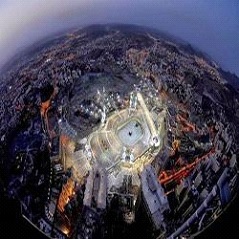
The Honourable Makkah, the Sacred and Secure valley on earth; Allah has distinguished it from among all places and made it sacred from the day He created the heavens and the earth. Allah commanded Prophet Ibraheem, may Allah exalt his mention, to build the first House on earth for Allah to be worshipped in at this spot and sent down the Black Stone from Paradise as a manifest sign of the sanctity of His Sacred House.
In Makkah springs the finest water on the surface of the earth, the water of Zamzam, which is food that suffices the hungry and a cure for the sick. It is the water with which the chest and heart of the chosen Prophet Muhammad was cleansed in order to prepare him for the paramount mission from the Almighty Allah.
Allah has made Makkah eternally sacred and secure; He Says (what means):
{Have they not seen that We made [Makkah] a safe sanctuary, while people are being taken away (i.e. killed and taken captive) all around them?} [Quran 29:67]
Allah has sent down blessings and mercy upon Makkah, the likes of which have
not been bestowed upon any other place or person on earth.
In order to make the matter clear, lest people confuse what is virtuous with what is not and what is sacred with what is not, Allah the Almighty sent down the Jibreel, may Allah exalt his mention, (the angel Gabriel) to point out the boundaries of the Sacred City, and Prophet Ibraheem, may Allah exalt his mention, placed signs marking its boundaries. Furthermore, Allah commanded His messenger, Muhammad to rebuild the structure of the House. This, indeed, is a clear sign and evidence manifesting the sanctity and holiness of this Secure City.It was with the command of Allah that Prophet Ibrahim, may Allah exalt his mention, proclaimed to the people the Hajj (pilgrimage) and Allah took it upon Himself to convey the sound of the call all around the world. Thereafter, the caravan of the honourable prophets, the righteous and those who followed them began to respond and come forth to the Sacred City. Prophet Moosa (Moses), may Allah exalt his mention, the one who was honoured by the miracle of Allah speaking to him, came forth, as came Prophet Yunus (Jonah), may Allah exalt his mention, the one who was swallowed by the whale, as well as a multitude of other prophets.
Makkah is the land where the Prophet Muhammad was born and where his prophethood commenced. It is where he first received revelation; on the peak of one of its lofty mountains lies the famous Cave Hira’ in which the Quran was revealed to him .
The honouring and sanctity of Makkah continued with the prophethood of Muhammad and he conveyed to us that the Ka’bah was to be the direction which the Muslims should face during their prayers, and that a single prayer in the Sacred Mosque was to be equivalent to a hundred thousand in any other mosque.
He guided the people to know that shedding blood (i.e., killing) in Makkah is prohibited as is felling trees and hunting, and that picking up lost items from its streets is prohibited, unless certain strict conditions are fulfilled.
The last and final Prophet openly announced his love of Makkah and its lofty status in the sight of Allah when he said, addressing it: “I swear by Allah! You are the best of the lands of Allah and you are the most beloved land to Allah.” [At-Tirmidhi and Ahmad]
How could we not glorify Makkah when it is a land that Allah Almighty has designated and singled out with the qualities of sanctity and of being glorified magnificently? How could we not glorify it when Allah has made it sacred, magnified the reward of performing good deeds in it, and has made its mention eternal by mentioning it in the Quran?Allah says: (what means): {That [has been commanded], and whoever honours the sacred ordinances of Allah — it is best for him in the sight of his Lord} [Quran 22:30]
Allah also says (what means): {That [is so]. And whoever honours the symbols [i.e. rites] of Allah - indeed, it is from the piety of hearts} [Quran 22: 32]
The sacred ordinances and symbols (rites) of Allah refers to the Sacred City, the Sacred House of Allah, and sacred places within them, and it is due to their special qualities that Allah has distinguished them from all other cities and lands.
Honouring and glorifying the rites of Allah is accomplished by respecting this city, by realising its status and virtues, and by continually expressing gratitude upon seeing it, as well as by holding the matter of worshipping Allah within it in high esteem. This is so because the first House of worship ever to be built was in Makkah, and it is towards it that the hearts of the Muslims are directed from all places on earth. How can worship in it not then have such a high status and value?
Allah made the reward of performing acts of worship in it multiples of that performed elsewhere and made the reward of a single prayer in the sacred mosque equivalent to a hundred thousand prayers in any other mosque. Additionally, fasting, spending in charity and all other acts of virtue in Makkah have a much higher reward than anywhere else in the world, higher than any other act of worship could reach in value.
⦁ Ramadan in Makkah
Wherever in the world they may be, when the sun sets at the end of the day, those who have fasted turn to face one location: the Sacred Ka'bah in the city of Makkah. The crystal-clear "Allahu Akbar" of the familiar Makkan Athan rings through the city where the Prophet Muhammad spent so much happiness and sorrow.
In Makkah, the spirit of giving and remembering Allah, is truly manifested during Ramadan. The emphasis remains on worship and not on food and festivities as in many other places. It is an amazing sight to see thousands upon thousands of people be all accommodated with dates and water (and even more) for the breaking of the fast. And as the Adhan is called, one cannot escape the sheer generosity of Makkans, offering food and water to all.
It is not unusual to see a man with a pick-up van full of cooked rice and chicken dishing food out to everyone who passes by. The wealthy provide Iftar and clothes for the poor, and organizations are active in giving huge amounts of charity.
Makkah in Ramadan is filled with visitors performing ‘Umrah or spending a vacation of their lifetime. For them, it is the Ramadan of a lifetime. For residents of the normally quiet city, however, the place is turned upside down.
"The traffic really picks up, and the routine of the city is reversed," said one resident of Makkah. "Day becomes night and night becomes day. People sleep in late and the shops stay open late."
Also, locals are flanked by visitors who are in the city for the month; a year's supply of houseguests comes all at once for them.
During Ramadan, there is much reading of the Quran in the city in which it was first revealed and the true spirit of Ramadan prevails.
Makkans usually break their fast in homes, often in big gatherings with families and friends. The breakfast usually begins with soups of all kinds, then with the traditional Samboosah and Soubia.
A common tradition of Makkaans is that bringing food to the mosque in their local area becomes a noticeable phenomenon during this month, to the point that hardly any Muslim is left hungry during this blessed month.
Families will bring their food to Al-Masjid Al-Haram (the Sacred Mosque) to break fast there and then offer the Maghrib Prayer together. Later at night, during Taraweeh Prayer, Al-Masjid Al-Haram will be as bright as daytime, and nearly as full as it does during Hajj.
It is amazing to think it, but in nearly every place on earth someone from our Ummah will be fasting Ramadan. No other religion could claim such a united and unanimous act of worship amongst its believers. So in the spirit of this joyous and blessed month, let us not forget our brothers and sisters in every part of the world. Let us make the effort to remember them in our supplications, because no matter where we reside on this planet we share something very special. We will always be a single Ummah under the mantle of Islam.
Source:Reference Link
⦁ Characteristics of the Sanctuary of Makkah
Allah The Almighty takes oath by the Sacred City in two places in the Quran. Allah The Almighty Says (what means):
· {And [by] this secure city [Makkah] } [Quran 95:3]
· {I swear by this city, Makkah -}[Quran 90:1]
Allah The Almighty did so because of the virtue of this blessed spot of land. There is no other place on earth that Allah The Almighty orders His servants to leave for except Makkah. No wonder then that it is the most beloved place to Allah, to the Prophet, , and to the sincere believers.
Reviewing the Quranic and Sunnah (Prophetic traditions) texts, we find that there are specific characteristics that make Makkah distinguished from other places, and certain rulings should be taken into consideration in Makkah. Therefore, we find ourselves obliged to present part of these characteristics. They are summarized in the following points:
1- It is the Qiblah for Muslims as they pray in its direction. Allah The Almighty Says (what means):
· {We have certainly seen the turning of your face, [O Muhammad], toward the heaven, and We will surely turn you to a Qiblah with which you will be pleased. So turn your face toward Al-Masjid Al-Haram. And wherever you [believers] are, turn your faces toward it [in prayer].} [Quran 2:144]
· {So from wherever you go out [for prayer, O Muhammad] turn your face toward Al- Masjid Al-Haram, and indeed, it is the truth from your Lord. And Allah is not unaware of what you do.} [Quran 2:149]
2- Allah The Almighty made it the Mother of Cities. Allah The Almighty Says (what means): {that you may warn the Mother of Cities and those around it.} [Quran 6:92] Ibn Katheer said, “Makkah was named the Mother of Cities because it is more honored than all cities.” All cities are subordinate to it.
3- Multiplication of the reward for good deeds in it. The Prophet, , said: “A prayer in Al-Masjid Al-Haram is better than one hundred thousand prayers in other mosques.” [Ahmad (Al-Arnaa’oot: Saheeh)] According to many scholars, such multiplication of good deeds in Makkah is on the basis of the sacredness and high status of this city before Allah The Almighty.
4- Gravity of committing a sin in it: Allah The Almighty Says (what means): {Whoever intends [a deed] therein of deviation [in religion] or wrongdoing - We will make him taste of a painful punishment.} [Quran 22:25] There is a threat for the mere intention to commit a sin in the sanctuary of Makkah. Ibn Al-Qayyim said, “Committing a sin in the Sanctuary (of Makkah) of Allah and His City is graver than committing it in any other place on earth. Therefore, whoever disobeys a king in his court is not like the one who disobeys him in a place far away from his house and court.”
5- Allah The Almighty made it a secure, sacred place: It is forbidden to kill people in it, cut its trees or chase game in it. In it, people feel secure for themselves and properties. It is the perfect secure place for every creature of Allah. Allah The Almighty Says (what means):
· {And whoever enters it shall be safe.} [Quran 3:97]
· {[Say, O Muhammad], "I have only been commanded to worship the Lord of this City, who made it sacred and to whom [belongs] all things. And I am commanded to be of the Muslims [those who submit to Allah ]} [Quran 27:91]
Ibn ‘Abbas, may Allah be pleased with him, said that the Prophet, , said: “Allah has made Makkah a Sanctuary (sacred place) the day He created the Heavens and the earth; it is sacred by the Order of Allah until the Day of Judgment. It was a sanctuary before me and will be so after me. It was made lawful for me (to fight in it) only for a few hours. None is allowed to chase its game or uproot its thorny shrubs or to cut its trees.” [Al-Bukhari] There is no exception but the plant of Ithkhir because of the need for it as indicated in other Sahih Hadiths.
6- Being the most beloved spot of land to Allah The Almighty: ‘Abdullaah bin ‘Adiyy, may Allah be pleased with him, said,“I saw the Messenger of Allah on his mount at Al-Hazwarah, saying: “By Allah, you are the best land of Allah and the most beloved land to Allah; had I not been driven out of you, I would have never left you.” [At-Tirmidhi and Ibn Maajah]
7- Being a place where supplication is most likely to be answered: The Prophet, , said: “Those who perform Hajj and ‘Umrah are the guests of Allah. If they supplicate Him, He would answer them and when they seek His Forgiveness, He would forgive them.” [An-Nasaa’i and Ibn Maajah (Al-Albaani: Saheeh)]
8- Impermissibility for polytheists to enter it: Allah The Almighty Says (what means): {O you who have believed, indeed the polytheists are unclean, so let them not approach Al-Masjid Al-Haram after this, their [final] year.} [Quran 9:28]
9- Impermissibility to pick up the found fallen things in it except for those who want to make a public announcement for them without claiming possession of them: Ibn ‘Abbas, may Allah be pleased with him, said that the Prophet, , said: “It is not allowed to pick up its fallen things except by a person who announces it publicly.” [Al-Bukhari]
10- Impermissibility of facing the Qiblah or turning one’s back to it when one relieves oneself: The Prophet, , said: “If anyone of you goes to an open space for answering the call of nature he should neither face nor turn his back to the Qiblah; he should either face the east or the west.” [Al-Bukhari and Muslim] According to scholars, this ruling is specific for those who are in an open place unlike those who are inside buildings.
11- The Antichrist cannot enter Makkah or Madinah: Anas, may Allah be pleased with him, said that the Prophet, , said: “There will be no town that the Antichrist will not enter except Makkah and Al-Madeenah.” [Al-Bukhari and Muslim]
12- Allah The Almighty defends it: This happened during the Year of the Elephant and would happen again at the end of time. ‘Aa’ishah, may Allah be pleased with her, said that the Prophet, , said: “An army will raid the Ka‘bah and when it reaches a desert land, all of them will be swallowed up by the earth.” [Al-Bukhari]
13- Hearts are attached to this city and people like it because Allah The Almighty answered the supplication of our father Ibraaheem (Abraham), may Allah exalt his mention, which is stated in the Quran where Allah The Almighty Says (what means): {Our Lord, I have settled some of my descendants in an uncultivated valley near Your sacred House, our Lord, that they may establish prayer. So make hearts among the people incline toward them.} [Quran 14:37]
Source:Reference Link
⦁ O Pilgrim, Remember the Sanctity of the Ancient House
The sanctity of Makkah as well as the sublime position of the Ancient House is clear even to those who possess modest knowledge and insight. This is clarified in many Quranic verses and Prophetic Hadiths (narrations). Scholars have also stated this in their books, their rites and in the books of Tafseer (exegesis). Thus, there is no ambiguity on this issue and all praise is due to Allah for this.
Nonetheless, the following points are worth remembering:
First: In the Noble Quran, Allah The Almighty Says (what means):
{Indeed, the first House [of worship] established for mankind was that at Makkah - blessed and a guidance for the worlds. In it are clear signs [such as] the standing place of Ibraaheem (Abraham). And whoever enters it shall be safe. And [due] to Allah from the people is a pilgrimage to the House - for whoever is able to find thereto a way. But whoever disbelieves - then indeed, Allah is free from need of the worlds.}[Quran 3: 96-97]
In these verses, Allah The Almighty clarifies that the Ancient House is the first House of worship established for humankind and that it is blessed and a guidance for the worlds. These are actually great indicators of the honored and exalted position of this House. Abu Tharr, may Allah be pleased with him, narrated that he said, ‘O Messenger of Allah! Which mosque was first built on the surface of the earth?’ The Prophet answered: ‘Al-Masjid Al-Haram (the Sacred Mosque in Makkah).’He said, ‘Which was built next?’ He replied: ‘Al-Aqsa Mosque (in Jerusalem).’ He said, ‘What was the period of time between the two?’ He said: ‘Forty years.’ He said, ‘Which was built next?’ He said: ‘Wherever (you may be, and) the prayer time becomes due, perform the prayer there, for it is a place of prayer.’" [Al-Bukhari and Muslim]
Second: This Ancient House was the first House established for humankind for worshipping and obeying Allah. However, there were many houses before it established for housing and residence. This House, however, was the first one to be established so that people would worship Allah therein and circumambulate it. Ibraaheem (Abraham), may Allah exalt his mention, was the first to build this House with the help of his son, Ismaa‘eel (Ishmael), may Allah exalt his mention. The next House to be built for worship on earth was Al-Aqsa Mosque (in Jerusalem). It was first built by Ya‘qoob (Jacob)ibn Is-haq (Isaac) ibn Ibraaheem, may Allah exalt their mention. The period between the construction of the two was forty years. Many years later, Al-Aqsa Mosque was inhabited by Prophet Sulaymaan (Solomon), may Allah exalt his mention.
Third: This Ancient House is the best and first house established for worship. It is a blessed House since Allah The Almighty distinguished it by the acts of circumambulation and worship. All these actions are means to expiate sins and forgive misdeeds. Allah The Almighty Says (what means): {And [mention] when We made the House a place of return for the people and [a place of] security. And take, [O believers], from the standing place of Ibraaheem a place of prayer. And we charged Ibraaheem and Ismaa‘eel, [Saying], "Purify My House for those who perform Tawaf (circumambulation) and those who are staying [there] for worship and those who bow and prostrate [in prayer]."} [Quran 2: 125]
Allah The Almighty has made the House a place of return for people to which they will always want to come and never feel unwillingness to go there. Rather, as soon as they return, they would love to come again, since Allah The Almighty has implanted love for this House and willingness to go to it within the hearts of the believers. There they experience great benefits, their ranks are exalted, the reward of their good deeds is multiplied and their misdeeds are forgiven.
Fourth: Allah The Almighty has made His Ancient House a safe place where people find safety and security. It is a safe sanctuary where even game is safe from being chased or killed, although it is lawful for Muslims to do so outside the sacred precincts of Makkah. Allah The Almighty Says (what means): {And whoever enters it shall be safe.} [Quran 3: 96]
The verse, however, does not mean that harm, killing, and so on, does not happen in this place. Rather, it means that safety and security must be granted to whoever enters it and no one is allowed to afflict it with harm. It was a practice during the pre-Islamic era that a person would encounter someone who had harmed him, even a person who had killed his father or brother for instance, but without afflicting him with harm unless he was outside the sacred sites.
Fifth: As Allah The Almighty has made the House a place of return for people and a place of security, He made it obligatory for Ibraaheem and Ismaa‘eel, may Allah exalt their mention, to purify it for those who perform Tawaf (circumambulation) and those who are staying there for worship and those who bow and prostrate in prayer. Allah The Almighty Says (what means): {And [mention, O Muhammad], when We designated for Ibraaheem the site of the House, [saying], "Do not associate anything with Me and purify My House for those who perform Tawaf and those who are staying [there] for worship and those who bow and prostrate.} [Quran 22: 25]
Those who stay there are the people who observe I‘tikaaf (staying at the Masjid for worship) and those who bow and prostrate are the people who perform prayers.
On the Day of the Conquest of Makkah, the Prophet drew the people's attention to this and said that it is a secure sanctuary and that it is Allah The Almighty, not people, Who has made it secure and sacred on the day He created the heavens and the earth. He said: "Allah has made this town a sanctuary. Its game should not be chased, its trees should not be cut, its grasses should not be removed, blood should not be shed there and lost items should not be picked up except by one who would announce it publicly."
Just as it was obligatory upon the Prophets Ibraaheem, Ismaa‘eel as well other Prophets, may Allah exalt their mention, including Muhammad to honor the House, Muslims are required to exalt and honor the Sacred House of Allah and avoid what is forbidden therein. This includes harming Muslims, and wronging or transgressing them, whether or not they are performing Hajj and ‘Umrah. It is also obligatory to purify this House for those who stay there for worship.
Sixth: Muslims are required to keep this House purified by avoiding acts of disobedience there and fearing the wrath and punishment of Allah The Almighty. They are also forbidden to harm each other or fight each other there, as even a minor sin there is considered a grave major sin. Just as good deeds are multiplied there, scholars are of the opinion that misdeeds are also multiplied. This multiplication does not occur in number; rather, it occurs in the punishment assigned to the act. The basic principle is that whoever comes with a misdeed will not be recompensed except with the like thereof. However, doing a misdeed in the Sacred House is not the same as when one does so in another place. Indeed, it is most grave and major there. Allah The Almighty Says (what means): {Indeed, those who have disbelieved and avert [people] from the Way of Allah and [from] Al-Masjid Al-Haram, which We made for the people - equal are the resident therein and one from outside; and [also] whoever intends [a deed] therein of deviation [in religion] or wrongdoing - We will make him taste of a painful punishment.} [Quran 22: 25]
This means that the Sacred House is sacred for all people, the resident therein and the one coming from outside for Hajj, ‘Umrah or any other purpose.
When Allah The Almighty enabled His Prophet to conquer Makkah, he addressed the people saying: "Allah has made this town a sanctuary since the day He created the Heavens and the Earth, and it will remain a sanctuary by virtue of the sanctity of Allah, not that of people. Allah has made fighting lawful for me for just an hour of the daytime, and its sanctity has returned again as it was yesterday. Let those who are present tell those who are not. No one is permitted to shed blood there, cut a tree, hunt game or pick up a lost item except by one who makes a public announcement about it."
If game and trees are safe there, then what about the Muslim? It is even more worthy to keep the Muslim secure and safe there. It is forbidden for anyone to do anything harmful to people there, whether by word or action. Rather, one should honor these sacred places, surrender to the Sharee‘ahof Allah and honor the sacred ordinances of Allah more than at any other time. One should be kind to his fellow Muslims, hope for goodness for them, hate to see evil afflicting them, help them to do good and avoid evil and never harm anyone with either a word or a deed. Allah The Almighty Says (what means): {In it are clear signs [such as] the standing place of Ibraaheem.} [Quran 3: 96]
Allah The Almighty has placed clear signs in the Sacred House. Commenting on the verse, scholars said that these signs are the Station of Ibraaheem, may Allah exalt his mention. All the sacred precincts of Makkah were a standing place in which Ibraaheem, may Allah exalt his mention, worshipped Allah, including ‘Arafat, Muzdalifah, Mina, and so on. This also includes the stone on which Ibraaheem, may Allah exalt his mention, stood while he was building the House. Muslims, therefore, are required to safeguard, protect and keep this noble sanctuary safe from any harm, out of compliance with the order of Allah and His Prophet, Muhammad .
Scholars clarified and unanimously agreed that it is obligatory to honor this House, safeguard it from any harm, protect it from all types of disobedience and injustice, make matters easy for the observers of Hajj and ‘Umrah and help them to do good and avoid evil and harm. No one is permitted to harm anyone there, with either words or deeds. Only those who are disbelievers in Allah and the Last Day, ignorant about the rulings of Allah or wrongdoers harm people in the Ancient House. Such people will be punished for their harm and wrongdoing. Those who are true believers in Allah and the Last Day, however, their belief and faith prevent them from doing what is forbidden by Allah The Almighty – whether in this sacred place or any other place. This place is indeed greater and superior than other places.
Makkah Al-Mukarramah (the honored city), is the most beloved town to Allah and the greatest place.Al-Madeenah comes next and then Al-Aqsa Mosque. These three mosques are distinguished by greater honor than any other mosque. They are the ever greatest, the best and the worthiest of honor and care than all the other Mosques of Allah.
Source:Reference Link