Historical Data Surah 89 · Ayah 3
The Treasury, Petra
The Treasury, Petra
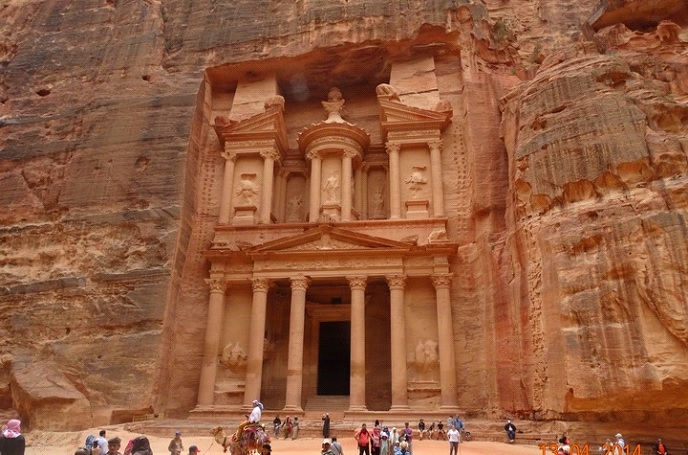
The Treasury in Petra – Photo: F.Pandor
This building, known as The Treasury is one of a series of buildings in Petra that was built by the Nabateans who followed a pagan religion and were closely linked to the people of Thamud. They were renowned for their elaborate skill of carving into rocks.
⦁ The Nabateans were a Semitic people, Arabs of southern Jordan, Canaan and the northern part of Arabia,
⦁ Petra lies on the slope of Mount Hor and close to the town of Wadi Musa (the valley of Moses). Harun (upon him be peace), the brother of Musa (upon him be peace) is buried close by, as is Miriam, their sister.
⦁ The Nabateans worshipped the Arab gods and goddesses of the pre-Islamic times as well as few of their deified kings. Many statues carved in the rock depict these gods and goddesses. Three of the idols worshipped by the disbelievers at the time of the Prophet (ﷺ), Lat, Uzza and Manat have their origins with the Nabateans. They used to believe that they were the daughters of Allah.
⦁ One of the first things that can be seen around the entrance to Petra are three huge blocks, standing 6 to 8 metres high. Tradition holds that they contained ‘jinn’, placed there to guard the city.
1.4. Various influences in Pre-Islamic Arabia
Some of the ancient buildings of Mada'in Salih in Arabia and the Dam of Marib in Yemen are reminders of how the influence of ancient technology reached Arabia. In the 7th century, the Arabs already had a calendar with twelve months named in Arabic (e.g. Muharram, Safar, Rabi‘ al-Awwal, Rabi‘ al-Thani, Jumada 'l-Ula, Jumada al-Akhir, Rajab, Sha‘ban, Ramadan, Shawwal, Dhu'l-Qa‘dah, and Dhu'l-Hijjah) which might have originated in ancient Mesopotamia. The Arabs had no schools or educational institutions in the pre-Islamic era, but these existed in Alexandria, Antioch, Edessa and Harran in Mesopotamia and Persia where some of them were employed at the medical school of Jundishapur (in south-west Persia) during the 6th and 7th centuries. In Syria, Byzantine (Eastern Roman) and Persian influence mingled. From here, Greek science and learning spread to the East and the West. Among the Syrians were two Christian sects. The Nestorians taught Greek science and philosophy in their schools and translated Greek books into the Syriac language and these were translated into Arabic during the Islamic period. Nestorias held theological views contrary to those of the patriarch of Constantinople and consequently they were banned in 481 C.E. Nestorias and his followers fled Byzantium for Syria, but on being persecuted there some of them escaped to Mesopotamia, and few of them were employed at the medical school of Jundishapur (which was founded by the Sassanian King Khusraw Anushirwan in the mid-6th century CE) [4]. The school at Jundishapur survived until the early ‘Abbasid period (9th century CE). Thus education in one form or another was available in Egypt, Syria, Mesopotamia and Persia at the time of the advent of Islam in the 7th century, though the inhabitants of Arabia, on the edge of civilization, remained in ignorance of them.
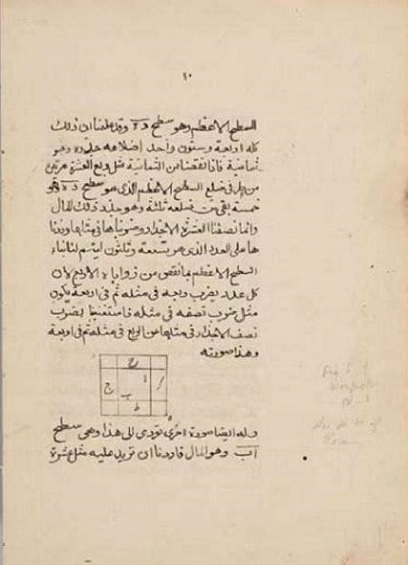
Figure 4: A page from Kitāb al-jabr wa-'l-muqābala, the first extant algebra text, written in about 825 CE by Muhammad ibn Mūsā al-Khwārizmī. (Source).
To see education in perspective we should now turn to some Arabic sources. Some taken from Ibn Qutaybah's (d.276 AH/ 889 CE) short encyclopaedia entitled al-Ma‘arif (Book of Knowledge) [5] and al-Khwarizmi's Mafatih al-Ulum [6] (Keys to Sciences), (composed ca 977 CE), and the history of philosophers, physicians, astronomers and mathematicians known in Arabic as Ta'rikh al-Hukama' [7] by Ibn al-Qifti (d. 1248). Al-Khwarizmi's book is regarded as the first attempt to survey the Islamic sciences. The work of Ibn al-Qifti, who was employed by the famous Saladin (Salah al-Din Ayyubi), comprises 414 biographies, including the biographies of Greek philosophers and physicians such as Euclid, Socrates, Aristotle, Plato, Galen, Ibn Sina, al-Khwarizmi, al-Farabi, al-Razi and Ibn Rushd.
The Arabs from the Arabian Peninsula lived close to the Near Eastern civilizations of antiquity. Knowledge of ancient arts, sciences and technology was transmitted to them from their wisemen (hukama') and elders in the form of folklore, tales and myths, and was passed on from generation to generation, although it is hard to determine exactly how much information was transmitted to the Arabs before the rise of Islam. The Arabs called the ancient sciences ‘ulum al-awa'il (literally, "sciences of the ancients") and on becoming civilized under Islam acknowledged that the ancient knowledge belonged to the category the awa'il (first occurrences, antiquity) as a theme in a chapter or as a title of a book. As we have already indicated, the Arabs until the 6th century CE transmitted everything orally, including Arabic poetry.
We learn from Ibn Qutaybah in al-Ma'arif every ancient thing known to the Arabs. The book begins with a chapter on the creation myth, which cites the Genesis in the Old Testament as a source narrated by Wahb ibn Munabbih. The interpretation of Islamic history begins with the story of Adam and Eve and proceeds to narrate the role of the Prophets and Messengers chosen by God from their children as part of the process of passing divine guidance to mankind from generation to generation. The story of the Prophets and Patriarchs was also narrated by the great Arab historian al-Tabari in his book Ta'rikh al-Rusul wa'l-Muluk (History of the Prophets and Kings).
Ibn Qutaybah claimed that before the advent of Adam and Eve, the earth was inhabited by spirits (Jinn). According to Ibn Qutaybah, Adam had tilled the soil and Eve had woven cloth and by so doing the pair had provided the essential first steps towards a civilized life. Adam's son Qabil became a farmer, and his brother Habil a shepherd [8]. Adam had 40 sons and 20 daughters. Adam was seen as a Prophet of God who received divine revelations. Among the revelations he received were ones which prohibited the eating of dead flesh (carrion). He also learnt from God about the alphabet and writing (e.g. the cuneiform). However, there is no evidence to substantiate this ‘myth'. Whether or not writing originated with Adam, we know from ancient inscriptions in Mesopotamia that some form of writing came into existence during the civilization of Sumer in the 3rd Millennium BCE.
Among the descendants of Adam were many Prophets including Seth ( Arabic Shith) who, it is claimed, lived 912 years and received fifty revelations; then came Noah, whose descendant was Idris (Enoch) [9]. Noah is associated with the story of the Flood and the construction of an Ark in which a pair of every living creature was saved from extinction. Among the children of Noah were Sam (whence the Semites) and Ham (whence the Hamites or Hamitics of Africa) who, according to Ibn Qutaybah, were Prophet of God [10]. Among the other Prophets listed by Ibn Qutaybah were: Hud, Salih, Abraham, Isma'il (Ishmael), Ya‘qub (Jacob), Yusuf (Joseph), Ayyub (Job), Musa (Moses), Harun (Aaron), Dawud (David), Sulayman (Solomon), Uzair (Ezra), Danyal (Daniel), Shu‘aib, Ilyas, Yasa‘, Zakariyah (Zakharaya), Yahya (John), Jarjis, Dhu'l-Qifl, ‘Isa (Jesus) and Muhammad [11].
According to the same author the total number of Prophets (as educators of mankind) was 124,000. Among them were 315 prophet-messengers (Nabiy Rasul); five of them were of Syriac origin, namely Adam, Shith (Seth), Idris (Enoch), Noah and Ibrahim (Abraham); and five were Arabs, namely Hud, Salih, Isma‘il, Shu‘aib and Muhammad (peace be upon all of them). Ibn Qutaybah also claimed that the first prophet of the Israelites was Moses (Musa) and their last prophet was ‘Isa (Jesus) [12]. This last view, which was expressed in the 9th century CE, may be considered contro¬versial today.
The stories of these Prophets served as illustrations of the divinely inspired educators of mankind. Moreover, the ‘creation myth' cited by Ibn Qutaybah had been repeatedly en¬dorsed by Islamic writers over the centuries. A modern doctoral dissertation of Cambridge University entitled ‘The Problem of Creation in Islamic Thought' examines the subject comprehensively from the standpoint of primary sources, such as the Qur'an, Hadith, Commentaries and Kalam (speculative theology) [13]. On the whole, Islam upholds the theory that every creature in heaven and on earth was created by God Almighty. This resembles the theory of divine creation ex nihilo. Therefore, mankind should offer praise and prayer to Him as an act of thankfulness and gratitude. From an Islamic perspective, there is no support for Darwinism.
3.2. Defining Islamic Science
Let us try to define now Islamic science and try to explain how it came into being. The Qur'an made its greatest impact on Muslim minds by making them aware of the natural world. The Qur'an also referred to peoples in the past, such as the Ad and Thamud, the people of Lut (Ashab Lut), Moses, Banu Israel and the Pharaohs. This emphasis on antiquity appears to be deductive in purpose.
Taking these factors into account, Muhammad Iqbal came to some interesting conclusions. He thought that the Qur'an pointed to Nature and History [71] as sources of human knowledge. He also claimed that the birth of Islam heralded the birth of inductive intellect [72]. He therefore concluded that Islam bridges the ancient and the modern worlds. He justified such a claim by assuming that Islam belonged to the ancient world in so far as it used revelation but was essentially modern in spirit. These conclusions of Iqbal may be significant in so far as Islam has motivated its adherents to pursue vigorously both religious and secular science. Islam encouraged scholars the exploration of all kinds of knowledge. One explains the pursuit of Islamic science thus: "Islamic science came into being from a wedding between the spirit that issued from the Qur'anic revelation and the existing sciences of various civilizations which Islam inherited and which it transmuted through its spiritual power into a new substance, at once different from and continuous with what had existed before it [73]."
THE THAMOD
After the •Ad, the Thamud rose to power, as the Qui' in says: "Remember (0 Thamud) that God made, you successors of the 'Ad."
As the 'Ad were masters of south-eastern Arabia extending from the coast of the Persian Gulf to the borders of Iraq, so were the Thamud masters of north-western Arabia, then known as Wadi-ul-Qura (as their valley had in its •fold a number of small villages scattered far and wide).
The ruins of the valley were witnessed by ·Muslim geographers and some relics are still visible. The Qur'an bas referred to this place as "wadi" as it says: ,The Thamod who used to cut stones in the Wadi (for the purpose of buildings)."
The town of hijr, the headquarters of the Thamud, was situated on the old road stretching from hijaz to Syria. Another town, viz. "Fajun Naqah," which is known among the Greeks as ••Badneitu" also stood there. Now hijr is called "madain salih,'' i.e. the town of Prophet salih
The past history of the Thamud ·is obscure. All We know is that. they were a powerful people of north Arabia.and like the • Ad they were skilful builders. Their special profession was to erect houses, mansions, and tombs of :stones inside the mountains. The relics of these buildings are still available with inscriptions . thereon in the Aramaic character. But most of these inscriptions belong to Nabateans who ruled in this place before and after Christ.
The period of the Thamud began after the destruction of the 'Ad. The proof is that the Thamud are more distinctly mentioned in Assyrian and Greek languages than the 'Ad, and the Qur'an also confirms this view when it says: "Remember (0 Thamud) that God made you accessors of the 'Ad."
The period of the Thamud came to a close before the advent of Moses, because the well-known tribes of north Arabia, on account of their political predominance, are mentioned in the Old Testament, but the name of Thamud does not appear in· the list ; the Qur'an also supports this view as it says: And he who believed said: 0- my people I surely I fear for you the like of what befell the Hordes, the like of what befell the people of Noah, Ad and Thamud and those after them.s
The period of the Thamud may be fixed from 1800 :a.c. to 1600 B c. Another proof of the destruction of' the Thamud before Moses is that during Moses's time the people of Midian were found occupying the .country which had been ruled over by the Thamud. Those who have carefully· studied the Exodus of the Old · Testament will have no hesitation in admitting it.
Prophet salih When the Thamud refused to believe in one God and: began to worship the physical embodiments of stars, God deputed a messenger named salih In the Old Testament a son of Arphaxad has been named salih, who is described as father of Abraham and Joktan, Christian .. priests who generally refer to the narrations of the Arabs and · anecdotes of the-- Qur'an as unhistorical look forward to the Qur'an for sanction here, in as far as they say that "Salih'' and Salah" were the name:; of the same person. If history permits it we have no objection.. The Prophet of· God invited the Thamud to the law of God, but they refused to listen to him.
The Prophet then advised them saying, ''Here is a she-camel, which is a Divine proof of my prophethood. Let her graze on the earth.One day she will drink water and" one day you will drink. If you have done· her 'any harm, that day Divine wrath will befall you." Good people believed in $alih) and wicked people turned deaf ears to him.
Nine men among the unbelievers entered into a conspiracy to attack salih and his followers at night.
They cut the knees of the camel and killed her. The anger of God befell them in the form of a serious earthquake.
The Quran describes the whole event in detail :
And to the Thamud (We sent) their brother ;,ali);l. He said :-
0 my people ! serve Allah; you have no God other than Him ;
clear proof ind~ed has come to you from -your Lord,; this i~ (as)
Allah's,she-camel for you a sign. therefore leave her alone to pasture
on Allah's earth, and do not do her any harm, otherwise
painful chastisement will overtake you. ·
And remember when He dlade yo successors of the 'Ad and
settled you in the land-you make mansions on its plains and
hew out houses in the mountains-remember therefore Allah's
benefits and do not act corruptly in the land, n,iil-king mischief.
The chiefs of those who behaved proudly among" his people
said tb those who were considered weak...;_ those who be lived from
among them-Do you know that ~alib is sent by his Lord? They
said: Sorely we are believers in what has been' sent 'with.
Those who were haughty said: Surely we are"deniers of what you believe in. So they slew the she-camel and revolted against their· Lord's commandment, and they said : o salih bring us.what you threatened us with; if you are one of the apostles. .
Then the earthquake overtook them, so they' became motionless bodies in their abodes. ·
Then he turned away: from them and said : 0 my people I did certainly deliver to you the message of my Lord, and I gave you good, advice, bot you do not love. those who. give good advice ..
The Thamod gave the lie to the apostles.
When their brother salih said to them :, Will you not guard(against evil) ?
Surely I am a faithful apostle to you. Therefore guard against (the punishment of) Allah and obey me. And I do not ask you any reward for it : my reward is only with the Lord of the worlds. me.
Will you be left secure .in what is here : In gardens and fountains. · And corn-fields and palm:. trees having fine spadices.? And you hew houses out of the mountains exultingly: Therefore.guard against (the punishment of) Allah and obey And do not obey the bidding of the extraftgant. Who make mischief in the land and do not act aright.
They said : You are only of the deluded ones: You are naught but a mortal like ourselves. So bring a sign if you are one of the truthful. He said : This is a she-camel: she shall have her portion of water, and you have your portion of water in au appointed time: And do not touch her with evil, Jest the chastisement of a grievous day should overtake you : .
But they. stabbed her, then regretted. So the chastisement overtook them Most surely there is a sign in this, but most of them do not believe. And most surely your Lord is the. Mighty, the Merciful.• And certainly We sent to the Thamiid their brother salih. saying: Serve Allah; and lo, they became two parties contending with each other.
He said : 0 my people I why do you seek to hasten evil before good ? Why do .you not ask forgiveness of AIJah so that you may be dealt with mercifully ?. They said : We have met with ill-luck ou account of. those with you. He said : The cause of your evil fortune is with Allah, nay, you are a people who are tried.
And there were in the city nine persons who made mischief in the land and did not act aright. They said : Swear to each other by Allah that we still certainly make a sudden attack on him and his family by night, then we will say to his heir: We did not witness. the destruction of his family, and we are most surely truthful. And they planned a plan, and We planned a plan while they perceived not. See, then, bow was the end of their-plan that We destroyed them and their people, aU (of them). So those are their houses fallen down because they were unjust :most surely there is a sign in this ~~~~ people .rho know. And We delivered those who believed and who gaarded (ag~ evil)\' . ,As to the Thamid: When it was said to them: Enjoy yourselves for a while : But they revolted against the commandment of their Lord, s~ the rumbling overtook them while they saw. So they were not able to rise up, not could they defend themselves.le The Tbamid and the 'Ad called the striking calamity a lie. Then as to the Trent!d they were destroyed by aa excessively severe punishment.in · The TabaRd rejected the warnins. So they said : What, a single mortal from among us I Shall we follow hila? .-. surety ,e shall in that case be in sure error and distress: ·· · Bas the reminder been otade to light upon him from among us 1 Nay, be is an insolent liar. To-morrow shall they know who is the liar, the insolent one. Surely We are gt>ing to send the she· camel as a· trial for them ; therefore watch them and have patience. And inform the~ .that the wat-er is shared between them· :every &bare of water's ball be attended. . ' But they called their companion, so be took (the sword) and slew (her).
How (great) was then My chastisement and My ,warning; Surely We sent upon them a single cry. So they were like the dry fragments of trees which the maker of an enclosure coltects.12 And that He did destroy the •Ad of O_ld ; And tile Themeid, so H~ spared not.13 The Thamiid gave the lie: (to the truth)in their inordinacy : When the most unfortunate of tl1em bh>ke forth with rilis chief. 1 So Allah's ap~(Ie said to them : (Leave alone) Allah's shec.ameJ~ and (give) hef (to) drink. · ' •i .'· But they called him a liar anJ slaughtered h~r; tffE!t~fore their Lord crushe1 them for their sin and levelled • them•( with the ground). And He fears not its consequence.l~ · And to the Thamiid .(We sent) their brother ~ilib; He said : 0 my. people I serve Allah, you have no god other than He;· He brought you into•being fr()m the earth, and made you dwell in it, therefore ask forgiveness of Him, then turn to Him. Surely my Lord is, Nigh. Answering. They sai~ .: . 0 --~~l,ib .1 surely you were one;_ amongst us in whom great expectations were placed before~tl;lis: do you (no\y) forbid us from worshiping what our Fathers worshipped? And as to that which you call us to' thost surely we are in disquieting doubt. , '·· · '' ··· He sald : 0 my people J tell. me if I' h~'O'~' clear p(qof from my Lord and He has granted to me mercy from Himself, who will then help me against Allah if I disobey ~im? Therefore you do not add to me other than loss: And, 0. my people I this-will be (as) Allah's she-camel for you, .a sign; therefore. leave her to pasture of Allah's tarth and do not touch her with evil, for- then .a near chastisement will overtake you. But they'"' stew ·her, so he said: Enjoy yourselves in your abc;>des for thre_e days, that is a. promise not to be belied J~
So far about those of the Thamud who refused to
believe in God and His Prophet. As regards the be·
lievers the Quran says :
·so when Our decree came to pass, We delivered ~ilio and
those who believed with him by mercy from Us, and (We saved
them) from the disgrace of that day. ·surely your Lord is the
Strong, the Mighty. · ·
And the rumbling overtook those who were unjust, so they
became motionless bodies in their abodes.
As though they bad never dwelt in them: now surely did the
Tbamud disbelieve in their Lord; now surely, away with the
Thamud.t6
And as to the Thamud, We showed them the right way, b.ut
they chose error above guidance, so there overtook them the
scourge of an abasing chastisement for what they earned.
And We delivered those who believed and guarded .(against evi1).17 .
. The TalmUd 1 I. The Thamud' II (i.e. those of the
Thamiid who survived the catastrophe) are met with'
in history in a more distinct way than the •Ad II. They
are mentioned both in the Assyrian inscriptions and
in the Roman history . .The Romans, a little before
Christ, had occupied Arabia Petra, close to the country
of the Thamtid, and the Predominant tribes of the
vicinity at that time were Nabateans and Edomites. Th~. Assyrian~ king Sargon II, who ruled from 722
to 705 B.C., led an invasion into Arabia, which fact he
allu<J,ed to i:p his inscription of victory. The subject
races of Arabia mentioned. in this inscription include
the Thamud also,18 which shows that they in their
16. xi. 66-68 •
. 17 •.. xli. 17-18. It is supposed that the camel with her young one was bOra of a rock of a mountain aa a miracle of Prophet '?ilil]. ill. response to
the demand of the unbelievers. The Qur·in does not mention •it, though it
has given a graphic description of the whole event. Hence we must reject it as a fiction By carefully reading, the verses of the Qur'4ln we come to tbe
conclusion that the Barmaid used to oppRess animals and God aeot a camel as His sign, saying that the day they oppressed bifl' would be the day of
Divine punishment. A certain hill Of the Thamid is desc(ibed as "FajjunNi.qah"
by the Arabs and "Badoet'~ by Ptolemy.
18. Hughes, Diy Liotti•y of Islam, p. 17.
subsequent period could not obtain any power, and
even if they did, they soon faded into obscurity.
Am.<mg the classical historians,Diodorus(d. 80 B.C ),
Pliny (d. 79 B c) and Ptolemy (d 140 B c.) have mentioned
the Thamud. 19 The first has spelt the word as
"Thamudani'' while Ptolemy as Thamudiatre, hut both
of them have fixed their home exactly in the place,
specified by the Arabs. 0 Another Greek author Uranus
(whose testimony is copied by Dr Sprenger) says that
the Thamud lived side by side with the NabateaNs.~
When the Romans occupied north Arabia, some
members of the Thamiid were ~enrolled in the auxiliary·
force of the Roman army. History has it that during
the reign of Justinian, 300 men of that tribe with long
spears and c~mels were included in the Imperial
army of Rome. As a large portion of their country
had been occupied by t~e.Midianites and the remaining
portions were taken· possession of by· the Nabateans,
it is not unlikely that 'the Thamud offered
their services to the Romans in their invasion against
the Nabateans in order to feed fat the· grudge they
bore against them (the Nabateans). ·
Curiously enough, 'rio mention of the Thamud is
found in the Old Testament; The fact is that it traces
the history of the world from its creatio~ down to the
days of the descendants of Abraham and then assumes
silence from the Flight of Egypt (approximately in
1600 B.c.) up to the advent of Moses nearly 450 B:c.,
and it was during this period that the Thamud had thei~ rise and fall. After this· period the Old Testament
makes Mention of those foreign peoples only who had.
diplomatic relations with the Israelites, and this
advantage was not enjoyed by the Midianites, the snc(~essors of the Thamud I (and hence no mention of
lhamtid I) When the Midianites were cru~hed by
the Israelites in 1000 or 900 B.c. Thamtld II regained some strength 1 and this was the period when ~.4e A:;syrian king Sarjon li invaded north Arabia·and obtained residuary from them (Thamiid II) in 700 B.c. Afterwards, before the advent of Christ, the Nabateans conquered ThamUd II and when the Romans attacked the former, the latter sided with the Romans (and hence the mention of Thamiid II in tfi·e :{{oman history). · . . Any way, at tile advent of ISlam, no remains of tire That were vis~biB.. Their Ian~ was occupied by the Jews and some minor tribes. Obviously, the Nabateans might have crushed the Thamtld. as a punish-. ment o1 the letter~s unpatriotic activity iii helping the Romans against their own countrymen