Misconception Surah 91 · Ayah 1
Does the Sun rotate
Does the Sun rotate
Question
Does the Sun rotate ?
Answer
Praise be to Allah.
The Sun does rotate, but not all at the same rate. While the Earth takes 24 hours to do one rotation, whether you are standing at the equator or close to either the South or North Pole, the Sun actually rotates fastest at its equator.
On the Sun’s equator any point takes 24.47 days to rotate completely around the star but as you get close to either of the Sun’s poles it can take up to 38 days.
These measurements have been made by using sunspots as tracers of the surface and watching them turn with the star.
Astronomers usually work with the rotation rate of an area about 26 degrees above or below the equator as this is where the most sunspots are observed. At this latitude, one complete rotation takes just over 27 days and this is known as a Carrington rotation.
Reference Link
THE SUN WILL EVENTUALLY EXPIRE
And the Sun runs to its resting place. That is the decree of the Almighty, the All-Knowing. (Surah Ya Sin, 38)
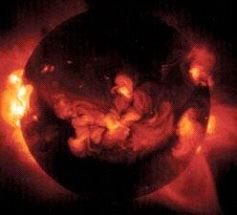
The Sun has been emitting heat for around 5 billion years as a result of the constant chemical reactions taking place on its surface. At a moment determined by Allah in the future, these reactions will eventually come to an end, and the Sun will lose all its energy and finally go out. In that context, the above verse may be a reference to the Sun's energy one day coming to an end. (Allah knows the truth.)
The Arabic word "limustaqarrin" in the verse refers to a particular place or time. The word "tajree" translated as "runs," bears such meanings as "to move, to act swiftly, to move about, to flow." It appears from the meanings of the words that the Sun will continue in its course in time and space, but that this motion will continue until a specific, predetermined time. The verse "When the sun is compacted in blackness," (Surat at-Takwir, 1) which appears in descriptions of Doomsday, tells us that such a time will be coming. The specific timing is known only to Allah.
The Arabic word "taqdeeru," translated as "decree" in the verse, includes such meanings as "to appoint, to determine the destiny of something, to measure." By this expression in verse 38 of Surah Ya Sin, we are told that the lifespan of the Sun is limited to a specific period, one ordained by Allah. Other verses of the Qur'an on the subject read:
Allah is He Who raised up the heavens without any support – you can see that – and then established Himself firmly on the Throne. He made the Sun and Moon subservient, each running for a specified term. He directs the whole affair. He makes the Signs clear so that hopefully you will be certain about the meeting with your Lord. (Surat ar- Ra'd, 2)
He makes night merge into day and day merge into night, and He has made the Sun and Moon subservient, each one running until a specified time. That is Allah, your Lord. The Kingdom is His. Those you call on besides Him have no power over even the smallest speck. (Surah Fatir, 13)
He created the heavens and the earth with truth. He wraps the night around the day and wraps the day around the night, and has made the Sun and Moon subservient, each one running for a specified term. Is He not indeed the Almighty, the Endlessly Forgiving? (Surah az-Zumar, 5)
The use of the word "musamman" in the above verses shows that the life span of the Sun will run for a "specified term." Scientific analysis regarding the end of the Sun describes it as consuming 4 million tons of matter a second, and says that the Sun will die when that fuel has all been consumed.
The heat and light emitted from the Sun is the energy released when matter is consumed as hydrogen nuclei turn into helium in the nuclear fusion process. The Sun's energy, and therefore its life, will thus come to an end once this fuel has been used up. (Allah knows the truth.)
Reference Link
Christianity and the Sun
Christianity emerged out of Judaism and therefore all of the early Jewish Christians (Jews who had accepted Jesus(as) as their Messiah) were monotheistic. However, they lived in the context of other civilisations such as the Romans, Greeks, Egyptians and Persians, all of whom
had strong cultures of their own. As Christians tried to politically distance themselves from the Jews, and also tried to gain acceptance in Europe, their theology sometimes became merged with local culture to the detriment of Christianity.
A key example of this was the interaction of Christianity in the Roman Empire with traditional Roman beliefs. The Romans had been persecuting Christians and despised the Jews whom they had defeated in
Jerusalem around 70 CE. They wanted all races in their empire to pay tribute to the Emperor and the Roman gods and goddesses. Over three centuries, gradually Christians began to associate Jesus(as) with the Roman god Sol Invictus by depicting Jesus(as) as having a solar halo around his head just like Sol Invictus, and by adopting the holy day of their god, December 25th, as the key date for Christianity, erroneously celebrated as the birthday of Jesus(as).
In the early 17th century, Christianity had to debate the place of the sun in the universe with scientists such as Galileo. The Orthodox view of the Church at that time was that man was central and therefore the earth must be at the centre of the universe and the universe must revolve around the earth. Galileo was condemned for his ‘scientific’ beliefs that were seen to be at odds with Orthodox religious beliefs. Modern science has proven the scientific view to be correct.
The long-term impact of Christian use of a Solar calendar is that its festivals are associated more with the seasons when they occur than the events they signify. Also, the legacy of the association with Sol Invictus is that the birthday of Jesus(as) is celebrated on December 25th, which used to be the winter solstice 2000 years ago. It is important to note that Jesus(as) himself would not have recognised some of the innovations that later became part of Christianity, as he was a practising Jew.
Summer Solstice June 21st marks the Summer Solstice, the longest day of the year in the northern hemisphere, after which the days start getting shorter.
At sites such as Stonehenge in the UK, pagans hold an annual celebration in which they chant hymns to the earth and sky, and it would be easy to assume that the site has hosted such druidic practices for thousands of years, but in actual fact, druid worship of midsummer at Stonehenge can only be traced back to 1905.
Islamic View of the Sun
The message of the Qur’an and Islam was revealed to man just over fourteen centuries ago and clearly set a monotheistic context in which celestial bodies had been created and followed the paths set for them by God.
Prayer times are set such that man is in prayer before sunrise, after midday and after sunset rather than having any connotation of praying ‘to’ the sun. The actual period when the sun is rising, is overhead at noon and in setting, are each avoided to remove any semblance of sun worship. Equally, the Islamic calendar is based on the lunar calendar, which is ten days shorter than the Solar calendar. On the face of it, this may seem insignificant, yet the impact of festivals such as ‘Eid and Ramadan being at different times of the year in different periods prevents any association of them with a season, and maintains the focus on the meaning and significance of the festival itself. There is no regular seasonal association with ‘Eid as there is with Christmas in some cultures.
In Islam, the celestial bodies are recognised in the context of the creation of the universe, and therefore the worshipper shifts attention from the visible celestial beings, to the Creative force that put them there and set them on their orbital paths, something that some earlier peoples would have misinterpreted out of ignorance.
Conclusion
The sun has been given an extraordinary position in early human culture, possibly as social leaders used their knowledge of seasons to maintain their own power and status through the ignorance of the masses.
It is Divine religion that has always given man the proper context for his place in the universe and in relation to his Creator. It is religion that confirmed to mankind that all of the powerful features and forces observed on earth, in the sky and as events, all originate from that same Creator and all observe the same laws of nature (science).
Through religion, man no longer relies upon relics and idols or on proxies for
God and more on a direct relationship with their Creator through prayer.
Reference Link