Scientific Data Surah 100 · Ayah 2
The moderating effect of love of money on relationship between socioeconomic status and happinesss
The moderating effect of love of money on relationship between socioeconomic status and happinesss
Abstract
The objective of this research is to determine the moderating effects of Love of Money (LOM) on the relationship between socio-economic status (SES) and happiness. This study explores not only the direct relationship between SES and happiness, but also indirect relationships that may exist through life domain satisfaction, such as through job, income and family satisfaction. Additionally, it further studies the moderating roles of LOM on those indirect or mediated relationships. Purposive sampling method was used to collect data from 433 samples drawn from four different target groups with the mix of level of income and LOM. For analysis of data, the structural equation modeling technique was employed. The findings reveal no direct relationship between SES and happiness, but findings did show an indirect, positive relationship between SES and happiness through job, family and income satisfaction. This suggests a multiple mediated relationship between SES and happiness. LOM has a negative effect on happiness as well as on job satisfaction and income satisfaction. In addition, LOM revealed moderating roles on SES-income satisfaction (strengthening) and job satisfaction-happiness (weakening) relationships. The results suggest that low LOM people have a sense of contentment because they are more satisfied with their income, no matter how much they earn, compared with the satisfaction of high LOM people. Also, high LOM people undermine job satisfaction as a source of happiness, therefore lowering their overall happiness or life satisfaction.
⦁ Introduction
One of the most studied relationships in happiness research is the income–happiness relationship. Based on Needs theory, income predicts happiness or life satisfaction (Diener et al., 1993, Graham, 2005). However, many researchers have found that income is a crucial determinant of happiness up to a certain point, and beyond that point, there is a lower correlation (Graham, 2005, Layard, 2005). Diener and Biswas-Diener (2002) suggest there could be a psychological factor such as desire for material wealth that can influence the relationship between money and happiness. Previous research found that desire for wealth is negatively related to life satisfaction. For example, there is ample evidence showing that materialistic values cause lower life satisfaction (Dittmar et al., 2014, Tang and Chiu, 2003). A similar construct that directly represents the desire for money is Love of Money (LOM). Previous research found that LOM results in lower satisfaction with pay and job as well as unethical behavior in the workplace (Tang and Chiu, 2003, Tang et al., 2004). Therefore, this paper aims to explore the role of LOM in the relationship between socio-economic status (income and education) and happiness of general Thai working people. In order to provide a more holistic view of happiness, three domains of life satisfaction, i.e., job satisfaction, family satisfaction, and income satisfaction were used to mediate the influence of SES on happiness. This research then further studied the moderating effects of the love of money on these mediated relationships (except family satisfaction). In short, this study seeks to determine how the desire for money influences life satisfaction in relation to economic and social status.
A review of relevant literature indicates that there is a lack of research on the relationship between socio-economic status (i.e., income and education) and happiness, particularly in relation to the desire for, or love of money. Therefore, it would benefit the field of knowledge to explore how a person's desire for money affects their happiness given their social and economic status. Moreover, as there is much evidence showing a strong negative association between materialism and happiness, this research would like to confirm that finding using the LOM construct.
⦁ Literature Review
Happiness
In a broad sense, happiness is all things that are positive. It is what is desired by all human beings and is their ultimate goal. People use money as a means to buy things they need, happiness on the other hand is the ultimate end that can be satisfied by itself. A review of happiness research shows that the term happiness is often used interchangeably with life satisfaction and subjective well-being (SWB) as well as with quality of life (Camfield, 2006, Ng, 2015). Specifically, happiness stresses the importance of subjective measurement of well-being. Diener, Emmom, Larsen, and Griffin (1985) proposed three main components of happiness or SWB, i.e., positive affect, negative affect, and life satisfaction. Based on this definition, the first two components involve emotional aspects (or feeling). Affect theory sees happiness as feelings and emotions. This is when a person continuously appraises how they feel, positively and negatively. As there are many things that make one feel happy and what can make one happy may be different for different people, what makes one feel happy is a complicated system. However, it could be said that such feeling is an expression of their gratification of needs. Meanwhile, life satisfaction refers to cognitive-judgmental aspects. In cognitive theory, happiness is the product of human thinking and an evaluation process. This process involves evaluating the difference between one's life as it is and how life should be (Veenhoven, 2010). Lyubomirsky (2001), states that cognitive processes moderate the impact of objective environment on well-being. This shows that human thought has an important impact on human behavior apart from the external environment in which people live. In short, evaluating one's happiness involves a combination of what is felt and how well one thinks one is doing in life. This research, therefore, defines happiness as an appreciation of one's life as a whole (Veenhoven, 1984). This definition involves both cognitive-judgmental and emotional aspects in evaluating one's own life as being satisfactory or not satisfactory. This is considered a common definition which is applied in happiness indices around the world.
SES and Happiness
Socio-economic status (SES) is a widely used construct capturing many dimensions of a person's social position. SES includes prestige, power and economic well-being (Oakes & Rossi, 2003). Income and education are considered to be good indicators, among many, that reflect the social class of a person (Ensminger, Fothergill, Bornstien, & Bradley, 2003). Income represents the economic well-being of a person and their ability to maintain a good living standard. Although studies into the income–happiness relationship have resulted in different findings and explanations, there is general agreement among scholars on the correlation (Diener & Biswas-Diener, 2002). The relationship was found to be stronger at the lowest economic levels or in cross-sectional studies while the strength of the relationship decreased in longitudinal studies. Education, as another indicator of SES, can significantly affect a person's occupation and income level (Krieger, Williams, & Moss, 1997). There are several studies that find a positive effect of education on happiness (Di Tella et al., 2001, Gerdtham and Johannesson, 2001, Hayo and Seifert, 2003). Firstly, higher education offers a better chance to attain a good job and promotions (Blanchflower & Oswald, 1994). Secondly, higher positions usually come with more autonomy, independence, and involvement in decision making as well as with less routine tasks (Albert & Davia, 2005). In addition, education can also benefit one's prestige and social acceptance (Castriota, 2006). Therefore, education can be an important factor in enhancing a person's life satisfaction. For these reasons, the first hypothesis is stated as follows:
⦁ Hypothesis 1
There is a positive association between SES and happiness.
Satisfaction in Life Domains as Multiple Mediators
According to the bottom-up theory, there are several facets of life which act as contributors to overall happiness (Headey, Veenhoven, & Wearing, 1991). To better understand the relationship between SES and happiness, this research further studied how life domains' satisfaction (job, family, and income satisfaction) can help explain the relationship. A number of research studies in several countries found a strong connection between family and happiness. This relationship was especially true for countries with collectivist culture, particularly in Asian countries (Lu & Gilmour, 2004). In Thailand, Senasu (2014) found that among the satisfaction achieved in many life domains, family satisfaction is the only determinant that predicts future happiness of Thai people. From a study by Helliwell and Putnam (2004), people who were highly connected to family, friends and other community members were happier. As family is important to one's happiness, resources such as money can be used to create well-being of a family, encourage family satisfaction, and thus enhance individual happiness.
Relevant literature shows that SES relates positively to job satisfaction in many ways. Generally, pay is considered to be one of the fundamental elements of job satisfaction (Judge, Piccolo, Podsakoff, Shaw, & Rich, 2010). Also, education leads to higher work positions that come with more challenging tasks, autonomy, promotion and recognition; all of which promote job satisfaction (Albert and Davia, 2005, Blanchflower and Oswald, 1994). There is much evidence showing that job satisfaction is one of the main positive indicators for life satisfaction (Judge, Thoresen, Bono, & Patton, 2001).
Income satisfaction can be viewed under the theory of human motivation by Maslow (1954). The theory asserts that there are two basic needs that must be satisfied before other needs. In this research, income is viewed as a means to satisfy these basic needs. Safety and security needs refer to freedom from physical and psychological harm. Satisfying such needs can be achieved through saving money which can be used to ensure that unexpected events can be faced without difficulty.
For these reasons, the second hypothesis is stated as follows:
⦁ Hypothesis 2
Satisfaction in life domains mediates the relationship between SES and happiness.
⦁ Hypothesis 2.1
Job satisfaction mediates the relationship between SES and happiness.
⦁ Hypothesis 2.2
Family satisfaction mediates the relationship between SES and happiness.
⦁ Hypothesis 2.3
Income satisfaction mediates the relationship between SES and happiness.
Love of Money
Love of money (LOM) is defined as the degree to which an individual desires money. Once desire for money builds up, a person can become obsessed with money (Argyle & Furnham, 1998). Tang (2007, p.379) summarized the definitions of LOM as “(1) one's wants, desires, values, and aspirations for money (Easterlin, 2006), (2) one's attitudes toward money (Tang, 1992), (3) one's meaning of money, and (4) not one's needs, but greed (Sloan, 2002), or materialism (Belk, 1985)”. The origin of the term “love of money” can be traced to the Bible, 1 Timothy 6:9–10 (NIV). The verse states “Those who want to get rich fall into temptation and a trap and into many foolish and harmful desires that plunge people into ruin and destruction. For the love of money is the root of all kinds of evil.” Research findings have supported this statement where the LOM results in unethical actions in the workplace (Sardžoska and Tang, 2012, Singhapakdi et al., 2013). Furthermore, previous research has continually found that LOM results in other negative behaviors. For example, high LOM causes employees to have lower pay satisfaction (Tang, 2007), and job satisfaction (Tang, 1992), which then causes withdrawal cognition and turnover. In addition, Tang and Chiu (2003) found LOM as a mediator for lower pay satisfaction, which in turn causes unethical behavior. By following their money motives, employees can simply fail to recognize intrinsic job satisfaction. Moreover, as LOM is related to greed (Sloan, 2002), it can also result in lower psychological well-being.
In this research, the LOM scale is adopted from Tang and Chiu (2003). It consists of four dimensions. The first dimension is “success”, which is a cognitive component to which individuals view money as a sign of success. This is when people keep scoring up the amount of money they have as it defines how well they are doing in their life. The second dimension is “rich” as an affective component. People who love money want to be rich and feel strongly positive about being rich. They believe that by being rich, their life will be better. The third dimension is “motivator”, a behavioral component, where LOM motivates people to work hard for it. The fourth dimension is important as another affective component. This is when individuals see money as their “primary factor” in life.
⦁ Love of Money as Moderators
Previous research found that people who place high importance on material wealth experience lower life satisfaction (Kasser and Ryan, 1993, Richins and Dawson, 1992). Self-Determination Theory (SDT) suggests that by primarily pursuing external wealth, people usually pay less attention to acquiring their psychological needs like autonomy, competence and relatedness. Satisfying these needs is the main factor that enhances happiness in the long-run. Also, their obsession with material wealth causes them to undermine sources of happiness that may already exist. Therefore, their perceived happiness is less than others. As a result, it can be predicted that LOM can not only decrease a person's happiness level as well as satisfaction in life domains, it can also change the pattern of the relationship between SES and happiness.
This research initially assumes that income and education (SES) increase job and income satisfaction. Satisfaction of high LOM groups is likely to be determined heavily by their income (SES level). Therefore, the relationship between SES and job/income satisfaction will be stronger for high LOM people than for low LOM people. For these reasons, the third hypothesis is stated as follows:
⦁ Hypothesis 3
LOM moderates the relationship between SES and satisfaction in life domains.
⦁ Hypothesis 3.1
The influence of SES on job satisfaction is higher for high LOM people than for low LOM people.
⦁ Hypothesis 3.2
The influence of SES status on income satisfaction is higher for high LOM people than for low LOM people.
In the fourth hypothesis, we estimate that high LOM people will be less sensitive to job satisfaction, but more sensitive to income satisfaction in order to be happy. Because their focus is primarily on material wealth, they could fail to recognize their happiness through job satisfaction. On the other hand, as high LOM people place value on money, income satisfaction could be a strong predictor of happiness. The fourth hypothesis is therefore stated as follows:
⦁ Hypothesis 4
LOM moderates relationships between satisfaction in life domains (i.e., job and income satisfaction) and happiness.
⦁ Hypothesis 4.1
The influence of job satisfaction on happiness is lower for high LOM people than for low LOM people
⦁ Hypothesis 4.2
The influence of income satisfaction on happiness is higher for high LOM people than for low LOM people.
The last hypothesis is based on assumptions regarding the moderating role of LOM on the SES-happiness relationship. According to aspiration theory, high aspirations lower life satisfaction. High aspiration implies high LOM. As human beings tend to adapt quickly to increases in material wealth, the happiness gained from such increases tends to disappear quickly. This is particularly true when high aspirations occur in groups which are disadvantaged in terms of finances and education. For groups with lower income and/or education, it would be harder for them to achieve what they aspire to. As a result, LOM causes more dissatisfaction among lower income and/or lower education level groups. The fifth hypothesis is therefore stated as follows:
⦁ Hypothesis 5
LOM moderates (strengthening effect) the SES-happiness relationship.
A brief overview of our conceptual model and proposed research hypotheses are presented in Figure 1. Satisfaction in life domains are proposed as multiple mediators of the SES and happiness relationship. Meanwhile, LOM is studied as a moderator of the mediated relationships.
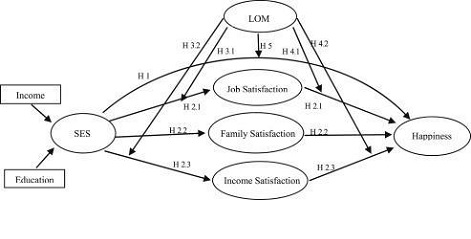
Methodology
Measures
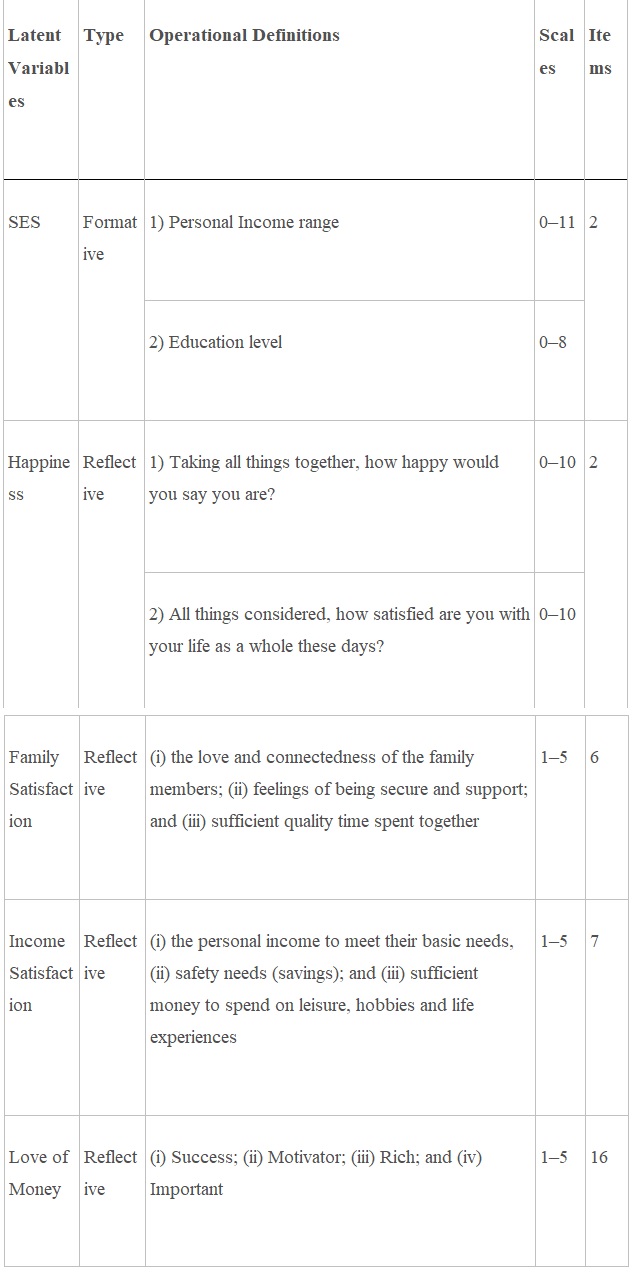
The conceptual model for this research consists of six latent variables including SES, happiness, job satisfaction, income satisfaction, family satisfaction and LOM. Following, are definitions for each of these variables as well as descriptions of measurement scales and items.
Happiness
Happiness is defined as overall appreciation of one's life as a whole (Veenhoven, 1984). In this research, there are two direct questions asking about life satisfaction and happiness. These questions and the methods used to rate them are widely used both by practitioners and academic researchers. The first question from Veenhoven (2012) asks “Taking all things together, how satisfied or dissatisfied are you with your life as a whole these days?” (Veenhoven, 2012, p. 336). The second question, taken from the European Social Survey(ESS) asks “Taking all things together, how happy would you say you are?”. In both questions, the respondents rate themselves on a Likert scale ranging from 0 to 10.
⦁ Satisfaction in Life Domains
Each domain of life satisfaction consists of 4–7 items. Respondents will rate all the items on a 5 point Likert scale ranging from 1 “strongly disagree” to 5 “strongly agree”. The operational definitions of each life-satisfaction domain are as follows:
Family satisfaction is defined as personal satisfaction with (i) the love and connectedness of family members (Gray, Chamratrithirong, Pattaravanich, & Prasartkul, 2013); (ii) feelings of being secure and supported (Gray et al., 2013, Senasu and Singhapakdi, 2018); and (iii) sufficient quality time spent together (Layard, 2005). Examples of items include “You and your family members share love and connectedness”, “You feel secure with your family”, and “You and your family members occasionally spend moments or time together”.
Job satisfaction is defined as personal satisfaction with (i) overall job satisfaction (Hackman & Oldham, 1975); (ii) job characteristics (Hackman & Oldham, 1975); (iii) management of time among work, family and free-time (also called work-life balance) (Senasu & Singhapakdi, 2018). Examples of items include “Generally speaking, I am very satisfied with this job”, “I am generally satisfied with the kind of work I do in this job” and “I am satisfied with the way I manage my time with work and personal life”.
Income satisfaction is defined as personal satisfaction with (i) overall income, (ii) income to meet basic needs and safety needs (Maslow, 1954, Oleson, 2004); and (iii) sufficient money to spend on leisure, hobbies and life experiences (Dunn, Aknin, & Norton, 2008). Examples of items include “How satisfied are you with your income”, “I have sufficient income for daily necessities”, and “Currently, I have enough income for my saving plan”.
⦁ Love of Money
This research adopts the love of money scale by Tang and Chiu (2003) consisting of 4 dimensions; success, motivator, rich and important. Examples of items include ‘‘Money is a symbol of my success’’ for success factor, ‘‘I am highly motivated by money’’ for motivator factor, ‘‘I want to be rich’’ for rich factor, and ‘‘Money is an important factor in the lives of all of us’’ for important factor. Respondents rate all the items on a 5 point–Likert scale ranging from 1 “strongly disagree” to 5 “strongly agree”. This LOM measurement scale includes a total 16 items - 4 items for each dimension.
Each of the latent variables in this model is summarized in Table 1.
Table 1
Data Collection and Data Analysis
This research adopted a purposive sampling method. A total of 433 samples were collected from four different target groups representing a mix of income level and LOM. The first two groups are selected based on high aspirations for money (high LOM) with high and low income. The first group was low-income with high-LOM. Samples were collected from lottery buyers who are street vendors; slum residents; motorbike taxi drivers; and low-income workers. The second group consisted of people with high-income and high-LOM. Samples were collected from business owners, successful entrepreneurs and owners of large corporations. Samples were collected from groups of people who attended high-connection short courses run by well-known institutions in Thailand. In order to gain information from people who were likely to live their life with low aspiration for money (low LOM), this research selected respondents from religious communities. Therefore, the third group consists of respondents from religious communities whose members are known to have high-incomes. The fourth group consists of respondents from other religious communities whose members have low incomes.
The data collected were then analyzed using a 2-step approach of structural equation modeling (SEM) to test both validity of research measurement models and the research hypotheses. The rationale behind the adoption of SEM was that it allows for testing multiple mediators and series of moderating effects all at once and can be conducted using a widely known statistical program, AMOS.
⦁ Results and Discussion
A total of 433 samples were collected with 127 male (29%) and 306 female (71%) samples. The age of respondents ranged from 20 to 60 + years old with the highest proportion in the age range of 31–40 years or 37 percent of the total sample. Education level held by respondents included 127 (29%) with high school or lower, 158 (37%) with diplomas and Bachelor degrees, and 148 (34%) with Master and Doctoral degrees. In terms of personal income, 156 (36%) respondents earned less than 15,000 baht per month, 139 (32%) earned in between 15,001 and 50,000 per month, and 138 (32%) earned above 50,001 baht per month.
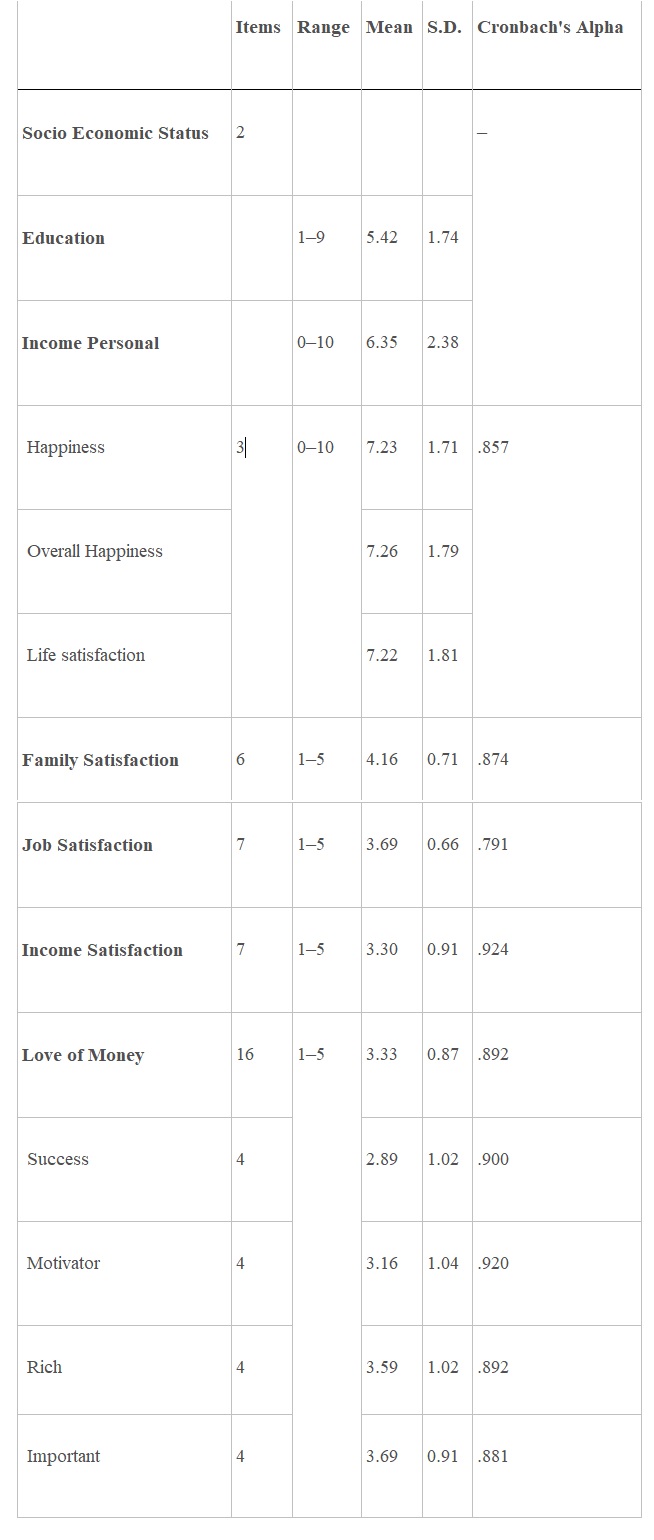
In Table 2, all measurements had a satisfactory level of internal consistency, above 0.7 as recommended by Nunnally (1978). Happiness showed a slight difference in mean between overall happiness (7.26) and life satisfaction (7.22) implying a valid interpretation between these two definitions. The LOM scale indicated that people, on average, perceive money as an important object and think it representative of personal achievements. The CFA produced a good model fit of χ2 (109) = 384.66, GFI = .906, CFI = .932, RMSEA = .077. LOM showed high factor loading with a range of between .77 and .86, with “rich” having the highest and “important” having the lowest loading. This rank of loadings was congruent with a previous study by Singhapakdi et al. (2013) who adopted this construct.
The results of the structural model are presented in Table 3. Although, the results show no direct relationship between SES and happiness, the mediated paths with job, family and income satisfaction were all positive and significant (H2 supported). This suggests that the relationship between SES and happiness were found through multiple mediators. As expected, this research found that LOM was negatively related to all dependent variables (job satisfaction, income satisfaction and happiness), which were a prerequisite in testing the moderation effect of LOM. This study then found two significant interacting effects: 1) SES × LOM on income satisfaction, and 2) job satisfaction × LOM on Happiness. As a result, LOM moderated the relationships between SES and income satisfaction (H3.2 supported), and between job satisfaction and happiness (H4.1 supported).
Table 2
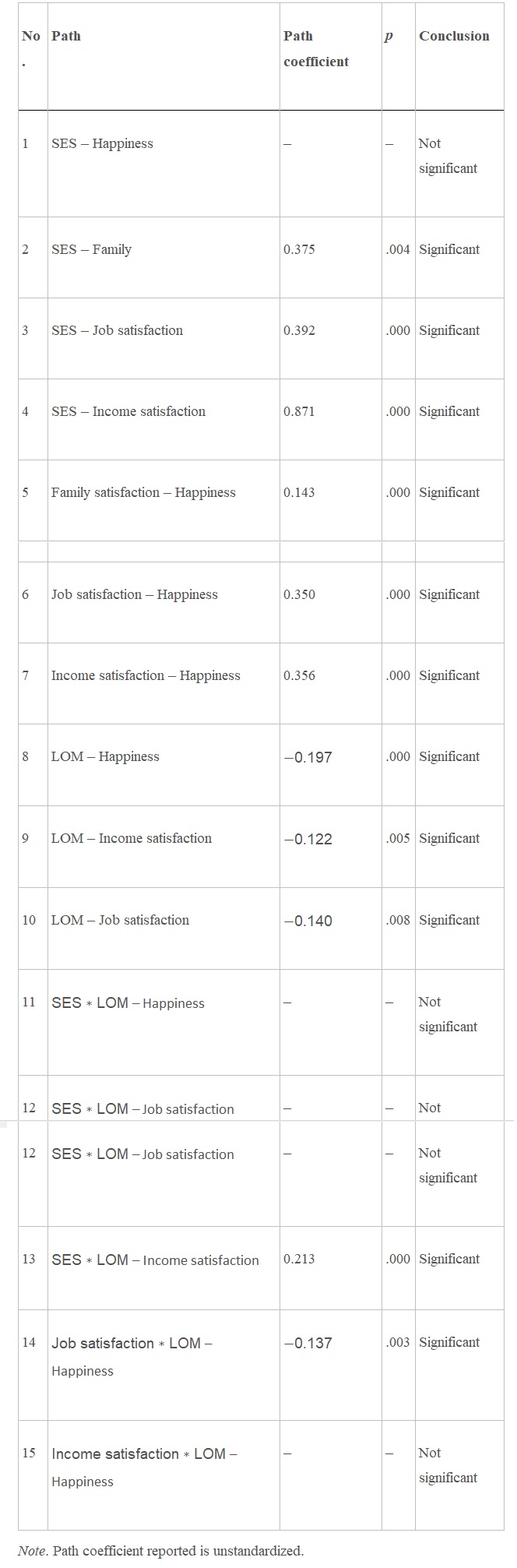
After adjusting the model by deleting the insignificant paths, the model yields a good fit of χ2 (310) = 935.669, cm in/df = 0.3.018, GFI = .859, CFI = .888, RMSEA = .068. The coefficient determinant R-square is .51 indicating that all of the research exogenous variables contribute up to 51 percent to happiness.
Figure 2(A) and 2(B) are the graphical depictions of the two significant interaction effects found in this study. In Figure 2(A), the graph shows that LOM strengthened the relationship between SES and income satisfaction. This result was supported by Tang, Luna-Arocas, Sutarso, and Shin-Hsiung Tang (2004) where LOM strengthened the relationship between income and pay satisfaction with a cross over pattern. Generally, income satisfaction was affected more by income and education level (SES) for the high LOM group. This is not surprising as the income satisfaction of people who value money highly can be determined by their level of income. There are two interesting points to be mentioned regarding these moderation effects of LOM. First, for those with low SES there was a big difference in income satisfaction between high- and low- LOM groups. According to aspiration theory, people who hold strongly to materialistic values experience less satisfaction than those who hold less strongly to materialistic values. Further, the level of satisfaction decreases when they are incapable of achieving materialistic goals (Barbera & Gurhan, 1997). Low SES means people with fewer opportunities in society. Their ability to achieve what they want is much less than people with high SES. As a result, their desire for money (high LOM) combined with less chance of having it causes them to experience a much lower level of satisfaction. The second interesting point to mention is that the low LOM group was less sensitive to SES level. This implies that their satisfaction with income might result from inner abilities, e.g., self-sufficiency or a sense of contentment.
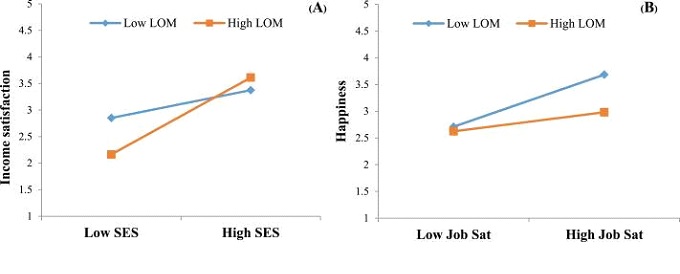
Figure 2(B) shows that LOM weakened the relationship between job satisfaction and happiness. Job satisfaction had only a slight influence on happiness for high LOM group whose overall happiness was less than the low LOM group. In addition, the low LOM group showed higher job satisfaction, which suggests that job satisfaction was an important factor for those who give less intrinsic value to external wealth. The fact that the high- LOM group experienced a much lower level of happiness can be explained with SDT theory. Those who primarily focus on money often undermine job satisfaction as their source of happiness. On the other hand, low LOM people are more intrinsically motivated. Because they enjoy the nature of the work they are doing, they are more likely to develop their competence in performing their work. As a result, their happiness level can increase significantly through job satisfaction.
⦁ Conclusions and Recommendation
This study highlighted LOM not only as a negative factor to happiness, job, and income satisfaction, but also as a moderator in the multiple mediated relationship between SES and happiness. Firstly, LOM strengthened the relationship between SES and income satisfaction. Though it is intuitive to predict high income satisfaction to be driven mostly by higher SES in a high LOM group, the findings suggest that the high LOM group experienced much lower income satisfaction than the low LOM group. In addition, the low LOM group generally maintained a high level of income satisfaction and were less sensitive to income satisfaction given their social status compared to the high LOM group. This research does not undermine the importance of SES on income satisfaction as well as overall happiness. The findings still emphasize the significance of SES as a fundamental factor to happiness; however, the low LOM group had the advantage of maintaining a high level of income satisfaction which in turn led to a higher level of life satisfaction.
Secondly, this research found a weakening effect of LOM on the relationship between job satisfaction and happiness. This finding is supported by SDT theory which proposes that LOM as an extrinsic motivator can undermine important psychological needs such as competence, relatedness and autonomy, which can be fulfilled through job satisfaction.
Given these conclusions, the theoretical and practical implications are discussed in the following section.
Theoretical Implications
To the best of the author's knowledge, this is the first research study that adopts the LOM construct to explain the relationship between SES and happiness. The negative effects of LOM found on job, family, income and overall life satisfaction contributes knowledge regarding another factor that negatively impacts on happiness. In addition, this research provided empirical evidence supporting one of the major components of the sufficiency economy philosophy (SEP) –moderation. To live with moderation means that one needs to be satisfied with what one has. This is congruent with the research findings that low LOM people were generally more satisfied with their income than those with high LOM.
Practical Implications
At a national level, this study provides confirmation of the importance of SES to job satisfaction, income satisfaction and family satisfaction; all of which relate to happiness. SES, therefore, is a matter of social well-being. Economic and social policy makers need to be aware of the social gap that exists and understand that education can bring about an improvement in social well-being, particularly for disadvantaged groups.
Within the context of organizations, organizations should realize that money is not the only, nor the best motivator for employees. Money can sometimes be a hygiene factor and at other times be a motivation factor (Herzberg, 1987). To some, especially those who are satisfied with their job and have intrinsic motivation, their pay level is of less importance to them. In some cases, research has shown that incentives or extrinsic motivation can negatively affect employee's intrinsic motivation (Deci, Koestner, & Ryan, 1999). As a result, organizations should provide other non-monetary rewards to supplement financial payment. It should be noted that even though money is not the primary focus to some, it does not mean that pay is not a motivating factor. As shown in this study, low-LOM people still show a positive relationship between income and income satisfaction, and between income and job satisfaction. In turn, these satisfactions lead to happiness. As this study found that LOM had negative effects on happiness as well as satisfaction in other life domains, organizations should beware of competing for employees by offering the highest pay as this could enhance the perception of loving money and therefore lower job satisfaction. Referring to the SDT, non-tangible rewards or activities that promote self-acceptance would be an alternative approach. For example, organizations may provide job empowerment, career development, challenging tasks and recognition.
Source:Reference Link