Scientific Data Surah 78 · Ayah 11
Sun Exposure: Vitamin D And Other Health Benefits Of Sunlight
Sun Exposure: Vitamin D And Other Health Benefits Of Sunlight
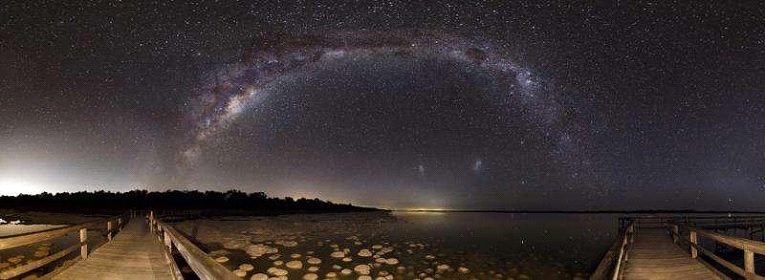
The universe is so big that even light hasn’t had time to cross it in nearly 14 billion years Credit: inefekt69
Our brains struggle to comprehend how big the universe is because everything here on Earth, and even the Earth itself, is very small when compared to the immense scale of the universe.
So let's think about it a different way, using something we see and interact with every day… light.
While we imagine light to be instantaneous, photons of light actually take time to travel from one side of the room to the other.
In the time it took you to read this far, a photon of light leaving the Sun has travelled about 10 million kilometres – equivalent to travelling around the Earth 250 times.
Light that leaves our second nearest star, Proxima Centauri, takes just over four years to reach Earth and so we can define it as four light years away.
As such, if you were to look at Proxima Centauri, you would not be seeing the star as it is right now, but how it 'was' 4 years ago!
We see all things in the universe as they were in the past, whether they're on the other side of the room or the other side of the galaxy.
To take this concept further, the nearest large galaxy to us is Andromeda which is so big and close that you can see it in the night sky with your naked eye.
What you're really seeing is 1,000's of billions of stars in a configuration similar to our Milky Way. However, all of those stars are about 2.5 million light years away, which means you're seeing Andromeda as it was 2.5 million years ago.
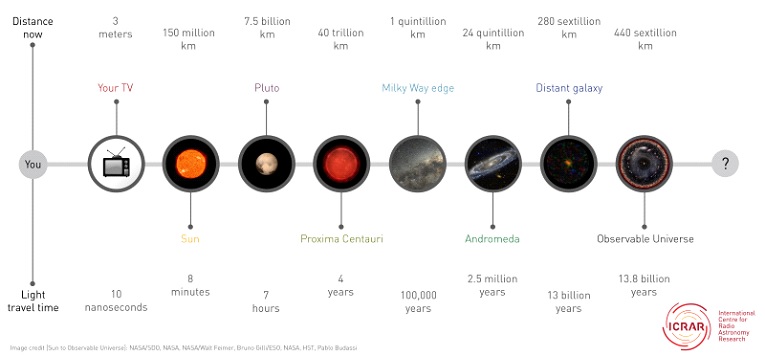
The whole universe is littered with galaxies just like the Milky Way and Andromeda, and using our most powerful telescopes we can see light from galaxies that has taken more than 13 billion years to reach us!
Since a photon of light left one of these galaxies, life sparked into existence and evolved. Dinosaurs ruled the Earth. Humans appeared, developed tools, art, science and technology, built the Hubble Space Telescope, put it into orbit and finally stopped that poor photon on its 13 billion year journey!
The universe is about 13.8 billion years old, so any light we see has to have been travelling for 13.8 billion years or less – we call this the 'observable universe'.
However, the distance to the edge of the observable universe is about 46 billion light years because the universe is expanding all of the time.
Imagine that a photon of light is emitted from a point on the edge of our observable universe.
While that photon has been travelling through space, the universe has expanded. We have moved away from the point where the light was emitted, and it has moved away from us!
Though the light might have only travelled for 13.8 billion years, the distance from us to the point it came from is, at present, 46 billion light years!
So how big is our universe? Well we don't really know, but it's big. So big that even light hasn't had time to cross it in nearly 14 billion years! And it's still getting bigger all of the time.
Reference Link
⦁ How Big is Our Universe?
The universe is a big, big place. But how big? And how do we know?
Throughout history, humans have used a variety of techniques and methods to help them answer the questions 'How far?' and 'How big?' Generations of explorers have looked deeper and deeper into the vast expanse of the universe. And the journey continues today, as new methods are used, and new discoveries are made. (To learn more about distance, visit How Big is Our Universe.)
In the third century B.C., Aristarchus of Samos asked the question 'How far away is the Moon?' He was able to measure the distance by looking at the shadow of the Earth on the Moon during a lunar eclipse.
It was Edmund Halley, famous for predicting the return of the comet that bears his name, who three centuries ago found a way to measure the distance to the Sun and to the planet Venus. He knew that the planet Venus would very rarely, every 121 years, pass directly between the Earth and the Sun. The apparent position of the planet, relative to the disk of the Sun behind it, is shifted depending on where you are on Earth. And how different that shift is depends on the distance from both Venus and the Sun to the Earth. This rare event, the transit of Venus, occurred again quite recently, June 8, 2004.
It was knowing this fundamental distance from the Earth to the Sun that helped us find the true scale of the entire Solar system for the first time
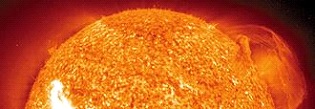
Image to right: Our sun, the nearest star, is 93 million miles away. That's why the sun, which is a million times the size of the Earth, looks so small. It would take the Space Shuttle seven months to fly there. Credit: SOHO - ESA & NASA
When we leave the solar system, we find our star and its planets are just one small part of the Milky Way galaxy. The Milky Way is a huge city of stars, so big that even at the speed of light, it would take 100,000 years to travel across it. All the stars in the night sky, including our Sun, are just some of the residents of this galaxy, along with millions of other stars too faint to be seen.
The further away a star is, the fainter it looks. Astronomers use this as a clue to figure out the distance to stars that are very far away. But how do you know if the star really is far away, or just not very bright to begin with? This problem was solved in 1908 when Henrietta Leavitt discovered a way to tell the 'wattage' of certain stars that changed their pulse rate linked to their wattage. This allowed their distances to be measured all the way across the Milky Way.
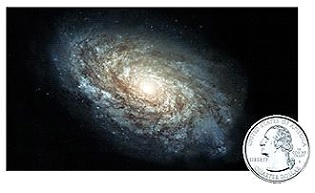
Image above: How Big is the Milky Way? Imagine that our entire Solar System were the size of a quarter. The Sun is now a microscopic speck of dust, as are its nine planets, whose orbits are represented by the flat disc of the coin. How far away is the nearest star to our sun? In our model, Proxima Centauri (and any planets that might be around it) would be another quarter, two soccer fields away. This is the typical separation of stars in our part of the galaxy. Credit: Hubble Heritage Team (AURA/STSCI/NASA); US Mint
Beyond our own galaxy lies a vast expanse of galaxies. The deeper we see into space, the more galaxies we discover. There are billions of galaxies, the most distant of which are so far away that the light arriving from them on Earth today set out from the galaxies billions of years ago. So we see them not as they are today, but as they looked long before there was any life on Earth.
Finding the distance to these very distant galaxies is challenging, but astronomers can do so by watching for incredibly bright exploding stars called supernovae. Some types of exploding stars have a known brightness - wattage - so we can figure out how far they are by measuring how bright they appear to us, and therefore how far away it is to their home galaxy.
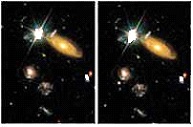
Image to right: The picture on the right was taken three weeks after the one on the left. In that time, a star at the edge of one of these distant galaxies has exploded -- "gone supernova." Can you spot the supernova in the picture at right? Even though the explosion is as bright as a billion suns, it is so far away that it is just a speck of light. Credit: NASA and J. Blakeslee (JHU)
The image below is both the oldest and youngest picture ever taken. It is the oldest because it has taken the light nearly 14 billion years to reach us. And it is the youngest because it is a snapshot of our newborn universe, long before the first stars and galaxies formed. The bright patterns show clumps of simple matter that will eventually form stars and galaxies. This is as far as we can see into the universe. It is time, not space, which limits our view. Beyond a certain distance, light hasn't had time to reach us yet.
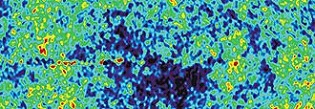
Image above: What is the furthest we can see? In 2003, NASA's WMAP satellite took images of the most distant part of the universe observable from Earth. The image shows the furthest we can see using any form of light. The patterns show clumps of matter that eventually formed into galaxies of stars. Credit: NASA/WMAP Science Team
So how big is the universe? No one knows if the universe is infinitely large, or even if ours is the only universe that exists. And other parts of the universe, very far away, might be quite different from the universe closer to home. Future NASA missions will continue to search for clues to the ultimate size and scale of our cosmic home.
Reference Link