Scientific Data Surah 86 · Ayah 5
By the sky which sends back
By the sky which sends back
The sky above us, acts like a “a well protected roof”. The sky protects our world by sending back the radioactive particles, radiation and harmful ultraviolet rays coming from the space. While it reflects back to space what is harmful for man, it prevents the evaporated water necessary for life on earth from leaving the atmosphere.
If the atmosphere had not been endowed with this capacity, the maintenance of a desired temperature to foster life on earth would be impossible. Life is possible only within a narrow temperature bracket. In extreme low or extreme high temperatures, life cannot be sustained. The atmosphere helps a lot in ensuring that the earth stays within those liveable temperatures and is protected from life harming phenomena.
This verse of Surat at-Tariq in the Qur’an, refers to the “returning” function of the sky.

[I swear] By the Sky, that returns Quran(86:11) In this verse God swears by the sky and its function of ‘returning’ without specifying what it ‘returns.’ In Islamic doctrine, a divine oath signifies the magnitude of importance of a special relation to the Creator, and manifests His majesty and the supreme truth in a special way. The word “rajaai” interpreted as “return” in Qur’an translations has meanings of “sending back” or “returning.”
Seven Layers Of Atmosphere
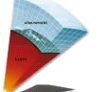
The atmosphere is a word which denotes all the air surrounding the earth, from the ground all the way up to the edge from which space starts. The atmosphere is composed of several layers, each defined because of the various phenomena which occur within the layer.
As is known, the atmosphere surrounding the Earth consists of seven layers. According to the modern geological definitions the seven layers of atmosphere are as follows:
1. Troposphere
2. Stratosphere/ Ozonephere
3. Mesosphere
4. Thermosphere
5. Exosphere
6. Ionosphere
7. Magnetosphere
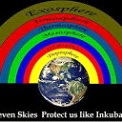
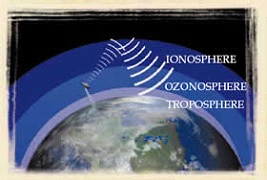
Each layer serves an important purpose for the benefit of life on Earth. Each layer of the atmosphere has beneficial attributes for human beings. Research has revealed that these layers have the function of turning the materials or rays they are exposed to back into space or back down to the Earth. Now let us examine, employing a few fitting examples, this “returning” function of the layers encircling the Earth.
Troposphere
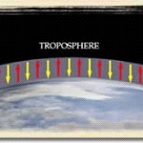
The lowest layer of Earth’s atmosphere, It extends from Earth’s surface up to 7 km (23,000 ft) at the poles, and about 17-18 km (56,000 ft) at the equator. The troposphere is bounded above by the tropopause, a boundary marked by stable temperatures. Although variations do occur, temperature usually declines with increasing altitude in the troposphere.
The troposphere is denser than the layers of the atmosphere above it (because of the weight compressing it), and it contains up to 75% of the mass of the atmosphere. Fifty percent of the total mass of the atmosphere is located in the lower 5.6 km (18,000 ft) of the troposphere. It is primarily composed of nitrogen (78%) and oxygen (21%) with only small concentrations of other trace gases. This layer enables water vapour, so very essential for life on earth, rising from the surface of the earth to be condensed and turned back as rain.
Stratosphere/ Ozonesphere
The second lowest layer of Earth’s atmosphere, it lies above the troposphere and is separated from it by the tropopause. It extends from the top of the troposphere to about 50 km (32 mi; 170,000 ft).
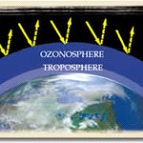
The stratosphere contains the ozone layer, the part of the Earth’s atmosphere which contains relatively high concentrations of ozone The atmosphere layer that blocks the rays that might be fatal to life on Earth is the Ozonosphere. It reflects harmful radiation and ultraviolet light coming from space and turns both back into space. hence preventing them from reaching the Earth and harming life.
The stratosphere defines a layer in which temperatures rises with increasing altitude. This rise in temperature is caused by the absorption of ultraviolet (UV) radiation from the Sun by the ozone layer. Such a temperature profile creates very stable atmospheric conditions, and the stratosphere lacks the air turbulence that is so prevalent in the troposphere. Consequently, the stratosphere is almost completely free of clouds or other forms of weather.
Mesosphere
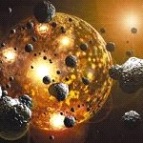
The mesosphere is the layer in which many meteors burn up while entering the Earth’s atmosphere. Imagine a baseball zipping along at 30,000 miles per hour. That’s how big and fast many meteors are. When they plow through the atmosphere, meteors are heated to more than 3000 degrees Fahrenheit, and they glow. A meteor compresses air in front of it. The air heats up, in turn heating the meteor. The falling stars we see at night are not stars at all; they are actually meteoroids burning up in our atmosphere due to the extreme heating they undergo.

Thermosphere
The thermosphere (literally “heat sphere”) is the outer layer of the atmosphere, separated from the mesosphere by the mesopause. It extends from the top of the mesosphere to over 640 km (400 mi; 2,100,000 ft). Within the thermosphere temperatures rise continually to well beyond 1000 degrees C. The few molecules that are present in the thermosphere receive extraordinary amounts of energy from the Sun, causing the layer to warm to such high temperatures. Although the measured temperature is very hot, the thermosphere would actually feel very cold to us because the total energy of only a few air molecules residing there would not be enough to transfer any appreciable heat to our skin.
Ionosphere
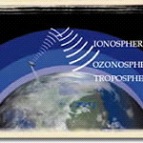
The lower part of the thermosphere, from 80 to 550 km above the Earth’s surface, contains the ionosphere. Beyond the ionosphere extending out to perhaps 10,000 km is the exosphere or outer thermosphere, which gradually merges into space. Temperature increases with height. Although the temperature can rise to 1,500 degrees C (2,730 degrees F), a person would not feel warm because of the extremely low pressure. This layer reflects radio waves broadcast from a certain centre back down to the Earth, just like a passive communications satellite. Thus, it makes wireless communication, radio, and television broadcasting possible over long distances.
Exosphere
This is the upper limit of our atmosphere. The atmosphere here merges into space in the extremely thin air. Air atoms and molecules are constantly escaping to space from the exosphere. In this region of the atmosphere, hydrogen and helium are the prime components and are only present at extremely low densities. This is the area where many satellites orbit the Earth. The International Space Station orbits in this layer, between 320 and 380 km (200 and 240 mi). The exosphere contains free-moving particles that may migrate into and out of the magnetosphere or the solar wind.
Magnetosphere
The magnetosphere layer turns the harmful radioactive particles emitted by the Sun and other stars back into space before they reach Earth is surrounded by a magnetic force field – a bubble in space called “the magnetosphere” tens of thousands of miles wide. The magnetosphere acts as a shield that protects us from solar storms. However, according to new observations from NASA’s IMAGE spacecraft and the joint NASA/European Space Agency Cluster satellites, immense cracks sometimes develop in Earth’s magnetosphere and remain open for hours. This allows the solar wind to gush through and power stormy space weather. Fortunately, these cracks do not expose Earth’s surface to the solar wind. Our atmosphere protects us, even when our magnetic field does not.
The Arabic word “raj” means “to return, to turn.” Rain is a prerequisite for the perpetuation of life on earth. The water that the sun’s rays cause to evaporate does not disappear into space. Rain and water also returned to earth at the time of the Prophet, but scientific knowledge to explain the process was lacking. Once the layers of the atmosphere came to be differentiated, it was understood that the Troposphere, which is one of these layers, prevented the escape of vapor into space and contributed to the perpetuation of life on earth. This layer sends the condensed vapor back to earth in the form of precipitation.
Most of the phenomena that we have studied during our examination of the verse and in which the sky was likened to “a well protected roof” occur thanks to the sky’s return of certain things. The sky protects our world by sending back the radioactive particles, radiation and harmful ultraviolet rays coming from the space. While it reflects back to space what is harmful for man, it prevents the evaporated water necessary for life on earth from leaving the atmosphere.
If the atmosphere had not been endowed with this capacity, the maintenance of a desired temperature to foster life on earth would be impossible. Life is possible only within a narrow temperature bracket. In the spectrum of heat ranging from the temperature in the sun to absolute zero, life thrives only in a span of less than 1%. Once attained, maintenance of this 1% span is difficult. A sudden fall and rise in temperatures would also be deadly. For instance, when we feel comfortable, say at an ambient temperature of 20 degrees Celsius, if we witness a sudden increase of temperature, rising as high as 100 degrees Celsius or if there is a sudden fall to -100 degrees Celsius, destruction would be imminent. The atmosphere’s returning power maintains stability.
The composition of the atmosphere is as follows: 78% nitrogen, 21% oxygen and 1% carbon dioxide plus other gases. These rates are ideal for life on earth. If, for instance, the proportion of oxygen rose from 21% up to 22%, the chance of lightning likely to start a forest fire would increase by 70%. Had the oxygen and nitrogen rates in the atmosphere been in excess of what they actually are, vital functions gaining momentum would be to the detriment of life. Had these been inferior, these vital functions would sensibly slow down again, causing great damage to living beings. The steady maintenance of these rates has been possible by a series of phenomena of which the atmosphere’s property of reflection is but one; but the lack of this one characteristic would be fatal. Who would claim that this perfect umbrella immune to all adverse circumstances was a fortuitous event? Who would assert that our being protected and well guarded is the result of happy coincidences that duly perform their duties in keeping for us the water and the air vital for our survival?
Reference Link
ATMOSPHERIC COMPOSITION, TEMPERATURE & FUNCTION
The earth’s atmosphere is a reservoir of gases. Air is a mixture of gases that is naturally odorless, colorless, tasteless and formless. The atmosphere is bound to the Earth by gravity.
Protective functions of the Atmosphere
a) Air is the medium of life on Earth’s surface
b)
A major industrial and chemical raw material
c) Absorbs and interacts with harmful electromagnetic radiation and stream of charged particles in the solar wind.
d) Protects the earth from natural and human-caused space debris.
The Atmosphere and Air Pressure
The 300 miles (480 km) long column of air (making up the atmosphere) exerts its weight pressing downward under the force of gravity.
The weight of the atmosphere exerted on a surface produces AIR PRESSURE. This force (air pressure) is approximately 14.7 lb per square inch at sea level, equivalent to 1013.12 mb/m2 or 29.92 inches of mercury (in a barometer).
Air molecules create pressure on all surfaces through their motion, size and number.
STRUCTURE AND COMPOSITION OF THE ATMOSPHERE
The atmosphere is conveniently classified using 3 criteria:
a) Composition
b) Temperature
c) Function.
CHEMICAL COMPOSITION CRITERION:
Based on chemical composition, the atmosphere is divided into 2 broad regions:
a) The Heterosphere and…
b) The Homosphere.
HETEROSPHERE:
The outer atmosphere beginning from about 50 miles from the earth’s surface and extending to space Gases are not evenly mixed but assorted by gravity according to their atomic weight and reaction of the gases with solar radiation. Less than 0.001% of the mass of the earth’s atmosphere is in the heterosphere.
HOMOSPHERE:
Extends from earth’s surface to about 50 miles (80 kms). Density of air changes with altitude but the proportion of gases is nearly uniform. Exceptions are: Ozone O3, Water vapor, Pollutants & Some trace chemicals.
Mixture of gases in the Homosphere:
Symbol % by Volume Parts per Million
N2 78.084 780,840
O2 20.946 209,460
Ar 0.934 9,340
CO2 0.037 368
Nitrogen
An inert gas principally originating from volcanic sources. Oxygen: a by-product of photosynthesis. Argon, an inert gas that is a residue from the radioactive decay of a form of potassium. Carbon dioxide is a natural by-product of life processes.
ATMOSPHERIC TEMPERATURE criterion
Using temperature, the atmosphere can be divided into 4 distinct zones.
a) The Thermosphere
b) Mesosphere
c) Stratosphere and…
d) Troposphere
Thermosphere:
Between 50–300miles (80 – 480kms into outer space. Temperature rises to 22000F (12000C) and higher.
Mesosphere:
From 30–50 miles (50–80kms) above the earth’s surface.
The Mesopause (outer layer of Mesosphere) is the coldest region in the atmosphere about –1300F (-900C)
Stratosphere:
11–31 miles (18–50kms) from the Earth’s surface. Temperature increases with altitude
Troposphere:
The atmospheric layer that supports life. Home of the biosphere. Holds 90% of total mass of atmosphere and all water vapor, clouds, weather and air pollution.
Normal Lapse Rate: the phenomena by which temperature decreases rapidly with altitude. Temperature Inversion: a phenomenon by which temperature increases with altitude.
ATMOSPHERIC FUNCTION criterion
Based on function, the atmosphere has 2 zones that remove harmful solar radiation and charged particles:
a) The Ionosphere and…
b) The ozonosphere (ozone layer).
Ionosphere: extends throughout the thermosphere into the mesosphere. I absorbs Cosmic rays, gamma rays, X-rays and Ultraviolet radiation.
Ozonosphere: a layer of ozone gas (O3). Absorbs UV light and re-radiates it as long wave infrared radiation.
Reference Link
"By Heaven with its cyclical systems."(The Qur'an, 86:11)
This word interpreted as "cyclical" in Qur'an translations also has meanings of "sending back" or "returning".
As known, the atmosphere surrounding the Earth consists of many layers. Each layer serves an important purpose for the benefit of life. Research has revealed that these layers have the function of turning the materials or rays they are exposed to back into space or back down to the Earth. Now let us examine with a few examples of this "recycling" function of the layers encircling the Earth.
The troposphere, 13 to 15 kilometers above the Earth, enables water vapor rising from the surface of the Earth to be condensed and turn back as rain.
The ozone layer, at an altitude of 25 kilometers, reflects harmful radiation and ultraviolet light coming from space and turns both back into space.
The ionosphere, reflects radio waves broadcast from the Earth back down to different parts of the world, just like a passive communications satellite, and thus makes wireless communication, radio, and television broadcasting possible over long distances.
The magnetosphere layer turns the harmful radioactive particles emitted by the Sun and other stars back into space before they reach the Earth.
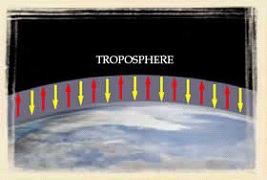
The presence of water is essential for life on Earth. One of the factors acting in the formation of water is the Troposphere, one of the layers of the atmosphere. The troposphere layer enables water vapour rising from the surface of the Earth to be condensed and turn back down to the Earth as rain.
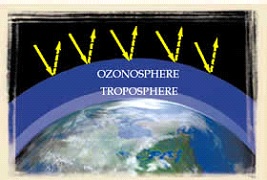
The atmosphere layer that blocks the rays that might be fatal to life on Earth is the Ozonosphere. The Ozonosphere turns harmful cosmic rays like ultraviolet back to space, hence preventing them from reaching the Earth and harming life.
In the above verse there are also factual implications that the public during the Prophet’s time did not know. As faults had not yet been discovered, the verse was believed to refer to the opening of the earth for the sprouting of vegetation.
In the post-Second World War years, scientists intensified submarine research activity with a view to having access to precious metals and minerals. During this research work, they came across something quite unexpected; the bottom of the seas were covered with fissures that came to be called “faults” or “cracks.” If we draw an analogy between the period that has elapsed since the Second World War until today with the period that has elapsed from the time of the descent of the Quran 1400 years ago, when there was reference to this information in the Quran, we can better appreciate the value of this reference.
-
EVERYTHING IS INTERCONNECTED
The Quran draws our attention to the sky, then to the earth, displaying the hidden mysteries and inciting us to inquire into them. As is the case with the sky, so it is with the depths of the earth-endless mysteries waiting to be unraveled. The “fractured earth” referred to in the verse is of towering importance from the point of view of establishing a connection between the magma under the ground and the surface. These cracks also play a decisive role in the formation of the submarine topography.
Information about the faults is also important as it provides us with detailed knowledge about earthquakes. Big earthquakes occur along the fault lines on the crust. Differentiated movements in the huge masses of substrata form a strain along the fault line. The rocks on each side of the cracks try to resist it before the crust gives way.
In any single earthquake, the amount of slip, in other words the relative displacement of the two fault surfaces, may be a few inches, it is only a couple of meters in the strongest earthquakes. Studies have been carried out on faults to map out the regions likely to suffer greater damages, the requirements for the construction of edifices to resist the tremor.
The greatest fault upon the earth is the one that stretches from Greenland’s offshore to Antarctica. The second largest one stretches along the Pacific Ocean along the Western shore of North and South America. The third important fault lies in the depths of the Asian continent under the Himalayas and follows the South Asian direction. Along with these greater ones there are shorter ones as well.
The Quran directs our attention to places where earthquakes can be expected to take place. If we give up our custom of reciting the Quran merely for the souls of those who have departed, and take it as a guide for our life, we can reach the truth hidden in it.
-