Scientific Data Surah 87 · Ayah 4
ABOUT 60 PERCENT of the world's pasture land
ABOUT 60 PERCENT of the world's pasture land
ABOUT 60 PERCENT of the world's pasture land (about 2.2 million km2), just less than half the world's usable surface is covered by grazing systems. Distributed between arid, semi arid and sub humid, humid, temperate and tropical highlands zones, this supports about 360 million cattle (half of which are in the humid savannas), and over 600 million sheep and goats, mostly in the arid rangelands.
Grazing systems supply about 9 percent of the world's production of beef and about 30 percent of the world's production of sheep and goat meat. For an estimated 100 million people in arid areas, and probably a similar number in other zones, grazing livestock is the only possible source of livelihood.
Environmental challenges
Grazing can be visualized as beautiful cows in lush pastures in nature. Indeed, livestock can improve soil and vegetation cover and plant and animal biodiversity, By removing biomass, which otherwise might provide the fuel for bush fires, by controlling shrub growth and by dispersing seeds through their hoofs and manure, grazing animals can improve plant species composition. In addition, trampling can stimulate grass tillering, improve seed germination and break-up hard soil crusts.
Grasslands in the wider sense are among the largest ecosystems in the world their area is estimated at 52.5 million square kilometres, or 40.5 percent of the terrestrial area excluding Greenland and Antarctica (World Resources Institute, 2000, based on IGBP data). In contrast, 13.8 percent of the global land area (excluding Greenland and Antarctica) is woody savannah and savannah; 12.7 percent is open and closed shrub; 8.3 percent is non-woody grassland; and 5.7 percent is tundra.
In its narrow sense, “grassland ” may be defined as ground covered by vegetation dominated by grasses, with little or no tree cover; UNESCO defines grassland as “land covered with herbaceous plants with less than 10 percent tree and shrub cover” and wooded grassland as 10-40 percent tree and shrub cover (White, 1983). In this study, grassland is used in its wider sense of “grazing land ”. The Oxford Dictionary of Plant Sciences (Allaby, 1998) gives a succinct definition:
“Grassland occurs where there is sufficient moisture for grass growth, but where environmental conditions, both climatic and anthropogenic, prevent tree growth. Its occurrence, therefore, correlates with a rainfall intensity between that of desert and forest and is extended by grazing and/or fire to form a plagioclimax in many areas that were previously forested.”
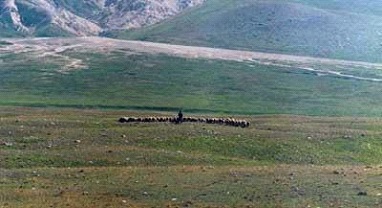 Grasslands - sheep on spring grazing.
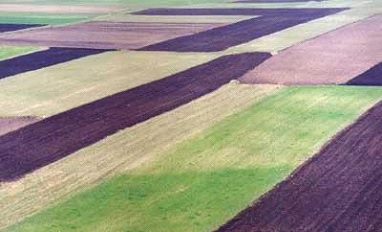 Mosaic of cultivated cropland and grassland.
No grassland is entirely natural, and there are many degrees of interference: fire, whether spontaneous or lit by man, has influenced, and continues to influence, large areas; and grazing by livestock and, in some continents, by large herds of wild herbivores. More invasive interventions have been clearing of woody vegetation either to give better grazing or originally for cropping; subdivision with or without fencing; provision of water points to extend the grazing area or season; and various “improvement” techniques such as over-sowing with pasture grass and legume seeds - with or without surface scarification and fertilizer.
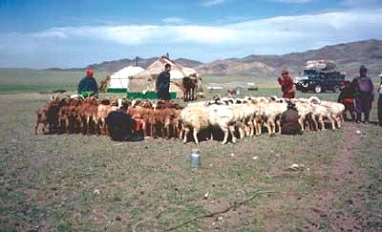 Milking at a transit camp on the way to summer pastures
 The terms “nomadism” and “transhumance ” are sometimes used indiscriminately when applied to mobile livestock production systems. Transhumance describes those pastoral systems where people with their animals moved between two distinct seasonal pasture areas, usually at considerable distance or altitude from each other (Plate 1.3). Nomadism is used for pastoral groups that have no fixed base, but follow erratic rain storms.
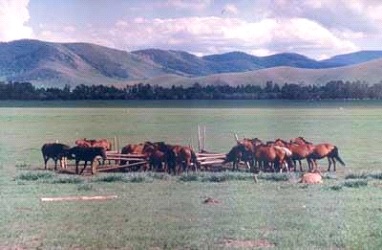 Horse herd on grasslands
 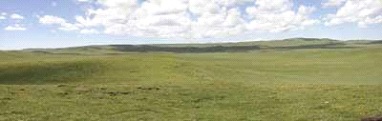 Grasslands on the Qinghai Plateau
Extensive grazing is usually the exploitation of managed natural ecosystems on which human activities may have had a considerable impact to facilitate or improve livestock production; it is a land use, not a specific crop, and must, for example, compete with crops, wildlife, forestry and recreation. The choice of use is not fixed and depends on economic factors as well as soil and climate. It is usually on land unsuitable for intensive cultivation because of topography, poor soil or a short growing season - the season may be limited by moisture availability or temperature. Exploitation by the grazing animal is, in many countries, the principal practical method of exploiting the natural vegetation of arid, stony, flooded, montane or remote areas. It follows, therefore, that all discussion of grassland must be in the context of animal production and of the human communities that gain their livelihood thereby.
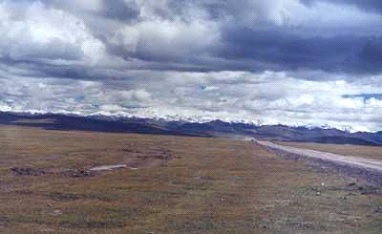 The high plateau near Lake Namtso, Tibet Autonomous Region, China.
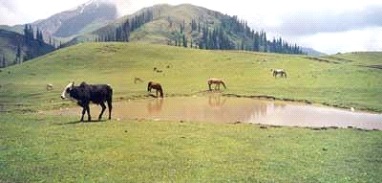 Subalpine pastures
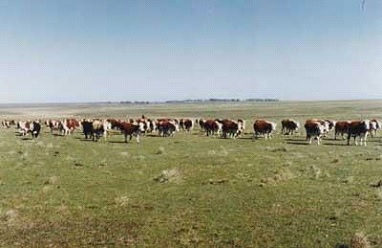 The Campos - winter scene on the Basaltic Campos in the north of Uruguay.
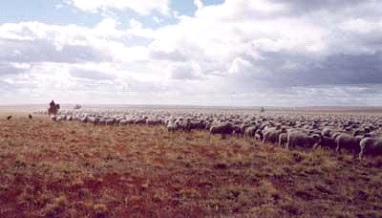 sheep being herded on the Magellan steppe
Sown pasture is important within commercial arable farming systems, and, since it competes with other crops for land and inputs, must be economically viable compared with other crops at the farm -system level. In well -watered areas it may replace natural grassland, often in association with crop production. Sown pastures are usually most productive in their early years and yields fall off thereafter; to remain productive they require careful management and inputs, with or without periodic resowing; they usually also need fencing and water reticulation. Since grazing requires fairly large, enclosed areas to be managed effectively, sown pasture is not really suited to smallholder farms.
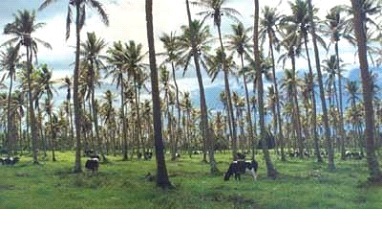 Cattle grazing under coconuts.
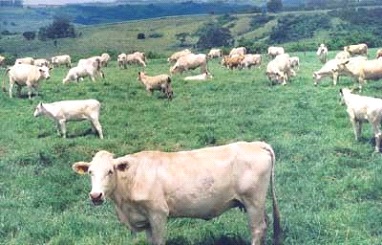 Improved pastures
 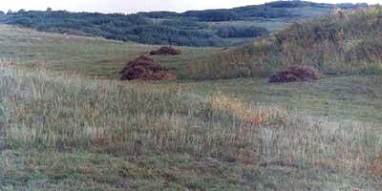 meadow hay prepared by herders for winter feeding.
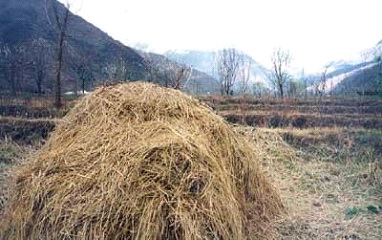 Straw stacked for use as winter feed
Crop residues, especially straws and stovers are very important as livestock feed in both commercial and traditional systems; in commercial farming they are usually part of the roughage ration and supplemented with other fodders and concentrates; in traditional subsistence systems they may be the main feed when grazing is not available. In the irrigated lands, crop residues are often the main feed of large ruminants year-round. Residues are not discussed in detail in most of the studies, but their conservation and use is described in a recent FAO Grassland Group publication (Suttie, 2000). In some extensive grazing systems with adjacent cropping zones, crop residues may also figure as lean-season feed. Lean seasons vary: in some areas it is winter; in tropical areas it is the dry season; and in Mediterranean zones it is the hot, dry summer. It is, of course, much more important in agricultural and mixed farming areas. Crop residues and stubbles are important in West Africa n transhumance systems and there is a complementarity between cropping and stock rearing communities: herders move north into the desert fringe during the rains (and the season when the crops are on the ground) and move back to the agricultural areas after harvest, in the dry season; traditionally the farmers did not keep livestock.
Some studies reported here, notably those on the Campos, North America and Australia, describe how exotic pasture plants have been introduced to grassland, often with fertilizer application and varying degrees of scarification of the surface and checks to the native vegetation, and have become naturalized. With an increasing interest in maintaining biodiversity and protecting native vegetation, attitudes to introduced “improving” plants may be changing. A primary quality of an improving plant is its ability to spread and colonize natural vegetation; now such qualities may cause a plant to be listed as an invasive alien.
Grazing systems can be roughly divided into two main types - commercial and traditional, with the traditional type often mainly aimed at subsistence.
Commercial grazing of natural pasture is very often large-scale and commonly involves a single species, usually beef cattle or sheep, which would mainly be for wool production. Some of the largest areas of extensive commercial grazing developed in the nineteenth century on land which had not previously been heavily grazed by ruminants; these grazing industries were mainly developed by immigrant communities in the Americas and Australasia, and to a much less degree in southern and eastern Africa.
Traditional livestock production systems are very varied according to climate and the overall farming systems of the area. They also use a wider range of livestock, since buffaloes, asses, goats, yak and camels are predominantly raised in the traditional sector. All species are discussed in the various chapters, but buffalo, of which there are 170 million worldwide (FAOSTAT, 2004), are little mentioned since most are kept in agricultural or agropastoral systems in tropical and sub-tropical Asia (only Egypt and Brazil have significant numbers elsewhere), and are fed largely on crop residues, not on grasslands. In traditional farming systems livestock are often mainly kept for subsistence and savings, and are frequently multi-purpose, providing meat, milk, draught, fibres and frequently fuel in the form of dung-cakes. In many cultures the number of livestock is associated with social standing.
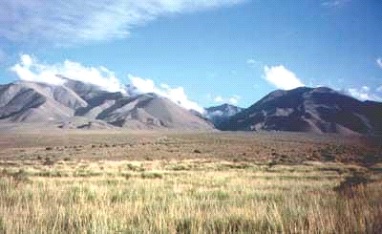 the higher altitude summer pastures of Turgen are used to avoid the insects in the lower Uvs lake basin.
 Many traditional systems are sedentary, and these are usually agropastoral, combining crop production with livestock that can utilize crop residues and by-products and make use of land unsuitable for crops. Extensive grassland s, however, are frequently exploited by mobile systems, transhumant or nomadic, where herds move between grazing areas according to season; some move according to temperature, others follow feed availability. Other factors may affect migratory movements: in the Great Lakes Basins region of Mongolia, herders have to leave the low grazing lands near Uvs lake and go to the mountains in June because of plagues of biting insects (Plate 1.14), returning to the lakeside in autumn, but having to move to the mountains in winter to avoid the very low temperatures of the basin (Erdenebaatar, 2003). Two areas of mobile herding are described in the chapters on Mongolia and the Tibet Plateau. Mobile herders often keep mixed flocks, as this helps reduce herding risk as well as making a fuller use of the vegetation on offer - the various species may be herded separately.
Political and economic changes over the past 150 years have had a marked effect on the distribution, condition and use of grasslands and these are described in most of the chapters. Settlement, ranching and the inroads of cropping into former grassland have been mentioned above. Former colonies have gained their independence and states that had been under absolute rulers have become democracies; this has often led to the breakdown of traditional authorities and grazing rights, raising the problems of privately owned livestock on public land. The great grazing lands of Central Asia, China and the Russian Federation have gone from feudal systems to collective management and then, in the past twenty years, to decollectivization and privately owned stock - approaches to management and grazing rights have varied from country to country and some are described in the chapters on the Russian Federation, Mongolia and Tibet Autonomous Region, China.
The herbaceous layer of grazing lands is usually, but not always, grasses; several other plant types cover large grazed areas. Cyperaceae, especially Kobresia spp., dominate many of the better-watered, hard-grazed yak pastures, especially those of the alpine meadow type. Halophytes, notably Chenopodiaceae, both herbaceous and shrubby, are important on alkaline and saline soils in many arid and semi -arid grazing lands. In tundra, lichens, especially Cladonia rangifer, and mosses provide reindeer feed. Sub-shrubs are important: various species of Artemisia are important in steppic regions of the old world from North Africa to the northern limit of the steppe, and also occur in North America. Ericaceous sub-shrubs (species of Calluna, Erica andVaccinium) are very important grazing for sheep and deer on UK moorland.
Browse is frequently mentioned as a significant feed source, often consumed in the lean season and in some cases fruits are also eaten. Tree fodder is especially important in tropical and sub-tropical situations with alternating wet and dry season s and is discussed in the chapters on Africa and Australia (where it may be referred to as “top feed”). Various mixed shrub formations (garrigue, maquis) are grazed in the Mediterranean zone. Trees and shrubs, notably Salix spp., are also winter feed in some cold areas.
Extensive grassland s have multiple uses in addition to being a very important source of livestock feed and of livelihoods for stock raisers and herders. Most grasslands are important catchment areas and the management of their vegetation is of primordial importance for the water resources of downstream lands; mismanagement of the grazing not only damages the pasture, but, since it increases erosion and run-off, can cause serious damage to agricultural land and infrastructure lower in the catchment and cause siltation of irrigation systems and reservoirs. The main benefits of good catchment management mainly accrue to communities outside the grasslands, but the maintenance efforts have to be made by herders or ranchers. These grasslands are major reserves of biodiversity, providing important wildlife habitat and in situ conservation of genetic resources. In some regions, grasslands are important for tourism and leisure, and may have sites of religious significance (Plate 1.15); in other areas, wild foods, medicines and other useful products are collected (Plate 1.16).
Grasslands are a very large carbon sink at world level. Minahi et al. (1993) state that they are almost as important as forests in the recycling of greenhouse gasses and that soil organic matter under grassland is of the same magnitude as in tree biomass; the carbon storage capacity under grassland can be increased by avoiding tillage.
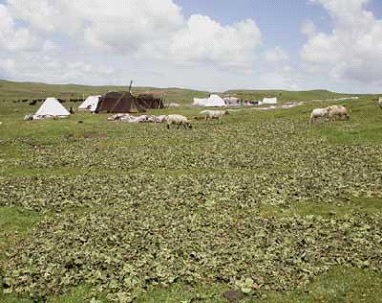 Drying herbs at the summer