Scientific Data Surah 89 · Ayah 2
what kind of punishment people of aad went through
what kind of punishment people of aad went through
These articles can give us a gist of what kind of punishment people of aad went through(drought, violent winds, yellowing of trees and plants etc), and we can understand by the given facts how severe the punishment was.
Drought facts
Drought is generally defined as an extended period - a season, a year, or several years - of deficient precipitation compared to the statistical multi-year average for a region that results in water shortage for some activity, group, or environmental sector (NDMC, 2008).
However, dozens of more specific drought definitions are used around the world according to the lack of rain over various time periods, or measured impacts such as reservoir levels or crop losses. (UNISDR)
Drought can be defined according to meteorological, agricultural, hydrological, and socio-economic criteria. Meteorological, when precipitation departs from the long-term normal; Agricultural, when there is insufficient soil moisture to meet the needs of a particular crop at a particular time. Agricultural drought is typically evident after meteorological drought but before a hydrological drought; Hydrological, when deficiencies occur in surface and subsurface water supplies; Socio-economic, when human activities are affected by reduced precipitation and related water availability.
⦁ Droughts are the primary cause of most ill health and death because they deny access to adequate water supplies and often trigger or exacerbate malnutrition and famine.
⦁ Droughts’ duration and their intensity have generally increased. While regional droughts have occurred in the past, the widespread spatial extent of current droughts is broadly consistent with expected changes in the hydrologic cycle under warming.
DIRECT IMPACTS
⦁ Reduced crop, rangeland, and forest productivity
⦁ Reduced water levels
⦁ Increased fire hazard
⦁ Damage to wildlife and fish habitat
⦁ Increased livestock and wildlife mortality rates
⦁ Increased insect infestations
INDIRECT IMPACTS
⦁ Reduced income for farmers and agribusiness
⦁ Risk of foreclosures on bank loans to farmers and businesses, who may their assets
⦁ Increased prices for food and timber
⦁ Increased unemployment
⦁ Reduced tax revenues
⦁ Increased crime and insecurity
Changes of extreme drought and flood events in Iran
Highlights
•A set of statistical analyses are used to assess changes in extreme flood and drought events in Iran.
•Monotonic changes are detected in drought severity and flood magnitude in different local, regional, and national scales.
•Increase in extreme events can be attributed to climate change, land-use changes, and inappropriate management policies.
Abstract
⦁ Located in an arid and ⦁ semi-arid region of the world, ⦁ Iran has experienced many extreme flood and drought events in the last and current century.
⦁ The present study aims to assess the changes in Iran's flood magnitude and drought severity for 1950–2010, with some time span variation in some stations.
⦁ The increase in flood magnitude and drought severity can be attributed partly to ⦁ land use changes, an annual rainfall negative trend, a maximum rainfall increasing trend, and inappropriate water resources management policies.
⦁ The paper indicates a critica l situation related to ⦁ extreme climate change in Iran and the increased risk of environmental changes in the 21st century.
Reduced Carbon Dioxide Sink and Methane Source under Extreme Drought Condition in an Alpine Peatland
Abstract:
⦁ Potential changes in both the intensity and frequency of extreme drought events are vital aspects of regional climate change that can alter the distribution and dynamics of water availability and subsequently affect carbon cycles at the ecosystem level.
⦁ The effects of extreme drought events on the carbon budget of peatland in the Zoige plateau and its response mechanisms were studied using an in-field controlled experimental method.
⦁ The results indicated that the peatland ecosystem of the Zoige plateau functioned as a carbon sink while under the control (CK) or extreme drought (D) treatment throughout the entire growing season. Maximum fluxes of methane (CH4) emissions and the weakest carbon sink activity from this ecosystem were in the early growth stage, the most powerful carbon sink activity was during the peak growth stage, while the absorption sink activity of carbon dioxide (CO2) and CH4 was present during the senescence stage.
⦁ Extreme drought reduced the gross primary productivity (GPP) and ecosystem respiration (Re) of the peatland ecosystem by 14.5% and 12.6%, respectively (p< 0.05) and the net ability to store carbon was reduced by 11.3%. Overall, the GPP was highly sensitive to extreme drought. Moreover, extreme drought significantly reduced the CH4 fluxes of the ecosystem and even changed the peatland from a CH4 emission source to a CH4 sink. Subsequent to drought treatment, extreme drought was also shown to have a carry-over effect on the carbon budget of this ecosystem. Soil water content and soil temperature were the main driving factors of carbon budget change in the peatland of the Zoige plateau, but with the increase in soil depth, these driving forces were decreased. The findings indicated that frequent extreme drought events in the future might reduce the net carbon sink function of peatland areas, with an especially strong influence on CO2.
Drought and Agriculture
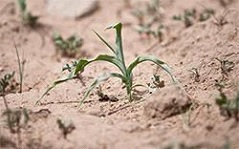
Drought, a devastating natural hazard, affects a significant proportion of the global population, particularly those living in semi-arid and arid regions. The percentage of the planet affected by drought has more than doubled in the last 40 years and in the same timespan droughts have affected more people worldwide than any other natural hazard. Climate change is indeed exacerbating drought in many parts of the world, increasing its frequency, severity and duration.
Severe drought episodes have a dire impact on the socio-economic sector and the environment and can lead to massive famines and migration, natural resource degradation, and weak economic performance. Drought can also exacerbate social tensions and fuel civil unrest.
Experience shows that proactive, risk-based management approaches are effective in enhancing the resilience of communities and their capacity to cope with drought, but despite the progress made, drought management and planning is often overlooked until a crisis unfolds. This reactive, crisis-led response gives rise to a fragmented policy space where interventions
Gale
 After a Gale – Wreckersby James Hamilton
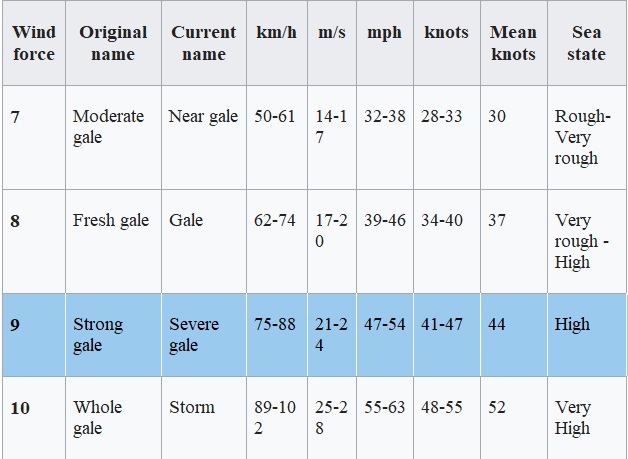
A gale is a strong wind, typically used as a descriptor in nautical contexts. The U.S. National Weather Service defines a gale as 34–47 knots (63–87 km/h, 17.5–24.2 m/s or 39–54 miles/hour) of sustained surface winds.[1] Forecasters typically issue gale warningswhen winds of this strength are expected. In the United States, a gale warning is specifically a maritime warning; the land-based equivalent in National Weather Service warning products is a wind advisory.
Other sources use minima as low as 28 knots (52 km/h; 14 m/s; 32 mph), and maxima as high as 90 knots (170 km/h; 46 m/s; 100 mph). Through 1986, the National Hurricane Center used the term gale to refer to winds of tropical force for coastal areas, between 33 knots (61 km/h; 17 m/s; 38 mph) and 63 knots (117 km/h; 72 mph; 32 m/s). The 90 knots (170 km/h; 46 m/s; 100 mph) definition is very non-standard. A common alternative definition of the maximum is 55 knots (102 km/h; 63 mph; 28 m/s).[2]
The most common way of measuring wind force is with the Beaufort scale[3] which defines a gale as wind from 50 kilometres per hour (14 m/s) to 102 kilometres per hour (28 m/s). It is an empirical measure for describing wind speed based mainly on observed sea conditions. On the original 1810 Beaufort wind force scale, there were four different "gale" designations whereas generally today there are two gale forces, 8 and 9, and a near gale 7: