Scientific Data Surah 89 · Ayah 3
EFFECTS OF EARTHQUAKE ON THE SURROUNDING ENVIRONMENT: AN OVERVIEW
EFFECTS OF EARTHQUAKE ON THE SURROUNDING ENVIRONMENT: AN OVERVIEW
ABSTRACT:
⦁ Earthquake is one of the most devastating natural calamities which causes sudden shaking of the earth surface.
⦁ It not only causes damage to buildings and other structures but also affects the surrounding environment and our lifestyle significantly.
⦁ An earthquake can trigger many sudden changes in the environment which can be classified as primary (e.g. subsidence, surface faulting) and secondary effects (displaced rocks, tsunami, ground cracks, liquefactions, landslides). These effects are known as earthquake environmental effects (EEE).
(1) Movement of mass along slope will occur when critical acceleration of the slope, ac gets exceeded by the inertial force acting on the sliding block. In equation 1, ac = the required acceleration for overcoming the frictional resistance of the landslide block and start sliding, g= acceleration due to gravity, ά = thrust angle of slope material, α = slope angle, FSstat = static factor of safety [41].
(2) Where, = effective cohesion = effective friction angle = material unit weight = unit weight of water m = represents the fractional depth of the water table with respect to the total slide depth z = stands for the slope-normal thickness of the failure slab = slope angle
11.4 The Impacts of Earthquakes
Some of the common impacts of earthquakes include structural damage to buildings, fires, damage to bridges and highways, initiation of slope failures, liquefaction, and tsunami. The types of impacts depend to a large degree on where the earthquake is located: whether it is predominantly urban or rural, densely or sparsely populated, highly developed or underdeveloped, and of course on the ability of the infrastructure to withstand shaking.
As we’ve seen from the example of the 1985 Mexico earthquake, the geological foundations on which structures are built can have a significant impact on earthquake shaking. When an earthquake happens, the seismic waves produced have a wide range of frequencies. The energy of the higher frequency waves tends to be absorbed by solid rock, while the lower frequency waves (with periods slower than one second) pass through the solid rock without being absorbed, but are eventually absorbed and amplified by soft sediments. It is therefore very common to see much worse earthquake damage in areas underlain by soft sediments than in areas of solid rock. A good example of this is in the Oakland area near San Francisco, where parts of a two-layer highway built on soft sediments collapsed during the 1989 Loma Prieta earthquake (Figure 11.17).
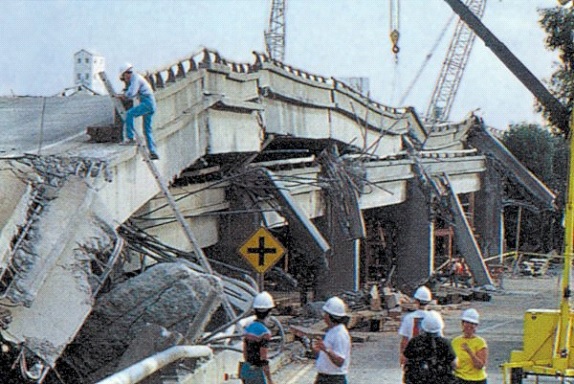 Figure 11.17 A part of the Cypress Freeway in Oakland California that collapsed during the 1989 Loma Prieta earthquake. [from: http://upload.wikimedia.org/wikipedia/ commons/9/91/Cypress_collapsed.jpg]
Building damage is also greatest in areas of soft sediments, and multi-storey buildings tend to be more seriously damaged than smaller ones. Buildings can be designed to withstand most earthquakes, and this practice is increasingly applied in earthquake-prone regions. Turkey is one such region, and even though Turkey had a relatively strong building code in the 1990s, adherence to the code was poor, as builders did whatever they could to save costs, including using inappropriate materials in concrete and reducing the amount of steel reinforcing. The result was that there were over 17,000 deaths in the 1999 M7.6 Izmit earthquake (Figure 11.18). After two devastating earthquakes that year, Turkish authorities strengthened the building code further, but the new code has been applied only in a few regions, and enforcement of the code is still weak, as revealed by the amount of damage from a M7.1 earthquake in eastern Turkey in 2011.
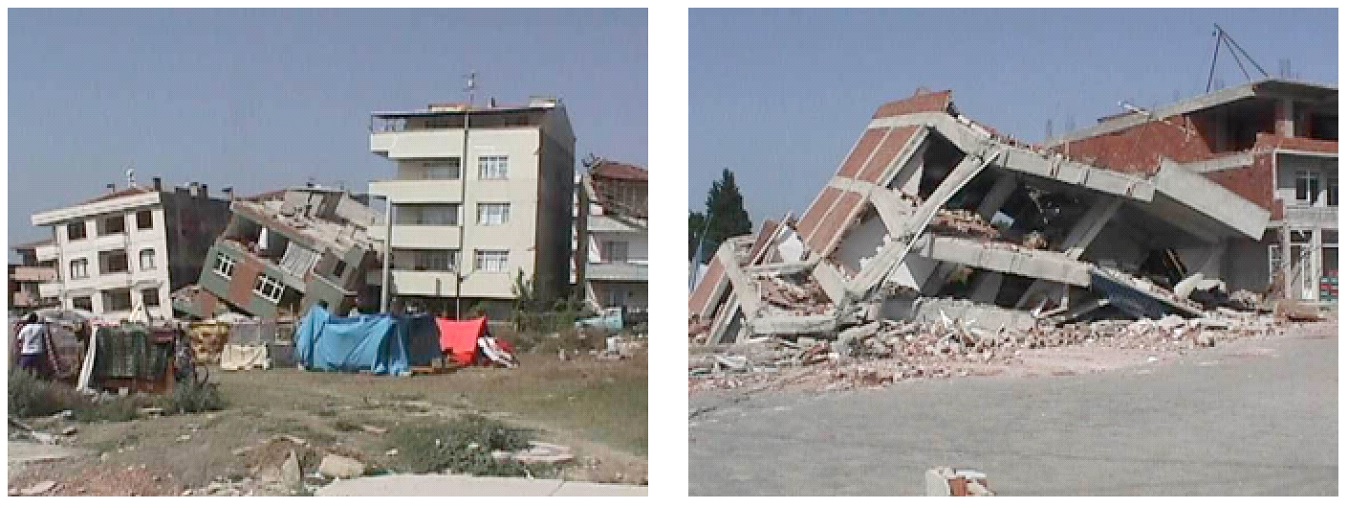 Figure 11.18 Buildings damaged by the 1999 earthquake in the Izmit area, Turkey. [from U.S. Geological Survey at: http://gallery.usgs.gov/sets/1999_Izmit,_Turkey_Earthquake/thumb/_/1]
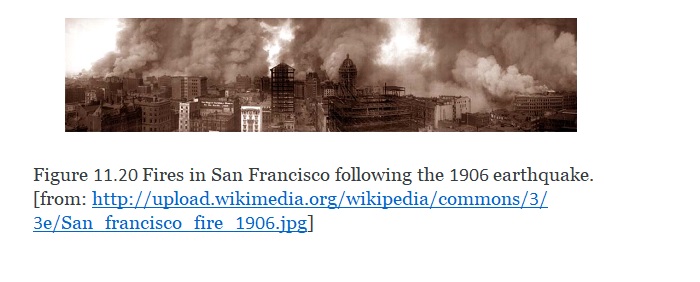
Fires are commonly associated with earthquakes because fuel pipelines rupture and electrical lines are damaged when the ground shakes (Figure 11.19). Most of the damage in the great 1906 San Francisco earthquake was caused by massive fires in the downtown area of the city (Figure 11.20). Some 25,000 buildings were destroyed by those fires, which were fuelled by broken gas pipes. Fighting the fires was difficult because water mains had also ruptured. The risk of fires can be reduced through P-wave early warning systems if utility operators can reduce pipeline pressure and close electrical circuits.
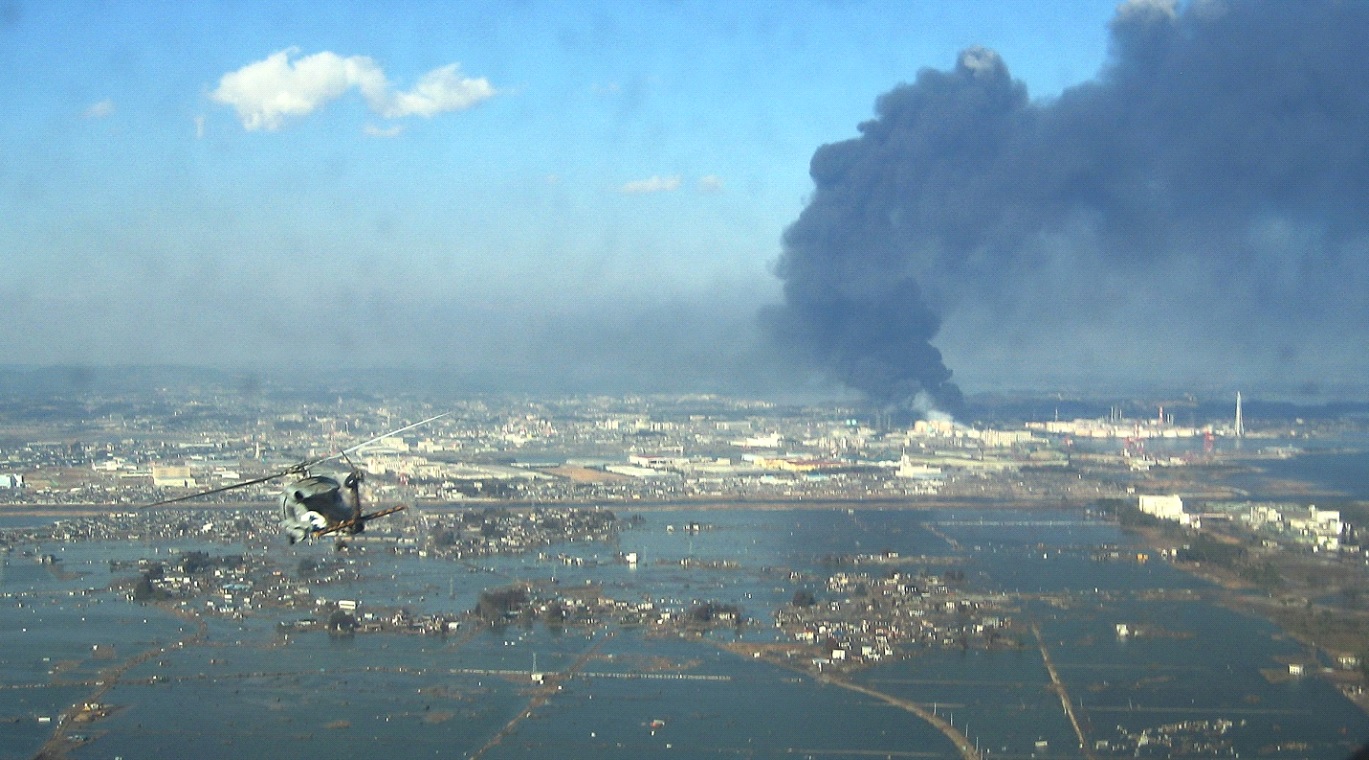 Figure 11.19 Some of the effects of the 2011 Tohoku earthquake in the Sendai area of Japan. An oil refinery is on fire, and a vast area has been flooded by a tsunami. [from:
Image]
Figure 11.19 Some of the effects of the 2011 Tohoku earthquake in the Sendai area of Japan. An oil refinery is on fire, and a vast area has been flooded by a tsunami. [from:
Image]

Earthquakes are important triggers for failures on slopes that are already weak. An example is the Las Colinas slide in the city of Santa Tecla, El Salvador, which was triggered by a M7.6 offshore earthquake in January 2001 (Figure 11.21).
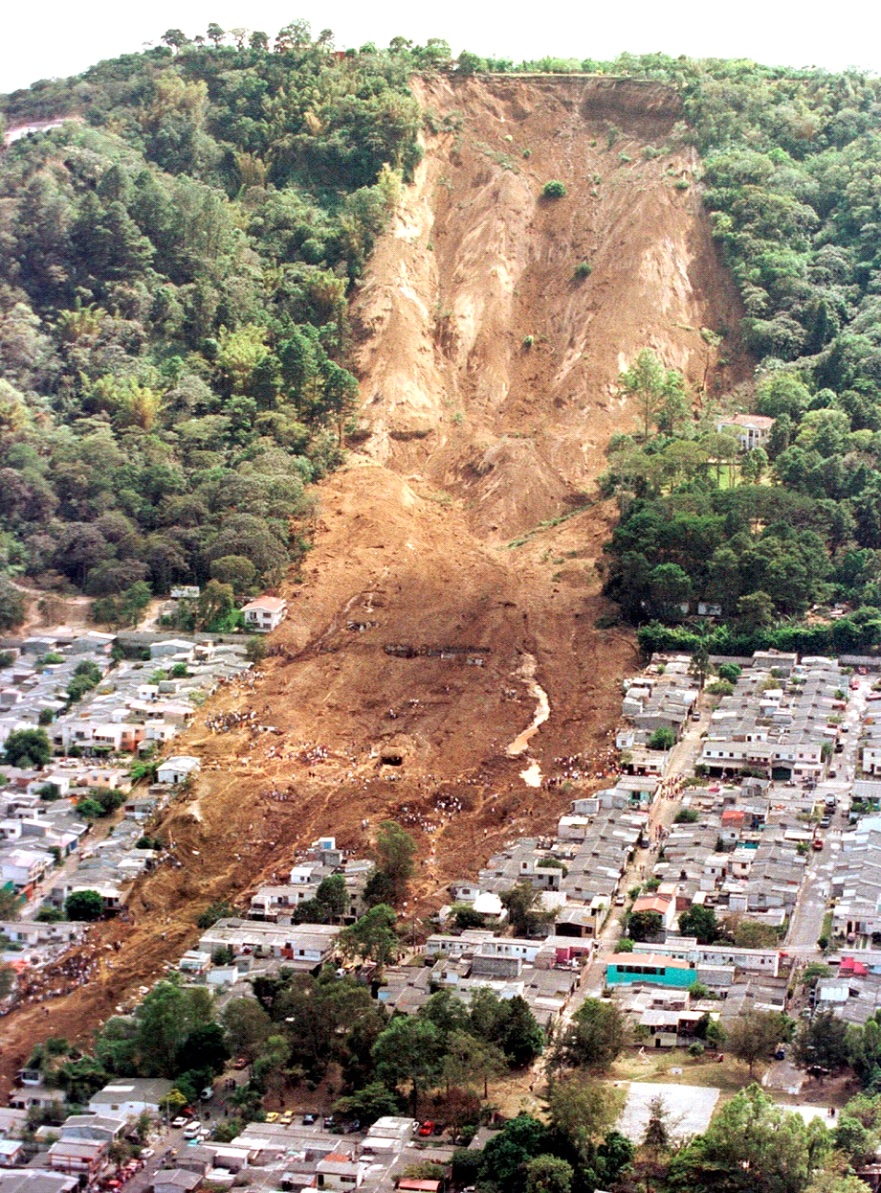 Figure 11.21 The Las Colinas debris flow at Santa Tecla (a suburb of the capital San Salvador) triggered by the January 2001 El Salvador earthquake. This is just one of many hundreds of slope failures that resulted from that earthquake. Over 500 people died in the area affected by this slide. [from: http://landslides.usgs.gov/learning/ images/foreign/ElSalvadorslide.jpg]
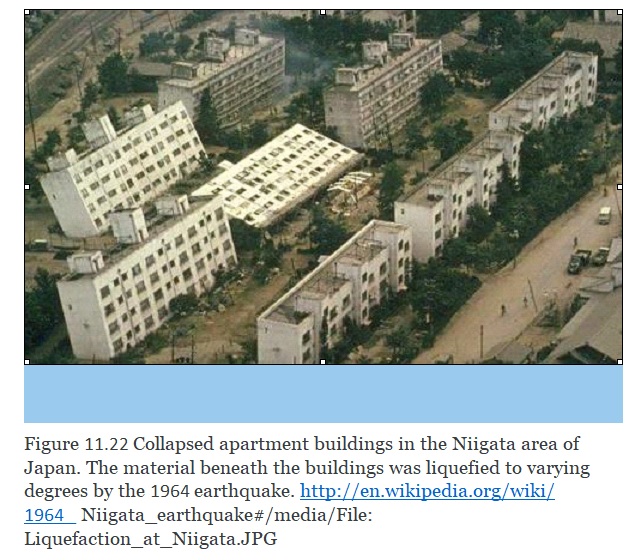
Ground shaking during an earthquake can be enough to weaken rock and unconsolidated materials to the point of failure, but in many cases the shaking also contributes to a process known as liquefaction, in which an otherwise solid body of sediment is transformed into a liquid mass that can flow. When water-saturated sediments are shaken, the grains become rearranged to the point where they are no longer supporting one another. Instead, the water between the grains is holding them apart and the material can flow. Liquefaction can lead to the collapse of buildings and other structures that might be otherwise undamaged. A good example is the collapse of apartment buildings during the 1964 Niigata earthquake (M7.6) in Japan (Figure 11.22). Liquefaction can also contribute to slope failures and to fountains of sandy mud (sand volcanoes) in areas where there is loose saturated sand beneath a layer of more cohesive clay.
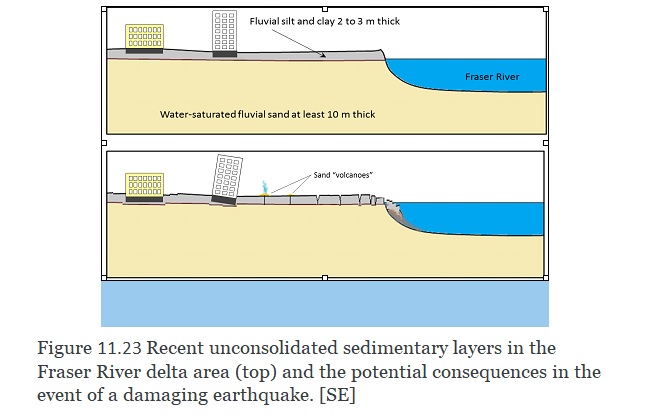
Parts of the Fraser River delta are prone to liquefaction-related damage because the region is characterized by a 2 m to 3 m thick layer of fluvial silt and clay over top of at least 10 m of water-saturated fluvial sand (Figure 11.23). Under these conditions, it can be expected that seismic shaking will be amplified and, the sandy sediments will liquefy. This could lead to subsidence and tilting of buildings, and to failure and sliding of the silt and clay layer. Current building-code regulations in the Fraser delta area require that measures be taken to strengthen the ground underneath multi-storey buildings prior to construction.
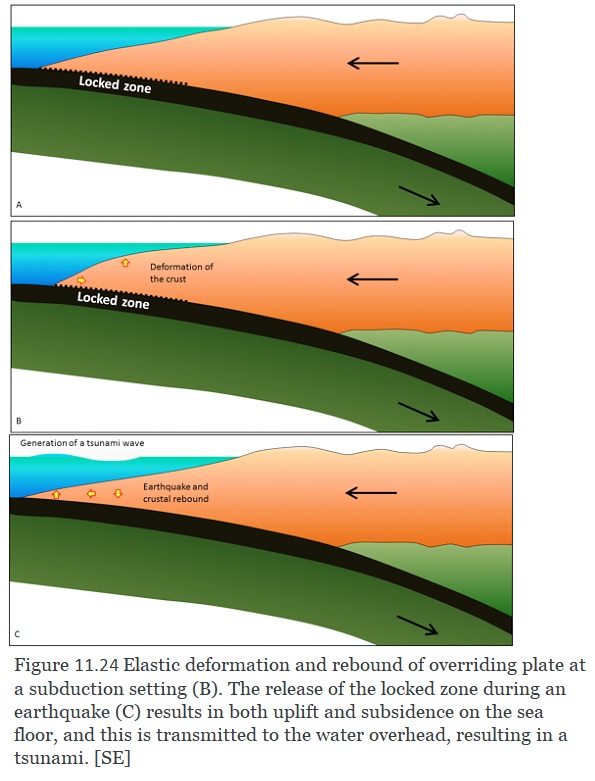
Subduction earthquakes with magnitude less than 7 do not typically generate significant tsunami because the amount of vertical displacement of the sea floor is minimal. Sea-floor transform earthquakes, even large ones (M7 to M8), don’t typically generate tsunami either, because the motion is mostly side to side, not vertical.
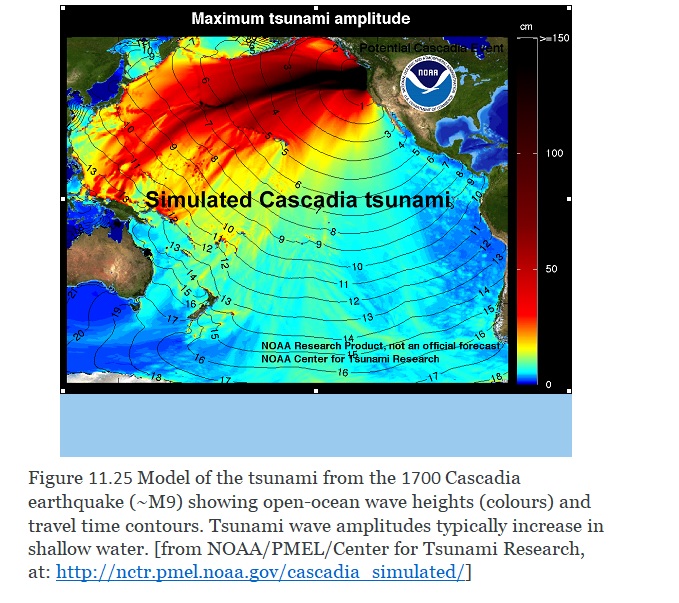
Tsunami waves travel at velocities of several hundred kilometres per hour and easily make it to the far side of an ocean in about the same time as a passenger jet. The simulated one shown in Figure 11.25 is similar to that created by the 1700 Cascadia earthquake off the coast of British Columbia, Washington, and Oregon, which was recorded in Japan nine hours later.
Tsunami are discussed further in Chapter 17 under the topic of waves and coasts.
On the use of wooden beams as an anti-seismic device in stone masonry in Qasr el-Bint, Petra, Jordan
Abstract
Timber string-courses have clearly been used to strengthen stone ashlar buildings in Petra, Jordan. These embedded beams, used as a form, held the brittle stone ashlars together, especially during earthquakes. In this study, tied and frictional surfaces were used to represent the interaction between the masonry blocks and the embedded wooden beams. Micro and macro modelling were used to evaluate the effect of using the embedded wooden beams on the integrity of the sandstone monument Qasr el-Bint. The traction-separation behaviour of the cohesive element was employed to model the mortar joints. A continuum, plastic-based, damage constitutive model (CDP) was used to represent the behaviour of the masonry walls. The results of these investigations demonstrated the role of the embedded wood string-courses as an anti-seismic device in reducing the shear stress of the stone masonry structure by up to 33%. The repairing and preserving of these beams that function as anti-seismic devices are needed to strengthen the structure against potential earthquakes.
Al-Hijr Archaeological Site (Madâin Sâlih)
⦁ The Archaeological Site of Al-Hijr (Madâin Sâlih) is the first World Heritage property to be inscribed in Saudi Arabia.
⦁ Formerly known as Hegra it is the largest conserved site of the civilization of the Nabataeans south of Petra in Jordan.
⦁ It features well-preserved monumental tombs with decorated facades dating from the 1st century BC to the 1st century AD. The site also features some 50 inscriptions of the pre-Nabataean period and some cave drawings.
⦁ Al-Hijr bears a unique testimony to Nabataean civilization. With its 111 monumental tombs, 94 of which are decorated, and water wells, the site is an outstanding example of the Nabataeans’ architectural accomplishment and hydraulic expertise.
⦁ Description is available under license CC-BY-SA IGO 3.0 Outstanding Universal Value
⦁ The archaeological site of Al-Hijr is a major site of the Nabataean civilisation, in the south of its zone of influence. Its integrity is remarkable and it is well conserved. It includes a major ensemble of tombs and monuments, whose architecture and decorations are directly cut into the sandstone.
⦁ It bears witness to the encounter between a variety of decorative and architectural influences (Assyrian, Egyptian, Phoenician, Hellenistic), and the epigraphic presence of several ancient languages (Lihyanite, Thamudic, Nabataean, Greek, Latin).
⦁ It bears witness to the development of Nabataean agricultural techniques using a large number of artificial wells in rocky ground. The wells are still in use.
⦁ The ancient city of Hegra/Al-Hijr bears witness to the international caravan trade during late Antiquity.
Criterion (ii): The site of Al-Hijr is located at a meeting point between various civilisations of late Antiquity, on a trade route between the Arabian Peninsula, the Mediterranean world and Asia. It bears outstanding witness to important cultural exchanges in architecture, decoration, language use and the caravan trade. Although the Nabataean city was abandoned during the pre-Islamic period, the route continued to play its international role for caravans and then for the pilgrimage to Mecca, up to its modernisation by the construction of the railway at the start of the 20th century.
Criterion (iii): The site of Al-Hijr bears unique testimony to the Nabataean civilisation, between the 2nd and 3rd centuries BC and the pre-Islamic period, and particularly in the 1st century AD. It is an outstanding illustration of the architectural style specific to the Nabataeans, consisting of monuments directly cut into the rock, and with facades bearing a large number of decorative motifs. The site includes a set of wells, most of which were sunk into the rock, demonstrating the Nabataeans' mastery of hydraulic techniques for agricultural purposes.
The testimony borne by Al-Hijr to the Nabataean civilisation is of outstanding integrity and authenticity, because of its early abandonment and the benefit over a very long period of highly favourable climatic conditions.
CAMEl-A POTENTIAL DAIRY ANIMAL IN DIFFICULT ENVIRONMENTS
⦁ Camels were originally domesticated for their milk. Following the move to use the camel as a beast of burden especially for armies, there has been a return to its original task.
⦁ Camel is no more the animal of the old world, but an animal which may be use to combat the growing desertification and to feed millions of people living in those areas.
⦁ There are many scientific data concerning the anatomy, physiology and endocrinology of lactation in camels.
⦁ It has been shown that camels can provide 15-20 liters of milk per day for a lactation period of up to 18 months, making a very good farm animal.
⦁ This was the milk production of a normal camel one cannot imagine how much milk allah’s camel used to produce
⦁ The camel produces in harsh and hostile conditions where other animal may not survive.
⦁ The camel sustain its productivity in difficult conditions and comparatively lesser affected by the adverse factors like lack of feed, water, season and length of lactation.
INTRODUCTION
⦁ Camel possesses certain physiological features that enable him to thrive in extremely arid environment.
⦁
Dromedaries use water economically in almost all metabolic functions. The body temperature of the animal can fluctuate between 93F and 105F therefore, sweating is reduced.
⦁ They don't overheat,can withstand water loss, and store fats in the hump for use in times of food and water deprivation
⦁
Camel is a quality and variety browser. If the good quality forage is not available, the camel then can efficiently utilize poor quality forage with higher crude fiber, more than the other herbivores, by increasing the retention time of the fiber in the fore stomach for longer time up to 74 hours.
⦁
On the other hand, if feeding on low-protein forages can recycle and utilize body urea for microbial protein synthesis much more efficiently than the true ruminant (Schwartz and Dioli, 1992).
⦁ As camel intake per kg of milk produced is very less, it will be suitable specie to be maintained even on marginal and poor grazing lands.
⦁
According to some reports, camels need only 1.9 kg of dry matter to produce a liter of milk, compared with 9.1 kg for cows (Stiles, 1983).
CAMEL GENETIC BIODIVERSITY
Camel posses vide genetic biodiversity and there are many breeds of camel in the arid and semi-arid areas of the world. Each breed has been developed by their own perspective pastoralist community for their own breeding goals. Some camel breeds were developed for the work hence they are good draught animals. The camel evolved for the long traveling in the desert in caravans are now good race animals.
⦁
MILK PRODUCTION
⦁ Camel was originally domesticated for milk. God gifted cow camel to Prophet Saleh some 3500 Be back to drink the milk only.
⦁ The camel's milk was a gift from God for the Arab Bedouins.
⦁ In the Holy Quraan the true worth of the camel has been described.
⦁
some specimens have been reported to yield as high as 40 liters per day (Qureshi, 1986).
⦁
LACTATION LENGTH
⦁ Lactation.length of she camel depends upon various factors and varies from 9 to 18 months (Qureshi, 1986).
⦁
The mainly available food item for the pastoralists is the milk of she-camel; therefore, they do not dry the animal, which results in the lengthy lactation period, even higher than 18 months.
⦁
However according to some researchers, the milk yield and lactation length of Pakistani camel averaged 1894.93 liters and 445.58 days (15 months), respectively (Baloch, 2001).
⦁
Farmers reported a lactation length of 270 to 525 days (9-18 months) with a the total milk yield ranging in between 1,250 to 3,650 liters with an average of 1,800 liters per lactation (Jasra and Aujla, 1998).
⦁
MILKING PATTERN
⦁
The mainstay of a nomad's food is camel milk. It is consumed fresh or soured. In the northeastern mountainous area of Balochistan, both regular milking of two times daily and milking when needed, both 265 Raziq, Younas and Kakar systems are practiced simultaneously (Raziq, 2004). According to Jasra and AUjla, (1998), she camel was milked twice a day, while young calves were weaned at an age of 9 to 11 months. The camels are milked twice in 24 hrs but 4 times milking is also not uncommon. The camel has a unique capability that it can be milked any time during 24 hrs and six times milking has also been noticed in some animals (Qureshi, 1986), that excited many workers to initiate some studies on the hormonal profile of this specie and the letdown
A unique and fascinating creature! the camel
⦁ Camel had been playing pivotal role in socioeconomic life of its breeders.
⦁ Camel is even highly praised in the religious beliefs and highly appreciated in the holy books.
In holy Quran it is said "Do they not look at the Camels, how they are made? And at the Sky, how it is raised high? And at the Mountains, how they are fixed firm? And at the Earth, how it is spread out? In these honored verses, Allah (Praise & Glory be to him) surpassed the camel upon all other living
creatures, and made the contemplation of how it was made prior to raising high the sky, fixing firm the mountains, or spreading out the earth. In this honored verse, the Creator, who knows the secrets of his creatures, advises people to Camel contains equal quantity of milk in four quarters, not like cows, which have more milk inhindquarters.
⦁ The colostrums are white and watery instead of thick and cream colored (cow colostrums).
⦁ The content of niacin in camel milk is remarkably higher than in cow milk.
⦁ Camel milk contains five times more vitamin C compared to cow milk.
⦁ Vitamin C is anti infectious and is very important for human health,especially in dry and deserted areas.
⦁ Camel milk contains insulin like protein and is therefore used to treat Diabetes mellitus.
⦁ Camel milk has higher levels of potassium, magnesium, iron, copper, manganese, sodium and zinc than cow milk
⦁ Camel milk contains medicinal properties to treat different ailments such as autoimmune diseases,allergies, asthma, rashes, diabetes, liver disorders, ascites, rheumatism, inflammatory conditions,piles, urethral irritation, infectious diseases like tuberculosis, stress, depression, peptic ulcers and
Cancer.
⦁ Camel milk is a nervine tonic and helps in good eyesight. The pastoral people depending on camel milk never get weak eyesight.
⦁ It is a booster of the immune system, contains protective proteins, including the immunoglobulin necessary for maintaining the immune system and nutritional advantages for brain development.
⦁ Camel milk has higher levels of lactoferrin and lysozyme which play a central role in the determination of these properties.
⦁ It contains 2530 times as much lactoferrin as cow milk. Lactoferrin is a fairly recently discovered iron containing protein that has been shown to have antiviral, antifungal, anti inflammatory,
analgesic and anticarcinogenic effects.
⦁ Camel milk is use as aphrodisiac, especially in the stressful conditions of the dry hot weather.
⦁ The low quantity of beta casein and the lack of beta lactoglobulin are linked to the hypoallergenic effects of camel milk.
⦁ Because of the low lactose content, it does not cause lactose intolerance problem in infants.
⦁ Camel milk can be the best replacement of infant food after the mother's breast.
⦁ Camel milk is a rich source of proteins with potential antimicrobial and protective activity.
⦁ The camel milk fat is bound with the protein; therefore, it is difficult to remove fats from camel's milk.
⦁ The fat globule are smaller in camel milk than in cow milk and it's explain that camel milk is unstable at high temperature.
⦁ Camel milk protein is coated with fats, which enhance protein absorption. It passes the acidic stomach undisturbed (does not coagulate easily because of fat coating) and reaches the intestines for absorption.
⦁ Camels' milk fat contains much higher concentration of long chain fatty acids (C 14 C 18) than short chain fatty acids, and is therefore healthier.
⦁ Sour camel milk is not waste but is a part of the traditional diet in Somalia as "susa" and in Arabia as "Algarss" and in Baloch pastoral as "Sorain".
⦁ A camel dairy in the UAE and an Austrian chocolatier recently teamed up in a joint venture to produce chocolate made from camel milk, sweetened with honey from Yemen.
⦁ Mongolian nomads in the Gobi Desert distil a delicious drink from soured camel milk with low alcohol content, known as "camel vodka".
⦁ Camel meat is healthier as they produce carcasses with less fat as well as having less levels of cholesterol in fat than other meat animals.
⦁ Camel meat is also relatively high in polyunsaturated fatty acid in comparison to beef. This is an important factor in reducing the risk of cardiovascular disease.
⦁ Camel meat is also used for remedial purposes for diseases such as hyperacidity, hypertension,pneumonia and respiratory disease as well as an aphrodisiac.
⦁ Camels reach live weights of about 650 kg at 7–8 years of age, and produce carcass weights ranging from 125 to 400 kg with dressingout percentage values from 55% to 70%. Camel carcasses contain about 57% muscle, 26% bone and 17% fat.
⦁ Camel lean meat contains about 77% water, 19% protein, 2.8% fat, and 1.2% ash with a small amount of intramuscular fat, which renders it a healthy food for humans.
⦁ Camel meat has been described as raspberry red to dark brown in color and the fat of the camel meat is white.
⦁ The amino acid and mineral contents of camel meat are often higher than beef, probably due to lower intramuscular fat levels.
⦁ Camel meat has been processed into burgers, patties, sausages and shawarma to add value.
⦁ Because of its low cholesterol content, Australia's National Heart Foundation has put camel meat on its list of highly recommended food items.
⦁ "Camburgers" and "camfurters" are among the products that have been produced by a team of scientists around Prof. Farah at the Swiss Federal
Institute of Technology.
⦁ Camels can travel many days without feed or water. In the kind of terrain I like to ride in, this is a very important factor.A traveler can continue journey without bothering too much about the feed and water.
⦁ Camel eats each and everything when tired and hungry.
The long muscular legs allows camels to cover great distances, they walk up to 40 km per day with 200 to 300 kg of baggage.
⦁ Camel is better as riding animal than horse. They are quieter and gentler than horses.
⦁ Camels seem smarter than horses about getting themselves out of a precarious situation. If a horse gets tangled up in a rope, it may struggle violently and get rope burns (or worse). A tangled up camel will, after briefly testing the bonds, sit quietly and figure out what to do next.
⦁ Camels can carry more weight than horses. Also, a well designed camel saddle has more room to carry whatever extra gear you are packing than a horse saddle has.
⦁ Riding a camel is quiet and peaceful (that is, once the camel is well trained enough that it no longer grumbles along the way). Camel's slipperlike feet make hardly any noise.
⦁ Without the clip clop of hooves, you can hear the wind sighing in the brush, the rustle of autumn leaves, a coyote howl in the distance on a moonlight ride.
⦁ The camels are the most disciplined and obedient creatures. They and can be ordered to sit or stand again and again and can walk in a row silently behind the leading man, woman or even a child.
⦁ The camel is a unique beast of burden, which is loaded in sitting position and gets up with a jerk of its long neck.
⦁ Camels do not need to be shod. The cost of shoeing horses can really add up! Furthermore, camels don't usually colic like horses do, although they occasionally bloat.
⦁ There is a certain pride in riding a well trained camel. It is a sign of prestige for camel owner to ride and travel on a mehari camel.
⦁ The disease register of camel is quite short (very few fatal diseases are reported in camel).
⦁ Camel is resistant to many notorious diseases like foot and mouth disease, mad cow disease (BSE) and Brucellosis etc.
⦁ Camel is resistant to ticks diseases. A load of more than 100 ticks on camel body cannot affect camel health and production.
⦁ The camel has a large mouth, with 34 sharp teeth. They enable the animal to eat rough thorny bushes without damaging the lining of its mouth.
⦁ Camel can eat everything (bark, dates seed, salty mud and even paper) when there is scarcity of feed, while in good feeding conditions, it does prefer protein rich diet.
⦁ The long flexible neck and legs saves it from ground heat and gives easy approach to tall trees for browsing.
⦁ Camel can browse at 3.5 m above the ground.
⦁ The formation of the mouth is such that there are long conical papillae on the inside of the cheeks directed backward and the camel can browse at the thorny plants without any harm. The canine teeth help the camel to take into grip the twigs. Such kind of teeth is not found in other ruminants.
⦁ The soft palate is developed and comes out on one side of the mouth like a red hanging bladder.This happens usually in rutting (breeding) seasons.
⦁ Camel has a well developed power to smell.
⦁ They can smell water 50 mile away by smelling geosmin which is a fragrance produced by streptomyces species growing in the dump soil.
Under very hot conditions, the camel may drink only every 810 days and lose up to 30% of the its live body weight through dehydration. Other animals die at 10% live body loss through dehydration.
⦁ Camel urinate less than 1 liter of urine per day in hot summer days. In the period of water scarcity
⦁ camel urinates a semi liquid substance like syrup.
⦁ Oval shape erythrocytes (instead of round in other animals) expand up to 200% their normal size as camels drink rapidly an amount of 190 liter of water in 1015 minutes.
⦁ Camel can store water in its all body compartments (intracellular, extracellular, blood and digestive tract etc). Every organ has the extraordinary capacity to store water.
⦁ They can live without water for 3 days in summer and 7 days in winter. However, there are some examples of this animal remaining without water for 20 to 40 days. After 40 days the camel goes blind due to excessive dehydration.
⦁ Camel can vary body temperature up to 6.7 Cº, having a great endurance power to stand scorching heat. Camel even absorbs heat in the day time by increasing body temperature and dissipates it in the cool night.
⦁ The ability of camel to allow its body temperature to fluctuate in response to some form of environmental stress saves significant amounts of energy and water.
⦁ The well developed hump is full of fat that serves as a store of water and food at the time of starvation.The fat of hump gets dissolved gradually during starvation and collects again at the time the camel gets adequate water and feed.
⦁ The flat pads of the feet are horny and cushioned and help the camel to walk on the sand without making any sound while the feet of other animals sink into the sand.
⦁ Due to this quality, the camel has been given the name as the "ship of the desert".
⦁ Camel feet are soft and friendly to vegetation. The hooves of cow or small ruminants are more aggressive to the soil and contribute more often to the degradation of the pastures in case of overgrazing.
⦁ The chest pad helps the animal to take rest on it while sitting on the ground. The rest of the body is saved from concussion against the ground. There are other pads at the knee and half joint and in front of the joint of thighs.
⦁ These prevent the limbs from concussion against the ground.
⦁ The spines of all vertebrates of the thoracic region are long & high and make the hump, which is more developed than all other Brahman cattle.
⦁ The camel sleeps less and possesses great power of remembrance. It keeps in mind the harsh behavior, beating or even the abuses from the camel man and takes revenge at the appropriate time.
⦁ The male urinates in spurts while standing and urine goes back in between the hind legs and falls on the ground. Its refresh the femoral vein and decrease the heart temperature for water economy.This enables the animal to save itself from slipping in its urine.
⦁ Camels are hornless and lack gall bladder.
⦁ Camel has prominent eyes with a wide range of vision. They are protected by an overhanging upper lid with long eyelashes, which protect the eyeballs from powerful rays of the sun.
⦁ The upper lip of the mouth has a cut in the middle. The flaps of the upper lip not only help in catching the twigs (thin shoots of the trees and bushes) but also enable the nostrils to cover to keep out the sand and dust at the time of dust storms.
⦁ The ears are small but have a great power of hearing. Camel can hear and understand the voice of its herder from a long distance.
The camels are regarded as the most intelligent animals and can find out their way in the desert when there are no signs of road.
⦁ The Bedouin gives name Ata ullah to camel, mean the gift of God.