Scientific Data Surah 91 · Ayah 1
The Sun: The Center of Our Solar System
The Sun: The Center of Our Solar System
The sun (which, incidentally, is only a medium-size star) is larger than any of the planets in our solar system. Its diameter is 1,392,000 kilometers (864,949 miles). Earth's diameter is only 12,756 kilometers (7,926 miles). More than one million Earths could fit inside the sun. The large mass of the sun produces an enormous gravitational pull that keeps all the planets of the solar system in their orbits. Even Pluto, which is six billion kilometers (3,728,227,153 miles) away, is kept in orbit by the sun.
Reference Link
THE HELIO-CENTRIC SYSTEM
He created the heavens and the Earth with truth. He wraps the night around the day and wraps the day around the night, and has made the Sun and Moon subservient, each one running for a specified term.
Is He not indeed the Almighty, the Endlessly Forgiving? ( Surat az-Zumar, 5)
In the above verse the movement of the Earth is described by the word “yukawwiru,” which comes from root verb “takwir,” meaning “to cover up a spherical body,” in the way that the rotation of the Earth gives rise to night and day, like the winding of a turban.
In addition to the spherical shape of the Earth the word is also the most accurate expression of its movement around the Sun. Because of the Earth’s spherical shape and its movement around the Sun, the Sun always illuminates one side of the Earth while the other is in darkness. The side in shadow is shrouded by the darkness of night, to be replaced by the brightness of day when the Sun rises.
The positions of the Sun and Earth are revealed as follows in Surah
Ya Sin: “And the Sun runs to its resting place.”
That is the decree of the Almighty, the All-Knowing. And We have decreed set phases for the Moon, until it ends up looking like an old palm spathe. It is not for the Sun to overtake the Moon nor for the night to outstrip the day; each one is swimming in a sphere.
(Surah Ya Sin, 38-40)
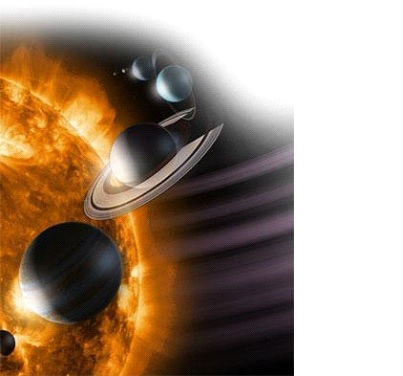
The movements of the Sun and Moon in verse 40 of Surah Ya Sin are described by the Arabic word "yasbahoona," meaning “flowing, passing or swimming.” This word refers to an action performed by someone on their own. Someone acting according to this verb continues to perform it alone, with no intervention from anyone else. The above verses may therefore be referring to the Sun’s independent movement in the universe, independent of any other celestial body. (Allah knows the truth.) It is impossible for us to see or follow the movement of the Sun with our own eyes. It is only possible to determine that movement using special technological equipment. As stated in verse 39 of Surah Ya Sin, in addition to rotating around its own axis once every 26 days, the Sun also moves through its own course.
The verse also reports that the Sun is not allowed to “overtake the Moon,” and the Qur’an thus states that the Sun and Moon do not revolve around the same body, as astronomers put it. At the same time, the verse makes it clear that there is no connection between the motion responsible for night and day and the movement of the Sun and Moon. (Allah knows the truth.)
Until the 16th century it was thought that the Earth was the center of the universe. This view is known as the “Geo-centric model,” from the Greek words geo (Earth) and centron (center). This belief was questioned by the famous astronomer Nicolaus Copernicus in 1543 in his book De Revolutionibus Orbium Coelestium (Of the Revolutions of Heavenly Spheres), in which he suggested that the Earth and the other planets revolve around the Sun. But as a result of observations using a telescope performed by Galileo Galilei in 1610, it was scientifically established that the Earth revolves around the Sun. Since it had hitherto been thought that the Sun revolved around the Earth, most scholars of the time rejected Copernicus’ theory.
The famous astronomer Johannes Kepler's views setting out the movements of the planets confirmed the heliocentric model in the 16th and 17th centuries. In this model, whose name comes from the words Helios (Sun) and centron (center), the Sun is the center of the universe, rather than the Earth. Other heavenly bodies also revolve around the Sun. Yet this was all revealed 1400 years ago in the Qur’an.
By saying that the Earth was the center of the universe, the ancient Greek astronomer Ptolemy was responsible for the geo-centric idea of the universe that prevailed for hundreds of years. For that reason, at the time of the revelation of the Qur’an, nobody knew that the Earth-centered model that accounted for the formation of day and night in terms of the movement of the Sun was incorrect. On the contrary, all the stars and planets were regarded as revolving around the Earth. Despite these prevalent errors of the time, the Qur’an contains many expressions that agree with the scientific facts regarding day and night:
By the Sun and its morning brightness, and the moon when it follows it, and the day when it displays it, and the night when it conceals it (Surat ash-Shams, 1-4)
As set out in the above verse, day, the brightness of the Sun, is the result of the movement of the Earth. It is not the movement of the Sun that is responsible for night and day. In other words, the Sun is immobile in terms of night and day. The information in the Qur’an refutes the thesis that the Earth is fixed while the Sun revolves around it. The Qur’an is clearly descended from the presence of our Lord, He Who is unfettered by space and time. As science and technology advance more and more examples of the compatibility between the Qur’an and science are coming to light. This is set out in another verse from the Qur’an:
There is instruction in their stories for people of intelligence. This is not a narration which has been invented but confirmation of all that came before, a clarification of everything, and a guidance and a mercy for people who believe. (Surah Yusuf, 111)
Characteristics of the Sun:
The sun is a big star. At about 864,000 miles (1.4 million kilometers) wide, it could hold 109 planet Earths across its surface. If the sun were a hollow ball, more than a million Earths could stuff inside it. But the sun isn't hollow; it's filled with scorching hot gases that account for more than 99.8 percent of the total mass in the solar system.
The temperature is about 10,000 degrees Fahrenheit (5,500 degrees Celsius) on the surface and more than 28 million degrees Fahrenheit (15.5 million Celsius) at the core.
Deep in the sun's core, nuclear fusion reactions convert hydrogen to helium, which generates energy. Particles of light called photons carry this energy through the sun's spherical shell, called the radiative zone, to the top layer of the solar interior, the convection zone. There, boiling motions of gases (like in a lava lamp) transfer the energy to the surface. This journey takes more than a million years
The sun's surface, or atmosphere, is divided into three regions: the photosphere, the chromosphere, and the solar corona. The photosphere is the visible surface of the sun and the lowest layer of the atmosphere. Just above the photosphere are the chromosphere and the corona, which also emit visible light but are only seen during a solar eclipse, when the moon passes between the Earth and sun
Other characteristicas of sun:
Solar Wind and Flares:
⦁ i897⦁ How big can sunspots get?
Chemical composition of Sun:
Sunspots and solar cycles
Explanation of sun and its brightness:
The Arabic word for the sun in the Qur’an, is shams. It is also referred to as siraaj which means a ‘torch’ or as wahhaaj meaning ‘a blazing lamp’ or as diya which means ‘shining glory’. All three descriptions are appropriate to the sun, since it generates intense heat and light by its internal combustion.
The Arabic word for the moon is qamar and it is described in the Qur’an as muneer which is a body that gives noor i.e. reflected light. Again, the Qur’anic description matches perfectly with the true nature of the moon which does not give off light by itself and is an inactive body that reflects the light of the sun.
Not once in the Qur’an, is the moon mentioned as siraaj, wahhaaj or diya nor the sun as noor or muneer.
This implies that the Qur’an recognizes the difference between the nature of sunlight and moonlight.
Reference Link
What would happen to Earth if the sun did get significantly brighter or dimmer?
What happens to the Earth's temperature when the sun changes is a combination of what the sun does and the reaction of our atmosphere. The base temperature of the Earth increases as the sun gets brighter and decreases when the sun gets dimmer. The atmosphere of the Earth then increases that starting temperature. Without an atmosphere the Earth's surface would have a temperature around freezing (with enormous day to night changes). Our atmosphere retains some of the warmth and increases the average surface temperature to about 60 Fahrenheit(15.5 degrees Celsius). The seasonal temperature changes are still large, but the day to night changes are much smaller.
So a dimmer sun should mean lower surface temperatures, but the calculation is difficult.
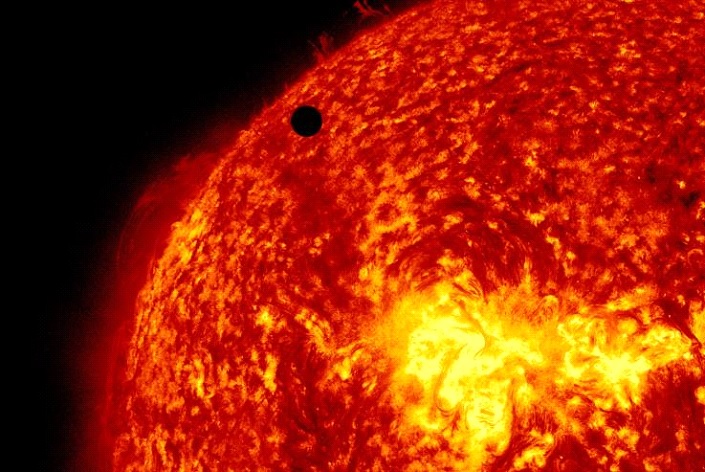
What would Earth be like without the Sun?
Of course, without the Sun none of us would even exist in the first place. Scientists who have studied the origins of life on Earth point to Earth's perfect positioning with regard to its distance from the Sun as a main factor in creating the conditions that allow life to exist on Earth.
Without the Sun's rays, all photosynthesis on Earth would stop. All plants would die and, eventually, all animals that rely on plants for food — including humans — would die, too.
While some inventive humans might be able to survive on a Sun-less Earth for several days, months, or even years, life without the Sun would eventually prove to be impossible to maintain on Earth.
Reference Link