Scientific Data Surah 91 · Ayah 2
Moon-Light is Reflected Light
Moon-Light is Reflected Light
It was believed by earlier civilizations that the moon emanates its own light. Science now tells us that the light of the moon is reflected light.
However this fact was mentioned in the Qur’an 1,400 years ago in the following verse: “Blessed is He Who made Constellations in the skies, and placed therein a Lamp and a Moon giving light.” [Al-Qur’an 25:61]
The Arabic word for the sun in the Qur’an, is shams. It is also referred to as siraaj which means a ‘torch’ or as wahhaaj meaning ‘a blazing lamp’ or as diya which means ‘shining glory’.
All three descriptions are appropriate to the sun, since it generates intense heat and light by its internal combustion. The Arabic word for the moon is qamar and it is described in the Qur’an as muneer which is a body that gives noor i.e. reflected light.
Again, the Qur’anic description matches perfectly with the true nature of the moon which does not give off light by itself and is an inactive body that reflects the light of the sun. Not once in the Qur’an, is the moon mentioned as siraaj, wahhaaj or diya nor the sun as noor or muneer.
This implies that the Qur’an recognizes the difference between the nature of sunlight and moonlight.
The following verses relate to the nature of light from the sun and the moon:
“It is He who made the sun to be a shining glory and the moon to be a light (of beauty).” [Al-Qur’an 10:5]
“See ye not how Allah has created the seven heavens one above another, “And made the moon a light in their midst, and made the sun as a (Glorious) Lamp?” [Al-Qur’an 71:15-16]
The Glorious Qur’an and modern science, are thus in perfect agreement about the differences in the nature of sunlight and moonlight.
Reference Link
Distinctive Features:
⦁ The Moon is a spherical rocky body, probably with a small metallic core, revolving around Earth in a slightly ⦁ eccentric orbit at a mean distance of about 384,000 km (238,600 miles).
⦁ Its equatorial radius is 1,738 km (1,080 miles), and its shape is slightly flattened in a such a way that it bulges a little in the direction of Earth.
⦁ Its mass distribution is not uniform—the centre of mass is displaced about 2 km (1.2 miles) toward Earth relative to the centre of the lunar sphere, and it also has surface mass concentrations, called ⦁ mascons for short, that cause the Moon’s gravitational field to increase over local areas.
The Moon has no global magnetic field like that of Earth, but some of its surface rocks have remanent magnetism, which indicates one or more periods of magnetic activity in the past. The Moon presently has very slight seismic activity and little heat flow from the interior, indications that most internal activity ceased long ago.
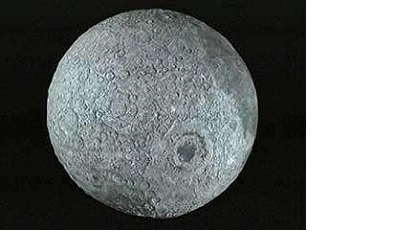 Moon: Three-dimensional mapThree-dimensional map of the Moon created from data collected by the Clementine spacecraft.NASA/GSFC/Scientific Visualization Studio
⦁ Scientists now believe that more than four billion years ago the Moon was subject to violent heating—probably from its formation—which resulted in its differentiation, or chemical separation, into a less dense crust and a more dense underlying mantle.
⦁ This was followed hundreds of millions of years later by a second episode of heating—this time from internal radioactivity—which resulted in volcanic outpourings of ⦁ lava.
⦁ The Moon’s mean ⦁ density is 3.34 grams per cubic cm, close to that of Earth’s mantle. Because of the Moon’s small size and mass, its surface gravity is only about one-sixth of the planet’s; it retains so little atmosphere that the molecules of any gases present on the surface move without collision.
⦁ In the absence of an atmospheric shield to protect the surface from bombardment, countless bodies ranging in size from ⦁ asteroids to tiny particles have struck and ⦁ cratered the Moon.
⦁ This has formed a debris layer, or ⦁ regolith, consisting of rock fragments of all sizes down to the finest dust.
⦁ In the ancient past the largest impacts made great basins, some of which were later partly filled by the enormous lava floods.
⦁ These great dark plains, called ⦁ maria (singular ⦁ mare [Latin: “sea”]), are clearly visible to the naked eye from Earth.
⦁ The dark maria and the lighter highlands, whose unchanging patterns many people recognize as the “man in the moon,” ⦁ constitute the two main kinds of lunar territory.
⦁ The mascons are regions where particularly dense lavas rose up from the mantle and flooded into basins.
PHASES OF THE MOON
The Moon orbits Earth at an average distance of 382,400 kilometers. The lunar month is the 29.53 days it takes to go from one new moon to the next.
During the lunar month, the Moon goes through all its phases. You can see the phases drawn in the image below.
Just like the Earth, half of the Moon is lit by the Sun while the other half is in darkness.
The phases we see result from the angle the Moon makes with the Sun as viewed from Earth.
The diagram below on the right is one you typically see in books. Don't let it confuse you. The images of the Moon show what you see the Moon look like from Earth when it is at given points in its orbit. It does not show which side of the Moon is lit by the Sun. The side lit by the Sun is always the side that is pointed toward the Sun, as seen in the diagram.
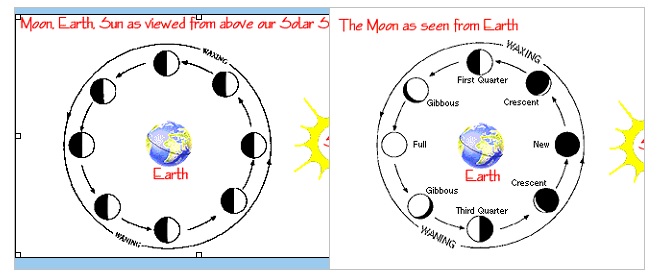
We only see the Moon because sunlight reflects back to us from its surface. During the course of a month, the Moon circles once around the Earth.
If we could magically look down on our solar system, we would see that the half of the Moon facing the Sun is always lit.
But the lit side does not always face the Earth! As the Moon circles the Earth, the amount of the lit side we see changes.
These changes are known as the phases of the Moon and it repeats in a certain way over and over.
Reference Link
The Moon in 4K
Using updated survey data a stunning ultrahigh-definition tour of the lunar surface brings our satellite to life.
Reference Link
The moon is front and center during a total solar eclipse:
In the lead-up to a total solar eclipse, most of the attention is on the sun, but Earth's moon also has a starring role.
"A total eclipse is a dance with three partners: the moon, the sun and Earth," said Richard Vondrak, a lunar scientist at NASA's Goddard Space Flight Center in Greenbelt, Maryland. "It can only happen when there is an exquisite alignment of the moon and the sun in our sky."
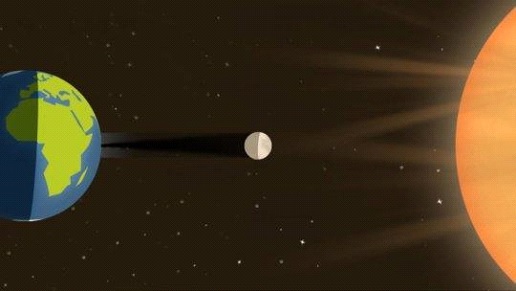
During this type of eclipse, the moon completely hides the face of the sun for a few minutes, offering a rare opportunity to glimpse the pearly white halo of the solar corona, or faint outer atmosphere.
This requires nearly perfect alignment of the moon and the sun, and the apparent size of the moon in the sky must match the apparent size of the sun.
On average, a total solar eclipse occurs about every 18 months somewhere on Earth, although at any particular location, it happens much less often.