Scientific Data Surah 91 · Ayah 2
What would Earth be like with no moon?
What would Earth be like with no moon?
Earth without its moon would be a very different world indeed. No eclipses. Smaller tides. But the biggest change would be in the length of Earth’s day.
Most moons in our solar system are tiny relative to the planets they orbit. These planets wouldn’t miss a moon or two if one got knocked out of orbit. But Earth’s moon is relatively large. So Earth without its large nearby moon would be a very different world indeed.
Imagine … no solar or lunar eclipses.
No calendars based on a system of months. The word month, after all, stems from a word that means moon. That’s because many calendars are based on the changing phases of the moon.
With no moon, there’d be no nearby world for astronauts to visit. We might never have begun to venture out into the solar system.
The moon and sun together cause the tides. If we’d never had a moon, we’d still have tides, but they wouldn’t be as strong.
What’s more, the moon has a place in human culture. Imagine no romantic moonlight walks – no concept of moon madness, or lunacy.
But the biggest change – for us humans and for other earthly life – would be in the length of Earth’s day. Without a moon, Earth would spin faster. Our day would be shorter. Why?
It’s because, billions of years ago when Earth was young, our planet spun around on its axis much faster. Our world’s cycle of day and night was less than 10 hours long. The ebb and flow of the tides are what put the brakes on Earth’s spin. So – if you’re imagining Earth with no moon – you have to imagine our day on Earth much shorter than our present-day 24 hours.
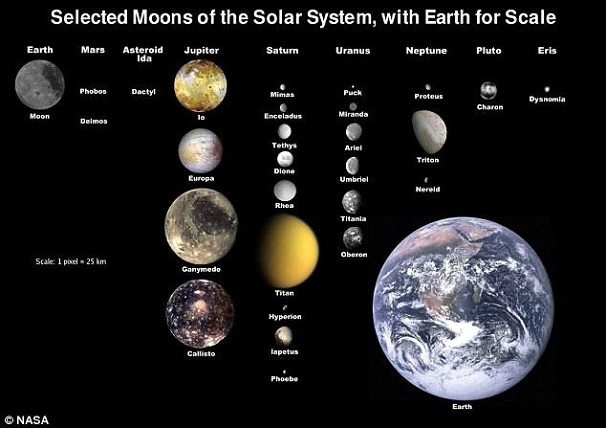
Selected moons of the solar system, with the Earth for scale. Notice that the moon is pretty big relative to Earth. But Pluto and its moon are even closer in size. Image via NASA.
Bottom line: How our planet would be different, if Earth didn’t have a moon.
Reference Link
What If the Moon Didn't Exist?: The Fun of Counterfactuals in Science
The recession of the Moon from Earth implies that the Moon is gaining energy, just as a ball can rise in the air only if it is given energy by being thrown upward. That energy given to the Moon comes from Earth, namely from our planet’s rotation – we are spinning more slowly today than we were when Earth first formed. Earth loses energy because the Moon creates tides on our rapidly spinning planet. These tides are not in a straight line between the centers of the two worlds. Rather, the high tide closest to the Moon is pulled ahead of the Moon by Earth’s rapid rotation. In turn, the water in that high tide gravitationally pulls the Moon in the direction of the Moon’s orbit, giving the Moon energy (like you would give a ball hanging on a string energy if you held the string and spun around). As a result the Moon (and the ball on the string) spiral outward. Earth, in turn, slows down because of friction between the water in the high tides and the body of Earth.
How fast Earth was originally spinning depends on how close Earth and Moon were when the Moon formed, a distance that is not yet known. The first "aha" moment for me in going through this argument came when I took reasonable assumptions for the Moon’s original distance and, using the conservation of angular momentum, calculated plausible spin rates for the young Earth. The length of the day was originally between 5 and 10 hours. Work done by Jihad Touma and Jack Wisdom (Figure 1, in a paper published after What if the Moon Didn’t Exist?) suggest a 5-hour day.
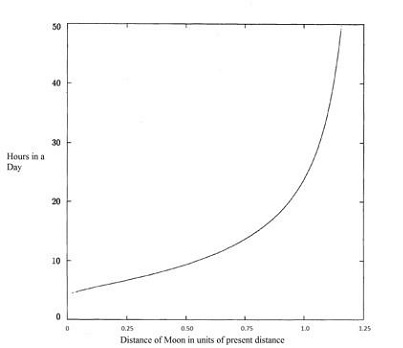
As an example of how much care one must use in creating alternative, scientifically plausible, worlds, let’s continue on with the scenario of there never having been a Moon. If it had never existed, then the tidal force from the Moon that slowed our Earth would not have occurred and Earth’s rotation rate would not have slowed due to a lunar tidal effect. Are there any other sources of tides on Earth that would have slowed it down? The answer is yes: the Sun and the planets, especially Jupiter, create tides here. But would they alone slow Earth’s rotation significantly? The tides from all the bodies except the Sun are negligible for our purposes. The Sun creates about 1/3 of the tides on Earth today, so it might seem that Earth would have slowed down 1/3 as much as it did in real life with the Moon in play. This is not correct. The vast majority of the rotational energy lost by Earth came when the Moon was young and very close to Earth. This realization led to the second "aha" moment about Earth as it is that I felt while creating a Moonless Earth. If the Moon was originally 10 times closer than it is today, the equations reveal that tides on Earth back then were 1000 times higher than they are today! (Tides vary inversely as the third power of the distance between the worlds.) Therefore, when they were young, the Moon would have been spiraling away and Earth would have been slowing down much faster than they are today. Taking this into account, tides created by the Sun on Earth without the Moon over the past 4.6 billion years would cause Earth to now be rotating with somewhere between a 7 and 12 hour day.
https://blogs.scientificamerican.com/guest-blog/what-if-the-moon-didnt-exist-the-fun-of-counterfactuals-in-science/
The Moon's Orbit
Today, the concept is widely spread that the Moon is a satellite of the Earth around which it revolves in periods of twenty-nine days. A correction must however be made to the absolutely circular form of its orbit, since modern astronomy ascribes a certain eccentricity to this, so that the distance between the Earth and the Moon (240,000 miles) is only the average distance.
We have seen above how the Quran underlined the usefulness of observing the Moon's movements in calculating time (sura 10, verse 5, quoted at the beginning of this chapter.) This system has often been criticized for being archaic, impractical and unscientific in comparison to our system based on the Earth's rotation around the Sun, expressed today in the Julian calendar.
This criticism calls for the following two remarks:
a) Nearly fourteen centuries ago, the Quran was directed at the inhabitants of the Arabian Peninsula who were used to the lunar calculation of time. It was advisable to address them in the only language they could understand and not to upset the habits they had of locating spatial and temporal reference-marks which were nevertheless quite efficient. It is known how well-versed men living in the desert are in the observation of the sky. they navigated according to the stars and told the time according to the phases of the Moon. Those were the simplest and most reliable means available to them.
b) Apart from the specialists in this field, most people are unaware of the perfect correlation between the Julian and the lunar calendar: 235 lunar months correspond exactly to 19 Julian years of 365 1/4 days. Then length of our year of 365 days is not perfect because it has to be rectified every four years (with a leap year) .
With the lunar calendar, the same phenomena occur every 19 years (Julian). This is the Metonic cycle, named after the Greek astronomer Meton, who discovered this exact correlation between solar and lunar time in the Fifth century B.C.
Reference Link