Scientific Data Surah 91 · Ayah 4
PHASE OF MOON
PHASE OF MOON
The word comes from the Latin for "balance scale" (as does the name of the zodiac constellation Libra) and refers to the way such a scale tips up and down on alternating sides. The sub-Earth point gives the amount of libration in longitude and latitude. The sub-Earth point is also the apparent center of the Moon's disk and the location on the Moon where the Earth is directly overhead.
The Moon is subject to other motions as well. It appears to roll back and forth around the sub-Earth point. The roll angle is given by the position angle of the axis, which is the angle of the Moon's north pole relative to celestial north. The Moon also approaches and recedes from us, appearing to grow and shrink. The two extremes, called perigee (near) and apogee (far), differ by about 14%.
The most noticed monthly variation in the Moon's appearance is the cycle of phases, caused by the changing angle of the Sun as the Moon orbits the Earth. The cycle begins with the waxing (growing) crescent Moon visible in the west just after sunset. By first quarter, the Moon is high in the sky at sunset and sets around midnight. The full Moon rises at sunset and is high in the sky at midnight. The third quarter Moon is often surprisingly conspicuous in the daylit western sky long after sunrise.
Reference Link
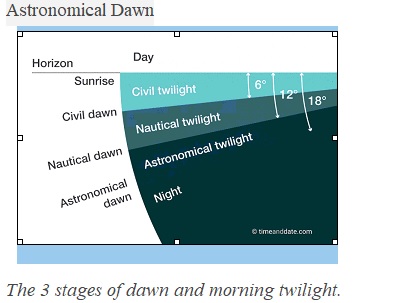
When the Sun passes the elevation angle of -18 degrees as it ascends towards the horizon before sunrise, a very small portion of its rays begin to permeate the firmament. The Earth's upper atmosphere begins to scatter and reflect the sunlight, illuminating the lower atmosphere.
However, at this point, the twilight is so faint that it is generally indistinguishable from night, especially in areas with light pollution. Astronomers may be unable to observe some of the fainter stars and galaxies as the Sun passes this mark.
Astronomical dawn marks the beginning of astronomical twilight, which lasts until nautical dawn.
Reference Link
What are day and night?
Daytime is when you can see the sun from where you are, and its light and heat can reach you. Nighttime is when the sun is on the other side of the Earth from you, and its light and heat don’t get to you.
We get day and night because the Earth is turning and sometimes you can see the sun, and sometimes you can’t. It takes 24 hours for the world to turn all the way around, and we call this a day. Over a year, the length of the daytime in the part of the Earth where you live changes. Days are longer in the summer and shorter in the winter.
Top 10 facts
⦁ It takes 24 hours for the Earth to turn all the way around. That makes one day and one night.
⦁ At any moment, half of the world is in daytime and half is in nighttime.
⦁ The world is like a ball. We call the top half the Northern hemisphere and the bottom half the Southern hemisphere. The line between them is called the equator.
⦁ In the Northern hemisphere, we have summer in June, July and August and winter is in December, January and February.
⦁ In summer the days are longer than they are in winter. In London, the longest day is about 16 hours and 39 minutes and the shortest is 7 hours and 45 minutes.
⦁ In the Southern hemisphere the seasons are the other way around. When it is summer here it is winter there. Imagine celebrating Christmas on a long, hot summer day!
⦁ To help us understand where we are in the world, we also split the world into right and left halves called the Eastern hemisphere and the Western hemisphere.
⦁ The line between the Eastern and Western hemisphere’s is called the ‘Prime Meridian’ and it goes through Greenwich Royal Observatory in London.
⦁ The world is split into time zones. France is in the time zone to the East of Britain, so time is one hour ahead there. When it is 1pm in Britain it is 2pm in France.
⦁ On the opposite side of the world from London is the International Date Line. On one side of the line time is 12 hours behind Britain, and on the other side time is 12 hours ahead of Britain. That means that it is a different day on each side of the line.
Reference Link
The Science of Better Sleep
Sleep is wonderful. It is amazing, and it is absolutely necessary for a long and happy life. So thank goodness it is so darn enjoyable.
Unfortunately, many people just can’t seem to consistently get all the rest they need. They toss and turn and don’t know what to do. They wonder what can they do if they don’t want to take medication or supplements? What actions can they take? Luckily with a little knowledge about the science of sleep and some of today’s technology, slumber nirvana is just a few steps away.
Why?
Sleep is the way your body restores itself, processes the day’s events and files the memories away. This allows you to wake up feeling energized and ready for the next day. The process of sleeping and waking up is controlled by your body’s circadian rhythm and the circadian rhythm is heavily affected by darkness and light. According to Dr. Michael J. Brues the more consistent and stable that rhythm is, the better we sleep.
How it works is really pretty cool. As night comes and it gets darker, your body starts to create a hormone called melatonin. What melatonin does is make us feel tired and gets the body ready for sleep. Once we sleep through the night and we are exposed to light, our body starts to create a hormone called serotonin which wakes us up and gives us a bunch of “start your day right” energy. This keeps us going through the day until darkness and the cycle or rhythm starts all over again.
Reference Link