Scientific Data Surah 92 · Ayah 4
What is Fire
What is Fire
Like the two sides to a coin , Allah taala has created creation with mutual contrasts - for example the physiology of the human heart is one and the same for each human being yet this same heart urges some of us to aim for that which pleases only Allah taala thereby leading to jannah and in contrast to this right at the other end of the spectrum , are those whose sole objective in life is to fulfil their own earthly desires even if that entails going against Allah in sin and kufr thereby leading one’s self to hellfire.
The Qur’an urges mankind to take heed and to follow the path of righteousness and to distance one’s self from the path of sins.
In this science section on Verse 4 of Surah Al Layl an effort shall be made to present the two completely contrasting views on the uses of fire -
Typically, fire comes from a chemical reaction between oxygen in the atmosphere and some sort of fuel (wood or gasoline, for example). Of course, wood and gasoline don't spontaneously catch on fire just because they're surrounded by oxygen. For the combustion reaction to happen, you have to heat the fuel to its ignition temperature.
Here's the sequence of events in a typical wood fire:
Something heats the wood to a very high temperature. The heat can come from lots of different things -- a match, focused light, friction, lightning, something else that is already burning...
When the wood reaches about 300 degrees Fahrenheit (150 degrees Celsius), the heat decomposes some of the cellulose material that makes up the wood.
Some of the decomposed material is released as volatile gases. We know these gases as smoke. Smoke is compounds of hydrogen, carbon and oxygen. The rest of the material forms char, which is nearly pure carbon, and ash, which is all of the unburnable minerals in the wood (calcium, potassium, and so on). The char is what you buy when you buy charcoal. Charcoal is wood that has been heated to remove nearly all of the volatile gases and leave behind the carbon. That is why a charcoal fire burns with no smoke.
The actual burning of wood then happens in two separate reactions:
When the volatile gases are hot enough (about 500 degrees F (260 degrees C) for wood), the compound molecules break apart, and the atoms recombine with the oxygen to form water, carbon dioxide and other products. In other words, they burn.
The carbon in the char combines with oxygen as well, and this is a much slower reaction. That is why charcoal in a BBQ can stay hot for a long time.
Fire Variables
In the last section, we saw that fire is the result of a chemical reaction between two gases, typically oxygen and a fuel gas. The fuel gas is created by heat. In other words, with heat providing the necessary energy, atoms in one gaseous compound break their bonds with each other and recombine with available oxygen atoms in the air to form new compounds plus lots more heat.
Only some compounds will readily break apart and recombine in this way -- the various atoms have to be attracted to each other in the right manner. For example, when you boil water, it takes the gaseous form of steam, but this gas doesn't react with oxygen in the air. There isn't a strong enough attraction between the two hydrogen atoms and one oxygen atom in a water molecule and the two oxygen atoms in an oxygen molecule, so the water compound doesn't break apart and recombine.
If the above example is explored - a relation can be drawn to those who work solely for the pleasure of Allah taala . Such a person would always be on the lookout for good deeds. He/she would try his best to help the poor/needy people living in severely frigid areas in winter , to stock up on sufficient logs of wood and matches to keep warm.
Fire helps to keep us warm in the cold , it helps us to cook , it emits light, but fire also has the capacity to cause severe harm and destruction as can be explored below :-
A side effect of these chemical reactions is a lot of heat. The fact that the chemical reactions in a fire generate a lot of new heat is what sustains the fire. Many fuels burn in one step. Gasoline is a good example. Heat vaporizes gasoline and it all burns as a volatile gas. There is no char. Humans have also learned how to meter out the fuel and control a fire. A candle is a tool for slowly vaporizing and burning wax.
As they heat up, the rising carbon atoms (as well as atoms of other material) emit light. This "heat produces light" effect is called incandescence, and it is the same kind of thing that creates light in a light bulb. It is what causes the visible flame. Flame color varies depending on what you're burning and how hot it is. Color variation within in a flame is caused by uneven temperature. Typically, the hottest part of a flame -- the base -- glows blue, and the cooler parts at the top glow orange or yellow.
In addition to emitting light, the rising carbon particles may collect on surrounding surfaces as soot.
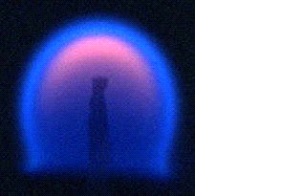
Fire forms a sphere in microgravity.
[PHOTO COURTESY NASA]
The dangerous thing about the chemical reactions in fire is the fact that they are self-perpetuating. The heat of the flame itself keeps the fuel at the ignition temperature, so it continues to burn as long as there is fuel and oxygen around it. The flame heats any surrounding fuel so it releases gases as well. When the flame ignites the gases, the fire spreads.
On Earth, gravity determines how the flame burns. All the hot gases in the flame are much hotter (and less dense) than the surrounding air, so they move upward toward lower pressure. This is why fire typically spreads upward, and it's also why flames are always "pointed" at the top. If you were to light a fire in a microgravity environment, say onboard the space shuttle, it would form a sphere!
The most flammable compounds contain carbon and hydrogen, which recombine with oxygen relatively easily to form carbon dioxide, water and other gases.
Different flammable fuels catch fire at different temperatures. It takes a certain amount of heat energy to change any particular material into a gas, and even more heat energy to trigger the reaction with oxygen. The necessary heat level varies depending on the nature of the molecules that make up the fuel. A fuel's piloted ignition temperature is the heat level required to form a gas that will ignite when exposed to a spark. At the unpiloted ignition temperature, which is much higher, the fuel ignites without a spark.
The fuel's size also affects how easily it will catch fire. A larger fuel, such as a thick tree, can absorb a lot of heat, so it takes a lot more energy to raise any particular piece to the ignition temperature. A toothpick catches fire more easily because it heats up very quickly.
A fuel's heat production depends on how much energy the gases release in the combustion reaction and how quickly the fuel burns. Both factors largely depend on the fuel's composition. Some compounds react with oxygen in such a way that there is a lot of "extra heat energy" left over. Others emit a smaller amount of energy. Similarly, the fuel's reaction with oxygen may happen very quickly, or it may happen more slowly.
The fuel's shape also affects burning speed. Thin pieces of fuel burn more quickly than larger pieces because a larger proportion of their mass is exposed to oxygen at any moment. For example, you could burn up a pile of wood splinters or paper much more quickly than you could a block of wood with the same mass, because splinters and paper have a much greater surface area.
In this way, fires from different fuels are like different species of animal -- they all behave a little differently. Experts can often figure out how a fire started by observing how it affected the surrounding areas. A fire from a fast-burning fuel that produces a lot of heat will inflict a different sort of damage than a slow-burning, low-heat fire.
In this second part , the science data can be related to a person who is given to sins at any cost in order to satisfy his/her worldly desires. Instead of using fire to help someone, such a person would not hesitate to set on fire the property of others for various sinful reason such as - jealousy, enmity, seeking revenge. THeir short short sightedness disables them from seeing beyond the temporary shallow desires of this world and hence they easily succumb to such sins.
From this it can be understood that just as different people may strive towards opposite goals, in the same way fire can be used by a good person to help the needy or may be misused by the one who gives in to evil deeds .