Scientific Data Surah 95 · Ayah 4
Human Evolution
Human Evolution
Studies in evolutionary biology have led to the conclusion that human beings arose from ancestral primates. This association was hotly debated among scientists in Darwin's day. But today there is no significant scientific doubt about the close evolutionary relationships among all primates, including humans.
Many of the most important advances in paleontology over the past century relate to the evolutionary history of humans. Not one but many connecting links—intermediate between and along various branches of the human family tree—have been found as fossils. These linking fossils occur in geological deposits of intermediate age. They document the time and rate at which primate and human evolution occurred.
Scientists have unearthed thousands of fossil specimens representing members of the human family. A great number of these cannot be assigned to the modem human species, Homo sapiens. Most of these specimens have been well dated, often by means of radiometric techniques. They reveal a well-branched tree, parts of which trace a general evolutionary sequence leading from ape-like forms to modem humans.
Paleontologists have discovered numerous species of extinct apes in rock strata that are older than four million years, but never a member of the human family at that great age. Australopithecus, whose earliest known fossils are about four million years old, is a genus with some features closer to apes and some closer to modem humans. In brain size, Australopithecuswas barely more advanced than apes. A number of features, including long arms, short legs, intermediate toe structure, and features of the upper limb, indicate that the members of this species spent part of the time in trees. But they also walked upright on the ground, like humans. Bipedal tracks of Australopithecus have been discovered, beautifully preserved with those of other extinct animals, in hardened volcanic ash. Most of our Australopithecus ancestors died out close to two-and-a-half million years ago, while other Australopithecus species, which were on side branches of the human tree, survived alongside more advanced hominids for another million years.
Distinctive bones of the oldest species of the human genus, Homo, date back to rock strata about 2.4 million years old. Physical anthropologists agree that Homo evolved from one of the species of Australopithecus. By two million years ago, early members of Homo had an average brain size one-and-a-half times larger than that of Australopithecus, though still substantially smaller than that of modem humans. The shapes of the pelvic and leg bones suggest that these early Homo were not part-time climbers like Australopithecus but walked and ran on long legs, as modem humans do. Just as Australopithecus showed a complex of ape-like, human-like, and intermediate features, so was early Homo intermediate between Australopithecus and modem humans in some features, and dose to modem humans in other respects.
The earliest
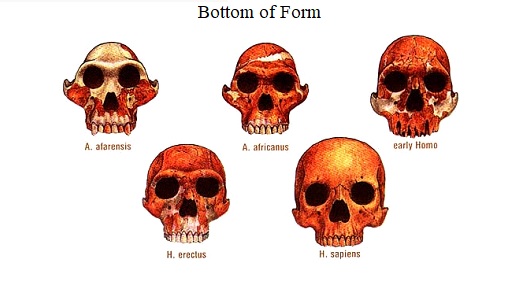
Early hominids, such as members of the Australopithecus afarensis species that lived about 3 million years ago, had smaller brains and larger faces than species belonging to the genus Homo, which first appeared about 2.4 million years ago. White parts of the skulls are reconstructions, and the skulls are not all on the same scale.
stone tools are of virtually the same age as the earliest fossils of Homo.Early Homo, with its larger brain than Australopithecus, was a maker of stone tools.
The fossil record for the interval between 2.4 million years ago and the present includes the skeletal remains of several species assigned to the genus Homo. The more recent species had larger brains than the older ones. This fossil record is complete enough to show that the human genus first spread from its place of origin in Africa to Europe and Asia a little less than two million years ago. Distinctive types of stone tools are associated with various populations. More recent species with larger brains generally used more sophisticated tools than more ancient species.
Molecular biology also has provided strong evidence of the close relationship between humans and apes. Analysis of many proteins and genes has shown that humans are genetically similar to chimpanzees and gorillas and less similar to orangutans and other primates.
DNA has even been extracted from a well-preserved skeleton of the extinct human creature known as Neanderthal, a member of the genus Homo and often considered either as a subspecies of Homo sapiens or as a separate species. Application of the molecular clock, which makes use of known rates of genetic mutation, suggests that Neanderthal's lineage diverged from that of modem Homo sapiens less than half a million years ago, which is entirely compatible with evidence from the fossil record.
Based on molecular and genetic data, evolutionists favor the hypothesis that modem Homo sapiens, individuals very much like us, evolved from more archaic humans about 100,000 to 150,000 years ago. They also believe that this transition occurred in Africa, with modem humans then dispersing to Asia, Europe, and eventually Australasia and the Americas.
Discoveries of hominid remains during the past three decades in East and South Africa, the Middle East, and elsewhere have combined with advances in molecular biology to initiate a new discipline—molecular paleoanthropology. This field of inquiry is providing an ever-growing inventory of evidence for a genetic affinity between human beings and the African apes.
Opinion polls show that many people believe that divine intervention actively guided the evolution of human beings. Science cannot comment on the role that supernatural forces might play in human affairs. But scientific investigations have concluded that the same forces responsible for the evolution of all other life forms on Earth can account for the evolution of human beings.
Reference Link
Anatomy of the human brain
The largest part of the human brain is the cerebrum, which is divided into two hemispheres, according to the Mayfield Clinic. Underneath lies the brainstem, and behind that sits the cerebellum. The outermost layer of the cerebrum is the cerebral cortex, which consists of four lobes: the frontal, parietal, temporal and occipital. [Related: Nervous System: Facts, Functions & Diseases]
Like all vertebrate brains, the human brain develops from three sections known as the forebrain, midbrain and hindbrain. Each of these contains fluid-filled cavities called ventricles. The forebrain develops into the cerebrum and underlying structures; the midbrain becomes part of the brainstem; and the hindbrain gives rise to regions of the brainstem and the cerebellum.
Human verses other animals
Overall brain size doesn't correlate with level of intelligence. For instance, the brain of a sperm whale is more than five times heavier than the human brain but humans are considered to be of higher intelligence than sperm whales. The more accurate measure of how intelligent an animal may be is the ratio between the size of the brain and the body size, according to the University of California San Diego's Temporal Dynamics of Learning Center.
Among humans, however, brain size doesn't indicate how smart someone is. Some geniuses in their field have smaller- than-average brains, while others larger than average, according to Christof Koch, a neuroscientist and president of the Allen Institute for Brain Science in Seattle. For example, compare the brains of two highly acclaimed writers. The Russian novelist Ivan Turgenev's brain was found to be 2,021 grams, while writer Anatole France's brain weighed only 1,017 grams.
Humans have a very high brain-weight-to-body-weight ratio, but so do other animals. The reason why the human's intelligence, in part, is neurons and folds. Humans have more neurons per unit volume than other animals, and the only way to do that with the brain's layered structure is to make folds in the outer layer, or cortex, said Eric Holland, a neurosurgeon and cancer biologist at the Fred Hutchinson Cancer Research Center and the University of Washington.
"The more complicated a brain gets, the more gyri and sulci, or wiggly hills and valleys, it has," Holland told Live Science. Other intelligent animals, such as monkeys and dolphins, also have these folds in their cortex, whereas mice have smooth brains, he said.
Humans also have the largest frontal lobes of any animal, Holland said. The frontal lobes are associated with higher-level functions such as self-control, planning, logic and abstract thought — basically, "the things that make us particularly human," he said.
Left brain verses right brain
The human brain is divided into two hemispheres, the left and right, connected by a bundle of nerve fibers called the corpus callosum. The hemispheres are strongly, though not entirely, symmetrical. The left brain controls all the muscles on the right-hand side of the body and the right brain controls the left side. One hemisphere may be slightly dominant, as with left- or right-handedness.
The popular notions about "left brain" and "right brain" qualities are generalizations that are not well supported by evidence. Still, there are some important differences between these areas. The left brain contains regions involved in speech and language (called the Broca's area and Wernicke's area, respectively) and is also associated with mathematical calculation and fact retrieval, Holland said. The right brain plays a role in visual and auditory processing, spatial skills and artistic ability — more instinctive or creative things, Holland said — though these functions involve both hemispheres. "Everyone uses both halves all the time," he said.
Reference Link
How Your Brain Works:
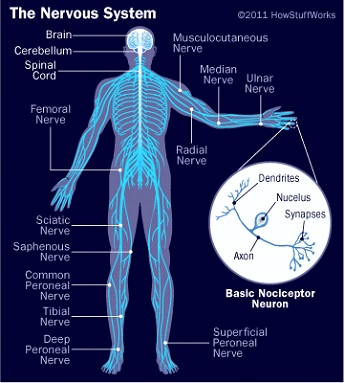
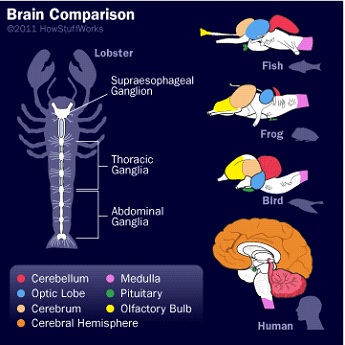
Every animal you can think of -- mammals, birds, reptiles, fish, amphibians -- has a brain. But the human brain is unique. Although it's not the largest, it gives us the power to speak, imagine and problem solve. It is truly an amazing organ.
The brain performs an incredible number of tasks including the following:
⦁ It controls body temperature, blood pressure, ⦁ heart rate and breathing.
⦁ It accepts a flood of information about the world around you from your various senses (⦁ seeing, ⦁ hearing, ⦁ smelling, ⦁ tasting and touching).
⦁ It handles your physical movement when walking, talking, standing or sitting.
⦁ It lets you think, ⦁ dream, reason and experience emotions.
All of these tasks are coordinated, controlled and regulated by an organ that is about the size of a small head of cauliflower.
Your brain, spinal cord and peripheral nerves make up a complex, integrated information-processing and control system known as your central nervous system. In tandem, they regulate all the conscious and unconscious facets of your life. The scientific study of the brain and nervous system is called neuroscienceor neurobiology. Because the field of neuroscience is so vast -- and the brain and nervous system are so complex -- this article will start with the basics and give you an overview of this complicated organ.
We'll examine the structures of the brain and how each section controls our daily functions, including motor control, visual processing, auditory processing, sensation, learning, memory and emotions.
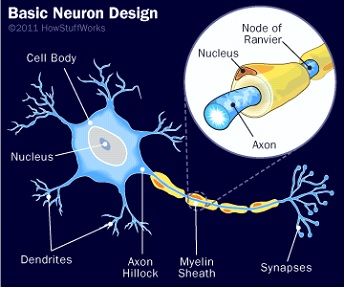
Your brain is made of approximately 100 billion nerve cells, called neurons. Neurons have the amazing ability to gather and transmit electrochemical signals -- think of them like the gates and wires in a computer.
Neurons share the same characteristics and have the same makeup as other cells, but the electrochemical aspect lets them transmit signals over long distances (up to several feet or a few meters) and send messages to each other.
Reference Link
⦁
Reference Link
⦁
Reference Linkl
⦁
Reference Link
⦁
Reference Link