Scientific Data Surah 96 · Ayah 1
The Larynx- Voice box
The Larynx- Voice box
WHERE IS THE LARYNX?
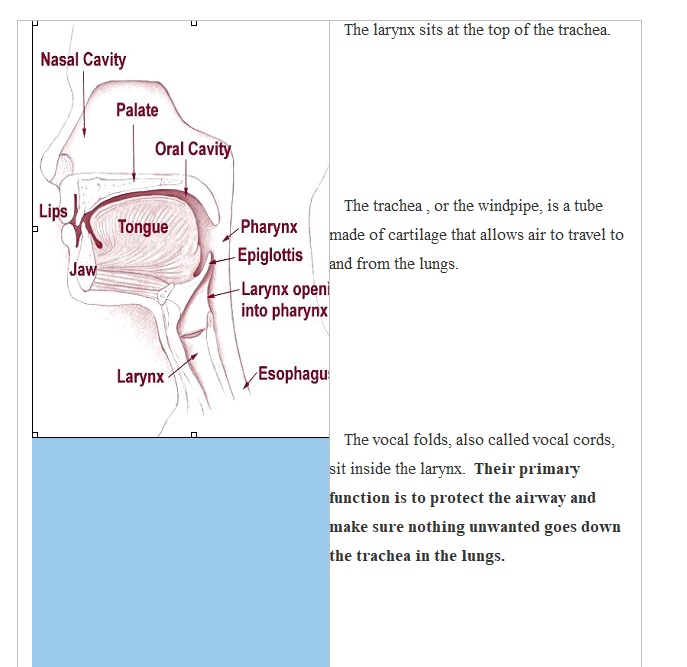
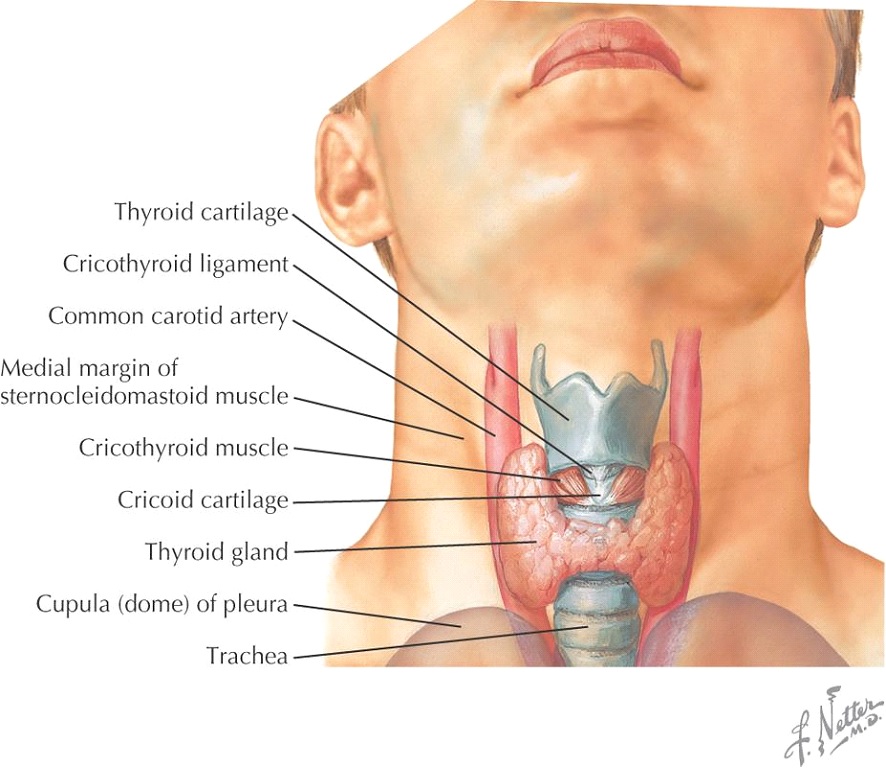
WHAT IS THE LARYNX MADE OF?
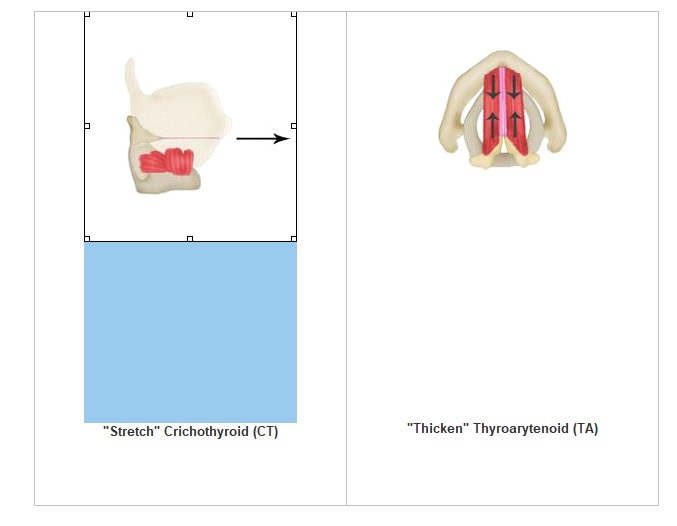
The vocal folds are attached to the cartilages. The 2 main cartilages can rock and glide on top of each other to change the vocal folds' shape.
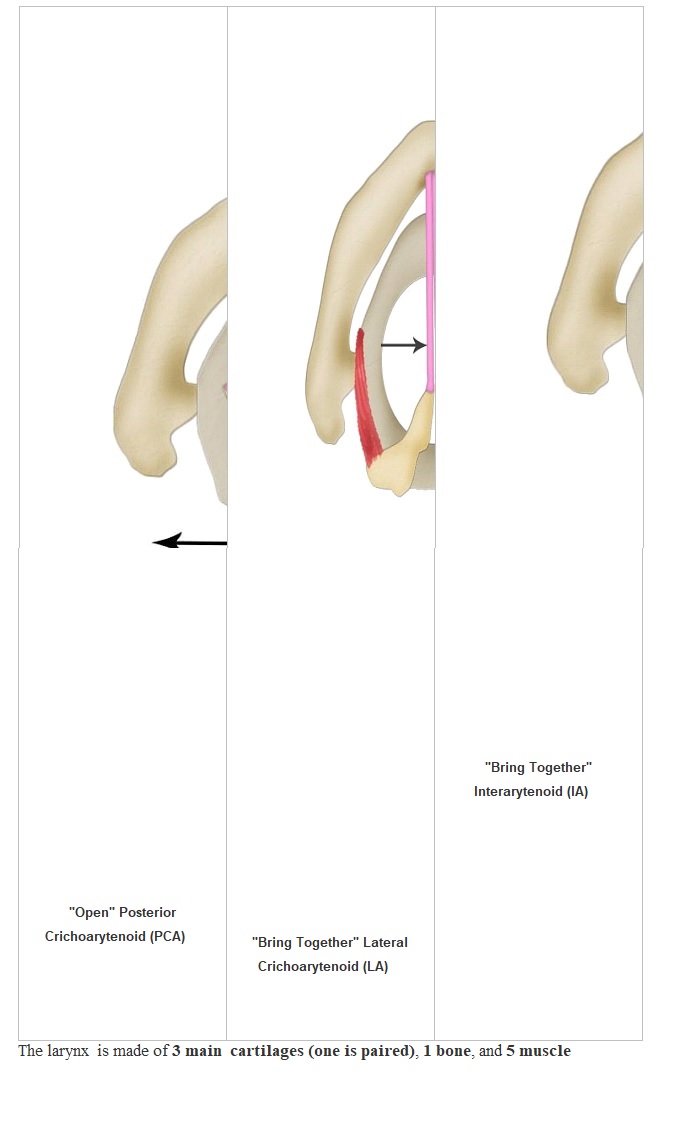
There are muscles that help bring the vocal folds together.
The vocal folds come together to
a) keep unwanted particles out of the lungs
b) stop airflow
c) phonate (i.e. make sound, speaking, singing)
There are muscles that open the vocal folds.
The vocal folds open to
a) let air in (inhalation/inspiration)
b) let air out (exhalation/expiration)
The opening and closing muscles are antagonistic (when one activates, the other has to release).
There are muscles that stretch and thin the vocal folds
In phonation, when the vocal folds stretch they
a) change the pitch created by the vocal folds
b) increase tension on the vocal folds to create higher pitches
There are muscles that shorten and thicken the vocal folds
In phonation, when the vocal folds thicken they
a) contribute to a 'heavier' sound
b) contribute to a 'louder' sound
c) decrease tension on the vocal folds to create lower pitches
The stretching and thickening muscles are antagonistic (when one activates, the other has to release).
WHAT'S THE LARYNX'S PURPOSE IN THE BODY?
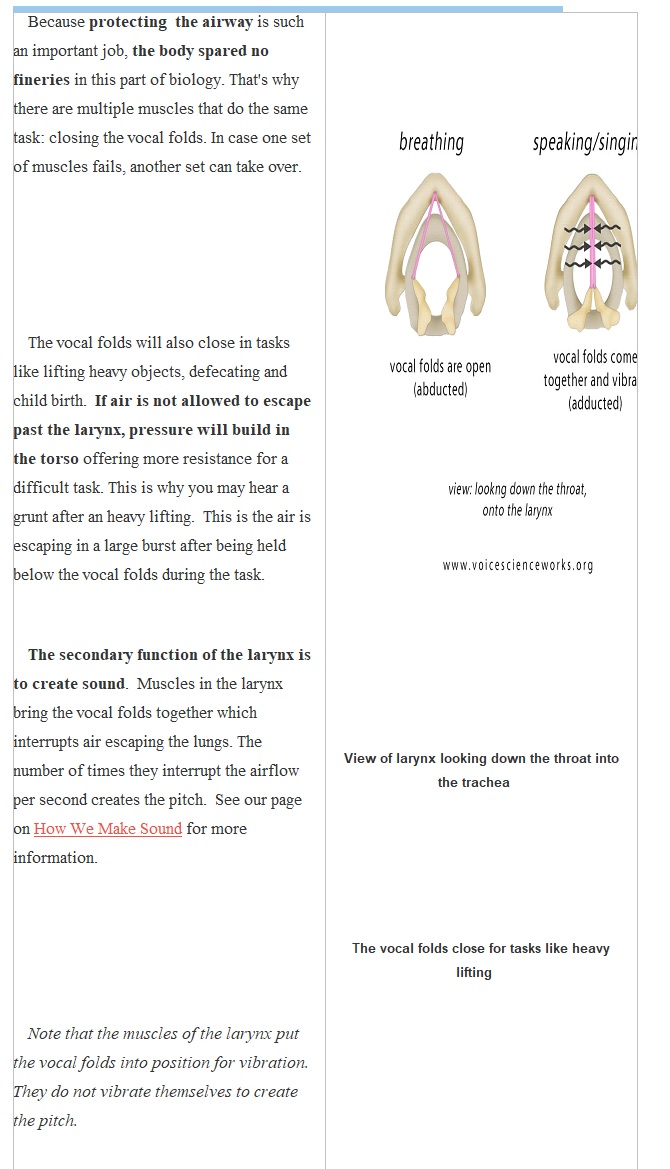
HOW DOES THE LARYNX CONTRIBUTE TO THE SOUND BEING MADE?
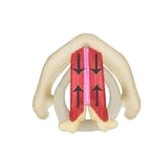
The Thickening Muscle (The TA muscle)
When the heavy muscle that shortens and thickens the vocal folds is active, a larger bulk of the folds is active in vibration.
This affects the quality of the sound.
For lower notes, the folds vibrate slower and therefore can remain shorter and thicker. For higher notes, the folds vibrate faster. It can be easier to allow just the edges of the folds to vibrate, meaning the TA Heavy Muscle will be have to be less active.
This is likely where we get language like
"let go as you get higher", "don't push the top note", "turn it over, transition early","don’t bring up the weight"
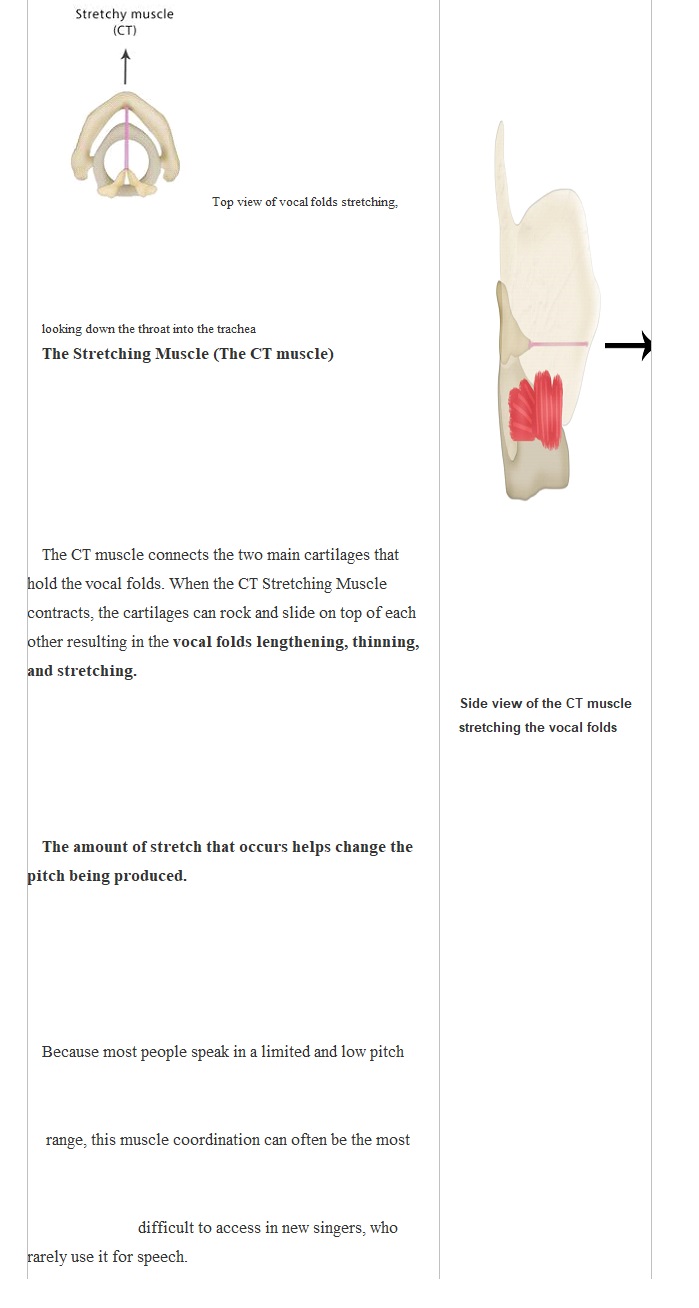
Trade Off Between Muscles
The heavy thickening muscle (TA) and the stretching thinning muscle (CT) are considered antagonistic. As one increases activeness, the other must decrease.
When people experience a crack or break in the voice, it may be a result of the shortening muscle and the stretching muscle having an unbalanced trade off in muscle activeness.
The vocal folds themselves are a highly specialized combination of muscle, ligament, and mucosa. The vocal ligament is of particular interest, because it is able to bear significant amounts of pressure. This is one reason why the human vocal folds are able to phonate over such a large range of notes. In the image below, the thin pink line represents the vocal ligament.
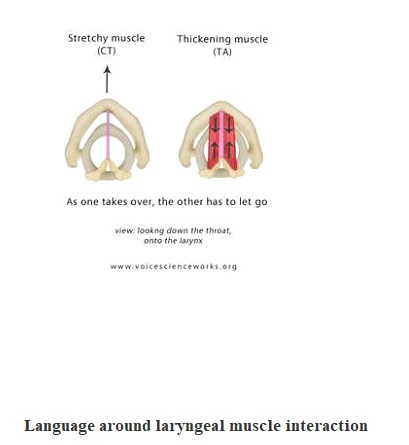
<p>When we begin to understand laryngeal muscle function, we create opportunities to speak with greater clarity about the voice. Traditional voice terminology uses terms like "head voice" and "chest voice" to describe vocal registers. Laryngeally speaking, most of what defines the difference between these two metaphors focuses on a singular event in the voice known by various labels like "break, crack, flip, etc." Everyone who has tried to glide across their range from low to high has felt this event. Without getting too deep into the weeds of the "registration" discussion, when we choose to view the voice as a wider collection of events than just the one "break", new opportunities open up.</p>
<p>To discuss the differences in laryngeal activity in ways that don't depend upon the "break", we like to use terminology that focuses on muscle engagement and interaction. For example, when a sound has more harmonics overall (described as brighter, bigger, heavier, etc.), more of the muscle mass of the vocal folds (thickening muscle, or TA) is in contact. By contrast, when a sound has fewer harmonics overall (described as warmer, richer, pure, etc.) less of the muscle mass of the vocal folds (thickening muscle, or TA) is in contact. In this configuration, they might even be in a ligament-dominant posture, meaning that the thickening muscle isn't touching at all. The benefit of describing laryngeal muscle interaction with this kind of language is that, this example provides two points of distinct information that align with science, and are visible in a spectrogram such that a vocalist can see them in addition to hearing them.</p>
<p>Other actions of the vocal folds can be described in similar ways. We've found that when we allow our more metaphoric/less specific language to recede from our vocabulary and be replaced by specific language, learning increases at a rapid pace, and future confusion tends to be replaced by exciting questions.</p>
<p>Some people prefer the terms "mode 1" and "mode 2" to replace the metaphoric "chest" and "head". Where the more traditional "chest" and "head" describe the entire vocal event (including breath pressure, vocal fold vibration, and acoustic resonance), the mode1/mode 2 terminology focuses specifically on laryngeal events. Note that Ingo Titze uses "modal" and "Falsetto" in Principals of Voice Production, for similar reasons.* This change that allows for specific attention to the vocal folds is welcome. Yet, where specific language can be used, as described above, we encourage it.</p>
<p>Here are some of the events and language that we use</p>
<p>Muscle mass variations</p>
<p>The amount of the thickening muscle (TA) that touches during vocal fold vibration impacts the energy in the harmonics produced. When more muscle mass touches during vibration, all harmonics have more energy, when less touches, all harmonics have less energy. <br />We like to use our hands to demonstrate this, showing the palms and fingers in vibration for the full muscle mass, and fewer fingers for less muscle mass, flipping to the first fingers alone for a ligament-dominant position.</p>
<p>When the thickening muscle (TA) is in vibration, it assumes the bulk of the strain on the vocal folds. When the thickening muscle (TA) is not in vibration, that is, when the folds are on their edges, the vocal ligament assumes the bulk of the strain on the vocal folds.</p>
<p>Three important elements to remember: <br />1) The stretchy (CT) and thickening (TA) muscles are always both in use, and in a constant, rapidly-changing dance with one another. There isn't a moment when one stops and the other starts. There is, however, a moment when the thickening (TA) muscle is no longer touching, and therefore no longer in vibration.</p>
<p>2) There are countless variations of how the thickening muscle (TA) can be in vibration. When the full muscle mass touches during vocal fold vibration, for example, vocalists create the greatest amount of harmonic output. If that outcome is desirable, knowing how it feels and sounds will be important for recreating it. The same can be said of any muscle mass configuration.</p>
<p>3) Without the most sophisticated equipment, a vocalist can't be sure of exactly how much muscle mass is in vibration. We use our ears and understanding of the instrument to get a general idea of muscle use. The need to generalize often leads people to narrow their options to two or three (head, chest, and mix, for example), yet, countless options actually exist. Finding ways to create greater clarity and measurable repetition can be delightful explorations.</p>
<p>Opening and Bring Together Muscles</p>
<p>The interplay between the opening (PCA) and bring together (LCA and IA) muscles can influence sound output in significant ways. The engagement of these muscles often depends upon how acoustic back pressure aligns with breath pressure from below. When acoustic alignment is insufficient to meet breath pressure demands, the bring together (LCA and IA) further engage to ensure continued phonation. This can often result in a "pressed" sound. If the bring together muscles (LCA and IA) respond slowly, or without focus, a "breathy" sound can result. Like the stretchy (CT) and thickening (TA) muscle interaction, there are countless variations in the rapid dance that the opening (PCA) and bring together (LCA and IA) muscles engage in.</p>
<p>Johan Sundberg in The Science of the Singing Voice, uses the terms "breathy", "pressed", and "flow" to describe three potential postures of the opening (PCA) and bring together (LCA and IA) muscles. Breathy and pressed are described above. "Flow" phonation generally describes a posture wherein acoustic back pressure and breath pressure are more equalized, allowing the opening (PCA) and bring together (PCA and IA) muscles to interact with greater ease. (Sundberg, Johan. The Science of the singing Voice. Northern Illinois University press, 1987, pg 79-85).</p>
<p>Maximum Flow Declination Rate</p>
<p>How quickly the vocal folds come together adds another important element to the overall discussion. The scientific measurement for this element is the "maximum flow declination rate." Simply put, it means the rate at which the flow of air from the beneath the vocal folds stops. For simple shorthand, you can refer to it as the "closing rate". Remember that each time the vocal folds are in full contact, the air flow ceases for that moment. This "full closure" moment is essential for creating sound. How quickly that air flow cessation occurs influences energy in the harmonic output. If the folds come together very quickly, all of the harmonics have increased energy. If the folds come together more slowly, the harmonics have less energy. Hearing the maximum flow declination rate (or "closing rate") as an unique contribution to sound can be difficult. Like laryngeal muscle interaction, it's impossible to assess specifically without sophisticated equipment. Software like VoxInSilico and Voce Vista's EGG capacity create distinct visual assessments to measure the "closing rate." Being aware of its important contribution, however, can open the ears to new variables in the overall sound, and lead to new language choices.</p>
<p>The Break</p>
<p>As mentioned above, the interaction between a muscle-dominant vocal fold posture and ligament-dominant vocal fold posture can sometimes feel like a singular event. This transition can be one in which the strain on the vocal folds transfers directly from the thickening muscle (TA) to the vocal ligament, but, it can also be more gradual. When the dance between the stretchy (CT) and thickening (TA) muscles meets an abrupt transition such that the amount of vocal fold mass leaps from thickening muscle (TA) dominant position to a ligament dominant position, the entire mechanism (breath pressure, vocal fold mass, and acoustics) destabilizes for a moment, creating an auditory "break" in the sound, and a sharp physical and emotional response. We choose to see this event as a part of the mechanism as a whole, rather than defining vocalization by it. There are many physical and acoustic approaches to helping the stretchy (CT) and thickening (TA) muscles learn to coordinate smoothly. By contrast, some styles like yodeling require that this event be emphasized. Psychological attention to allowing this transition to be an acceptable part of the process can often be as important.</p>
<p>Remember that the vocal folds are highly complex structures, and we can't feel them. Learning to track sensations that accompany the many and varied vocal fold adjustments can be a tricky business, but can also lead to some distinctly reliable information. The transition moment can occur at many points across the vocal range, sometimes by choice, and sometimes without intention. Learning to navigate this event can be an important part of voice training.</p>
<p>*Ingo Titze defines the interplay between stretchy (CT) and thickening (TA) muscles as such: "The thyroarytenoid (TA) muscle, which is known to be active in modal register [mode 1], bulges the vocal fold medially below the level of the vocal processes [where the vocal folds connect to the arytenoid cartilages]. This creates a thicker and deeper vibrating structure. In falsetto register [mode 2]...the ligament is called upon to support the longitudinal tension. In modal register [mode 1], the entire cover (including the ligament) is lax and the TA muscle is used to regulate the effective tension of the vocal fold." (Titze, Ingo R. Principles of Voice Production, page 291.)<br />Link: Reference Link </p>