Ayat 1
قُلْ يَٰٓأَيُّهَا ٱلْكَٰفِرُونَ.(1)
Say, O disbelievers,(1) [Al-Kaafiroon: 1]
Section 01
Traditional understanding
Translation, tafseer from classical and modern scholars, transliteration, word-by-word grammar.
Translation Sahih International
Say, O disbelievers,(1)
Virtues and Characteristics of the Surah:
Sayyidah 'Aishah & reports that the Messenger of Allah has said that it is better to recite two surahs in the sunnah prayer of fajr, namely, the Surah Al Kafirun and Surah Al-Ikhlas. [Transmitted by Ibn Hisham as quoted by Mazharil. Ibn Kathir cites several traditions in which a large number of Companions report that they heard the Messenger of Allah often recite Surah Al Kafirun and Al-Ikhlas in the sunnah prayer of fajr and maghrib. Some of the Companions requested the Messenger of Allah to teach them some supplications to recite at the time of sleeping. He taught them to recite Surah Al Kafirun and said that this will give them immunity from idolatry. [Transmitted by Tirmidhi; and Abu Dawud].
(1)Although the Holy Prophet (upon whom be peace) has been commanded to tell this to the disbelievers plainly, the theme that follows makes it explicit that every believer should tell the disbelievers plainly what has been said in the following verses; so much so that the person who has just believed and repented of kufr is also bound to express similarly his disgust with and disapproval of the creed and rites of worship and gods of kufr. Thus, though the first addressee of the word qul (say) is the Holy Prophet (upon whom be peace) himself, the command is not restricted to him alone but it reaches every believer through him.
(2)The word "kafir' is no abuse, which might have been used for the addressees of this verse, but it implies the one who refuses to believe, or is an unbeliever. As against it the word "mu min" is used for the believer. Therefore, the Holy Prophet's saying, by Allah's command, "O disbelievers, ... ', in fact, means: "O you, who have refused to believe in my apostleship and in the teachings brought by me." Likewise. when a believer uses this word, it will imply those who do not believe in the Holy Prophet Muhammad (upon whom be Allah's peace and blessings),
(3) The word used is "O kafirs" and not "O mushriks"; therefore, the addressees are not only the mushriks but all those people who do not acknowledge Muhammad (upon whom be Allah's peace and blessings) as Allah's Messenger and the teachings and guidance brought by him as the teaching and guidance given by Allah Himself, whether they be Jews, Christians, Zoroastrians or the disbelievers, polytheists and pagans of the entire world. There is no reason why this address be restricted to the pagans of Quraish or of Arabia only.
(4) To address the deniers with the word "O kafirs" is just like addressing certain people as "O enemies", or "O opponents". Such an address is not, in fact, directed to the person of the addressee but it is made on the basis of their characteristic of enmity and opposition, and lasts only until they are so characterized. If one of them gives up enmity and opposition, or turns a friend and supporter, he no longer remains the addressee of this word. Likewise, the address of "O kafirs" to the people also is in view of their characteristic of kufr and not their person. This address would be perpetual for him who continues to be a kafir till death, but the one who believes will no longer be its addressee.
(5) Many scholars from among the commentators have expressed the opinion that in this Surah the address of "O disbelievers" applied only to a few persons of Quraish, who were visiting the Holy Prophet (upon whom be peace) with proposals of compromise regarding religion and about whom Allah had informed His Messenger than they would not believe. They have formed this opinion for two reasons. First, that it is followed by La a`budu ma ta`budun: "I do not worship him or those whom you worship" . They say that this does not apply to the Jews and Christians, for they worship Allah. Second, that this is also followed by: wa la antum `abiduna ma a`bud "Nor are you worshipers of Him Whom I worship". Their reasoning is that this statement does not apply to the people who at the revelation of this Surah were disbelievers but later believed. Both these arguments are incorrect. As for these verses, their explanation that follows will show that they do not bear the meaning which has been understood from them. Here, to point out the error of the reasoning it would be enough to say that if the addressees of this Surah were only these people, why then does this Surah still continue to be recited when they are dead and gone from the world long long ago? And what was the need of making this Surah a part of the Qur'an permanently so that the Muslims should continue to read it for ever afterwards?
Transliteration
Ayah 1
Qul ya ayyuha alkafiroona
Word-by-word
Ayah 1
| # | Arabic | Pronunciation | Meaning | Root |
|---|---|---|---|---|
| 1 | قُلْ | Qul | Say | ق و ل |
| 2 | يَاأَيُّهَا | Yaayyuha | O | — |
| 3 | الْكَافِرُونَ | alkafiroona | disbelievers! | ك ف ر |
Section 02
Cross-references
Similar verses elsewhere in the Qur’an and authentic ahadith narrated about this ayah.
Section 03
Articles & resources
Long-form articles, scientific commentary, and historical context linked from the legacy archive.
Section 04
Audio & video lectures
12 videos · 6 audio lectures from contemporary scholars.
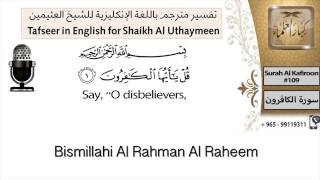 Tafseer of Surah Al-Kafiroon - Shaykh Ibn Al-Uthaymeen
haykh Ibn Al-Uthaymeen
Video · youtube
Tafseer of Surah Al-Kafiroon - Shaykh Ibn Al-Uthaymeen
haykh Ibn Al-Uthaymeen
Video · youtube
Tafseer of Surah Al-Kafiroon - Shaykh Ibn Al-Uthaymeen
haykh Ibn Al-Uthaymeen
Video · youtube
Tafseer of Surah Al-Kafiroon - Shaykh Ibn Al-Uthaymeen
haykh Ibn Al-Uthaymeen
Video · youtube
 1/4- Tafseer Surah Al-Kafirun : Surah An-Nasr By Dr. Israr Ahmed
Dr. Israr Ahmed
Video · youtube
1/4- Tafseer Surah Al-Kafirun : Surah An-Nasr By Dr. Israr Ahmed
Dr. Israr Ahmed
Video · youtube
1/4- Tafseer Surah Al-Kafirun : Surah An-Nasr By Dr. Israr Ahmed
Dr. Israr Ahmed
Video · youtube
1/4- Tafseer Surah Al-Kafirun : Surah An-Nasr By Dr. Israr Ahmed
Dr. Israr Ahmed
Video · youtube
 Tafseer of Surah 109 - Kafirun - Nouman Ali Khan
Nouman Ali Khan
Video · youtube
Tafseer of Surah 109 - Kafirun - Nouman Ali Khan
Nouman Ali Khan
Video · youtube
Tafseer of Surah 109 - Kafirun - Nouman Ali Khan
Nouman Ali Khan
Video · youtube
Tafseer of Surah 109 - Kafirun - Nouman Ali Khan
Nouman Ali Khan
Video · youtube
 In Depth Analysis & Tafseer of Surah 109 al-Kafirun by Nouman Ali Khan
Nouman Ali Khan
Video · youtube
In Depth Analysis & Tafseer of Surah 109 al-Kafirun by Nouman Ali Khan
Nouman Ali Khan
Video · youtube
In Depth Analysis & Tafseer of Surah 109 al-Kafirun by Nouman Ali Khan
Nouman Ali Khan
Video · youtube
In Depth Analysis & Tafseer of Surah 109 al-Kafirun by Nouman Ali Khan
Nouman Ali Khan
Video · youtube
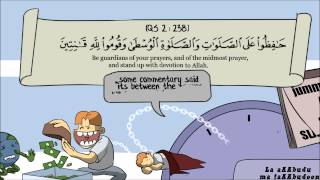 Worshipper or Slave of God? | Surah Al Kafiroun illustrated lesson | Subtitled
Nouman Ali Khan
Video · youtube
Worshipper or Slave of God? | Surah Al Kafiroun illustrated lesson | Subtitled
Nouman Ali Khan
Video · youtube
Worshipper or Slave of God? | Surah Al Kafiroun illustrated lesson | Subtitled
Nouman Ali Khan
Video · youtube
Worshipper or Slave of God? | Surah Al Kafiroun illustrated lesson | Subtitled
Nouman Ali Khan
Video · youtube
 Why do Muslims abuse non-Muslims by calling them 'Kafirs'? Dr Zakir Naik (Urdu)
Dr. Zakir Naik
Video · youtube
Why do Muslims abuse non-Muslims by calling them 'Kafirs'? Dr Zakir Naik (Urdu)
Dr. Zakir Naik
Video · youtube
Navaid Aziz – 26 Tafsir Juz E Amma Surah Al Kafirun
Navaid Aziz
Audio lecture
Navaid Aziz – 26 Tafsir Juz E Amma Surah Al Kafirun
Navaid Aziz
Audio lecture
Nouman Ali Khan – 109 Kafirun A
Nouman Ali Khan
Audio lecture
Nouman Ali Khan – 109 Kafirun A
Nouman Ali Khan
Audio lecture
Nouman Ali Khan – 109 Kafirun B
Nouman Ali Khan
Audio lecture
Nouman Ali Khan – 109 Kafirun B
Nouman Ali Khan
Audio lecture
Why do Muslims abuse non-Muslims by calling them 'Kafirs'? Dr Zakir Naik (Urdu)
Dr. Zakir Naik
Video · youtube
Why do Muslims abuse non-Muslims by calling them 'Kafirs'? Dr Zakir Naik (Urdu)
Dr. Zakir Naik
Video · youtube
Navaid Aziz – 26 Tafsir Juz E Amma Surah Al Kafirun
Navaid Aziz
Audio lecture
Navaid Aziz – 26 Tafsir Juz E Amma Surah Al Kafirun
Navaid Aziz
Audio lecture
Nouman Ali Khan – 109 Kafirun A
Nouman Ali Khan
Audio lecture
Nouman Ali Khan – 109 Kafirun A
Nouman Ali Khan
Audio lecture
Nouman Ali Khan – 109 Kafirun B
Nouman Ali Khan
Audio lecture
Nouman Ali Khan – 109 Kafirun B
Nouman Ali Khan
Audio lecture
References
- Tafseer — Abdullah Yusuf
- Tafseer — Dr. Farooq Azam
- Tafseer — Ibn Abbas
- Tafseer — Jalalain
- Tafseer — Ma’arif Ul-Quran
- Tafseer — Mufti Taqi Usmani
- Tafseer — Shaikh Ashiq Ilahi
- Tafseer — Tafheem Ul-Quran
- Translation — Sahih International
- Hadith collections — 6 narrations from Bukhari, Muslim, Tirmidhi, Abu Dawud and others (see Cross-references)
- Linked articles — 6 long-form pieces