Scientific Data Surah 88 · Ayah 12
Do They not Look At the Camel
Do They not Look At the Camel
This is the creation of Allah: the camel
Camels have lived in some of the most desolate corners of our planet, and not only do they live, they thrive. Most large animals are unable to survive in these kinds of desolate places. This is because of their large requirement for resources such as food and water. Camels are able to use this to ther advantage as a survival strategy.
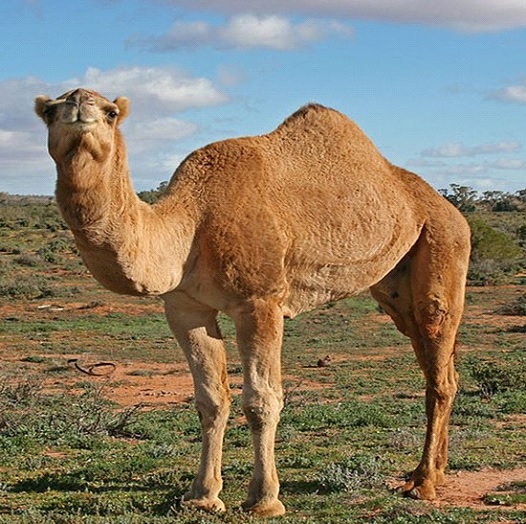
Allah almighty had supported this animal with some characteristics to enable it to live in desert in unbearable circumstances. The question is why the nature or coincidence did support that animal with these characteristics and didn't support the others!!!?
Camels can travel long distances which allow them to take advantage of the maximum number of resources. They can withstand a massive amount of dehydration which allows them to survive not only between watering holes, but sometimes between seasons. For food, camels are omnivorous. They can eat almost anything be it vegetation, meat, or bone, -- salty or sweet, a camels stomach knows no limits.
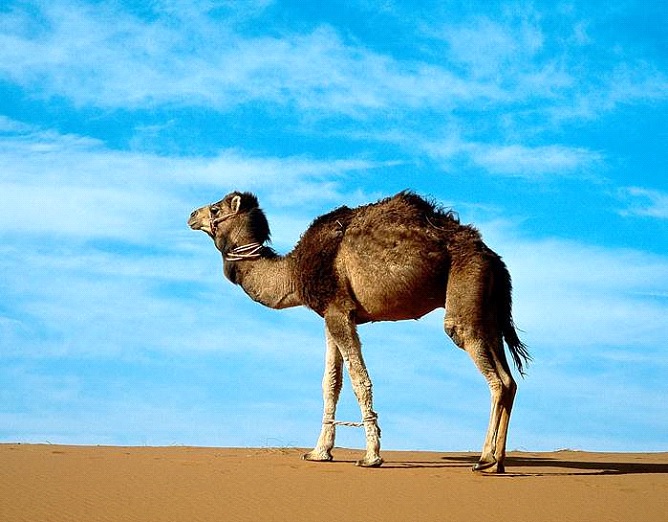
Look at this beautiful creation, when we see that we have to remember Allah's saying: (Say: "Have ye seen (these) 'Partners' of yours whom ye call upon besides God? Show me what it is they have created in the (wide) earth. Or have they a share in the heavens?)(Sûrat Fatir- verse40)
General Characteristics of the camel:
The camel's body Length is 300 cm (10ft) and its Shoulder Height is 180-210 cm (6-7 ft). The Tail Length of the camel is 50 cm (20in) and its weight is from 600 to1000 kg (1320-2200 lb).
The smooth coat is beige to light brown in wild-type individuals, with the undersides slightly lighter. The legs are long and slender, with callousness on the 'knees' where they touch the ground when the animal is lying down. Though often called the one-humped camel, the dromedary has two humps used for energy storage in the form of fat. The under-developed anterior hump sits over the shoulders and the large rear hump is found in the centre of the back. The upper lip is deeply split, and the nostrils can be closed. There are long eyelashes, which help to keep sand out of the eyes. The two broad toes on the feet are able to spread widely as an adaptation to walking on sand.
Ecology and Behavior
The ability of the camel to survive in desert conditions without water for long periods of time is rivaled by none. The many physiological adaptations the dromedary has even earned it the title "ship of the desert". Dromedaries can glean much of their needed water from desert vegetation, and can survive after losing over 40 percent of their body weight in water.
When water is available (fresh or salty), camels drink well - up to 57 liters at a time. Camels also have a flexible 'thermostat', and will not start sweating until their body temperature reaches 42oC / 107.5oF. Nor do heating mechanisms kick in during the cooler nights until the internal temperature reaches 34oC / 92oF. Besides saving energy, this physiological adaptation allows the camel to "store" coolness in preparation for the next day. On hot days, dromedaries will rest together in closely packed groups, with reduces the heat reflecting off of the ground considerably.
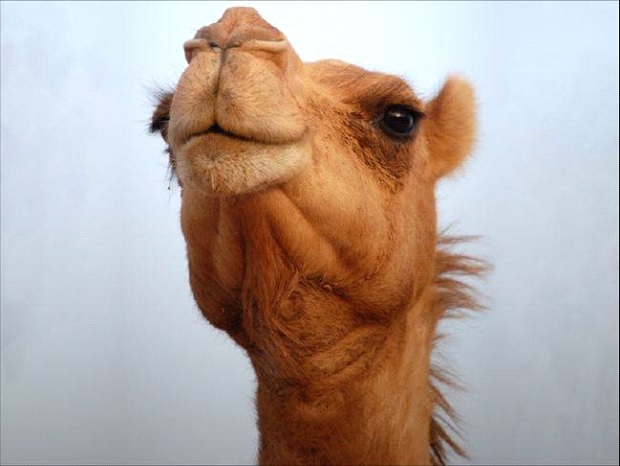
The mouth is very sturdy, able to chew thorny desert plants. Long eyelashes and ear hairs, together with sealable nostrils, form a barrier against sand. Their gait and their widened feet help them move without sinking into the sand
Also to save water the kidneys and intestine of a camel are very efficient at retaining water. Urine comes out as thick syrup, and their feces are so dry that they can fuel fires. Camels do not store water in their humps as is commonly believed. The humps are actually a reservoir of fatty tissue. Concentrating body fat in their humps minimizes heat-trapping insulation throughout the rest of their body, which may be an adaptation to living in hot climates. When this tissue is metabolized, it acts as a source of energy, and yields more than 1 g of water for each 1 g of fat converted through reaction with oxygen from air.
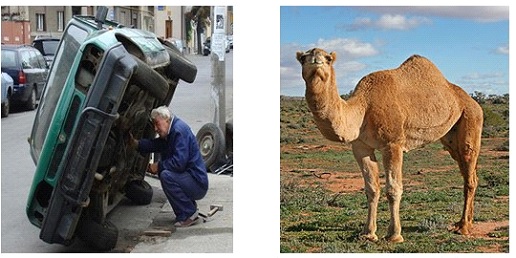
This car is a human made… But who created this magnificent creation, coincidence or Allah?
Allah says: (Do they not look at the Camels, how they are made?* and at the Sky, how it is raised high?* and at the Mountains, how they are fixed firm?*and at the Earth, how it is spread out?*Therefore do thou give admonition, for thou art one to admonish) (Sûrat Al-Ghasyha verse 17-21).
By: Abduldaem Al-Kaheel
Reference Link
⦁ Why do they not reflect on the camels and how they are created? (88:17)
⦁ I think it’s interesting that of all the animals mentioned in the Quran—dogs, horses, birds, locusts, etc—God picked the camel as the one we should reflect upon. It’s not the most beautiful animal in the world; it’s not the fastest or the strongest; it’s not the most loyal or the most wild. But it’s a little bit of all of those things, and that gives it its character and its worth. God combined all of these traits, and many more, to create an animal perfectly suited to fill its niche in the world, and when we reflect just on that, it can teach us a lot about submitting to God’s will, and accepting our own place in the world with more grace and tolerance.
⦁ The camel is absolutely perfect for what it needs to do and where it needs to survive. Without camels, travel in the deserts would be extremely difficult. For centuries, man was only able to cross the vast deserts of Arabia and Africa with the help of this sturdy beast. Even today, the camel is still used daily to make travel in these areas possible.
⦁ And He created the livestock for you, to…provide you with luxury during your leisure, and when you travel. And they carry your loads to lands that you could not reach without a great hardship. (16:5-7)
⦁ There are two types of camels: the dromedary with a single hump and the Bactrian with two humps. The Bactrian lives primarily in Mongolia and Central Asia. It is shorter and stockier and more adapted to rocky terrain and cooler temperatures. Its endurance and strength are legendary. Up to 1000 pounds can be carried by the Bactrian camel and it can travel nearly 30 miles a day with that load.
⦁ The dromedary is found in the desert regions of Arabia and Africa. They are now a totally domesticated animal and they rely on their owners to provide their foods of choice: dates, good grass, and grains such as wheat and oats. But they are able to make do when food is scarce on whatever they can find: thorny bushes, dried leaves, old seeds, even nibbling on their owners’ tents!
⦁ All of the camel is practical for its survival and for its service to man. A camel’s feet, although hoofed, have large pads that spread out in the soft sand to keep the animal from sinking in. Its face is designed as protection from sun and sand. The thick eyebrows, heavy eyelids and thick lashes all keep out sand, and there’s even a third eyelid that can close in heavy storms. The slit nostrils have special muscles which can close them against blowing sand. The ears have thick hair inside as well as outside to prevent dirt and sand from getting down inside the ear, and possibly causing infection.
⦁ A camel’s hump is a lump of fat. This is used as a source of energy when food is scarce. The hump may actually shrink when no food is available, and the camel can live off it for many days. It will then reform perfectly when food is again available. Because food is so scarce, the camel has been designed to be able to eat anything. The lining of the mouth is very tough so that the camel can bite and chew thorny cactus plants without harm to its mouth. This opens up a whole food source not available to other pack animals.
⦁ Most incredible is how the camel deals with heat and lack of water. First of all, camels have a low metabolic rate, so energy is used slowly. The body temperature has a wide range of normal. It may start the day at 94 and hit 105 in the heat of the afternoon. Our normal temperature is 98 and at 101, we’re sick. This adaptation allows the camel to function normally even in extreme heat.
⦁ The camel is one of few animals that can sweat. Sweating is a more efficient cooling system than panting and less precious fluid is lost. With its coarse body hair providing protection against the direct sun, the camel doesn’t have to sweat until its body temperature is near the top of its range. This helps conserve every precious drop of water.
⦁ No other creature can process water in the same way. The camel doesn’t lose water from blood, only from the tissue. Thus the blood stays properly thin enough to circulate and remove body heat. This is one of the problems for humans. When we become seriously dehydrated, our blood may become too thick to circulate properly.
⦁ The camel will only drink when needed and only replace what’s lost. If it lost five gallons over the last two days, it will drink five gallons and walk away. It may not drink at all in winter. In fact, if its regular diet contains good, moisture-rich grass, then the camel will need very little water year round. And, most amazing, if the camel has been without water for some time, it can quickly replace all the water it lost. It can drink 25 gallons in a few minutes. Other mammals drinking too fast can become sick or even die from a condition called water intoxication.
⦁ So camels are truly remarkable animals. All of these adaptations that they have, plus their pre-disposition to domestication, have made them a wonderful partner for man. Camel’s milk is rich in potassium, iron and vitamin C and lower in fat and lactose than cow’s milk. The meat is hearty and, although a little tough, has a good flavor. The hide is used for leather, and the long hair, which is shed every summer, is made into rope, used to make fine brushes and can be woven into a light yet warm cloth. The Bedouin name for the camel is “Ata Allah”: gift of God.
⦁ When we reflect on their creation, as God instructs us to do in 88:17, when we look at all the remarkable modifications God has given the camel, we can’t help but marvel at the ways He made them fit perfectly into their niche. May God help each of us to fill our own niche as well.