Scientific Data Surah 90 · Ayah 6
Pathological gambling and obsessive-compulsive disordertowards a spectrum of disorders of volition
Pathological gambling and obsessive-compulsive disordertowards a spectrum of disorders of volition
Introduction
Pathological gambling (PG) is a behavioral disorder significantly associated with personality disorders, especially the cluster B ones (impulsive group).1 PG has been considered akin to substance-related disorders, but a relationship to obsessive-compulsive disorder (OCD) has also been proposed.2 Stein and Hollander have placed PG within the spectrum of OCD related disorders, closer to the impulsive pole of an impulsivity-compulsivity dimensional axis, and away from OCD.3 One of the hypotheses underlying the proposal of such spectrum is that hyperactivity of brain serotonergic systems is responsible for risk avoidance, and hypoactivity for risky behaviors, e.g. compulsivity and impulsivity.4
Skodol and Oldham have proposed that impulsivity and compulsivity are personality components with the ability to influence and model the expression of symptoms in psychiatric syndromes.5 According to them, such components should be regarded as cognitive and/or emotional predispositions that facilitate the expression of impulsive and compulsive behaviors. Nevertheless, there is considerable controversy on whether a behavior should be regarded as impulsive or compulsive. Many authors use the word compulsive to describe behaviors that are repeated until and despite causing harm to the performer, underscoring the impulsive nature of the patient, thus suggesting an overlap between the concepts of impulsivity and compulsivity.6-7 On the other hand, the proposition of an Impulsive-Compulsive spectrum of disorders calls for a sharper psychopathological distinction between such concepts. Indeed, OCD rituals and PG wagering may resemble each other regarding repetition and harmful potential from an observer's perspective, but they certainly hold different purposes and meanings in the realm of the subjective psychopathology of each syndrome. OCD rituals aim primarily at controlling negative emotional states (anxiety, shame, guilt) or threats.8-9 The meaning of wagering in PG is more complex and may vary according to the context. Relapsing on wagers may be interpreted as giving up into the urge of a potentially pleasurable activity,10 hence of an impulsive nature.11 But wagering coerced by debts, chasing previous losses and attempting to avoid negative consequences12 resemble the OCD feelings of being overwhelmed by compulsions beyond the will.
Impulsivity and compulsivity are related to the decision-making process and motivated behavior.13-14 They are considered temperamental components, although there has been no consensus on their trait components. Cloninger has proposed a relationship between temperament factors and motivated behavior.14 According to him, Novelty Seeking – a factor for behavior activation, is likely to play a role in the initiation of motivated behavior, whilst Harm Avoidance would have a major role in the maintenance of such behaviors, because of the fear of negative consequences when interrupting them.
Pathological gamblers seem to combine impulsive and compulsive features. Previous studies found gamblers to be more impulsive than average, and PG was classified among the impulse control disorders in the DSM-III.15-18However, two recent studies have found OCD symptoms to be more common among pathological gamblers than in healthy volunteers or non-pathological gamblers.19-20 Skodol and Oldham have affirmed that among anxiety disorders in comorbidity with PG, OCD is the most common one.5 The comorbidity between PG and OCD is still a controversial issue. In two literature reviews, the authors have cast doubts on the studies that had found a significant association between the two syndromes, arguing that facts such as secondary comorbidity and multiple comorbidities had not been addressed.21-22 Moreover, studies looking for familial relationships between PG and OCD have failed to find any association.23-24
Such conflict would better be addressed in a direct comparison between PG and OCD. A recent study by Kim and Grant has contrasted pathological gamblers, OCD subjects, and healthy volunteers for temperament factors, according to Cloninger's tridimensional model of temperament.25 Gamblers displayed significantly greater Novelty Seeking than OCD and healthy subjects. However, this study presents three limitations. First, in the process of selection PG and OCD subjects with other ongoing comorbidities were excluded. Since for both diagnoses comorbidity is a rule, this may have hampered the samples representativeness. Second, comparisons were not controlled for differences on demographic prospects and the impact of depression and anxiety symptoms on the personality assessment.26-27 Third, the study did not contrast Axis I characteristics of PG and OCD. In order to evaluate whether two psychiatric disorders are interrelated, Klein has proposed that the following variables should be examined: symptom profile, age of onset, course and evolution, temporal transitions between syndromes, and pre-morbid personality characteristics, among others.28
The main objective of the current study is to investigate the relationship of PG and OCD by contrasting their Axis I course and comorbidity and Axis II characteristics (temperament profile). A secondary objective is to gather evidence for an empirical test of the concept of an Impulsive-Compulsive spectrum of disorders by contrasting the temperament profiles.
The hypotheses are: 1) if PG and OCD are related, their course and comorbidity profile must be similar, and temporal transitions and comorbidity between them should be significant; 2) OCD patients should display personality characteristics that are related to the compulsive nature of the syndrome; 3) PG may share compulsive traits with OCD, but it will differ regarding impulsivity related traits; 4) if impulsivity and compulsivity are opposite poles of one dimension, then impulsive and compulsive traits should have a significant and inverse relationship.
Method
This study was divided in two parts. In part 1, treatment-seeking gamblers were compared to treatment-seeking OCD patients. All patients included in the sample had never received psychiatric treatment for their condition and were drug free at the time of assessment. In part 2, which deals with personality, an additional sample of healthy subjects was added to the clinical sample to serve as a reference for personality scores. Written informed consent was obtained from all participants, and approval from the institutional ethics committee was obtained.
1. Part 1
1) Patients
This study was carried out at the Psychiatry Clinic of Universidade de São Paulo Medical Centre. Patients were recruited by advertising or referred from other services. Patients meeting criteria for PG29 were consecutively admitted between April 1998 and September 2000. Then, among OCD treatment-seeking subjects, we selected those who matched gambling subjects for age, gender, and education level. The South Oaks Gambling Screen (SOGS)30-31 and Section 5 of the Schedules for Clinical Assessment in Neuropsychiatry (SCAN)32 were used for further diagnostic confirmation. Patients with psychotic symptoms were excluded. The translations of SOGS and SCAN into Portuguese were validated previously.33-34
2) Measures
The matched samples of PG and OCD patients were submitted to a thorough psychiatric examination, using the complete SCAN interview, with special emphasis in the order and age of onset of obsessions and rituals, and gambling symptoms. As the SCAN does not provide a section for exploring gambling symptoms, a questionnaire developed for this purpose was added.35
The following five course variables present at the introductory session of the SCAN were studied: 1) age at first prodromata symptom (defined as "any unspecific sign of emotional discomfort lasting more than a month"); 2) age at onset of first specific symptom (defined as "first bet for pathological gamblers, first obsession or first compulsion for OCD patients", whichever came first); 3) age at problem recognition (defined as "the subject's or close relative's perception of a problem regarding PG or OCD symptoms" that refers to the first time when problems arising from the diagnosis were acknowledged); 4) subject's perception of symptoms onset, and 5) quality of remission periods if ever present. For further investigation of the syndromes progression, the psychiatric history was divided in two periods: 1) prodromal period, ranging from age at first prodromata symptom to age at onset of first specific symptom; 2) syndrome consolidation period, ranging from age at onset of first specific symptom to age at problem recognition.
Comorbidity analysis was arbitrarily restricted to the diagnoses occurring in the last two years prior to the interview, since the recollection of symptoms long past would be less reliable. Also, as the clinical sample would be matched to healthy controls, we thought that a two year psychiatric symptom free frame would be best for precluding bias from previous psychiatric disorder on controls' personality assessment. Diagnoses generated by the program CATEGO32 based on the SCAN data were grouped into four categories: depressive disorders, substance-related disorders, somatoform disorders, and phobic/panic disorders. The remaining disorders were not grouped because their small frequencies precluded statistical analysis.
In order to investigate possible transitions between their syndromes, PG subjects undertook Section 5 of the SCAN, and OCD patients answered the SOGS. Gamblers with history of OCD symptoms, thus reaching the SCAN threshold for possible lifetime OCD diagnosis were submitted to a further clinical interview for diagnostic confirmation. The same procedure was adopted for the OCD patients. A five-point cut-off is proposed to identify a probable pathological gambler.30 In order to increase sensitivity for gambling problems, we decided to lower the threshold to three or higher on SOGS when using it on OCD patients.
3) Statistical analysis
Continuous data were analyzed by univariate analysis of variance (one-way ANOVA). Normal distribution was assumed. Categorical data were preferably analyzed by c2 test for 2x2 contingency tables with continuity correction; otherwise univariate logistic regression was used for non-2x2 contingency tables to yield risk calculations. A Bonferroni's correction was adopted readjusting the level of significance to p < 0.0045 (p = 0.05÷11 comparisons).
2. Part 2
1) Subjects
For the second part of this study, a sample of healthy volunteers matching the clinical samples for gender, age and level of education was collected. Candidates were selected among employees of a recreational club in the city of São Paulo and their relatives. Candidates were initially screened for psychiatric disorders with the Self-Report Questionnaire (SRQ-20).36 A five-point cut-off was adopted as criterion for excluding subjects with possible psychiatric disorders.37 Candidates were then personally interviewed using the SCAN. The criteria for final selection were: 1) absence of any Axis I diagnosis in the last two years prior to the interview; 2) absence of a chronic or recurrent lifetime psychiatric diagnosis (i.e. recurrent mood disorders, eating disorders, psychotic disorders, and/or substance-related disorders).
2) Measures
The healthy volunteer controls filled the same demographic questionnaire applied to the clinical samples. The three samples were again contrasted for demographics.
All patients and healthy volunteers (total n = 120) answered the Tridimensional Personality Questionnaire (TPQ)38and the Barratt Impulsiveness Scale version 11 (BIS-11).39 The BIS-11 was added as a reference for the TPQ variables. Temperament variables positively and significantly related to the BIS-11 score were hypothesized to be impulsive traits. Unlike the case of impulsivity that has on the BIS-11 a valid measure accepted by most researchers in the field, we could not find one single measure or scale that could reliably represent the temperament roots of compulsivity, with authors frequently resorting to checklists of obsessive-compulsive symptoms, which seemed inappropriate for the current study design, since it would artificially force a difference on compulsivity between PG and OCD from the start. Thus, we adopted a different strategy: temperament traits differentiating OCD subjects from healthy volunteers were hypothesized to be compulsive traits. We did not assume the opposite, i.e. traits differentiating PG from controls as necessarily impulsive since the true nature of PG (impulsive, compulsive, or else) is one of the objects of this investigation. The translation of the TPQ into Portuguese was validated by a test/retest trial with bilingual non-psychiatric subjects.40 The translation of the BIS-11 followed the same procedures.
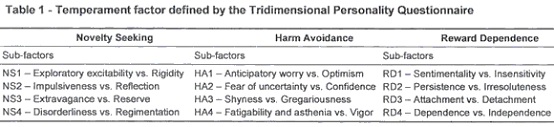
Each temperament factor defined by the TPQ is divided into the four sub-factors listed in Table 1.
3) Statistical analysis
PG, OCD and healthy volunteers were contrasted for all temperament sub-factors. The sub-factors that efficiently discriminated at least one of the clinical samples from the healthy volunteers were selected for the next analysis. A variable was considered a good discriminator when the 95% mean confidence interval for one of the clinical samples did not overlap with the mean confidence interval for the healthy sample. Comparisons were performed through univariate analysis of covariance (ANCOVA), with anxiety and depression scores from the SCAN as covariates.
The selected personality variables were then compared to the BIS-11 score on a partial correlation analysis (normal distribution assumed) controlled for anxiety and depression to determine whether they were impulsive or compulsive in nature. Variables classified as impulsive or compulsive were then adjusted for anxiety and depression scores through the ANCOVA parameters. The adjusted impulsive and compulsive scores separately entered a discriminant analysis in order to produce a single standardized composite score for impulsivity (IMP) and a standardized score for compulsivity (CMP). The three sub-samples were compared for their scores on IMP and CMP through analysis of variance (ANOVA) with a Bonferroni post-hoc analysis for the differences between means. Finally, the association of IMP and CMP was determined through Pearson's Correlation test for each sample and for the total sample. The SPSS41 software package was used for statistical analysis.
Results from Part 1
1. Demographics
Seventy-two pathological gamblers (from now on referred simply as gamblers) and 47 OCD patients were interviewed. Patients missing a match were dropped. One gambling patient was excluded because of a Delusional Disorder. Twenty male gamblers and 20 female gamblers matching 40 OCD patients for gender, age, and level of education were selected. Gamblers and OCD subjects were contrasted showing no differences regarding demographics. The average age of the 80 subjects was 40.5 ± 10.1 years (range 20-66); their average years of formal education was 11.9 ± 4.1. Fifty-nine percent were married with 2-3 children (2.3 ± 1.1). Fifty-four percent were employed and working regularly. Sixty-three percent of the clinical sample was catholic (the predominant religion in Brazil). Further analysis was conducted with the whole sample including those previously excluded because of match missing, the overall results were similar.
2. Analysis of course variables
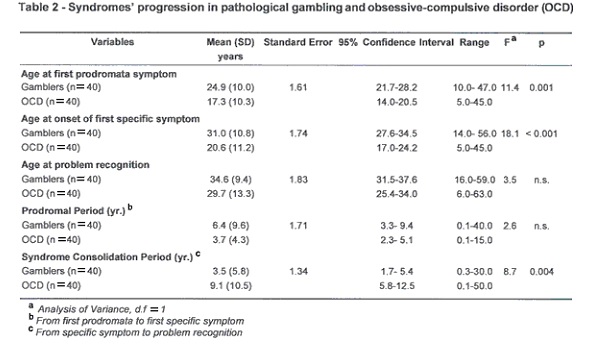
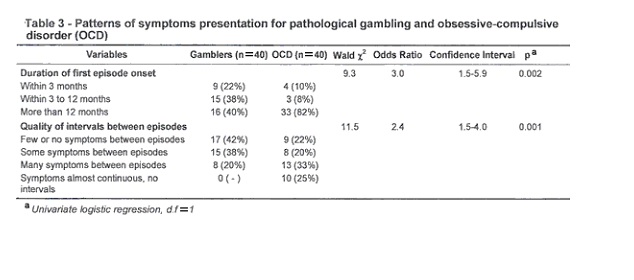
OCD patients had significantly earlier onset of symptoms than PG. Table 2 shows the analysis of progression for PG and OCD. Regarding the progression of the syndromes, splitting the data according to gender in a one-way ANOVA with Bonferroni post-hoc analysis showed that the faster consolidation for gamblers, when compared to OCD patients, is mainly due to the female gamblers (F = 4.0, d.f. = 79, p = 0.011). The syndrome consolidation period for female gamblers was 8.3 ± 2.7 years shorter (mean difference ± standard error) when compared to male OCD patients (p = 0.015), and 7.5 ± 2.7 years shorter when compared to female OCD patients (p = 0.038); it was also 4.6 years shorter than for male gamblers, but this difference did not reach statistical significance. Table 3 shows subjects' report of patterns of symptoms onset and stability over time. In sum: results from the analysis of course data suggest that OCD patients displayed symptoms earlier than gamblers, but took longer in fully recognizing the syndrome. They also reported a more insidious onset and greater symptom stability than gamblers.
3. Analysis of comorbidities
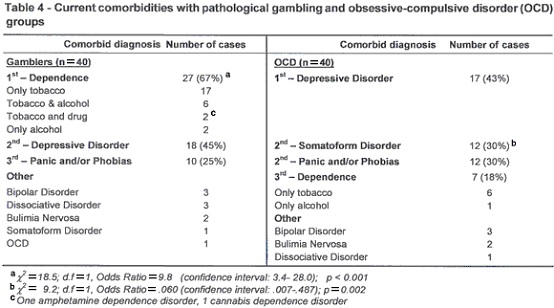
Table 4 shows the results of the comorbidity analysis for PG and OCD. Gamblers and OCD patients did not differ regarding the number of disorders in comorbidity with the main syndrome. Nineteen percent of the total sample presented no comorbidity, 51% had one comorbid diagnosis, 24% had two, and 6% had three or more. Additional analysis through c2 test for 2x2 contingency tables did not reveal a significant impact of gender on the comorbidity prospects of both PG and OCD subjects.
As for transitions between syndromes, four gamblers reported occurrence of obsessions and rituals once or more in life, with content encompassing matters other than those related to gambling. In three of these cases, symptoms did not reach significance for a lifetime OCD diagnosis, and tended to remit spontaneously when the stress caused by gambling problems was diminished. The fourth case, a 45-year-old female gambler did not regard her OCD symptoms as demanding treatment, but refused gambling treatment because it would take time reserved for house cleaning. Her OCD symptoms preceded the gambling symptoms, but they reached relevance for an OCD diagnosis shortly after she began experiencing problems with gambling. Overall, only one OCD patient scored higher than the 3-point threshold for probable PG in the SOGS. Further evaluation of this case confirmed that the patient had comorbid Bipolar Disorder and that the gambling period was limited to a manic episode and clearly related to euphoric mood. All five cases were personally interviewed by one of us (HT).
Results from Part 2
Table 5 shows the temperament sub-factors that efficiently discriminated gamblers or OCD patients from the healthy volunteers. The BIS-11 score was significantly higher for gamblers when compared to OCD patients and healthy volunteers by ANCOVA controlling for anxiety and depression (estimated marginal means: 76.7, 64.5, 64.7; standard errors: 1.4, 1.5, 1.8; d.f. = 2; F = 25.0; p < 0.001). Table 6 shows a partial analysis of correlation between the selected temperament sub-factors and the BIS-11 score, controlled for anxiety and depression. Data show an almost complete separation of variables, with Novelty Seeking sub-factors (NS2, NS3 and NS4) correlating strongly among each other and with the BIS-11 score, confirming them as temperamental representatives of impulsivity. The Harm Avoidance sub-factor (HA2) did not correlate with the other temperament variables, neither with the BIS-11 score except for a moderate and inverse correlation to NS4. HA2 was the only variable that significantly differentiated OCD patients from healthy volunteers; hence it was regarded as a compulsive trait.
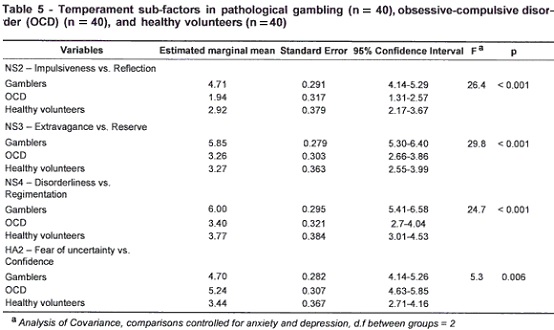
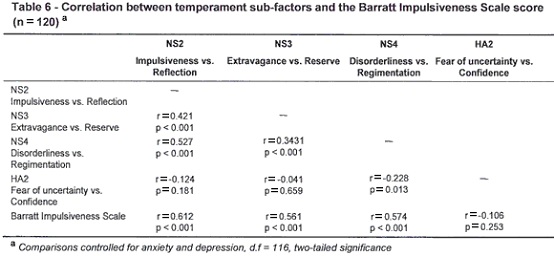
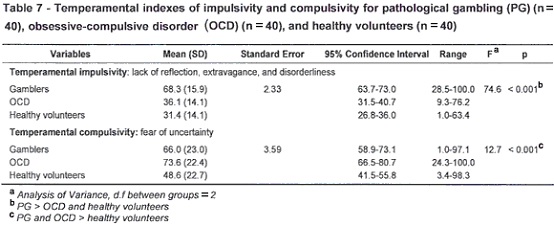
The selected four variables of temperament were then adjusted for anxiety and depression (NS2a, NS3a, NS4a and HA2a, respectively) based on the regression parameters generated by ANCOVA. The adjusted impulsivity scores (NS2a, NS3a and NS4a) entered a stepwise discriminant analysis (n = 120) to generate a single composite index of impulsivity (IMP). The discriminant analysis kept all three variables in the model and built two canonical functions. Function 1 presented the largest eigenvalue, accounting for 97.1% of the total sample's dispersion. The construction of IMP indexes for each subject on the sample was based on Function 1's canonical coefficients. The standardized canonical coefficients for NS2a, NS3a and NS4a were respectively 0.326, 0.608 and 0.259. IMP and HA2a were standardized and their range settled between 1 and 100 for easy comparison between groups. The standardized value of HA2a was considered our final temperamental indicator of compulsivity, namely CMP. Table 7 shows the comparison between gamblers, OCD patients and healthy volunteers for IMP and CMP through one-way ANOVA. Additional ANOVAs for IMP and CMP having diagnosis and gender as co-factors did not uncover a significant contribution of gender. Bivariate Pearson's correlation tests between IMP and CMP were run for each of the three sub-samples and for the total sample. Regardless of the samples and diagnostic groups, IMP and CMP showed no significant correlation, thus being confirmed as orthogonal constructs.
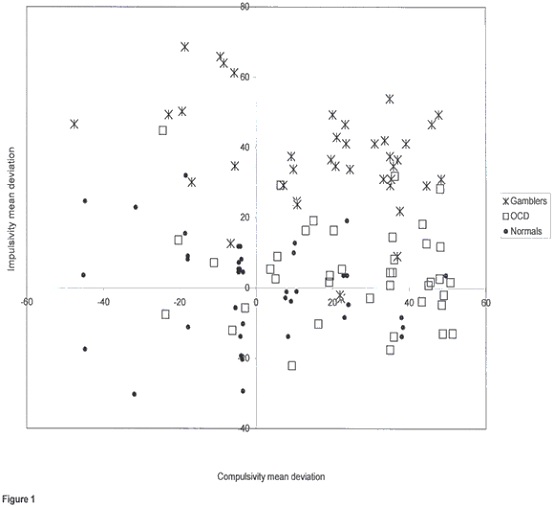
Finally, for a better visualization of the personality data, the IMP and CMP mean scores for healthy volunteers were subtracted from the scores of each subject of the sample, hence providing values of deviation from the normal parameters of impulsivity and compulsivity. The results are plotted in Figure 1
Discussion
Data from this study show that PG and OCD present different courses and progression. OCD symptoms start earlier than problem gambling. The onset of some OCD cases occurs in childhood.42-43 Though juvenile gambling has been an increasing problem,44 no pathological gambling starting in early childhood has ever been reported. Establishing pathological gambling onset at the occurrence of the first bet was a conservative measure, since any other age reference (e.g. age at first increase of gambling activity or first problem caused by gambling), would render an even shorter consolidation period for PG. Of interest, PG's progression, but not OCD's, is influenced by gender.35,45 The access to addictive forms of gambling particularly for the female population is a relatively new phenomenon in Brazil,46 and it could be argued that the gamblers showed a later age of onset because of this. Finally, in 80% of the PG sample, course was intermittent with remissions and relapses likely triggered by gambling opportunities, resembling substance dependence.47-48 On the contrary, OCD presented more steady symptoms with no apparent external modulators, as reported in a prior study.49
The comorbidity profiles found in this study support the association of PG with substance dependence.50-52 By contrast, OCD was associated with somatoform disorders. The cross-sectional nature of this study does not allow distinguishing if the somatic complaints and worries represent a true comorbidity or secondary symptoms. Nonetheless, such symptoms were more frequent among OCD patients than gamblers, which is compatible with previous reports.53-54
The remaining comorbidity profile is quite similar for both syndromes and in accordance with the literature, particularly for the high comorbidity with depression and anxiety disorders.55-56
This study failed to find a meaningful association between PG and Bipolar Disorder, as previously reported.57-58Gamblers did report frequent mood swings, but the elevated mood lasted less than 4 days, and most euphoric experiences were linked to winning streaks of short duration. Temporal transitions and comorbidity between PG and OCD were also infrequent. Therefore, symptoms profile, course and comorbidity data do not provide evidence of PG as related to OCD.
In the personality battery, the only trait discriminating OCD patients from healthy volunteers was Fear of Uncertainty. This is in agreement with Pierre Janet's proposal that the core of the OCD is an unremitting doubt, a "Delusional Doubt".59 Unlike Kim and Grant's study,25 PG subjects in this study did share this compulsive temperament trait with OCD. This could be due to the fact that the former study previously excluded gamblers with comorbidities with depression and anxiety. Nonetheless, both studies identified gamblers as more impulsive than healthy volunteers and OCD subjects, e.g. higher scores on Novelty Seeking. The sub-factors of Novelty Seekingthat were higher in gamblers were highly correlated with the BIS-11, a well-established measure of impulsivity.
It may seem contradictory that gamblers who fear uncertainty should risk themselves in a game of chance. However, gamblers may not see gambling as a chance game. Ladouceur et al. have stressed that the typical gambler carries a set of cognitive distortions which includes denial of randomness and beliefs that patterns can be spotted in chance events.60 In this distorted sense, gambling could be even financially rewarding. The gamblers' combination of high Novelty Seeking and high Harm Avoidance is similar to the one described for cigarette smokers, and provides further evidence for Cloninger's hypothesis of the relation between temperament factors and motivated behavior. It is tempting to speculate whether Novelty Seeking could be related to gambling initiation, while Harm Avoidance to its maintenance, once the cessation of gambling implies on ceasing any possibility of immediate recovery, and instant confrontation with financial damage.
According to the current data, the temperamental roots of impulsivity were all from the Novelty Seekingtemperament factor, best described as a tendency to react without further reflection (NS2), to indulge without restraint (NS3), and to pay little attention to patterns and rules (NS4). Compulsivity was related to one sub-factor of Harm Avoidance, which the description is a temperamental leaning to experience discomfort in face of doubt (HA2), hence the necessity to avoid it or control it. These descriptions based on empirical evidence from this study are compatible with theoretical concepts about impulsivity and compulsivity,59,61-62 although they do not exhaust the components from both concepts. Further research is needed to achieve a comprehensive view of impulsivity and especially compulsivity that in the current model was restricted to one single trait.
Contrary to our initial assumptions, impulsivity and compulsivity measures varied independently; therefore, they are likely to be behavioral expressions of different brain systems. Ketzenberger and Forrest63 have also found impulsivity and compulsivity to be independent among alcoholics, and Matsunaga et al., assessing impulsive control disorders among OCD patients, have concluded that impulsivity was probably orthogonal to compulsivity.64 Such findings call for a review of the concept of an Impulsive-Compulsive spectrum of disorders. Figure 2 depicts a bidimensional alternative in which impulsivity and compulsivity are represented as orthogonal dimensions. Although sharing compulsive features, PG and OCD would be located in different quadrants, with PG in the addictions quadrant in accordance to our findings. The rationale for this model is that a combination of normals rates of impulsivity and compulsivity is associated with a decreased likelihood of impulsive/compulsive disorders. For instance, high impulsivity is related to an impulsive sub-type of addiction,65-66 and to anti-social personality disorder.67-68 High compulsivity is related to syndromes with high need for control.53,69-70 High rates of both may predispose to addiction/abuse behaviors. Indeed, high NS combined with high HA has been described for tobacco smokers,71 independent studies have stressed obsessive-compulsive symptoms and impulsive features in eating disordered patients,72-74 as well as in Borderline Personality Disorder67,75 with frequent comorbidity with anxiety and depression.65 Finally, except for residual Schizophrenia,29 the combination of low impulsivity and compulsivity is unlikely to occur naturally, but rather as a consequence of brain damage to the frontal lobes and/or structures in the basal ganglia and limbic system.76-77
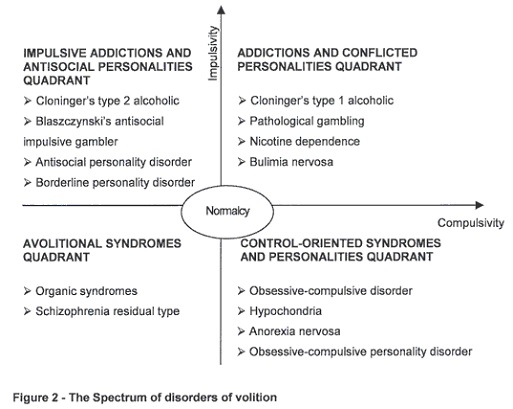
Most of the syndromes in this model were tentatively grouped by others in search for a dimensional understanding of psychiatric disorders.78 For the sub-set of the potentially gratifying repetitive behaviors, labels such as Behavioral Addictions79 and Excess Behavior Disorders80 have been used. As a model, the Impulsive-Compulsive Spectrum has the advantage of not only grouping these disorders, but also proposing a relationship to other repetitive syndromes such as OCD. Nevertheless, the biaxial structure of the Spectrum of Disorders of Volition presents further advantages: 1) it acknowledges the existence of independent factors in the organization of the Spectrum; 2) it reintroduces the concept of volition drives, one aspect of those syndromes pointed out in the early days of Psychiatry,81 but lately neglected;13 3) it is open to the possibility of a continuum between normal and pathological behavior.
The current study is based on only two clinical models and one single approach to temperament. Besides, it does not deal with the possibility of PG and OCD being heterogeneous diagnostic categories. Additional studies encompassing larger samples should investigate whether the same findings would hold true for sub-types of both syndromes. For instance, recent studies have drawn attention to a subtype of OCD patient that presents comorbid impulse control disorders. They represent around a third of treatment-seeking OCD subjects, they have an earlier onset, and a more diffuse psychopathology and clinical prognosis.82-83 Future studies singularizing early onset OCD may locate this subjects on the transition from the control-oriented quadrant to the impulsive upper quadrants in the spectrum of disorders of volition. Further limitations include sample selection based on a clinical setting and the matching process, although as earlier stated, a parallel analysis with a sample including match missing subjects yielded similar outcome, only with smaller significance levels probably due to greater bias from demographic differences that matching helped preventing. An asset of the current study was the fact that it used patients not previously medicated, thus avoiding this potential bias on the assessment of course, comorbidity, and personality. Finally, the trans-sectional nature of this study precludes causation inferences. In light of such constraints, the findings of this study should be regarded as preliminary.
No clear evidence of a relationship between PG and OCD was found. Impulsive and compulsive traits were independent. The impulsive-compulsive nature of PG was confirmed. Uncontrolled gambling may be a model for understanding the interactions between personality and disorders of volition.
Source:
Reference Link