Scientific Data Surah 91 · Ayah 11
Camels: Facts, Types & Pictures
Camels: Facts, Types & Pictures
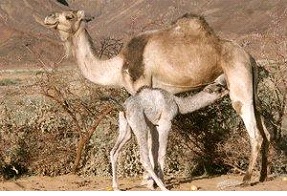
Camels are mammals with long legs, a big-lipped snout and a humped back. There are two types of camels: dromedary camels, which have one hump, and Bactrian camels, which have two humps. Camels' humps consist of stored fat, which they can metabolize when food and water is scarce.
In addition to their humps, camels have other ways to adapt to their environment. They have a third, clear eyelid that protects their eyes from blowing sand. Two rows of long lashes also protect their eyes. Sand up the nose can be a problem, but not for camels. They can shut their nostrils during sand storms.
Humans have used camels as a means of transport for thousands of years. They can carry about 375 to 600 lbs. (170 to 270 kilograms) on their backs, according to National Geographic. This earned these beasts of burden a nickname, "ships of the desert." Domestic camels are often the main source of meat, milk and even leather or wool products.
Size
Most camels tower above humans. A Bactrian camel, according to the San Diego Zoo, grows to a shoulder height of 6 feet (1.8 meters) and a body length of 10 feet (3 m). They normally weigh 1,320 to 2,200 lbs. (600 to 1,000 kg) when they are fully grown.
Dromedary camels get up to about 6.5 feet (2 m) tall at the shoulder and weigh 880 to 1,325 lbs. (400 to 600 kg).
Diet
Camels aren't picky about what they eat. Their thick lips allow them to eat things that most other animals couldn't, such as thorny plants. Camels are herbivores, though, so you won't find them eating meat.
Filling up on water, when it's available, is very important for camels. They can drink 30 gallons (113 liters) of water in just 13 minutes. Their bodies rehydrate faster than any other mammal.
When there is little food and water, the camel's hump fat releases water; 9.3 grams of fat releases 1.13 grams of water, according to research by the University of Singapore. Camels can survive up to six months without food or water.
Habitat
The two types of camel are found in different parts of the world. The dromedary camel, also called an Arabian camel, can be found in North Africaand the Middle East. The Bactrian camel lives in Central Asia. No matter the type, camels are usually found in the desert, prairie or steppe. Though many people think that camels only live in hot climates, they do well in temperature ranges from 20 degrees F (minus 29 degrees C) to 120 degrees F (49 degrees C).
Habits
Camels like to stay together in groups called herds. The herds are led by a dominant male, while many of the other males form their own herd called a bachelor herd. Camels are very social and like to greet each other by blowing in each other's faces.
Offspring
After a gestation of 12 to 14 months, a mother camel will find a private spot to have her young. Female camels usually only have one baby, but sometimes camels have twins.
Baby camels are called calves. The newborn calf is able to walk within 30 minutes, though the two won't rejoin the herd until around two weeks later. Camels become fully mature when they are 7 years old. Camels live around 17 years.
Classification/ Taxonomy
Dromedary camels (Camelus dromedarius) and the domestic Bactrian camel (Camelus bactrianus) were named in 1758 by Swedish zoologist Carl Linnaeus, who only knew of the domestic variety. Wild Bactrian camels (Camelus ferus) were discovered in 1878 by Nikolai Prejevalsky, a Russian geographer who explored Mongolia and Tibet.
For many years, the wild Bactrian was thought to be a subspecies of the domestic Bactrian. However, in recent years, DNA analysis confirmed that C. ferus was a separate species, according to the San Diego Zoo. The main difference between the two species is that the wild Bactrian has three more chromosome pairs than the domestic Bactrian.
Here is the classification of camels, according to Integrated Taxonomic Information System
Family: Camelidae
Genus: Camelus
Species:
⦁
Camelus bactrianus (Bactrian camel)
⦁
Camelus dromedarius (one-humped camel)
Subspecies:
⦁
Camelus bactrianus bactrianus
⦁
Camelus bactrianus ferus (wild Bactrian camel)
The wild Bactrian camel is considered critically endangered by the International Union for Conservation of Nature and has a population that is decreasing. In fact, wild camels are one of the most endangered large mammals. According to the Wild Camel Protection Foundation, there are fewer than 1,000 wild camels alive.
Other facts
Camels can run at 25 mph (40 kph) for long periods. If their owner is in a hurry, they can kick their speed up to 40 mph (67 kph).
The camel's hump is like a storage container. When camels use their stored fat, their hump will diminish. When they eat and drink again the hump will refill with fat.
Camels have oval-shaped red blood cells that help continue blood flow during times when water is scarce.
Camels are known for spitting on people. In fact, the animals are throwing up the contents of their stomach along with spit. This is a defense tactic when the animals feel threatened.
Reference Link
Scientist: First cloned camel born in Dubai
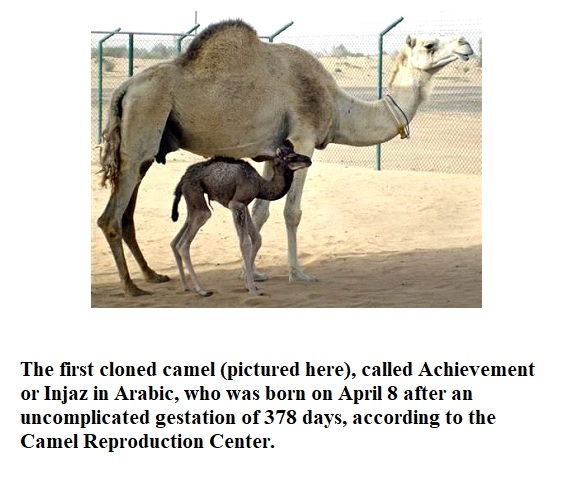
— A scientist says the world's first cloned camel has been produced in the desert emirate of Dubai.
Nisar Ahmad Wani, a senior reproductive biologist at the government's Camel Reproduction Center, says the cloned camel is a six-day-old, one-humped female called Achievement or Injaz in Arabic.
Injaz was born April 8 after an uncomplicated gestation of 378 days, the center said in a press release Tuesday.
The center said she was created from cells harvested from an ovary of an adult female camel.
Camels are a valuable commodity in the desert sheikdoms of the Persian Gulf. They are used for racing and transport. They are famous for healthy low-fat milk and can fetch owners millions of dollars at camel beauty contests.
Reference Link
Camels act on a hump
Camels can sniff out the microbes that lead them to water, says Paul Simons
Bad-tempered, obstinate, a tendency to spit, kick and grunt like a weightlifter. You could say that camels have a bit of an image problem, but they also have a magic about them as they tramp off in single file across miles of desert in search of water and then, seemingly against all the odds, find an oasis.
In fact, the wild Bactrian camels of the Gobi desert are reputed to be able to find water up to 50 miles away. How camels can divine water in this way has given scientists the hump for ages. But now a British team may have sniffed out the secret, and it is right under our noses, lying in the ground.
The John Innes Centre (JIC) in Norwich would not seem an obvious place to investigate camels or deserts. It is world renowned for research on microbes, and last year unravelled all 8,000 genes in Streptomyces, a soil bacterium stuffed with an amazing medicine chest of antibiotics, anti-inflammatory and anti-cancer drugs vital to the pharmaceutical industry. It was while they were pinpointing what each of these Streptomyces genes does that the scientists knocked out a musty smell. This particular gene was responsible for making geosmin, which gives an alluring fragrance of rain on soil or the musty scent of florists.
In the desert, Streptomyces gives off a signature smell in damp ground. Once that scent is carried on a breeze, it can be picked up by the camel's well-tuned nostrils. In fact, it could be a matter of life or death for the camel. So much for the camels, but does the Streptomyces get anything out of its scent? According to Professor Keith Chater, from JIC, the smell could be a way of luring animals into carrying its spores.
"You could imagine that the camels would disperse the spores as they take a drink," he explains. "Either they would eat or drink the spores, or they would get stuck on them and then get dispersed wherever the camel moves to." And it's not just camels that are attracted to the seductive perfume of geosmins, because earthworms and springtails are also drawn to the bacterial spores. Whether the animals get any medicinal benefits from the bacteria is not known, but many creatures - including humans - eat soil.
"The discovery is not as useless as it first seems," says Prof Chater. "Gardeners may delight in the smell of geosmin in freshly turned soil, but the smell is less welcome when it is produced by pharmaceutical factories that are growing Streptomyces in bulk to produce antibiotics. By shutting down the bacteria's ability to produce geosmin, we can make the factories less smelly for neighbours."
Presumably if that genetic mutation ever got out into the wild it would be seriously bad news for camels. But botanists have discovered geosmins in some cacti flowers and an Amazonian rainforest flower. These all have a very unusual musty-earthy smell, which could be what is fooling insects into thinking the plants have water.
As the insects rummage around in vain for a drink, they accidentally pollinate the flower.
Reference Link
The She-Camel of Thamud
An Allegorical Allusion to Jesus and his Suffering
The story of the suffering She-camel and the pain inflicted by the people of Thamud is a reoccurring theme within the Quran.
The story can be read on multiple levels.
This page considers this story of the she-camel as an allegorical illustration of the story of Jesus,
the crucifixion, and the suffering inflicted upon him by the people of the Talmud.
It is noteworthy that the first reference to the She-Camel in the Quran is found in the same surah
as the only repeated New Testament quote from Jesus also about a camel.
The two ideas are connected, and it is appropriate to be thinking of Jesus as the story of the she-camel is recited.
Jesus says, "It is easier for a camel to go through the eye of the needle, than for a rich man to enter into the kingdom of God." Matthew 19:24
"It is easier for a camel to go through the eye of a needle, than for a rich man to enter into the kingdom of God." Mark 10:25
"It is easier for a camel to go through a needle's eye, than for a rich man to enter into the kingdom of God." Luke 18:25
According to this revelation, the allotment of the rich and the punishment of the sinner may also be one and the same. The gates of heaven will not be opened till the camel goes through the eye of the needle. Though this sounds like a desperate and impossible situation, even so, this can still be a day of salvation and opportunity. All things are possible with God. The Camel is a sign reminding the reader that the gates of heaven, and the entrance to the garden has been provided by Allah, even for the most blind of sinners. Though the punishment be severe, He is most merciful.
Again, "they who deny Our revelations and scorn them, for them the gates of heaven will not be opened nor will they enter the Garden untilthe camel goeth through the needle's eye." Surah 7:40
By connecting the teaching of Jesus about the camel that goes through the eye of the needle together with the story of the She-camal of Thamud, this surah joins Jesus to the She-Camel in the listeners mind. Once this connection has been recognized, the suffering of the she-camel as an allegorical allusion to the sufferings of Jesus, is only a small step away.
Indeed, Jesus, and the She-camel, and the camel going through the eye of the needle are subtly presented as all being one and the same. The She-camel becomes a sign pointing to the sufferings of Jesus, and the opening up of the gates of Paradise.
This page pesents a side by side comparison of these similarities unveiling the She-Camel's allegorical and hidden identity as the suffering servant Jesus:
May our appreciation of the Holy Quran, Allah, and his servant Jesus be deepened as we open our hearts.
Reference Link
Properities of The She-Camel
This she-camel has special properities which make her destinctive from other she-camels, such as the large size of her body and its attractive color that is mainly brown with yellow and her dense hair, and her ability to drink the water of all the people so that nothing of it is left at the day of her drink, and also giving milk so much that it was enough for the people at that day, the youngs and adults, to drink, and also whatever was on earth of plants was a pasture for her and no one has the right to prohibit her from that, and she didn't use to hurt or do damage towards anyone either in self or his plants or his trees, and she did not need a guard, and the rest of the animals used to get afraid of her and get off her way.
What is understood from the Holy Phrases about the she-camel is that no one of Þamud should do harm to her or to her food or her drink that was appointed for her at her appointed day, and she also don't approach the water at the day of their drinking, so her meanings and her characterestics are not obvious except for the One who created her. For this they were warned and the threat was directed to them whenever they wanted to harm her, and the punishment will befall on them for the slightest harm they might do or for killing her, and Sâlih (PUH) did his best with his people to advice them for he had the pity on them with sincerity, and carried so much of their cause and had patient with them to the fullest, and he was lonely with sorrow for them for they were his people and his tribe and his beloved if only they obeyed God, but what a sorrow (You would be heard if you were calling a living, but there is no such life when the one you're calling).
He used to remind them of the gifts of God to them and try to prohibit them to do mischiefs on earth and worship other gods instead of the true God, and also prohibited them to be tyrants on earth with pride, and for the main heads and tyrants in his people had the pride upon him and they didn't accept to be governed by the commandments and prohibitions of Sâlih like the other people and become under his rule after their pride and their rule, and for them such matter is something not to be discussed and not to be taken as it is for their pride keeps them from being under the rule of a man that had no money nor power, and they never look at what they were worshipping of idols that have no benefits nor harm, no feelings and don't talk to them or guide them, and they would know that the Creator is some One else only if they did meditate and understand.
Sâlih (PUH) is His messenger to them and his prophecy was proved by the miracles that none of the creatures would make, and the mischiefers that had the rule among the people of Sâlih went to the believers that followed him and asked them as if they were mocking: do you know that Sâlih was sent from his God? And their answer to them was: we are believers in whatever he was sent for. Then the tyrants said: we disbelieve in what you've believed in. We've pointed out before that the destruction of the people of Sâlih ,for their killing of the she-camel and refusing the commandments of God and His prophet, was done by the Cry as was mentioned in the Holy Quran in God's saying: And the (awful) Cry overtook those who did wrong, so that morning found them prostrate in their dwellings(Hud:67). Yes, and Quran also mentioned several ways of punishing them with the quake, the thunders, tyranny..etc as in the chapters of Al-A`râf, Al-Ðâriyât, Al-Hâqqah and Al-Sho`arâ' , and no doubt that all of the other ways of punishing were revealed all together, because the Cry which is the great noise, is done by the thunder and mostly accompanied with the quake and we shall believe that the conditions for the Cry are all satisfied in the Holy Phrases, and also the tyranny which is the expansion of the circle of destruction that was revealed upon them and upon what they used to worship and upon where they used to live, so tyranny overcame them and their homes as mentioned in His saying: Then see the nature of the consequence of their plotting, for lo! We destroyed them and their people, every one, See, yonder are their dwellings empty and in ruins because they did wrong. Lo! herein is indeed a portent for a people who have knowledge(Al-Naml:51-52).
With no doubt it is apparent that the people of Sâlih were in doubt about his prophecy and his message and his truthfulness about everything he claimed about the prophecy and the message of God to them before the foundation of the she-camel and her weanling, especially the main tyrants of them, and it is probable that some of them believed just by calling them back to God with showing them the clues for that as it is with the rest of the messengers and prophets for such people had wisdom and kind hearts and the good-will, and mostly they are the weak people on earth, and they said to the tyrants of the people of Sâlih: Lo! In that wherewith he hath been sent we are believers(Al-A`râf:75). Yes, and when he got with the great miracle of his which was the she-camel out of the rock as they requested, those who were on faith been even more faithful, and it is probable that all of them believed in him at that time if it wasn't for the devil's seducation and the soul that runs after mischiefs and the stubborness of the harsh disbelievers that grabbed with them those of weak faith and those who have no working mind or wisdom. And in a famous speech (Hadith) [this line probably taken from a famous Hadith for the prophet Muhammad PUH]: People are following their kings religions for their greedness for this life's wreckage and their fear of power. So from here and there, those of stubborness got back from being faithful without a clue or a prove, and been doubting and disbelieving, and said to him: Let whatever you were promising come over us if you were saying the truth. And as a witness for this we have God's saying: And as for Thamud, We gave them guidance, but they preferred blindness to the guidance(Fossilat:17). So, the she-camel is the miracle to prove the truthfulness of Sâlih and his message from God to them, and it is a test for them, for God did say: Lo! We are sending the she-camel as a test for them; so watch them and have patience(Al-Qamar:27), so by her, the prove was done and the forbidden happened along with the torture, and all is said and done, and God did say about this: We never punish until we have sent a messenger(Al-Isrâ':15).
Reference Link
DESCRIPTION ABOUT CAMELS:
A unique and fascinating creature! the camel
⦁ Camel had been playing pivotal role in socioeconomic life of its breeders.
⦁ Camel is even highly praised in the religious beliefs and highly appreciated in the holy books.
In holy Quran it is said "Do they not look at the Camels, how they are made? And at the Sky, how it is raised high? And at the Mountains, how they are fixed firm? And at the Earth, how it is spread out? In these honored verses, Allah (Praise & Glory be to him) surpassed the camel upon all other living
creatures, and made the contemplation of how it was made prior to raising high the sky, fixing firm the mountains, or spreading out the earth. In this honored verse, the Creator, who knows the secrets of his creatures, advises people to Camel contains equal quantity of milk in four quarters, not like cows, which have more milk inhindquarters.
⦁ The colostrums are white and watery instead of thick and cream colored (cow colostrums).
⦁ The content of niacin in camel milk is remarkably higher than in cow milk.
⦁ Camel milk contains five times more vitamin C compared to cow milk.
⦁ Vitamin C is anti infectious and is very important for human health,especially in dry and deserted areas.
⦁ Camel milk contains insulin like protein and is therefore used to treat Diabetes mellitus.
⦁ Camel milk has higher levels of potassium, magnesium, iron, copper, manganese, sodium and zinc than cow milk
⦁ Camel milk contains medicinal properties to treat different ailments such as autoimmune diseases,allergies, asthma, rashes, diabetes, liver disorders, ascites, rheumatism, inflammatory conditions,piles, urethral irritation, infectious diseases like tuberculosis, stress, depression, peptic ulcers and
Cancer.
⦁ Camel milk is a nervine tonic and helps in good eyesight. The pastoral people depending on camel milk never get weak eyesight.
⦁ It is a booster of the immune system, contains protective proteins, including the immunoglobulin necessary for maintaining the immune system and nutritional advantages for brain development.
⦁ Camel milk has higher levels of lactoferrin and lysozyme which play a central role in the determination of these properties.
⦁ It contains 2530 times as much lactoferrin as cow milk. Lactoferrin is a fairly recently discovered iron containing protein that has been shown to have antiviral, antifungal, anti inflammatory,
analgesic and anticarcinogenic effects.
⦁ Camel milk is use as aphrodisiac, especially in the stressful conditions of the dry hot weather.
⦁ The low quantity of beta casein and the lack of beta lactoglobulin are linked to the hypoallergenic effects of camel milk.
⦁ Because of the low lactose content, it does not cause lactose intolerance problem in infants.
⦁ Camel milk can be the best replacement of infant food after the mother's breast.
⦁ Camel milk is a rich source of proteins with potential antimicrobial and protective activity.
⦁ The camel milk fat is bound with the protein; therefore, it is difficult to remove fats from camel's milk.
⦁ The fat globule are smaller in camel milk than in cow milk and it's explain that camel milk is unstable at high temperature.
⦁ Camel milk protein is coated with fats, which enhance protein absorption. It passes the acidic stomach undisturbed (does not coagulate easily because of fat coating) and reaches the intestines for absorption.
⦁ Camels' milk fat contains much higher concentration of long chain fatty acids (C 14 C 18) than short chain fatty acids, and is therefore healthier.
⦁ Sour camel milk is not waste but is a part of the traditional diet in Somalia as "susa" and in Arabia as "Algarss" and in Baloch pastoral as "Sorain".
⦁ A camel dairy in the UAE and an Austrian chocolatier recently teamed up in a joint venture to produce chocolate made from camel milk, sweetened with honey from Yemen.
⦁ Mongolian nomads in the Gobi Desert distil a delicious drink from soured camel milk with low alcohol content, known as "camel vodka".
⦁ Camel meat is healthier as they produce carcasses with less fat as well as having less levels of cholesterol in fat than other meat animals.
⦁ Camel meat is also relatively high in polyunsaturated fatty acid in comparison to beef. This is an important factor in reducing the risk of cardiovascular disease.
⦁ Camel meat is also used for remedial purposes for diseases such as hyperacidity, hypertension,pneumonia and respiratory disease as well as an aphrodisiac.
⦁ Camels reach live weights of about 650 kg at 7–8 years of age, and produce carcass weights ranging from 125 to 400 kg with dressingout percentage values from 55% to 70%. Camel carcasses contain about 57% muscle, 26% bone and 17% fat.
⦁ Camel lean meat contains about 77% water, 19% protein, 2.8% fat, and 1.2% ash with a small amount of intramuscular fat, which renders it a healthy food for humans.
⦁ Camel meat has been described as raspberry red to dark brown in color and the fat of the camel meat is white.
⦁ The amino acid and mineral contents of camel meat are often higher than beef, probably due to lower intramuscular fat levels.
⦁ Camel meat has been processed into burgers, patties, sausages and shawarma to add value.
⦁ Because of its low cholesterol content, Australia's National Heart Foundation has put camel meat on its list of highly recommended food items.
⦁ "Camburgers" and "camfurters" are among the products that have been produced by a team of scientists around Prof. Farah at the Swiss Federal
Institute of Technology.
⦁ Camels can travel many days without feed or water. In the kind of terrain I like to ride in, this is a very important factor.A traveler can continue journey without bothering too much about the feed and water.
⦁ Camel eats each and everything when tired and hungry.
The long muscular legs allows camels to cover great distances, they walk up to 40 km per day with 200 to 300 kg of baggage.
⦁ Camel is better as riding animal than horse. They are quieter and gentler than horses.
⦁ Camels seem smarter than horses about getting themselves out of a precarious situation. If a horse gets tangled up in a rope, it may struggle violently and get rope burns (or worse). A tangled up camel will, after briefly testing the bonds, sit quietly and figure out what to do next.
⦁ Camels can carry more weight than horses. Also, a well designed camel saddle has more room to carry whatever extra gear you are packing than a horse saddle has.
⦁ Riding a camel is quiet and peaceful (that is, once the camel is well trained enough that it no longer grumbles along the way). Camel's slipperlike feet make hardly any noise.
⦁ Without the clip clop of hooves, you can hear the wind sighing in the brush, the rustle of autumn leaves, a coyote howl in the distance on a moonlight ride.
⦁ The camels are the most disciplined and obedient creatures. They and can be ordered to sit or stand again and again and can walk in a row silently behind the leading man, woman or even a child.
⦁ The camel is a unique beast of burden, which is loaded in sitting position and gets up with a jerk of its long neck.
⦁ Camels do not need to be shod. The cost of shoeing horses can really add up! Furthermore, camels don't usually colic like horses do, although they occasionally bloat.
⦁ There is a certain pride in riding a well trained camel. It is a sign of prestige for camel owner to ride and travel on a mehari camel.
⦁ The disease register of camel is quite short (very few fatal diseases are reported in camel).
⦁ Camel is resistant to many notorious diseases like foot and mouth disease, mad cow disease (BSE) and Brucellosis etc.
⦁ Camel is resistant to ticks diseases. A load of more than 100 ticks on camel body cannot affect camel health and production.
⦁ The camel has a large mouth, with 34 sharp teeth. They enable the animal to eat rough thorny bushes without damaging the lining of its mouth.
⦁ Camel can eat everything (bark, dates seed, salty mud and even paper) when there is scarcity of feed, while in good feeding conditions, it does prefer protein rich diet.
⦁ The long flexible neck and legs saves it from ground heat and gives easy approach to tall trees for browsing.
⦁ Camel can browse at 3.5 m above the ground.
⦁ The formation of the mouth is such that there are long conical papillae on the inside of the cheeks directed backward and the camel can browse at the thorny plants without any harm. The canine teeth help the camel to take into grip the twigs. Such kind of teeth is not found in other ruminants.
⦁ The soft palate is developed and comes out on one side of the mouth like a red hanging bladder.This happens usually in rutting (breeding) seasons.
⦁ Camel has a well developed power to smell.
⦁ They can smell water 50 mile away by smelling geosmin which is a fragrance produced by streptomyces species growing in the dump soil.
Under very hot conditions, the camel may drink only every 810 days and lose up to 30% of the its live body weight through dehydration. Other animals die at 10% live body loss through dehydration.
⦁ Camel urinate less than 1 liter of urine per day in hot summer days. In the period of water scarcity
⦁ camel urinates a semi liquid substance like syrup.
⦁ Oval shape erythrocytes (instead of round in other animals) expand up to 200% their normal size as camels drink rapidly an amount of 190 liter of water in 1015 minutes.
⦁ Camel can store water in its all body compartments (intracellular, extracellular, blood and digestive tract etc). Every organ has the extraordinary capacity to store water.
⦁ They can live without water for 3 days in summer and 7 days in winter. However, there are some examples of this animal remaining without water for 20 to 40 days. After 40 days the camel goes blind due to excessive dehydration.
⦁ Camel can vary body temperature up to 6.7 Cº, having a great endurance power to stand scorching heat. Camel even absorbs heat in the day time by increasing body temperature and dissipates it in the cool night.
⦁ The ability of camel to allow its body temperature to fluctuate in response to some form of environmental stress saves significant amounts of energy and water.
⦁ The well developed hump is full of fat that serves as a store of water and food at the time of starvation.The fat of hump gets dissolved gradually during starvation and collects again at the time the camel gets adequate water and feed.
⦁ The flat pads of the feet are horny and cushioned and help the camel to walk on the sand without making any sound while the feet of other animals sink into the sand.
⦁ Due to this quality, the camel has been given the name as the "ship of the desert".
⦁ Camel feet are soft and friendly to vegetation. The hooves of cow or small ruminants are more aggressive to the soil and contribute more often to the degradation of the pastures in case of overgrazing.
⦁ The chest pad helps the animal to take rest on it while sitting on the ground. The rest of the body is saved from concussion against the ground. There are other pads at the knee and half joint and in front of the joint of thighs.
⦁ These prevent the limbs from concussion against the ground.
⦁ The spines of all vertebrates of the thoracic region are long & high and make the hump, which is more developed than all other Brahman cattle.
⦁ The camel sleeps less and possesses great power of remembrance. It keeps in mind the harsh behavior, beating or even the abuses from the camel man and takes revenge at the appropriate time.
⦁ The male urinates in spurts while standing and urine goes back in between the hind legs and falls on the ground. Its refresh the femoral vein and decrease the heart temperature for water economy.This enables the animal to save itself from slipping in its urine.
⦁ Camels are hornless and lack gall bladder.
⦁ Camel has prominent eyes with a wide range of vision. They are protected by an overhanging upper lid with long eyelashes, which protect the eyeballs from powerful rays of the sun.
⦁ The upper lip of the mouth has a cut in the middle. The flaps of the upper lip not only help in catching the twigs (thin shoots of the trees and bushes) but also enable the nostrils to cover to keep out the sand and dust at the time of dust storms.
⦁ The ears are small but have a great power of hearing. Camel can hear and understand the voice of its herder from a long distance.
The camels are regarded as the most intelligent animals and can find out their way in the desert when there are no signs of road.
⦁ The Bedouin gives name Ata ullah to camel, mean the gift of God.