Surah 091 of 114

سورة الشمس

Ash-Shams

15 verses · tap any ayah to deep-dive

Ayat 1

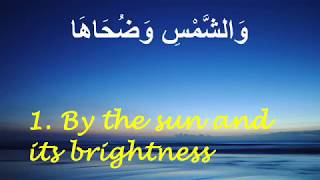
وَٱلشَّمْسِ وَضُحَىٰهَا.(1)

By the sun and its brightness(1) [Ash-Shams: 1]

Back to surah / Surah 091 · Ash-Shams / Ayah 1

Section 01

Traditional understanding

Translation, tafseer from classical and modern scholars, transliteration, word-by-word grammar.

Translation Sahih International

By the sun and its brightness(1)

Tafseer Abdullah Yusuf

The first pair is the glorious sun , the source of our light and physical life, and the moon which follows or acts as second to the sun for illuminating our world. The moon, which is in the sky' with the sun. is pale and inconspicuous; in the sun's absence she shines with reflected light and may metaphorically be called the sun's vicegerent. So with Revelation and the great Prophets who brought it; and the mine of Teachers who derive their light reflected. or perhaps doubly reflected, from the original source.

Tafseer Dr. Farooq Azam

By the sun and its brightness;

Tafseer Ibn Abbas

And from his narration on the authority of Ibn 'Abbas that he said regarding the interpretation of Allah's saying (By the sun and his brightness): '(By the sun and his brightness) Allah swears by the sun and its light.

Tafseer Jalalain

By the sun and her morning light.

Tafseer Ma’arif Ul-Quran

(I swear by the sun and his broad light, ... 9l:l). The phrase 'and his broad light' is, though conjoined to 'by the sun' by means of the conjunctive particle 'and', the context indicates that 'broad light' is in adjectival position qualifying shams 'the sun', that is to say, 'I swear by the sun when it is in the time of forenoon.
The word duha is that part of the day when the sun rises [early in the morning] and goes up slightly higher [on the sky], and its light spreads on the earth. Man observes it to be near to himself and observes it fully on account of lack of heat.

Tafseer Mufti Taqi Usmani

I swear by the sun and his broad light,

Tafseer Shaikh Ashiq Ilahi

Allah begins this Surah by taking several oaths. Allah says, "By the sun and its light! By the moon when it follows the sun!" The moon following the sun is seen clearly during the middle of the lunar months when the full moon rises to dominate the sky with its radiance after sunset. The moon then remains the light of the sky until sunrise.

Tafseer Tafheem Ul-Quran

The word duha as used in the original applies both to the light of the sun and to its heat. Although in Arabic its well known meaning is the time between sunrise and meridian when the sun has risen high, at that height it does not only give light but heat too. Therefore, when the word duha is attributed to the sun, its full meaning can be expressed more appropriately by its radiant brightness than by its light, or by the time of the day that it indicates.

Transliteration

Ayah 1

Waalshshamsi waduhaha

Word-by-word

Ayah 1

# Arabic Pronunciation Meaning Root
1 وَالشَّمْسِ Waalshshamsi By the sun ش م س
2 وَضُحَاهَا waduhaha and its brightness ض ح و

Section 02

Cross-references

Similar verses elsewhere in the Qur’an and authentic ahadith narrated about this ayah.

Section 03

Articles & resources

Long-form articles, scientific commentary, and historical context linked from the legacy archive.

Section 04

Audio & video lectures

16 videos · 0 audio lectures from contemporary scholars.

References

  1. Tafseer — Abdullah Yusuf
  2. Tafseer — Dr. Farooq Azam
  3. Tafseer — Ibn Abbas
  4. Tafseer — Jalalain
  5. Tafseer — Ma’arif Ul-Quran
  6. Tafseer — Mufti Taqi Usmani
  7. Tafseer — Shaikh Ashiq Ilahi
  8. Tafseer — Tafheem Ul-Quran
  9. Translation — Sahih International
  10. Hadith collections — 8 narrations from Bukhari, Muslim, Tirmidhi, Abu Dawud and others (see Cross-references)
  11. Quranic cross-references — 8 parallel verses
  12. Linked articles — 10 long-form pieces

Ayat 2

وَٱلْقَمَرِ إِذَا تَلَىٰهَا.(2)

And [by] the moon when it follows it(2) [Ash-Shams: 2]

Back to surah / Surah 091 · Ash-Shams / Ayah 2

Section 01

Traditional understanding

Translation, tafseer from classical and modern scholars, transliteration, word-by-word grammar.

Translation Sahih International

And [by] the moon when it follows it(2)

Tafseer Abdullah Yusuf

The first pair is the glorious sun. the source of our light and physical life, and the moon which follows or acts as second to the sun for illuminating our world. The moon, when she is in the sky with the sun, is pale and inconspicuous; in the sun’s absence she shines with reflected light and may metaphorically be called the sun’s vicegerent. So with Revelation and the great Prophets who brought it; and the minor Teachers who derive their light reflected, or perhaps doubly reflected , from the original source.

Tafseer Dr. Farooq Azam

By the moon, as it follows it (the sun);

Tafseer Ibn Abbas

:(And the moon when she followeth him) when it follows the sun, on the first night when the new moon is seen,

Tafseer Jalalain

By the moon when it follows her rising after she has set.

Tafseer Ma’arif Ul-Quran

The second oath is taken by (and by the moon when she follows him, ... 91:2). This signifies one of two things:
(1)The moon following the sun is seen clearly during the middle of the lunar months when the full moon rises to dominate the sky with its radiance after sunset.
(2)The phrase 'when she follows him' could signify just as the sun is seen in full in broad light, so does the moon, following the sun, becomes full.

Tafseer Mufti Taqi Usmani

And by the moon when she follows him,

Tafseer Shaikh Ashiq Ilahi

Allah begins this Surah by taking several oaths. Allah says, "By the sun and its light! By the moon when it follows the sun!" The moon following the sun is seen clearly during the middle of the lunar months when the full moon rises to dominate the sky with its radiance after sunset. The moon then remains the light of the sky until sunrise.

Tafseer Tafheem Ul-Quran

That is, when the night comes, the sun hides and its light remains hidden throughout the night. This state has been described, saying that the night covers up the sun, for the night actually signifies the sun's hiding behind the horizon because of which its light cannot reach that part of the earth where the night has fallen.

Transliteration

Ayah 2

Waalqamari itha talaha

Word-by-word

Ayah 2

# Arabic Pronunciation Meaning Root
1 وَالْقَمَرِ Waalqamari And the moon ق م ر
2 إِذَا itha when
3 تَلَاهَا talaha it follows it ت ل و

Section 02

Cross-references

Similar verses elsewhere in the Qur’an and authentic ahadith narrated about this ayah.

Section 03

Articles & resources

Long-form articles, scientific commentary, and historical context linked from the legacy archive.

Section 04

Audio & video lectures

20 videos · 6 audio lectures from contemporary scholars.

Tafseer of Surah Shams Sheikh Assim Al Hakeem Video · youtube Tafseer of Surah Shams Sheikh Assim Al Hakeem Video · youtube Tafseer of Surah Shams Dr.Muhammad Salah Video · youtube Tafseer of Surah Shams Dr.Muhammad Salah Video · youtube Recitation of Surah Shams Yasir Qadhi Video · youtube Recitation of Surah Shams Yasir Qadhi Video · youtube Tafseer of surah shams Yahya Ibrahim Video · youtube Tafseer of surah shams Yahya Ibrahim Video · youtube "the Quran miracles⦁ "⦁ The alternation between day ⦁ &⦁ night (1/3) Dr. Zaghloul El- Naggar(Science) Video · youtube "the Quran miracles⦁ "⦁ The alternation between day ⦁ &⦁ night (1/3) Dr. Zaghloul El- Naggar(Science) Video · youtube "⦁ the Quran miracles⦁ "⦁ The alternation between day ⦁ &⦁ night (2/3) Dr. Zaghloul El- Naggar(Science) Video · youtube "⦁ the Quran miracles⦁ "⦁ The alternation between day ⦁ &⦁ night (2/3) Dr. Zaghloul El- Naggar(Science) Video · youtube ⦁ the Quran miracles⦁ "⦁ The alternation between day ⦁ &⦁ night (3/3) Dr. Zaghloul El- Naggar(Science) Video · youtube ⦁ the Quran miracles⦁ "⦁ The alternation between day ⦁ &⦁ night (3/3) Dr. Zaghloul El- Naggar(Science) Video · youtube In Depth Analysis & Tafseer of Surah Nouman Ali Khan Video · youtube In Depth Analysis & Tafseer of Surah Nouman Ali Khan Video · youtube Moon reflecting the sun by Dr.Zakir Naik Dr. Zakir Naik Video · youtube Moon reflecting the sun by Dr.Zakir Naik Dr. Zakir Naik Video · youtube Light of the moon reflected light in Qur'an Dr. Zakir Naik Video · youtube Light of the moon reflected light in Qur'an Dr. Zakir Naik Video · youtube surah shams surah shams Audio lecture surah shams surah shams Audio lecture surah+shams surah+shams Audio lecture surah+shams surah+shams Audio lecture SurahAsh-shams Dr.Israr Ahmad Audio lecture SurahAsh-shams Dr.Israr Ahmad Audio lecture




References

  1. Tafseer — Abdullah Yusuf
  2. Tafseer — Dr. Farooq Azam
  3. Tafseer — Ibn Abbas
  4. Tafseer — Jalalain
  5. Tafseer — Ma’arif Ul-Quran
  6. Tafseer — Mufti Taqi Usmani
  7. Tafseer — Shaikh Ashiq Ilahi
  8. Tafseer — Tafheem Ul-Quran
  9. Translation — Sahih International
  10. Hadith collections — 8 narrations from Bukhari, Muslim, Tirmidhi, Abu Dawud and others (see Cross-references)
  11. Linked articles — 10 long-form pieces

Ayat 3

وَٱلنَّهَارِ إِذَا جَلَّىٰهَا.(3)

And [by] the day when it displays it(3) [Ash-Shams: 3]

Back to surah / Surah 091 · Ash-Shams / Ayah 3

Section 01

Traditional understanding

Translation, tafseer from classical and modern scholars, transliteration, word-by-word grammar.

Translation Sahih International

And [by] the day when it displays it(3)

Tafseer Abdullah Yusuf

The next contrasted pair consists, not of luminaries, but conditions, or periods of time. Day and Night.
The Day reveals the sun's glory and the Night conceals it from our sight. So there may be contrasts in out subjective recept inn of divine light. But is there. working all the time, and must appear in its own good time.

Tafseer Dr. Farooq Azam

By the day, as it shows its splendor;

Tafseer Ibn Abbas

And the day when it revealeth him,

Tafseer Jalalain

And [by] the day when it reveals her, as it rises [high]

Tafseer Ma’arif Ul-Quran

And by the day when it shows its brightness ... 91:3).

The attached pronoun ha 'its' may possibly refer to the earth or the world, although neither of the nouns precedes it.
Such usage in Arabic is commonplace, especially if the phenomenon, such as the earth or the world, with which man is generally familiar.
In such a case Arabs commonly refer to the phenomenon simply by using a pronoun without making prior reference to it. The addressee understands the meaning by implication.
The Qur'an has many examples of, and bears ample testimony to, this grammatical phenomenon.
The verse thus signifies 'by the day and by the world or the earth which the day has brightened up'. In other words, 'by the day when it is fully bright'. Another possibility, which is more pertinent to the context, is that the pronoun 'its' refers to the 'sun' in which case it signifies 'by the day when it brightens up the Surah Ash-Shams : 91 : 1 - 15 sun'.
This relation of attribution, in this case, would be a metaphorical relationship. Although the sun is usually understood to be the cause of the day to come out, here the day is said to brighten up the sun. Thus the verse would signify 'when the sun is seen brightened up because the day is out'.

Tafseer Mufti Taqi Usmani

And by the night when it envelops him,

Tafseer Shaikh Ashiq Ilahi

Allah continues, "By the day when it illuminates it!" Some commentators state that the pronoun "it" refers to the sun. Therefore, they say that a metaphorical
relationship is drawn here between the sun and the day. Although the sun is
usually regarded as the cause for the day, here the day is said to illuminate the
sun. Such metaphorical relationships are commonly used in Arabic.

Other commentators state that the pronoun "it" refers to the earth. Although the earth is not mentioned earlier in the verses of this Surah, Arabs commonly refer to a familiar phenomenon like the earth by simply using a pronoun without making
prior reference to the phenomenon. The addressee then understands the
meaning by implication. The implied text will therefore be: "By the earth and the
day when it ( the day ) illuminates it ( the earth)."

Tafseer Tafheem Ul-Quran

"Who established it": Who established it like a vault over the earth.
In this verse and in the two succeeding verses, the word ma has been used. A section of the commentators has taken this ma as an infinitive, and interpreted these verses to mean "By the heaven and its being established, by the earth and its being spread out, and by the human self and its being balanced. " But this meaning is not correct for the reason that the following sentence: "then inspired it with its wickedness and its piety", does not fit in with the context.
Other commentators have taken ma here in the meaning of mun or alladhi and they interpret the sentence to mean: "Who established the heaven, who spread out the earth, and who balanced the human self. " This second meaning is correct in our view, and no one can object that ma in Arabic is used of lifeless things and irrational creatures, For in the Qur'an itself there are numerous instances that ma has been used in the meaning of mun, e.g. we la antum `abiduna ma a `bud ("nor are you the worshipers of Him Whom I worship"), fankihu ma taba lakun~-mia-an-nisa ` ("so, marry from among the women those whom you like") .wa la tanlkihu ma nakaha abaa ukum min-nisa' ("do not marry those women whom your fathers had married").

Transliteration

Ayah 3

Waalnnahari itha jallaha

Word-by-word

Ayah 3

# Arabic Pronunciation Meaning Root
1 وَالنَّهَارِ Waalnnahari And the day ن ه ر
2 إِذَا itha when
3 جَلَّاهَا jallaha it displays it ج ل و

Section 03

Articles & resources

Long-form articles, scientific commentary, and historical context linked from the legacy archive.

Section 04

Audio & video lectures

12 videos · 4 audio lectures from contemporary scholars.

References

  1. Tafseer — Abdullah Yusuf
  2. Tafseer — Dr. Farooq Azam
  3. Tafseer — Ibn Abbas
  4. Tafseer — Jalalain
  5. Tafseer — Ma’arif Ul-Quran
  6. Tafseer — Mufti Taqi Usmani
  7. Tafseer — Shaikh Ashiq Ilahi
  8. Tafseer — Tafheem Ul-Quran
  9. Translation — Sahih International
  10. Linked articles — 4 long-form pieces

Ayat 4

وَٱلَّيْلِ إِذَا يَغْشَىٰهَا.(4)

And [by] the night when it covers it(4) [Ash-Shams: 4]

Back to surah / Surah 091 · Ash-Shams / Ayah 4

Section 01

Traditional understanding

Translation, tafseer from classical and modern scholars, transliteration, word-by-word grammar.

Translation Sahih International

And [by] the night when it covers it(4)

Tafseer Abdullah Yusuf

By the Night as it conceals it;

Tafseer Dr. Farooq Azam

By the night as it draws a veil over it;

Tafseer Ibn Abbas

And the night when it enshroudth him) and the night when it enshrouds the light of day and the day reveals the darkness of the night,

Tafseer Jalalain

And [by] the night when it enshrouds her, covering her up with its darkness (idhā, ‘when’, in all three instances is an absolute adverbial, operated by the verbal action of the oath).

Tafseer Ma’arif Ul-Quran

The fourth oath is taken thus:
(and by the night when it envelops him,. . .91:4).
In other words, whe; it [the night] sets in, the brightness of the sun is concealed [and only darkness prevails].

Tafseer Mufti Taqi Usmani

and by the night when it envelops him,

Tafseer Shaikh Ashiq Ilahi

By the night when it conceals the sun!" When night sets in, the light of the sun is concealed and only darkness prevails.

Tafseer Tafheem Ul-Quran

That is, when the night comes, the sun hidden throughout the night. This state has been described, saying that the night covers up the sun, for the night actually signifies the sun's hiding behind the horizon because of which its light cannot reach that part of the earth where the night has fallen.

Transliteration

Ayah 4

Waallayli itha yaghshaha

Word-by-word

Ayah 4

# Arabic Pronunciation Meaning Root
1 وَالَّيْلِ Waallayli And the night ل ي ل
2 إِذَا itha when
3 يَغْشَاهَا yaghshaha it covers it غ ش و

Section 03

Articles & resources

Long-form articles, scientific commentary, and historical context linked from the legacy archive.

Section 04

Audio & video lectures

12 videos · 4 audio lectures from contemporary scholars.

References

  1. Tafseer — Abdullah Yusuf
  2. Tafseer — Dr. Farooq Azam
  3. Tafseer — Ibn Abbas
  4. Tafseer — Jalalain
  5. Tafseer — Ma’arif Ul-Quran
  6. Tafseer — Mufti Taqi Usmani
  7. Tafseer — Shaikh Ashiq Ilahi
  8. Tafseer — Tafheem Ul-Quran
  9. Translation — Sahih International
  10. Linked articles — 4 long-form pieces

Ayat 5

وَٱلسَّمَآءِ وَمَا بَنَىٰهَا.(5)

And [by] the sky and He who constructed it(5) [Ash-Shams: 5]

Back to surah / Surah 091 · Ash-Shams / Ayah 5

Section 01

Traditional understanding

Translation, tafseer from classical and modern scholars, transliteration, word-by-word grammar.

Translation Sahih International

And [by] the sky and He who constructed it(5)

Tafseer Abdullah Yusuf

By the Firmament(6150) and its (wonderful) structure;
The next contrasted pair is the wonderful firmament on high, and the earth below our feet, stretching away to our wide horizons. The sky gives us rain, and the earth gives us food. Yet both work together: for the rain is moisture sucked up from the earth, and the food cannot grow without the heat and warmth of the sun. There are many other contrasts under this head; yet they all point to unity.
The ma masdariyah in Arabic, in this and the subsequent clauses, is best translated in English by nouns. Thus what would literally be "and the (wonderful) making or construction of it" or "the fact of its (wonderful) construction" is, idiomatically, "its (wonderful) structure." "The (wide) spreading out" of the earth is rendered "its (wide) expanse," and so on.

Tafseer Dr. Farooq Azam

By the heaven and Him Who built it;

Tafseer Ibn Abbas

(And the heaven and Him who built it) by Him Who created it, i.e. Allah, Allah swore by Himself.

Tafseer Jalalain

By the heaven and the One Who built it,

Tafseer Ma’arif Ul-Quran

and by the sky, and the One who built it ... 91:5).
Most clearly the context suggests that the ma may be taken as infinitival particle [musdariyah], signifying 'by the sky and its make ' as elsewhere in the
Qur'an 2; 23 . .how my Lord has forgiven me.

Tafseer Mufti Taqi Usmani

And the heaven and Him Who built it,

Tafseer Shaikh Ashiq Ilahi

:"By the sky and the One Who created it! By the earth and the One Who spread it out! By the soul (of man ) and the One Who perfected it..." Commentators mention that Allah is referring to the perfection of the body of man in which He placed the soul. Together with the perfect physical body, Allah has also granted man his senses and the faculties of perception and intelligence.

Tafseer Tafheem Ul-Quran

:"Who established it": Who established it like a vault over the earth. In this verse and in the two succeeding verses, the word ma has been used. A section of the commentators has taken this ma as an infinitive, and interpreted these verses to mean "By the heaven and its being established, by the earth
and its being spread out, and by the human self and its being balanced. " But this meaning is not correct for the reason that the following sentence: "then inspired it with its wickedness and its piety", does not fit in with the context. Other commentators have taken ma here in the meaning of mun or alladhi and they interpret the sentence to mean: "Who established the heaven, who spread out the earth, and who balanced the human self. " This second meaning is correct in our view, and no one can object that ma in Arabic is used of lifeless things and irrational creatures, For in the Qur'an itself there are numerous instances that ma has been used in the meaning of mun, e.g. we la antum `abiduna ma a `bud ("nor are you the worshipers of Him Whom I worship"), fankihu ma taba lakun~-mia-an-nisa ` ("so, marry from among the women those whom you like") .wa la tanlkihu ma nakaha abaa ukum min-nisa' ("do not marry those women whom your fathers had married").

Transliteration

Ayah 5

Waalssamai wama banaha

Word-by-word

Ayah 5

# Arabic Pronunciation Meaning Root
1 وَالسَّمَآءِ Waalssamai And the heaven س م و
2 وَمَا wama and (He) Who
3 بَنَاهَا banaha constructed it ب ن ي

Section 03

Articles & resources

Long-form articles, scientific commentary, and historical context linked from the legacy archive.

Section 04

Audio & video lectures

12 videos · 4 audio lectures from contemporary scholars.

References

  1. Tafseer — Abdullah Yusuf
  2. Tafseer — Dr. Farooq Azam
  3. Tafseer — Ibn Abbas
  4. Tafseer — Jalalain
  5. Tafseer — Ma’arif Ul-Quran
  6. Tafseer — Mufti Taqi Usmani
  7. Tafseer — Shaikh Ashiq Ilahi
  8. Tafseer — Tafheem Ul-Quran
  9. Translation — Sahih International
  10. Linked articles — 4 long-form pieces

Ayat 6

وَٱلْأَرْضِ وَمَا طَحَىٰهَا.(6)

And [by] the earth and He who spread it(6) [Ash-Shams: 6]

Back to surah / Surah 091 · Ash-Shams / Ayah 6

Section 01

Traditional understanding

Translation, tafseer from classical and modern scholars, transliteration, word-by-word grammar.

Translation Sahih International

And [by] the earth and He who spread it(6)

Tafseer Abdullah Yusuf

By the Earth and its (wide) expanse

Tafseer Dr. Farooq Azam

by the earth and He Who spread it

Tafseer Ibn Abbas

(And the earth and Him who spread it) over the water,

Tafseer Jalalain

And [by] the earth and the One Who spread it, laid out flat.

Tafseer Ma’arif Ul-Quran

The sixth oath is: (and by the earth, and the One who spread it ... 91:6). The ma in this phrase too stands for masdariyyah or infinitival particle, signifying 'by the earth and its expanse'. The word tahwun means 'to spread'.
Thus in the two verses above attention has been focused on the great Designer and Architect of the sky and earth [that is, the universe], and on the perfection and complete freedom from flaw or defect in the design and creation of the universe. SayyidnZ QatZdah & and others reported this interpretation. KashshZf, BaidZwi and Qurtubi preferred this interpretation. Some of the commentators have taken ma in the sense of man 'the One Who' and refer it to 'Allah', signifying 'by the sky and its Maker and by the earth and One who spreads it. Thus far, all the oaths were taken by the created objects and phenomena. In between is taken oath by Allah. And Allah knows best!

Tafseer Mufti Taqi Usmani

And by the earth, and the One who spread it,

Tafseer Shaikh Ashiq Ilahi

After creating the perfect form of man, Allah " then inspired it ( the soul ) with what entails sin and what entails piety." Allah granted mankind the intelligence to recognise Him as their Lord and He also gave them the physical strength to worship Him. Therefore, man is obliged to worship Allah Alone. However, because the life of this world is a test for man, man is also exposed to evil and sin, as Allah says in Surah Balad that He has "showed him ( man ) the two paths" i.e the path of good and the path of evil. Man has therefore been granted the ability to do good as well as the ability to commit sin. Man therefore has the option to refrain from sin and to engage in good.

Tafseer Tafheem Ul-Quran

:"Who established it": Who established it like a vault over the earth. In this verse and in the two succeeding verses, the word ma has been used. A section of the commentators has taken this ma as an infinitive, and interpreted these verses to mean "By the heaven and its being established, by the earth
and its being spread out, and by the human self and its being balanced. " But this meaning is not correct for the reason that the following sentence: "then inspired it with its wickedness and its piety", does not fit in with the context. Other commentators have taken ma here in the meaning of mun or alladhi and they interpret the sentence to mean: "Who established the heaven, who spread out the earth, and who balanced the human self. " This second meaning is correct in our view, and no one can object that ma in Arabic is used of lifeless things and irrational creatures, For in the Qur'an itself there are numerous instances that ma has been used in the meaning of mun, e.g. we la antum `abiduna ma a `bud ("nor are you the worshipers of Him Whom I worship"), fankihu ma taba lakun~-mia-an-nisa ` ("so, marry from among the women those whom you like") .wa la tanlkihu ma nakaha abaa ukum min-nisa' ("do not marry those women whom your fathers had married").

Transliteration

Ayah 6

Waalardi wama tahaha

Word-by-word

Ayah 6

# Arabic Pronunciation Meaning Root
1 وَالْأَرْضِ Waalardi And the earth أ ر ض
2 وَمَا wama and by (He) Who
3 طَحَاهَا tahaha spread it ط ح و

Section 03

Articles & resources

Long-form articles, scientific commentary, and historical context linked from the legacy archive.

Section 04

Audio & video lectures

12 videos · 4 audio lectures from contemporary scholars.

References

  1. Tafseer — Abdullah Yusuf
  2. Tafseer — Dr. Farooq Azam
  3. Tafseer — Ibn Abbas
  4. Tafseer — Jalalain
  5. Tafseer — Ma’arif Ul-Quran
  6. Tafseer — Mufti Taqi Usmani
  7. Tafseer — Shaikh Ashiq Ilahi
  8. Tafseer — Tafheem Ul-Quran
  9. Translation — Sahih International
  10. Linked articles — 4 long-form pieces

Ayat 7

وَنَفْسٍۢ وَمَا سَوَّىٰهَا.(7)

And [by] the soul and He who proportioned it(7) [Ash-Shams: 7]

Back to surah / Surah 091 · Ash-Shams / Ayah 7

Section 01

Traditional understanding

Translation, tafseer from classical and modern scholars, transliteration, word-by-word grammar.

Translation Sahih International

And [by] the soul and He who proportioned it(7)

Tafseer Abdullah Yusuf

By the Soul, and the proportion and order given to it; Allah makes the soul, and gives it order, proportion, and relative perfection, in order to adapt it for the particular circumstances in which it has to live its life.
He breathes into it an understanding of what is sin, impiety, wrongdoing and what is piety and right conduct, in the special circumstances in which it may be placed. This is the most precious gift of all to man, the faculty of distinguishing between right and wrong.
After the six external evidences mentioned in verses 1-6 above, this internal evidence of Allah's goodness is mentioned as the greatest of all. By these various tokens man should learn that his success, his prosperity, his salvation depends on himself-on his keeping his soul pure as Allah made it; and his failure, his decline, his perdition depends on his soiling his soul by choosing evil.

Tafseer Dr. Farooq Azam

By the soul and He Who perfected it

Tafseer Ibn Abbas

: (And a soul and Him who perfected it) by creating it with two hands, two feet, two eyes, two ears as well as with all the other organs.

Tafseer Jalalain

And [by] the soul, that is to say, [by] all souls, and the One Who proportioned it, in its created form (mā in all three instances relates to the verbal action, or functions as man, ‘the one who’),

Tafseer Ma’arif Ul-Quran

:(and by the soul, and the One who made it well,. . .91:7) If, I in this phrase, the particle ma is taken to function as infinitival particle, it signifies 'by the human soul and its perfection'. If ma is taken in the sense of man (51, it signifies 'by the soul and the One who proportioned it'. The word taswiyah means, to proportion, balance, perfect. The meaning of this word has been explained in the previous Surah.

Tafseer Mufti Taqi Usmani

And by the soul, and the One who made it well,

Tafseer Shaikh Ashiq Ilahi

Allah takes the above oaths to emphasise that "Undoubtedly, the one who purified it (his soul ) has succeeded..." All the phenomena by which Allah has taken oaths are in front of man and he sees each of them. It is therefore up to him to ponder about these and to realise that only Allah controls all of them. When man recognises the great power of Allah, he will naturally obey Allah's commands and refrain from displeasing Him. Man will then make an effort to embellish his soul with good habits and rid it of evil character. When this is achieved, he will be on the path of salvation. Allah says in Surah Nur, "The successful ones are those who obey Allah and His apostle, who fear Allah and do not disobey Him." [ Surah 24, verse 52]

Tafseer Tafheem Ul-Quran

Balanced it" : gave man such a body which by virtue of its erect stature, its hands and feet, and its brain was most appropriate for him to live as man in the world. He blessed him with the senses of sight, hearing, touch, taste and smell which on account of their combination and their characteristics could become the best means of obtaining knowledge for him. He endowed him with the faculties of thinking and reasoning, imagination, memory, discrimination, judgment, will-power and such other mental powers by virtue of which he is able to perform the functions fit for man in the world. In addition, balancing also means that man was not created a sinner by birth and a criminal by instinct but on right and sound nature, anti was not characterized with any inborn crookedness because of which he may be unable to adopt the right path even if he wanted to do so. This same thing has been expressed in Surah Ar-Rum, saying: "Be steadfast on the nature whereupon Allah has created mankind." (v. 30), and the same has been explained by the Holy Prophet (upon whom be peace ) in a Hadith, saying: "Every new-born child is born on true human nature; it is his parents who make him a"Jew or a Christian or a Magian afterwards.
Its example is of an animal giving birth to complete and sound young one. Do you find any one with a torn or slit ear ?" (Bukhari, Muslim).
That is, it is the polytheistic people who on account of their superstitions of ignorance tear and slit the ears of animals after wards; otherwise God does not cause an animal to be born with torn ears from its mother's belly. In another Hadith the Holy Prophet said: "My Lord says: I had created all My servants on true Faith (i.e. on sound nature); then the satans came and led them astray from their Faith (i.e.. the true natural Faith) and made unlawful what I had made lawful for them, and commanded them to associate with Me those for whom I had sent down no authority." (Musnad Ahmad; )

Transliteration

Ayah 7

Wanafsin wama sawwaha

Word-by-word

Ayah 7

# Arabic Pronunciation Meaning Root
1 وَنَفْسٍ Wanafsin And (the) soul ن ف س
2 وَمَا wama and (He) Who
3 سَوَّىٰهَا sawwaha proportioned it س و ي

Section 04

Audio & video lectures

10 videos · 4 audio lectures from contemporary scholars.

References

  1. Tafseer — Abdullah Yusuf
  2. Tafseer — Dr. Farooq Azam
  3. Tafseer — Ibn Abbas
  4. Tafseer — Jalalain
  5. Tafseer — Ma’arif Ul-Quran
  6. Tafseer — Mufti Taqi Usmani
  7. Tafseer — Shaikh Ashiq Ilahi
  8. Tafseer — Tafheem Ul-Quran
  9. Translation — Sahih International

Ayat 8

فَأَلْهَمَهَا فُجُورَهَا وَتَقْوَىٰهَا.(8)

And inspired it [with discernment of] its wickedness and its righteousness,(8) [Ash-Shams: 8]

Back to surah / Surah 091 · Ash-Shams / Ayah 8

Section 01

Traditional understanding

Translation, tafseer from classical and modern scholars, transliteration, word-by-word grammar.

Translation Sahih International

And inspired it [with discernment of] its wickedness and its righteousness,(8)

Tafseer Abdullah Yusuf

Allah makes the soul . and gives it order,proportion,and relative perfection in order to adapt it for the particular circumstances in which it has to live its life. He breathes into it an understanding of what is sin,impiety, wrong-doing and what is piety and right conduct, in the special circumstances in which it may be placed. This is the most precious gift of all to man, the faculty of distinguishing between right and wrong. After the six external evidences mentioned in verses 1•6 above. this internal evidence of Allah's goodness is mentioned as the greatest of all . By these various tokens man should learn that his success, his prosperity, his salvation depends on himself-on his keeping his soul pure as Allah made it; and his failure, his decline,his perdition depends on his soiling his soul by choosing evil.

Tafseer Dr. Farooq Azam

And inspired it with knowledge of what is wrong for it and what is right for it.

Tafseer Ibn Abbas

:(And inspired it (with conscience of) what is wrong for it and (what is) right for it) He made known to it and explained what it should go for and what it should avoid; Allah swore by all these things as well as by Himself.

Tafseer Jalalain

and inspired to discern its vices and piety, He pointed out to it the path of good and that of evil (the placing of taqwā, ‘piety’, second takes into account the [rhyme] endings of the verses; the response to the oath is [the following:])

Tafseer Ma’arif Ul-Quran

(then inspired it with its [instincts of] evil and piety ... 91:B) The word ilharn denotes 'to cast into the heart'. The word fujEr denotes 'open transgression'. The meaning of taqwii is well-known. This sentence is linked with the seventh oath 'and by the soul, and the One who made it well, [91:711, signifyinithat Allah has equipped man with human soul which has the capacity to distinguish between good and bad, and right and wrong. In other words, in his make-up Allah has built in him a special ability to choose freely the righteous path or the sinful path. Whichever way he takes out of his own free will, he will be rewarded or punished. This interpretation is deducible from a traceable Hadith which is transmitted by Muslim on the authority of SayyidnZ 'ImrZn Ibn Husain &. The Holy Prophet $& was sitting in the company of his followers. They asked him a question regarding Divine Destination. In response, the Holy Prophet $#$ recited this verse. This verse will allay the doubt about Divine Destination only if the words 'then inspired it with its (instincts of) evil and piety, [91:811 are taken in the sense that human soul has been inspired with conscience to distinguish between right and wrong, and has also been granted the ability to do good as well as the ability to commit sin. Man is not a creature of pure force or coercion. He has free will to choose his path of good or evil. He, in fact, has the option to do good or refrain from sin. The choice is his, for which he is rewarded or punished.
Sayyidina Abu Hurairah and Ibn 'Abbas report that whenever the Holy Prophet & recited the verses [91:7-81 under comment would stop and recite the following supplication aloud: ,
'0 Allah! Give my soul its good. You are its Guardian and Master, and the best to purify it.'

Tafseer Mufti Taqi Usmani

Then inspired it with its (instincts of)
evil and piety.

Tafseer Shaikh Ashiq Ilahi

After creating the perfect form of man, Allah " then inspired it ( the soul ) with what entails sin and what entails piety."
Allah granted mankind the intelligence to recognise Him as their Lord and He also gave them the physical strength to worship Him. Therefore, man is obliged to worship Allah Alone. However, because the life of this world is a test for man, man is also exposed to evil and sin, as Allah says in Surah Balad that He has "showed him ( man ) the two paths" i.e
the path of good and the path of evil. Man has therefore been granted the ability to do good as well as the ability to commit sin. Man therefore has the option to refrain from sin and to engage in good.

Tafseer Tafheem Ul-Quran

The word ilham is derived from Jahm which means to swallow. According to this very basic meaning, the word ilham is used terminologically for Allah's inspiring a man with a concept or idea unconsciously. Inspiring the human self with its wickedness and its piety and virtue has two meanings: (1) That the Creator has placed in it tendencies to both good and evil, and this is the thing that every man feels in himself. (2) That Allah has endowed every man's unconscious mind with the concept that there is a moral good and there is a moral evil, that good morals and acts and evil morals and acts are not equal and alike; fujur (immorality) is an evil thing and taqva (abstention from evils) a good thing. These concepts are pot new to man; he is conscious of these by nature, and the Creator has endowed him with the ability to distinguish between good and evil naturally. This same thing has been said in Surah AI-Balad: "And We showed him both the highways of good and evil." v. 10); and in Surah Ad Dahr, thus: "We showed him the way, whether to be grateful or disbelieving" (v. 3); and the same has been expressed in Surah AIQiyamah, saying: "In man there is the reproaching self (conscience) which reproaches him when he commits evil (v. 2)," and "Man knows his own self best, even though he may offer many excuses." (w. 1415).
Here, one should also understand well that Allah has blessed every creature with natural inspiration according to its position and nature, as has been pointed out in Surah Ta Ha: "Who has given a distinctive form to everything and then guided it aright." (v. 50). For example, every species of animals has been given inspirational knowledge according to its needs by virtue of which the fish learns to swim, the bird to fly, the bee to make the beehive and the weaver-bird to build the nest instinctively. Man also in view of his different capacities has been granted separate kinds of inspirational knowledge. His one capacity is that he is an animal being; as such the most significant instance of the inspirational knowledge that he has been given is that the human child starts sucking the mother's milk soon on birth. which no one could teach it, had it, not been taught it instinctively by God. Another position of man is that 6e is a rational being. As such God has boon blessing him with . inspirational guidance continuously since the time of his creation, by virtue of which he has been discovering things and making inventions to develop his civilization. Anyone who studies the history of these discoveries and inventions will realize that there was hardly any which might be the result of man's own effort or thought, but mostly it so happened that suddenly an idea struck a person and he discovered or invented something. Besides these two, another position of man is that he is a moral being. In this position too Allah has blessed him by inspiration with discrimination between good and evil and of the realization of the good to be good and of the evil to be evil. This sense of discrimination and realization is a universal truth on account of which no human society in the world has even been without the concepts of good and evil; there has never been in history, nor is there now, a society which may not be having some kind of a system of rewarding the good and punishing the evil. this fact being prevalent in every age, at every place, and at every stage of civilization is a clear proof of its being natural and innate. Furthermore, this is also proof that a Wise Creator possessed of knowledge has endued man's nature with it, for in the elements of which man is made up and the laws which govern the material system of the world, no human origin of morals can be traced

Transliteration

Ayah 8

Faalhamaha fujooraha wataqwaha

Word-by-word

Ayah 8

# Arabic Pronunciation Meaning Root
1 فَأَلْهَمَهَا Faalhamaha And He inspired it ل ه م
2 فُجُورَهَا fujooraha (to distinguish) its wickedness ف ج ر
3 وَتَقْوَاهَا wataqwaha and its righteousness و ق ي

Section 02

Cross-references

Similar verses elsewhere in the Qur’an and authentic ahadith narrated about this ayah.

Section 03

Articles & resources

Long-form articles, scientific commentary, and historical context linked from the legacy archive.

Section 04

Audio & video lectures

12 videos · 4 audio lectures from contemporary scholars.

References

  1. Tafseer — Abdullah Yusuf
  2. Tafseer — Dr. Farooq Azam
  3. Tafseer — Ibn Abbas
  4. Tafseer — Jalalain
  5. Tafseer — Ma’arif Ul-Quran
  6. Tafseer — Mufti Taqi Usmani
  7. Tafseer — Shaikh Ashiq Ilahi
  8. Tafseer — Tafheem Ul-Quran
  9. Translation — Sahih International
  10. Hadith collections — 4 narrations from Bukhari, Muslim, Tirmidhi, Abu Dawud and others (see Cross-references)
  11. Linked articles — 6 long-form pieces

Ayat 9

قَدْ أَفْلَحَ مَن زَكَّىٰهَا.(9)

He has succeeded who purifies it,(9) [Ash-Shams: 9]

Back to surah / Surah 091 · Ash-Shams / Ayah 9

Section 01

Traditional understanding

Translation, tafseer from classical and modern scholars, transliteration, word-by-word grammar.

Translation Sahih International

He has succeeded who purifies it,(9)

Tafseer Dr. Farooq Azam

and indeed unsuccessful the one who corrupts it!

Tafseer Ibn Abbas

(He is indeed successful who causeth it to grow) who refines it, makes things clear for it and guides it to success,

Tafseer Jalalain

Successful indeed (qad: the lām [of laqad, ‘indeed’] has been omitted from it for the sake of brevity) will be the one who purifies it, purges it of sins,

Tafseer Ma’arif Ul-Quran

(success is really attained by him who purifies it, and failure is really suffered by him who pollutes it .... 91:lO). This is the subject of the seven oaths. The primitive meaning of tazkiyah is 'inner cleanliness', signifying 'he who obeyed Allah and purified his inner and outer selves.' Verse [lo] signifies 'he who caused his soul to sink in the swamp of sins will be deprived'. The word dassa is derived from the basic word dass' which denotes 'to bury in the ground' as for instance it occurs elsewhere in the Qur'an, thus:
'...or put it away into the dust? [16:5911
Some of the commentators have analysed that the pronouns of zakka 'He purified' and dassa 'He caused to pollute' as referring to 'Allah', signifying that 'he is successful indeed whose soul Allah has purified and he has failed whose soul Allah pollutes '. This verse has divided the entire mankind into two groups: [I] successful; and [2]nsuccessful. An example of the second group has been cited to show how it rejected the message of Allah and consequently how Allah destroyed them. Such a group will receive severe punishment in the Hereafter. Sometimes, however, an instalment of punishment is meted out to them in this world as in the case of Thamud. Their story is recounted fully in surah araf [S.7:73-79; S.11:61-68; S. 26:141-159; S.27:45-53; S..41:17-18; S.54:23-32; and S. 69:4-51. Here a brief reference is made to that story and their punishment.

Tafseer Mufti Taqi Usmani

success is really attained by him who purifies it

Tafseer Shaikh Ashiq Ilahi

Allah takes the above oaths to emphasise that "Undoubtedly, the one who purified it (his soul ) has succeeded..." All the phenomena by which Allah has taken oaths are in front of man and he sees each of them. It is therefore up to him to
ponder about these and to realise that only Allah controls all of them. When man recognises the great power of Allah, he will naturally obey Allah's commands and refrain from displeasing Him. Man will then make an effort to embellish his soul with good habits and rid it of evil character. When this is achieved, he will be on the path of salvation. Allah says in Surah Nur, "The successfid ones are those who obey Allah and His apostle, who fear Allah and do not disobey Him." [ Surah 24, verse 52]

Tafseer Tafheem Ul-Quran

This is for which an oath has been sworn by the things mentioned in the above verses. Let us now consider how those things bear upon it. The rule that Allah has followed in the Qur'an is that to bear testimony to the truths that He wants to impress on the human mind, he cites some of the most conspicuous, common-place things which every man sees in his surroundings, or in his own self. Accordingly here, pairs of contradictory things have been cited, each unlike the other in its effects and results, rather opposite and reverse. The first pair is of the sun and the moon. The light of the sun is intensely bright and also hot. As against it the moon has no light of its own. Even if it is there in the sky when the sun shines, it is without light. It shines when the sun hides, and even then its light is neither so bright that it may change the night into day nor is there any heat in it that it may have the same effect as the sun's light. Nevertheless, it has its own effects which are quite different from the effects of the sun. Likewise, there is the pair of the day and the night. Each is the reverse of the other. The effects and results of each are so different from the other that no one can say they are alike; so much so that even a most foolish person cannot possibly say that the day's being the day or the ,night's being the night does not make any difference. Likewise, there is the pair of the sky and the earth; the former has been raised high by the Creator and the latter spread like a carpet beneath it. Although both are serving the same universe, its system and expediencies, yet there is a world of difference between their functions and their effects and results. After citing these universal evidences, man's own self has been considered, and it has been said that after balancing it with suitable combination of the limbs, senses and mental powers and faculties the Creator has placed in it tendencies, inclinations and motives to both good and evil, which are contradictory to each other, and made him understand by inspiration the distinction between the two: that one is fujur, which is evil, and the other is tagva, which is good. Now, if the sun and the moon, the day and the night, the earth and the heaven, are not alike but necessarily different from each other in their effects and results, how can fujur and taqva of the self be alike in spite of being reverse of each other? Man himself in this world does not regard and acknowledge the good and the evil as equal, no matter what criteria of good and evil he might have devised for himself according to his selfpropounded philosophies. In any case, about whatever he regards as good, he holds the opinion that it is appreciable and worthy of praise, reward and recompense. On the contrary, about whatever he regards as evil, it is his own objective opinion that it is worthy of condemnation and punishment. But the real judgment does not lie with man; it lies with the Creator, Who has inspired man with his fujur and taqva. The fujur is that which is fujur in the sight of the Creator and the tagva that which is tagva in His sight, and both have separate results in the sight of the Creator. The result of the one is that he who purifies his self, should attain to eternal success, and the result of the, other is that he who suppresses his self, should be a failure.
Tazkiyah means to purify, develop and cultivate. In the context it clearly moans the one who purifies his self of fujur and develops it to the level of tagva and cultivates in it the ,good, will attain to eternal success. As against this; the word dassaha has been used, the infinitive of which is tadsiyah, which means to suppress, conceal, seduce and lead astray. The meaning of this also becomes clear from the
context; i. e. the one who suppresses the tendency in his self towards good instead of developing and cultivating it, who seduces it into doing evil, and makes fujur dominate over taqva so as to cover it up completely like the dead body which is buried and covered with earth, will be a failure. Some commentators have interpreted this verse to mean: "Truly successful was he whom (whose self) Allah purified .and a failure he whom (whose self) Allah suppressed." But this commentary is, firstly, opposed to the style of the Qur'an in view of the language, for if Allah had meant to say this, He would have said: "Truly successful was the self which Allah purified and a failure the self which Allah suppressed;" secondly, this commentary clashes with the other statements of the Qur'an on this subject. In Surah AlA`la, Allah says: "Truly successful was he who adopted purity." (v. 14). In Surah `Abasa, Allah has addressed His Holy Messenger, saying: "And. you would not be responsible if he did not adopt purity " In both these verses, adoption of purity has been regarded as an act of man. Besides, the truth stated at many places in the Qur'an is that man in this world is being put to the test. For example, in Surah AdDahr, it is said: "We created man from a mixed sperm-drop, to try him, and so We made him capable of hearing and seeing." (v. 2) In Surah AlMulk it is stated: "Who created death and life that he may try you to see which of you is best in deeds. (v. 2) Now, obviously, if the examiner at the outset encourages one candidate and discourages the other, the test would he a farce. Therefore, the correct commentary is that which Qatadah, `Ikrimah, Mujahid and Sa`id bin Jubair have given, saying that the subject zakkaha and dassaha is man and not God. As for the Hadith which Ibn Abi Hatim has related on the authority of Juwaybir bin Sa`id from Dahhak from Ibn `Abbas, saying that the Holy Prophet (upon whom be peace) himself interpreted this verse to mean: "Truly successful was the self whom the Almighty Allah purified"; this saying is not confirmed to be from the Holy Prophet, for its one reporter Juwaybir, has been rejected as a narrator of Hadith, and Dahhak did not meet Ibn `Abbas. However, the Hadith which Imam Ahmad, Muslim, Nasa'i and Ibn Abi Shaibah have related on the authority of Hadrat Zaid bin Arqam, is correct which says that the Holy Prophet used to pray: "O Allah, grant my self its taqva and purify it: You alone are the best to purify it; You alone are its Guardian and Master. " In almost similar words, this supplication of the Holy Prophet has been related by Tabarani Ibn Marduyah and lbn al-Mundhir from Hadrat `Abdullah bin `Abbas and Imam Ahmad from Hadrat `A'ishah. It actually means that man can only desire and seek tagva and tazkiyah; as for its attainment, it depends in any case on Allah's grace and,favour alone. And the same also is we of tadsiyah: Allah does not suppress a self forcibly, but when a man is resolved on iniquity, Allah deprives him of the grace of tagva and tazbyab, 'and leaves him alone to suppress and bury his self under nay heap of filth he likes.

Transliteration

Ayah 9

Qad aflaha man zakkaha

Word-by-word

Ayah 9

# Arabic Pronunciation Meaning Root
1 قَدْ Qad Indeed
2 أَفْلَحَ aflaha he succeeds ف ل ح
3 مَن man who
4 زَكَّاهَا zakkaha purifies it ز ك و

Section 02

Cross-references

Similar verses elsewhere in the Qur’an and authentic ahadith narrated about this ayah.

Section 03

Articles & resources

Long-form articles, scientific commentary, and historical context linked from the legacy archive.

Section 04

Audio & video lectures

12 videos · 4 audio lectures from contemporary scholars.

References

  1. Tafseer — Dr. Farooq Azam
  2. Tafseer — Ibn Abbas
  3. Tafseer — Jalalain
  4. Tafseer — Ma’arif Ul-Quran
  5. Tafseer — Mufti Taqi Usmani
  6. Tafseer — Shaikh Ashiq Ilahi
  7. Tafseer — Tafheem Ul-Quran
  8. Translation — Sahih International
  9. Hadith collections — 8 narrations from Bukhari, Muslim, Tirmidhi, Abu Dawud and others (see Cross-references)
  10. Linked articles — 2 long-form pieces

Ayat 10

وَقَدْ خَابَ مَن دَسَّىٰهَا.(10)

And he has failed who instills it [with corruption].(10) [Ash-Shams: 10]

Back to surah / Surah 091 · Ash-Shams / Ayah 10

Section 01

Traditional understanding

Translation, tafseer from classical and modern scholars, transliteration, word-by-word grammar.

Translation Sahih International

And he has failed who instills it [with corruption].(10)

Tafseer Abdullah Yusuf

This is the core of the Surah, and it is illustrated by a reference to the story of Thamud in the following verses.

Tafseer Dr. Farooq Azam

Indeed successful will be the one who purifies it,

Tafseer Ibn Abbas

(And he is indeed a failure) he is in loss (who stunteth it) who leads to sin, error and forsakenness.

Tafseer Jalalain

And he will indeed have failed he who eclipses it, he who obscures it with [acts of] disobedience (dassāhā is actually dassasahā, but the second sīn has been replaced with an alif for [phonetic] ease).

Tafseer Ma’arif Ul-Quran

(Success is really attained by him who purifies it, and failure is really suffered by him who pollutes it .... 91:lO). This is the subject of the seven oaths. The primitive meaning of tazkiyah is 'inner cleanliness', signifying 'he who obeyed Allah and purified his inner and outer selves.' Verse [lo] signifies 'he who caused his soul to sink in the swamp of sins will be deprived'. The word dassa is derived from the basic word dass' which denotes 'to bury in the ground' as for instance it occurs elsewhere in the Qur'an, thus:
'...or put it away into the dust? [16:5911
Some of the commentators have analysed that the pronouns of zakka 'He purified' and dassa 'He caused to pollute' as referring to 'Allah', signifying that 'he is successful indeed whose soul Allah has purified and he has failed whose soul Allah pollutes '. This verse has divided the entire mankind into two groups: [I] successful; and [2]nsuccessful. An example of the second group has been cited to show how it rejected the message of Allah and consequently how Allah destroyed them. Such a group will receive severe punishment in the Hereafter. Sometimes, however, an instalment of punishment is meted out to them in this world as in the case of Thamud. Their story is recounted fully in surah araf [S.7:73-79; S.11:61-68; S. 26:141-159; S.27:45-53; S..41:17-18; S.54:23-32; and S. 69:4-51. Here a brief reference is made to that story and their punishment.

Tafseer Shaikh Ashiq Ilahi

On the other hand, " the one who soiled it (his soul ) has certainly failed." The Arabic word "dassd" (translated above as " soiled" ) actually means "to cover" or " to conceal". Commentators state that in this context the word refers to covering the soul with the filth of disbelief and polytheism so that the lights of belief and good deeds are extinguished.
Among the many supplication that the Holy Prophet
used to make, one of them was:
O A l l a h ! Im bue my soul with piety and purify it , for v e r i l y Y o u a r e t h e b e s t t o p u r i f y i t . Y o u a r e i t s P a t r o n a n d P r o t e c t i n g F r i e n d.

Tafseer Tafheem Ul-Quran

The things stated in principle in the above verses, are now being explained by as historical precedent or what it is a precedent and how it relates to what has been stated above, one should consider well in .the. light of the other statements of the Qur'an the two basic truths which have been expressed in vv. 7-10.
Firstly, in these it has been stated that attar creating the human self on balanced and sound nature, Allah inspired it with its fujur and its taqwa. The Qur'an along with stating this truth also makes explicit that this inspirational knowledge of fujur and tagva is not enough for every man that he may by himself obtain detailed guidance from it, but for this purpose Allah gave detailed guidance to the Prophets through
Revelation in which it was explained what is fujur and what it applies to, which one should avoid, and what is taqwa which one should attain and develop, if man does not accept and acknowledge this clear and definite guidance sent down through Revelation, he can neither avoid fujur not find the way to taqwa.
Secondly, in these verses it has been stated that, the rewards and punishments are the necessary results which accrue from adoption of either fujur or taqva The result of cleansing the self of fujur and developing it ,with taqwa is eternal success and the result of suppressing its good tendencies and causing it to be overwhelmed with fujur is.failure, ruin and destruction.
To make man understand this truth a historical precedent is being cited and for this the tribe of Thamud has been taken as an illustration, for the various tribes destroyed in antiquity the territory of the Thamud was closest to Makkah. In northern Hijaz its historical ruins were extant. which the people of Makkah passed by during their trade journeys to Syria, and the way this tribe has been frequently referred to in the pre-Islamic poetry shows that its destruction was a common subject of talk among the Arabs.

Transliteration

Ayah 10

Waqad khaba man dassaha

Word-by-word

Ayah 10

# Arabic Pronunciation Meaning Root
1 وَقَدْ Waqad And indeed
2 خَابَ khaba he fails خ ي ب
3 مَن man who
4 دَسَّاهَا dassaha buries it د س و

Section 04

Audio & video lectures

12 videos · 4 audio lectures from contemporary scholars.

References

  1. Tafseer — Abdullah Yusuf
  2. Tafseer — Dr. Farooq Azam
  3. Tafseer — Ibn Abbas
  4. Tafseer — Jalalain
  5. Tafseer — Ma’arif Ul-Quran
  6. Tafseer — Shaikh Ashiq Ilahi
  7. Tafseer — Tafheem Ul-Quran
  8. Translation — Sahih International

Ayat 11, 12, 13, 14, 15

كَذَّبَتْ ثَمُودُ بِطَغْوَىٰهَآ.(11)

إِذِ ٱنۢبَعَثَ أَشْقَىٰهَا.(12)

فَقَالَ لَهُمْ رَسُولُ ٱللَّهِ نَاقَةَ ٱللَّهِ وَسُقْيَٰهَا.(13)

فَكَذَّبُوهُ فَعَقَرُوهَا فَدَمْدَمَ عَلَيْهِمْ رَبُّهُم بِذَنۢبِهِمْ فَسَوَّىٰهَا.(14)

وَلَا يَخَافُ عُقْبَٰهَا.(15)

Thamud denied [their prophet] by reason of their transgression,(11) [Ash-Shams: 11, 12, 13, 14, 15]

Back to surah / Surah 091 · Ash-Shams / Ayah 11, 12, 13, 14, 15

Section 01

Traditional understanding

Translation, tafseer from classical and modern scholars, transliteration, word-by-word grammar.

Translation Sahih International

Thamud denied [their prophet] by reason of their transgression,(11)

Tafseer Abdullah Yusuf

This is the core of the Sura. and it is illustrated by a reference to the stor), of the ll!amud in the following ve rses. 6154. The allusion to the story of the I!!.all1ud will be lInderswod by a rderenct: to vii . 73·79; sec specially u. 1044. Their prnphct was ~;'ilil.l. but he had to deal with an arrogant people. who oppressed the poor and denied them their rights nf watering ,lIId pasture for their cattle.
The prophel ~aJi .1 was given a cerlain she-came! as a Sign, a lest case, "This
she-camel of Allah is Sign unto you: so leave her to graze in AlIah's earth and let her
come no harm, or ye shall be seized with a griel'ous punishmen!"' (vii . 73). But they plolted to kill her and sent the most wicked man among them tn dare and do that deed of impiety. II was probably when she came to drink at the stream that she was hamstrung and killed. Sec xxvi. 155, .tnd liv. 27.
6156. That is, S!ilih: see last note.
6157. The man who was deputed 10 do Ihe impious deed of hamstringing the shecamel had of course the sympathy and co-opemlion of the whole people. Only he was more daring than Ihe res!.
6158. This verse has been variously construed. I follow lhe general opiniou in
referring the pronoun ' "Iheir Lord" in the last v'erse and the pronoun "its" to
the Punishment that was meted out to all, high and low, c(lually. [n th .. 1 case the meaning
would be: God decreed the total destruction of Ihe Iharm1d: in the case of creatures an)' such destruction might cause a I<KS to them. and they might fear the consequences of such loss or destruction. but All,th has created and can create :II will .• lIld there can be no question of any such apprehension in His case. An allernativc view is Ihat "him" refers to the prophct S!\Iih. mcntioned in verse 13. Thcn Ihe interpretation would be: Siitih had
no fear of the 'consequences for himself: he had wa rned the wicked his commission; he was sal'cd by Allah's mercy as a JUSt and rightcous man, and he wilh regrets (vii . 79). Yet anolher ~lte rnat ive refe rs "him'" to Ihe wicked man (mentioned in verse 12) who hamstrung the she,clunel: lie feared not the consequences of his deed .

Tafseer Dr. Farooq Azam

The people of Thamûd denied the truth because of their arrogant transgression.when the most wicked man among them was deputed to kill the she-camel.
They disbelieved him and hamstrung her. Therefore, for that crime, their Rabb let loose His scourge upon them and leveled them to the ground.For He (Allah) has no fear of its consequences(please check) no tafseer .

Tafseer Ibn Abbas

:(The tribe of) Thamud) the folk of Salih (denied (the Truth) in their rebellious pride) He says: their transgression led them to this.
(When the basest of them broke forth) when the most wretched of the folk, Qudar Ibn Salif and Masda', hamstrung the she-camel. (And the messenger of Allah) Salih (said) that is before they hamstrung the she-camel: (It is the she-camel of Allah) leave the she-camel of Allah alone, (so let her drink!) i.e. and let her drink in peace! [91:14] (But they denied him) they denied the message brought by Salih, (and they hamstrung her) they hamstrung the she-camel, (so Allah doomed them for their sin) so Allah destroyed them because of killing the she- camel and disbelieving in Salih (and razed (their dwellings)) killing the old and the young among them. [91:15]
(He dreadeth not the sequel (of events)) and it is also said this means: and He dreads not the one who instigated it'.

Tafseer Jalalain

Thamūd denied, their messenger Sālih, because of their rebellious nature,
When the most wretched of them, whose name was Qudār, was dispatched, [when] he hastened, in order to hamstring the she-camel with their approval.
[91:13] But then the messenger of God, Sālih, said to them, ‘[This is] the she-camel of God, so let her have her drink!’, her drink on her day — one day was hers, the next theirs. [91:14] But they denied him, with regard to his saying this [as being a command] from God — which if they contravened would immediately result in chastisement being sent down on them — then hamstrung her, they slew it in order to appropriate her [share of the] drinking water. So their Lord closed in on them, the chastisement, because of their sin, and meted it equally [among them], that is, the closing in on them, in other words, He subsumed them all by it, so that not one of them escaped. [91:15].

Tafseer Ma’arif Ul-Quran

This verse has divided the entire mankind into two groups: [I] successful; and [2]nsuccessful. An example of the second group has been cited to show how it rejected the message of Allah and consequently how Allah destroyed them. Such a group will receive severe punishment in the Hereafter. Sometimes, however, an instalment of punishment is meted out to them in this world as in the case of ThamGd. Their story is recounted fully in Surah A'rZf [S.7:73-79; S.11:61-68; S. 26:141-159; S.27:45-53; S..41:17-18; S.54:23-32; and S. 69:4-51.
Here a brief reference is made to that story and their punishment. ,, . So their Lord sent eradicating torment upon the;, and made it equal for all. And He has no fear of its consequence .... 91:14-15).
The word damdama refers to such tormenting scourge as is unleashed on a person or a nation again and again, until it destroys or crushes them completely. Fa-sawwEhE signifies that the scourge overtook the entire nation, men, women, children, and young and old. In conclusion, the verse says: 'Allah has no fear of its consequence'. It means that Divine torment that destroys a nation completely cannot be compared to the torment inflicted by the greatest king of this world, because a tyrant king who destroys his people on a large scale, fears for his life, lest the survivors or the supporters of the people destroyed should revenge on him and rebel against him. Whoever destroys others is himself in danger of avenge. Those who attack others must necessarily bear the brunt of counter-attack except Allah. When a people incur Divine punishment and are thus destroyed, Allah has no fear from any one.

Tafseer Mufti Taqi Usmani

:(The People of) Thamud denied the truth because of their transgression,
When rose up the one who was most wretched of them.
But they rejected him and killed her, so their Lord sent eradicating torment upon them because of their sin, and made it equal for all. 2 [14] And He has no fear of its consequence.
2) For their introduction, please see 7:73, 11:61-89 and 26:142 with their notes

Tafseer Shaikh Ashiq Ilahi

Allah Ta'ala then speaks of the nation of Thamud when He says, "The
Thamud falsified because of their rebelliousness Because they were a rebellious
nation, they falsified Sayyidina Salih .UU. They told him to prove his
apostleship by producing a pregnant camel from the mountain. When this
miracle took place before their eyes, only a few of them believed it. Sayyidina Salih UP said to them, "This is the camel. It will have a day to drink and your
animals soill have an appointed day to drink. Do not touch it with evil intentions, for
then the punishment of a grave day will afflict you."

However, they did not take heed
and plotted to kill the camel. Referring to this, Allah says, "When the worst of them stood up, the messenger of Allah warned them,

'Do not interfere with the camel of Allah and its drinking.

' Not withstanding the warning, " they denied him and killed the
camel." Not only did they kill the camel but they even said to Sayyidina Salih
"O Salih! Bring upon us that which you threaten us with if you are really from the messengers." As a result, "their Lord annihilated them because of their sins and made their destruction widespread" i.e. Allah's punishment afflicted all of them and none was left alive. The Thamud were destroyed by an earthquake and a scream from the sky.
The details of the Thamud are discussed in Surah A'raf [Surah 7,verses 73-79], Surah Hud [Surah 11, verses 6 1-68],Surah Shu'ara [Surah 26, verses 141-159],Surah Naml [Surah 27, verses 45-53],Surah HaMlm Sajdah [Surah 41, verses 17-18],Surah Qamar [Surah 54,verses 23-32] and Surah Haqqah [Surah 69,verses 4-5]. "Allah does not fear the consequences." Rulers of the world hesitate to punish people for their wrongs because they fear that the criminals or their tribes or families may revolt, thereby threatening the government. Allah has nosuch fears and has the power to punish people as and when He pleases. Man should therefore be wary that he does not displease Allah.

Tafseer Tafheem Ul-Quran

In their presumptuous insolence the Thamud called the Truth a lie.
The things stated in principle in the above verses, are now being explained by as historical precedent or what it is a precedent and how it relates to what has been stated above, one should consider well in.the. light of the other statements of the qur'an the two basic truths which have been expressed in vv. 7-10.
firstly, in these it has been stated that attar creating the human self on balanced and sound nature, allah inspired it with its fujur and its taqwa. the qur'an along with stating this truth also makes explicit that this inspirational knowledge of fujur and tagva is not enough for every man that he may by himself obtain detailed guidance from it, but for this purpose allah gave detailed guidance to the prophets through revelation in which it was explained what is fujur and what it applies to, which one should avoid, and what is taqwa which one should attain and develop, if man does not accept and acknowledge this clear and definite guidance sent down through revelation, he can neither avoid fujur not find the way to taqwa.
secondly, in these verses it has been stated that, the rewards and punishments are the necessary results which accrue from adoption of either fujur or taqva the result of cleansing the self of fujur and developing it,with taqwa is eternal success and the result of suppressing its good tendencies and causing it to be overwhelmed with fujur is.failure, ruin and destruction.
to make man understand this truth a historical precedent is being cited and for this the tribe of thamud has been taken as an illustration, for the various tribes destroyed in antiquity the territory of the thamud was closest to makkah. in northern hijaz its historical ruins were extant. which the people of makkah passed by during their trade journeys to syria, and the way this tribe has been frequently referred to in the pre-islamic poetry shows that its destruction was a common subject of talk among the arabs.
"belied the truth": belied the prophethood of the prophet salih, who was sent for their guidance. on account of their rebellious attitude they were not prepared to give up the fujur in which they were involved, and they were not inclined to accept the taqwa to which the prophet salih was calling them. for details, see al-a'raf: 73-76, hud: 61-62, ash-shu`ara': 141-153, an-naml: 45-49, al-qamar: 23-25.
at other places in the qur'an the following details, are given: the people of thamud challenged the prophet salih to present a sign (a miracle) if he was truthful. thereupon the prophet presented a she-camel miraculously before them and warned them to the effect: "this is allah's she-camel. she will graze at will in the land. one day will be for her to drink and one day for you and your cattle. if you molest her, you will be punished with a scourge." this proved to be a deterrent for some time. then they appealed to their most wicked and rebellious, chief to put an end to the she-camel, and he took up the responsibility and hamstrung her. (al-a`raf 73, ash-shu`ara: 134156, al-qamar: 29).
according to surah al-a`raf: 77, after they had killed the she-camel, the people of thamud said to the prophet salih: "bring the scourge with which you threatened us." and according to hud: 65, the prophet salih said to them: "well, you have only three more days to enjoy yourselves in your houses this is a limit that will not prove false. "
that is, allah is not like the kings of the world and the rulers of governments, who, when they want to take some action against a people, are compelled to consider what will be the consequences of their action. allah's power is supreme. he had no apprehension that some supporting power of the thamud would come out to avenge itself on him.

Transliteration

Ayah 11

Kaththabat thamoodu bitaghwaha

Ayah 12

Ithi inbaAAatha ashqaha

Ayah 13

Faqala lahum rasoolu Allahi naqata Allahi wasuqyaha

Ayah 14

Fakaththaboohu faAAaqarooha fadamdama AAalayhim rabbuhum bithanbihim fasawwaha

Ayah 15

Wala yakhafu AAuqbaha

Word-by-word

Ayah 11

# Arabic Pronunciation Meaning Root
1 كَذَّبَتْ Kaththabat Denied ك ذ ب
2 ثَمُودُ thamoodu Thamud
3 بِطَغْوَاهَآ bitaghwaha by their transgression ط غ ي

Ayah 12

# Arabic Pronunciation Meaning Root
1 إِذِ Ithi When
2 انۢبَعَثَ inbaAAatha (was) sent forth ب ع ث
3 أَشْقَاهَا ashqaha (the) most wicked of them ش ق و

Ayah 13

# Arabic Pronunciation Meaning Root
1 فَقَالَ Faqala But said ق و ل
2 لَهُمْ lahum to them
3 رَسُولُ rasoolu (the) Messenger ر س ل
4 اللهِ Allahi (of) Allah أ ل ه
5 نَاقَةَ naqata (It is the) she-camel ن و ق
6 اللهِ Allahi (of) Allah أ ل ه
7 وَسُقْيَاهَا wasuqyaha and her drink س ق ي

Ayah 14

# Arabic Pronunciation Meaning Root
1 فَكَذَّبُوهُ Fakaththaboohu But they denied him ك ذ ب
2 فَعَقَرُوهَا faAAaqarooha and they hamstrung her ع ق ر
3 فَدَمْدَمَ fadamdama So destroyed د م د م
4 عَلَيْهِمْ AAalayhim them
5 رَبُّهُم rabbuhum their Lord ر ب ب
6 بِذَنبِهِمْ bithanbihim for their sin ذ ن ب
7 فَسَوَّاهَا fasawwaha and leveled them س و ي

Ayah 15

# Arabic Pronunciation Meaning Root
1 وَلَا Wala And not
2 يَخَافُ yakhafu He fears خ و ف
3 عُقْبَاهَا AAuqbaha its consequences ع ق ب

Section 03

Articles & resources

Long-form articles, scientific commentary, and historical context linked from the legacy archive.

Section 04

Audio & video lectures

4 videos · 0 audio lectures from contemporary scholars.

References

  1. Tafseer — Abdullah Yusuf
  2. Tafseer — Dr. Farooq Azam
  3. Tafseer — Ibn Abbas
  4. Tafseer — Jalalain
  5. Tafseer — Ma’arif Ul-Quran
  6. Tafseer — Mufti Taqi Usmani
  7. Tafseer — Shaikh Ashiq Ilahi
  8. Tafseer — Tafheem Ul-Quran
  9. Translation — Sahih International
  10. Linked articles — 8 long-form pieces

Now Playing Ayah