Scientific Data Surah 91 · Ayah 11
The Rock from which the camel came out from
The Rock from which the camel came out from
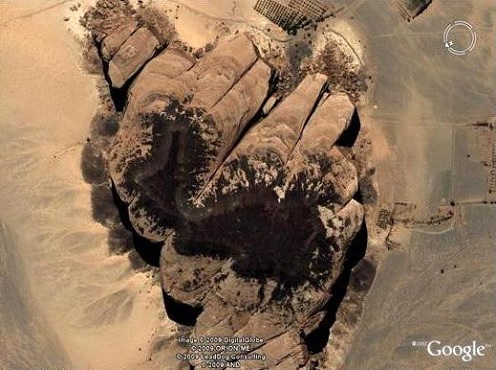
Thamud, one of the perished nation, lived in a valley which is about two hundred meters above sea level, it is also surrounded by tall mountains with 1200 meters average height.
Nowadays people call this rock" Al-Hwar mount", the word Hwar means" the baby of the she-camel", the significance of this name lies in the fact that the baby of the she-camel came back to his mother and went into it after it foamed three times, these were reference to the fact that the calamity would befall them after three days.
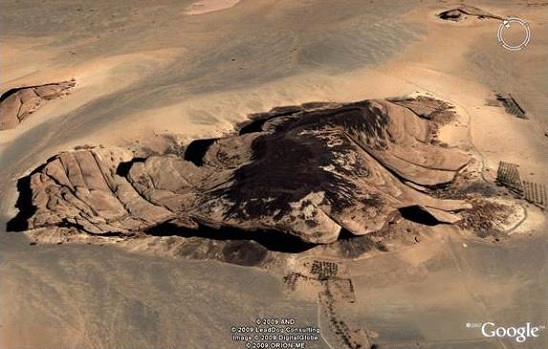
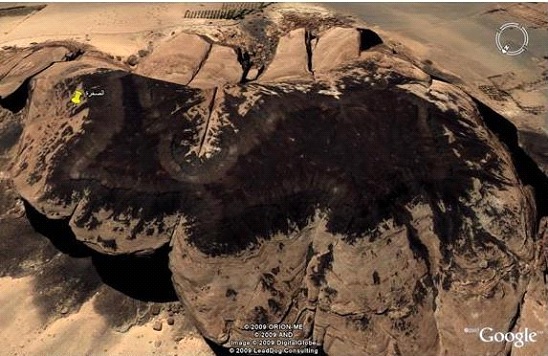
We can deduce the second proof from the narration that says" the stone has moved then cleft asunder to let a she-camel go out", a close look at the rock supports this narration; there is a subside in the ends of the rock, one of these subsides reaches(80) meters. Surely the going out of the she-camel must have caused such a malformation in the rock and that is why the corners of the rock subsided to be evidence to the emergence of the she-camel from the rock.
It is amazing that there are only two rocks which carry the sign of subsiding, they are near each other, and this is a proof that the she-camel went out from it.
The third evidence is that there is a black volcanic crater which takes the form of a she-camel in the sitting position, the length of the crater is fifty meter and the width is about twenty meters. The existence of this crater poses many questions that geologists can give answers too. Though the rock is big, it can't bear the signs of the explosion of a volcano because, if ever a volcano happened in it, it could have changed into pieces. One more question; the crater outline is clear and it has a geometrical shape which is different from the usual shapes of the volcanoes.
The existence of the volcano on this mountain from which the she-camel went out is really amazing because the big volcano on the other mountain could have prevented the emergence of the volcano of the rock, but God wanted to show people His miracles as from the same place from which the she-camel came out, the volcano erupted, the going out of the she-camel must have weakened the crust and this led to the swift emission of the trapped gas accompanied with the sound of the explosion which people could not bear.
God says what means: For We sent against them a single Mighty Blast, and they became like the dry stubble used by one who pens cattle. (54: 31)
Daily regulation of body temperature rhythm in the camel (Camelus dromedarius) exposed to experimental desert conditions
Rhythmicity is a fundamental property of all living organism. In mammals, the circadian clock, located in the suprachiasmatic nuclei of the hypothalamus (SCN) is central for these rhythmic processes and plays a pivotal role to control numerous circadian biological rhythms such as those of melatonin synthesis and secretion, behavioral features, or body temperature (Tb). In most mammals, rhythmic Tb represents a robust output of the master clock in the SCN, widely used in fundamental and clinical research to determine properties of the SCN clock. In a recent work, we observed that the daily Tb rhythm in the camel is a true circadian rhythm entrainable by environmental cues (light–dark cycle as in other mammals, but also the ambient temperature (Ta) cycle). However, we also demonstrated that, in some specific experimental conditions, a direct effect of Ta on thermal regulation (thus on Tb) is present El Allali et al. (2013). This suggests that in camel, which is known to present specific responses to Ta, the daily Tb rhythm is controlled by a complex mechanism. The aim of the present work was thus to study the nature of daily Tb rhythm in the camel and to determine its relationship with the circadian system under challenging conditions mimicking the desert environment.
The Camel (Camelus dromedaries) is not only able to adapt its physiological processes to the hostile environment of arid and desert areas but also capable of maintaining synthesis of hair, wool, muscles, milk, and in these conditions (Bengoumi and Faye 2002). Unlike small desert animals, camels are continuously exposed to heat, solar radiation, and lack of water and food. The camel's exceptional performance in the hot desert climate results from unique behavioral, anatomical, and physiological features to economize water by reducing the metabolic rate and regulating body temperature (Tb). The so‐called “adaptive heterothermy” in the dromedary camel was discovered more than 50 years ago (Schmidt‐Nielsen et al. 1957). In the absence of heat stress and with free access to water, the daily rhythm (controlled by circadian processes; see (El Allali et al. 2013) in rectal temperature presents an amplitude of about 2°C (the animal being then a perfect thermoregulator or homeotherm). During dehydration and heat stress, the amplitude of daily Tb rhythm exceeds 6°C (thermoconformer or poikilotherm) (Schmidt‐Nielsen et al. 1957). This variation in Tb in great excess of the limits of homeothermy has been advanced as a key adaptation of camels to their arid life (Schmidt‐Nielsen 1964), (Schmidt‐Nielsen et al. 1967), (MacFarlane et al. 1963), (Dahlborn et al. 1992), (Schroter et al. 1989), (Zine‐Filali 1991), (Ayoub and Saleh 1998), and (Bengoumi and Faye 2002). High amplitude in daily Tb rhythm is thus induced in the camel by privation of water and exposure to high Ta. Under these conditions, the Tb rhythm seems partly to follow that of Ta.
Our aim was thus to characterize the daily/circadian pattern of the Tb rhythm, in the specific conditions of adaptive heterothermy in response to daily heat with or without additional dehydration. Even if the capacity of the camel to exhibit a heterothermic state has been confirmed by different independent groups (Schroter et al. 1989), (Bengoumi and Faye 2002), (Robertshaw and Zine‐Filali 1995) and (Ayoub and Saleh 1998), one author (Al‐Haidary 2005) challenged that observation. Consequently, using the new technical tools developed to follow circadian parameters of Tb (see El Allali et al. 2013), we have characterized the adaptive heterothermic process according to the circadian/daily expression of Tb. It is also known that during experimental dehydration and heat stress, camels greatly decrease their food consumption. To our knowledge, the consequence of this decrease in food intake on the adaptive heterothermic process has not been previously studied. We thus decided to investigate the possible effects of food shortage on this process.
Experimental procedures
Animals
All the experimental procedures reported in this study were carried out in accordance with the recommendations for animal farm husbandry, experimentation, and surgery from the Hassan II Agronomy and Veterinary Institute of Rabat and of the Moroccan Ministry of Agriculture.
Six animals used were adult female camels (9–13 years), healthy, and nonpregnant of the local Moroccan variety. The experiments took place between July and August 2010, and during July 2011, in the veterinarian institute in Rabat, Morocco (34°1′12″N/6°49′48″W). The animals were kept for both experiments in controlled sheltered stables designed to monitor photoperiod and Ta. The animal could stand or sit in sternal recumbency comfortably (sitting up on the brisket with the legs tucked under the body, the natural sitting position in camel). LD cycle 12:12 was maintained automatically with timers, light on at 8:00 am and off at 08:00 pm (about 350 lux during the lighting period). Entrance of stable was gated with Safety Access System (SAS) to avoid external light exposure. “Cold” ambient temperature of 20–25°C (at the end of dark period) was obtained using six air conditioners with total power of 75,000 BTU. High ambient temperature (38–46°C at the end of light period) was obtained using nine electric heaters. The relative humidity (RH) of ambient air was, on average, 30% as measured by a hygrometer (Model STHW, Thermo Hygrometer electronic.
Reference Link