Ayat 1
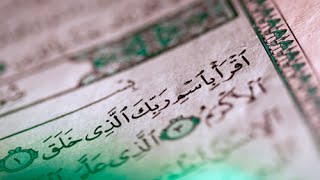
ٱقْرَأْ بِٱسْمِ رَبِّكَ ٱلَّذِى خَلَقَ.(1)
Recite in the name of your Lord who created -(1) [Al-Alaq: 1]
Section 01
Traditional understanding
Translation, tafseer from classical and modern scholars, transliteration, word-by-word grammar.
Translation Sahih International
Recite in the name of your Lord who created -(1)
(6204) The declaration or proclamation was to be in the name of Allah the Creator.
It was not for any personal benefit to the Prophet: to him there was to come bitter
persecution, sorrow, and suffering. It was the call of Allah for the benefit of erring
humanity. Allah is mentioned by his tide of "thy Lord and Cherisher", to establish
a direct nexus between the source of the Message and the one addressed. The
Message was not merely an abstract proposition of philosophy, but the direct
concrete message of a personal Allah to the creatures whom He loves and
cherishes. Thy addressed to the Prophet is appropriate in two ways: (1) he was in
direct contact with the divine Messenger (Gabriel) and Him Who sent the
Messenger; (2) he represented the whole of humanity, in a fuller sense than that in
which Christ Jesus is the "Son of Man".
It is universally agreed that the first five verses of Surah Al-'Alaq or Iqra' mark the very beginning of Quranic revelation. [Baghawil]. Bukhari, Muslim, other authentic sources and overwhelming consensus of scholars, ancient and modern, all concur on this point. However, some scholars state that Surah Al-Muddaththir was the first Surah to be revealed, and yet others say that Surah Al-Fatihah [The Opening] was revealed first. It is possible to reconcile between these different views as follows: After the revelation of Surah Al-'Alaq or Iqra', there was a temporary break in the revelation during which the Holy Prophet used to be very sad, but after some time, the Angel Jibra'il appeared to him once again, and he faced the same situation as he faced when the first verses of Surah Iqra' were revealed to him. On this occasion, the opening verses of Surah Al-Muddaththir were conveyed to him by the angel. From this point of view, it may be said that the first Surah to be revealed after the temporary break was Surah Al-Muddaththir. Some of the Companions held the view that Surah Al-Fatihah was the first Surah to be revealed. They probably meant to say that this was the first Surah to be revealed in a complete form. Undoubtedly, some verses (of Surahs Al-'Alaq or Iqra', Al-Muzzammil and Al-Muddathths) were revealed earlier, but the rest of the verses of those Surahs were revealed at later dates. Al-Fatihah is the first Surah that was revealed to the Holy Prophet in its entirety, all seven verses at once. [Mazhari]
The Holy Prophet's First Experience of Revelation
In a lengthy narration, as recorded in the Sahihs of Bukhari and Muslim, the Mother of the Faithful, Sayyidah Aisha says that revelation to the Messenger of Allah was started by true dreams. Whatever he saw in a dream would happen in reality as clearly as the light of dawn. Then solitude became dear to him, and he used to seclude
himself for worship in the cave Hira, (a cave in the mount known today as 'Jabal-un-Nur, which is clearly visible in front of Jannat-ul-Ma'la, the famous graveyard of Makkah) and therein he devoted himself to Divine worship for several nights before he came back to his family and took provisions for his retirement; then he would return to the Mother of the Faithful, Sayyidah Khadijah and take more provisions for a similar period. (The period of his stay in the cave is mentioned differently by different reports, but the report of sahihain maintains that it was a month, the whole month of Ramadan. Authentic traditions are silent about the mode of worship he adopted during this period. Some scholars have opined that he used to worship according to the SharTah of Nuh, Ibrahim and 'Isa, but neither any authentic report supports it, nor is it likely, because he was an 'ummiyy (unlettered). It is, therefore, more likely that his worship was concentration and reflection on Allah Almighty and His omnipotence until the Truth, that is, the revelation came to him while he was in the cave of Hira'; so the angel came to him and said, 'Read'. The Holy Prophet replied, 'I am not the one who can read'. (The Holy Prophet was under the impression that he was directing him to read a written document. Since the Holy Prophet could not read or write, he replied accordingly.) Then the angel embraced him and pressed him so hard that he felt extreme pain, then he released him and said, 'Read'. The Holy Prophet replied, 'I am not the one who can read'. Then he embraced him and pressed him a second time so hard that he felt extreme pain, then he released him again and said, 'Read'. The Holy Prophet replied, 'I am not the one who can read'. Then he embraced the Holy Prophet and pressed him a third time, then he released him and said, 'Read with the Name of your Lord Who created [everything], He created man from a clot of blood. Read, and your Lord is the most gracious, who imparted knowledge by means of the Pen. He taught man what he did not know.'
The Messenger of Allah returned with this message [of five verses] while his heart trembled and he came to Sayyidah Khadijah, saying 'wrap me up, wrap me up', and she wrapped him up, until the awe left him. (It should be noted that the fear felt by the Holy Prophet was due to the great responsibility delegated to him, and due to the unusual event of seeing an angel in his original form.) Then he said to Sayyidah Khadbah while he related to her what had happened: "I feared for myself." Sayyidah Khadljah said: 'Nay, by Allah, Allah will never expose you to disgrace, because you unite the ties of kinship, and bear the burden of the weak, and earn for the destitute, and offer hospitality to the guests, and help (people) in real distress.'
Then Sayyidah Khadijah took him to her cousin, Waraqah Ibn Naufal. He was a man who had adopted Christianity (which was a true religion at that time) during the days of Ignorance, and he used to write the Hebrew script, and translate it into Arabic. He was a very old man who had turned blind. Sayyidah Khadijah said to him, O Uncle's son! Listen to your brother's son. Waraqah asked him, My brother's son! What have you seen? So the Messenger of Allah related to him what he had seen. Waraqah said to him, This is the very same confidant [angel Jibra'il] whom Allah sent to Holy Prophet Musa; would that I were a young man at this time - would that I were alive when your people would expel you! The Messenger of Allah asked in surprise, "Will they expel me?" He replied. Yes; never has a man appeared with the like of that which you have brought, but he has been held in enmity; and if your time finds me alive, I shall help you with the fullest support. After that, not much time had passed before Waraqah died, and the revelation broke off temporarily. [Bukhari and Muslim]
The temporary break of revelation, according to Suhaill, lasted for about a year and half. Other reports say that it lasted to about three years. [Mazhari]
Verse [1] (Read with the Name of your Lord, Who created [everything]) In the prepositional phrase bismi rabbika [with the name of your Lord], the addition of the word ismi is significant in two ways [1] that whenever the Qur'an is being recited, the reader should begin by reciting the formula; "With the name of Allah, the All-Merciful, the Very-Merciful". When Jibra'il Amin suddenly appeared to the Holy Prophet and said 'iqra' (read) , he tendered apology that he is unable to read or recite, because he is unlettered. The phrase b-ismi rabbika points to the fact that under present circumstances you, O Holy Prophet, may be 'ummiyy' or unlettered, but Allah has the power to grant you the highest level of knowledge, the most elegant style of oration and eloquence, so that you would surpass and subdue the most educated or literate people, as it became manifest later on. [Mazhari].
[2]Allah has many Beautiful Names, but the blessed name rabb is particularly chosen in the verse here probably because it supports and emphasizes the theme that Allah cherishes and sustains the Holy Prophet through all the different stages of his development, until he is fully consummated. He can make him read and recite, despite being unlettered. In the relative clause al-ladhi khalaqa [Who created], particularly contains the Divine attribute of takhliq [creating] presumably because the first Divine favor is wujiid or 'existence' as a result of His drawing out beings from the realm of non-existence into the realm of existence. Many other favors of His follow. The verb khalaqa [created] is transitive and it requires an object that is absent here. This indicates the verb is used absolutely, and it signifies that the Creator has created the entire universe and every existent thing it contains.
The Holy Prophet UP & repeated what the angel said and then the angel left. The Holy Prophet immediately left for home in a very frightened state. He said to his wife Sayyidah Khadija "Cover me! Cover me!" When she covered him, he lay down for a while until the fear subsided. He then recounted the incident to Sayyidah Khadija [ Bukhari v. p. 3, 4 and Muslim v. 1 p. 88]
The verses of Surah Alaq were therefore the first verses of the Qur'an
revealed. After a while, Allah revealed the verses, "O you wrapped in garments.
Stand up and warn. Announce the greatness of your Lord. Keep your clothing clean. Stay away from sin." After this, revelation began coming continuously.
Allah Ta'ala says, 'Read in the name of your Lord who created". The command
to read is general and does not refer to anything specific. This first verse of the
Surah refers to Allah's making of the entire creation. Allah's creation is the
greatest manifestation of His power by which we ought to recognise Him.
After this Hadrat Aishah reports the words of the Holy Prophet himself, to the effect, "I said: I cannot read! There upon the Angel took me and pressed me until I could bear it no more. Then he left me and said: Read. I said: I cannot read! He pressed me a second time until I could bear it no more. Then he left me and said: Read. I again said: I cannot read! He pressed me for the third time until I could bear it no more. Then he left me and said: Iqra bismi Rabbi kal- ladhi khalaqa: (Read in the name of your Lord Who created) till he reached ma lam ya lam (what he did not know).
Then the Holy Messenger (upon whom be peace) returned home to Hadrat Khadijah trembling with fear, and said to her: `Cover me, cover me', and he was covered. When terror left him, he said: `O Khadijah, what has happened to me?' Then he narrated to her whatever had happened, and said: `I fear for my life'. She said; `No never! Be of good cheer. By God, never will God debase you: you treat the kindred well, you speak the truth, (one tradition adds: you restore what is entrusted to you), you bear the burden of the helpless, you help the poor, you entertain the guests, and you cooperate in good works.'
Then she took him to Waraqah bin Naufal, who was her cousin. He had become a Christian in pre-Islamic days, wrote the Gospel in Arabic and Hebrew, and had become very old and blind. Hadrat Khadijah said: `Brother, listen to the son of your brother.' Waraqah said to the Holy Prophet: `What have you seen, nephew?' The Holy Prophet described what he had seen. Waraqah said; `This is the same Gabriel (the Angel of Revelation) which Allah had sent down to Moses. Would that I were a young man during your Prophethood! Would that I were alive when your tribe would expel you!' The Holy Prophet said: `Will they expel me?' Waraqah said; `Yes, never has it so happened that a person brought what you have brought and was not treated as an enemy. If I live till then I would help you with all the power at my command.' But not very long after this Waraqah died.
This narrative is explicit that even until a moment before the coming Angel the Holy Messenger of Allah (upon whom be His peace) was without any expectation that he was going to be appointed a Prophet. Nothing to say of any such wish or expectation, he did not even have any idea that he would meet with such an experience. Coming down of the Revelation and appearing of the Angel face to face was an unexpected accident for him the first effect of which on him was precisely the same as could naturally be on a person meeting with such a tremendous experience, in the absence of any preparation. That is why when he proclaimed the message of Islam, the people of Makkah raised all sorts of objections, but no one said that they were already apprehending that he would make a claim, for he had been making preparations since long to become a Prophet.
From this narrative another thing which also becomes obvious is how pure was the Holy Prophet's life and how sublime was his character before Prophethood, Hadrat Khadijah was no young lady: she was 55 years old at the time this event took place and had been the Holy Prophet's life companion for 15 years. No weakness of the husband can remain hidden from the wife. She had during this long period of married life found him to be such a generous and noble man that when he told her of his experience in the Cave of Hira', she admitted without the least hesitation that it was indeed Allah's own Angel who had come to him with Revelation. Likewise, Waraqah bin Naufal also was an old inhabitant of Makkah, who had seen the Holy Prophet grow up from childhood. Particularly, for the past 15 years because of the close relationship he was even more intimately aware of his life, his Affairs and dealings. When he also heard of his experience, he did not regard it as an evil suggestion, but immediately said that it was the same Gabriel who had descended on Moses (peace be upon him). This meant that even according to him
the Holy Prophet was such a sublime person that there was nothing surprising in his being elevated to the office of Prophethood.
Transliteration
Ayah 1
Iqra biismi rabbika allathee khalaqa
Word-by-word
Ayah 1
| # | Arabic | Pronunciation | Meaning | Root |
|---|---|---|---|---|
| 1 | اقْرَأْ | Iqra | Read | ق ر أ |
| 2 | بِاسْمِ | biismi | in (the) name | س م و |
| 3 | رَبِّكَ | rabbika | (of) your Lord | ر ب ب |
| 4 | الَّذِى | allathee | the One Who | — |
| 5 | خَلَقَ | khalaqa | created | خ ل ق |
Section 02
Cross-references
Similar verses elsewhere in the Qur’an and authentic ahadith narrated about this ayah.
Section 03
Articles & resources
Long-form articles, scientific commentary, and historical context linked from the legacy archive.
Articles
Scientific Data
Misconceptions
- Read! In the Name of your Lord, Who has created (all that exists)is a command to recite from memory, not from a written page.html
- Read! In the Name of your Lord, Who has created (all that exists)is a command to recite from memory, not from a written page.html
- Who wrote the Qur’aan and how was it put together.html
- Who wrote the Qur’aan and how was it put together.html
- Why did the revelation to the Messenger of Allah (blessings and peace of Allah be upon him) cease for a while at the beginning of his mission, and how long did that last.html
- Why did the revelation to the Messenger of Allah (blessings and peace of Allah be upon him) cease for a while at the beginning of his mission, and how long did that last.html
Section 04
Audio & video lectures
0 videos · 14 audio lectures from contemporary scholars.
References
- Tafseer — Abdullah Yusuf
- Tafseer — Dr. Farooq Azam
- Tafseer — Ibn Abbas
- Tafseer — Jalalain
- Tafseer — Ma’arif Ul-Quran
- Tafseer — Mufti Taqi Usmani
- Tafseer — Shaikh Ashiq Ilahi
- Tafseer — Tafheem Ul-Quran
- Translation — Sahih International
- Hadith collections — 16 narrations from Bukhari, Muslim, Tirmidhi, Abu Dawud and others (see Cross-references)
- Quranic cross-references — 6 parallel verses
- Linked articles — 14 long-form pieces