Surah 078 of 114

سورة النبإ

An-Naba

40 verses · tap any ayah to deep-dive

Ayat 1

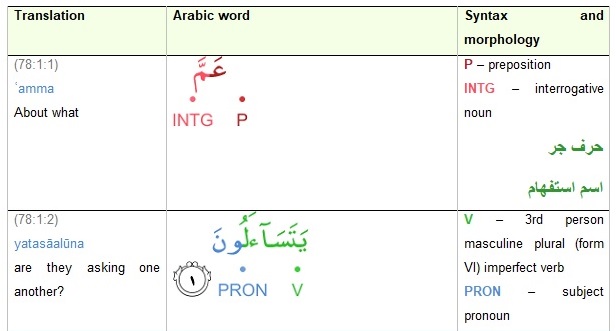
عَمَّ يَتَسَآءَلُونَ(1)

About what are they asking one another?(1) [An-Naba: 1]

Back to surah / Surah 078 · An-Naba / Ayah 1

Section 01

Traditional understanding

Translation, tafseer from classical and modern scholars, transliteration, word-by-word grammar.

Translation Sahih International

About what are they asking one another?(1)

Tafseer Abdullah Yusuf

Concerning what are they disputing ?

Tafseer Dr. Farooq Azam

About what are they asking ?

Tafseer Ibn Abbas

And from his narration on the authority of Ibn 'Abbas that he said regarding the interpretation of Allah's saying (Whereof do they question one another?): He says: 'what are they-meaning the people of Quraysh- talking about?'

Tafseer Jalalain

About what, about what thing, are they, the people of Quraysh, questioning one another?  

Tafseer Ma’arif Ul-Quran

(About what are they asking each other? ... 78:l). The word 'amma is made up of two particles: [1] The preposition عَنِ'an (about); and [2] the interrogative particle 'ma' (what?) (the last letter, that is, 'ma' has been omitted according to the grammatical composition. The sense is :About what are they asking each other?'

Tafseer Mufti Taqi Usmani

This means the event of Resurrection. The pagans used to deny it on the ground that once a human being is turned into dust, it is impossible for anyone to revive him. The forthcoming verses point out to Allah’s all-encompassing power with which He has created marvelous objects of the universe. If He had the power to create the universe out of nothing, how can one deny His power to raise human beings again ?

Tafseer Shaikh Ashiq Ilahi

Allama Qurtubi narrates that some members of the Quraysh were once having a discussion. When it was mentioned that the Qur'an spoke about Judgment Day, some of them accepted while others did not. " Ma' alimut Tanzil " adds that some of them asked, "What has Muhammad (PBUH)brought ?" It was with reference to this discussion that Allah revealed the verse " What do they ask about ? " Allah Himself replies to the question when He says, " About the great news ( Judgment Day ) concerning which they differ ? "While some of them believed in Judgment Day, others did not.

Tafseer Tafheem Ul-Quran

"The Great News": the news of the Resurrection and Hereafter, which the people of Makkah heard with amazement, then raised questions and doubts about it in their assemblies. When they met each other they would ask: "Did you ever hear that the dead will be resurrected to life? Is it credible that life will be infused once again into the bones which have decayed and become rotten?
Does it stand to reason that the former and the latter generations will rise up and gather together at one place? Is it possible that these huge mountains which are so firmly set in the earth will fly about like flakes of wool? Can it so happen that the sun and the moon and the stars should be extinguished and the order and system of the world be overturned and upset? What has happened to him who was until yesterday a sane and wise man among us? Today he is giving us strange, impossible news.
Where were this Hell and Heaven of which we had never heard from him before? where from have they appeared suddenly so that he has started depicting them so vividly before us?" Another meaning of fi-hi mukhtalifun also can be: "As these people themselves are not agreed on any one view about the end of the world, they hold varying views about it."Someone has been influenced by the Christian belief and believes in the life after death but thinks that the second life would not be a physical but only a spiritual life. Another does not deny the Hereafter absolutely but doubts whether it was possible or not. The Qur'an relates the view of these very people when it says: "We do only guess: we are not certain." (Al-Jathiyah: 32). And another plainly said: "There is no other life than this present life,and we shall never be raised back to life after our death." (Al-An`am: 29). Then, there were some atheists, who said: "Life is only this worldly life of ours. Here we shall die and live and nothing but the change of time destroys us." (Al-Jathiyah: 24). There were some others who were not atheist but they regarded the second life as impossible. According to them it was beyond the power of God to raise the dead back to life. They said, "Who will give life to these bones when they are rotten." (Ya Sin: 78). Their different views by themselves were a proof that they had no knowledge in this regard; they were only conjecturing and guessing. Had they any knowledge they would have agreed on one view. (For further explanation, see E.N. 6 of Surah Adh-Dhariyat). .

Transliteration

Ayah 1

AAamma yatasaaloona

Word-by-word

Ayah 1

# Arabic Pronunciation Meaning Root
1 عَمَّ AAamma About what?
2 يَتَسَآءَلُونَ yatasaaloona are they asking one another س أ ل

Grammar diagrams

Grammar diagram for ayah

Section 02

Cross-references

Similar verses elsewhere in the Qur’an and authentic ahadith narrated about this ayah.

Section 03

Articles & resources

Long-form articles, scientific commentary, and historical context linked from the legacy archive.

Section 04

Audio & video lectures

16 videos · 8 audio lectures from contemporary scholars.
Tafseer surah Naba Sheikh Assim Al Hakeem Video · youtube Tafseer surah Naba Sheikh Assim Al Hakeem Video · youtube What happens with the Kuffars - Sheikh Assim Alhakeem Sheikh Assim Al Hakeem Video · youtube What happens with the Kuffars - Sheikh Assim Alhakeem Sheikh Assim Al Hakeem Video · youtube Belief in the Last Day - Dr. Bilal Philips Bilal Philips Video · youtube Belief in the Last Day - Dr. Bilal Philips Bilal Philips Video · youtube SurahADay 078 Yahya Ibrahim Video · youtube SurahADay 078 Yahya Ibrahim Video · youtube 5min Tafseer Yahya Ibrahim Video · youtube 5min Tafseer Yahya Ibrahim Video · youtube Surah Naba - Beautifully explained by Nouman Ali Khan Nouman Ali Khan Video · youtube Surah Naba - Beautifully explained by Nouman Ali Khan Nouman Ali Khan Video · youtube Surah An Naba (The Great News) Complete Tafsir | illustrated Nouman Ali Khan Video · youtube Surah An Naba (The Great News) Complete Tafsir | illustrated Nouman Ali Khan Video · youtube Summary of Juz Amma by Mirza Yawar Baig Sheikh Yawar Ali Baig Video · youtube Summary of Juz Amma by Mirza Yawar Baig Sheikh Yawar Ali Baig Video · youtube Tafseer Of Juz Amma – Episode 01 – Surat An-Naba Abu Bakr Zoud Audio lecture Tafseer Of Juz Amma – Episode 01 – Surat An-Naba Abu Bakr Zoud Audio lecture 36 Tafsir Juz E Amma Surah Al Naba Navaid Aziz Audio lecture 36 Tafsir Juz E Amma Surah Al Naba Navaid Aziz Audio lecture Tafseer Daily – 078 an-Naba Yahya Ibrahim Audio lecture Tafseer Daily – 078 an-Naba Yahya Ibrahim Audio lecture Ramadan With The Quran – Day 1 Nouman Ali Khan Audio lecture Ramadan With The Quran – Day 1 Nouman Ali Khan Audio lecture

References

  1. Tafseer — Abdullah Yusuf
  2. Tafseer — Dr. Farooq Azam
  3. Tafseer — Ibn Abbas
  4. Tafseer — Jalalain
  5. Tafseer — Ma’arif Ul-Quran
  6. Tafseer — Mufti Taqi Usmani
  7. Tafseer — Shaikh Ashiq Ilahi
  8. Tafseer — Tafheem Ul-Quran
  9. Translation — Sahih International
  10. Hadith collections — 6 narrations from Bukhari, Muslim, Tirmidhi, Abu Dawud and others (see Cross-references)
  11. Quranic cross-references — 12 parallel verses
  12. Linked articles — 2 long-form pieces
Ayat 2

عَنِ ٱلنَّبَإِ ٱلْعَظِيمِ.(2)

About the great news -(2) [An-Naba: 2]

Back to surah / Surah 078 · An-Naba / Ayah 2

Section 01

Traditional understanding

Translation, tafseer from classical and modern scholars, transliteration, word-by-word grammar.

Translation Sahih International

About the great news -(2)

Tafseer Abdullah Yusuf

Great News; usually understood to mean the News or Message of the Resurrection or the Hereafter, about which there are various schools of thought among the Jews and Christians and other nations. There is practically nothing about the Resurrection in the Old Testament, and the Jewish sect of Sadducees even in the time of Christ denied the Resurrection altogether. The Pagan ideas of a future life-if any-varied from place to place and from time to time. Even in the early Christian Church, as we learn from Paul's First Epistle to the Corinthians,there were contentions in that little community (I. Corinthians, 1:11), and some definitely denied the resurrection of the dead (ib., 15:12). Great News may also be translated Great Message or a Message Supreme as I have translated at 38:67. In that case it would refer to the Qur'an, or the Message
of Revelation, or the Message of the Prophet, about which there was great contention in those days. As this Message also lays great stress on the Day of Judgement and the Resurrection, the practical result by either mode of interpretation amounts to the same

Tafseer Dr. Farooq Azam

made the night a mantle

Tafseer Ibn Abbas

((It is) of the awful tidings) they are talking about the tidings of the noble, glorious and great Qur'an,

Tafseer Jalalain

About the awesome tiding ([this is] the explication of that ‘thing’; the interrogative is meant to emphasise its
magnitude)this [awesome tiding] is the Qur’ān, comprising [news of] the Resurrection and so on, which the Prophet (s) brought. 

Tafseer Ma’arif Ul-Quran

(About the Great Event in which they
dispute! .... 78:2,3). The word naba' means 'news' but not every news is naba'. It means a 'momentous news of a great event'. This refers to the news of the Day of Judgement. The verse purports to convey that the inhabitants of Makkah ask about the Day of Judgement in which they dispute [while some of them believed in Resurrection, others did not.] Sayyidna Ibn 'Abbas & reports that when the revelation of Quran started, the pagan Arabs used to form circles and discuss and criticise it, especially about the tremendous import of Resurrection and Judgement referred to in the Qur'an. The pagans thought this was impossible, and they used to have protracted discussion. The disbelievers persuade themselves to believe that the predicted event will never take place, Surah An-Naba' : 78 : 1 - 40 683 though there were others who believed in the event. The Siirah opens by I shunning the enquirers and the enquiry, it wonders that anyone should raise any doubts about Resurrection and Judgement. Some of the commentators express the opinion that their enquiry was not a genuine one where they were keen to learn about the truth. So they ask half-mockingly and half in doubt, when that event, so loudly pronounced, will happen. Qur'an has responded by asserting one statement twice for emphasis, thus

Tafseer Mufti Taqi Usmani

This means the event of Resurrection. The pagans used to deny it on the ground that once a human being is turned into dust, it is impossible for anyone to revive him. The forthcoming verses point out to Allah’s all-encompassing power with which He has created marvelous objects of the universe. If He had the power to create the universe out of nothing, how can one deny His power to raise human beings again?

Tafseer Shaikh Ashiq Ilahi

Allama Qurtubi narrates that some members of the Quraysh were once having a discussion. When it was mentioned that the Qur'an spoke about Judgment Day, some of them accepted while others did not. " Ma' alimut Tanzil " adds that some of them asked, "What has Muhammad(PBUH) brought ?" It was with reference to this discussion that Allah revealed the verse " What do they ask about ? " Allah Himself replies to the question when He says, " About the great news ( Judgment Day ) concerning which they differ ? "While some of them believed in Judgment Day, others did not.

Tafseer Tafheem Ul-Quran

That is, whatever they say about the Hereafter is false, and all their concepts about it are wrong

Transliteration

Ayah 2

AAani alnnabai alAAatheemi

Word-by-word

Ayah 2

# Arabic Pronunciation Meaning Root
1 عَنِ AAani About
2 النَّبَإِ alnnabai the News ن ب أ
3 الْعَظِيمِ alAAatheemi the Great ع ظ م

Section 02

Cross-references

Similar verses elsewhere in the Qur’an and authentic ahadith narrated about this ayah.

Section 03

Articles & resources

Long-form articles, scientific commentary, and historical context linked from the legacy archive.

Section 04

Audio & video lectures

26 videos · 16 audio lectures from contemporary scholars.

Tafseer surah Naba 78:1-4. Sheikh Assim Al Hakeem Video · youtube Tafseer surah Naba 78:1-4. Sheikh Assim Al Hakeem Video · youtube Signs of the Last Day (Day of Judgement) Part 1 Sheikh Assim Al Hakeem Video · youtube Signs of the Last Day (Day of Judgement) Part 1 Sheikh Assim Al Hakeem Video · youtube Signs of the Last Day (Day of Judgement) Part 2 Sheikh Assim Al Hakeem Video · youtube Signs of the Last Day (Day of Judgement) Part 2 Sheikh Assim Al Hakeem Video · youtube Signs of the Last Day (Day Of Judgement) Part 3 Sheikh Assim Al Hakeem Video · youtube Signs of the Last Day (Day Of Judgement) Part 3 Sheikh Assim Al Hakeem Video · youtube Signs of the Last Day (Day Of Judgement) Part 4 Sheikh Assim Al Hakeem Video · youtube Signs of the Last Day (Day Of Judgement) Part 4 Sheikh Assim Al Hakeem Video · youtube Journey Through The Last Day - Sheikh Salim Al-Amry - YouTube Sheikh Salim Al- Amry Video · youtube Journey Through The Last Day - Sheikh Salim Al-Amry - YouTube Sheikh Salim Al- Amry Video · youtube Signs of the Day of Judgement Sheikh Dr Muhammad Salah Dr.Muhammad Salah Video · youtube Signs of the Day of Judgement Sheikh Dr Muhammad Salah Dr.Muhammad Salah Video · youtube The day of Judgement - Dr. Muhammad Salah Dr.Muhammad Salah Video · youtube The day of Judgement - Dr. Muhammad Salah Dr.Muhammad Salah Video · youtube How long will The Day of Judgement last Sheikh Dr Muhammad Salah Dr.Muhammad Salah Video · youtube How long will The Day of Judgement last Sheikh Dr Muhammad Salah Dr.Muhammad Salah Video · youtube The Events of the Day of Judgment, Muhammad Tim Humble, Part 1 Muhammed Tim Humble Video · youtube The Events of the Day of Judgment, Muhammad Tim Humble, Part 1 Muhammed Tim Humble Video · youtube THE DAY OF RESURRECTION - Tim Humble Animated Muhammed Tim Humble Video · youtube THE DAY OF RESURRECTION - Tim Humble Animated Muhammed Tim Humble Video · youtube Judgement Day - Heaven & Hell - Bilal Philips Bilal Philips Video · youtube Judgement Day - Heaven & Hell - Bilal Philips Bilal Philips Video · youtube Belief in the Last Day Dr. Bilal Philips Video · youtube Belief in the Last Day Dr. Bilal Philips Video · youtube Allah Will Ask To Come Closer On The Day Of Judgement bilal-assad Audio lecture Allah Will Ask To Come Closer On The Day Of Judgement bilal-assad Audio lecture Judgement Day khalid-yasin Audio lecture Judgement Day khalid-yasin Audio lecture Judgement Day Is Coming muiz-bukhary Audio lecture Judgement Day Is Coming muiz-bukhary Audio lecture The Judgement Day zahir-mahmood Audio lecture The Judgement Day zahir-mahmood Audio lecture The Moment Of Truth Judgement Day omar-suleiman Audio lecture The Moment Of Truth Judgement Day omar-suleiman Audio lecture Ramadan 2015 - Day 12 yasir-qadhi Audio lecture Ramadan 2015 - Day 12 yasir-qadhi Audio lecture The Day Of Judgement Part 2 bilal-assad Audio lecture The Day Of Judgement Part 2 bilal-assad Audio lecture Day of Judgement mufti-menk Audio lecture Day of Judgement mufti-menk Audio lecture

References

  1. Tafseer — Abdullah Yusuf
  2. Tafseer — Dr. Farooq Azam
  3. Tafseer — Ibn Abbas
  4. Tafseer — Jalalain
  5. Tafseer — Ma’arif Ul-Quran
  6. Tafseer — Mufti Taqi Usmani
  7. Tafseer — Shaikh Ashiq Ilahi
  8. Tafseer — Tafheem Ul-Quran
  9. Translation — Sahih International
  10. Hadith collections — 32 narrations from Bukhari, Muslim, Tirmidhi, Abu Dawud and others (see Cross-references)
  11. Quranic cross-references — 8 parallel verses
  12. Linked articles — 6 long-form pieces

Ayat 3

ٱلَّذِى هُمْ فِيهِ مُخْتَلِفُونَ.(3)

That over which they are in disagreement.(3) [An-Naba: 3]

Back to surah / Surah 078 · An-Naba / Ayah 3

Section 01

Traditional understanding

Translation, tafseer from classical and modern scholars, transliteration, word-by-word grammar.

Translation Sahih International

That over which they are in disagreement.(3)

Tafseer Abdullah Yusuf

About which they cannot agree.

Tafseer Dr. Farooq Azam

about which they are in disagreement

Tafseer Ibn Abbas

(Concerning which they are in disagreement) some of them disbelieve in Muhammad (pbuh) and in the Qur'an while others believe in them. This is because whenever Gabriel brought down a section of the Qur'an to the Prophet (pbuh) and he recited it to them, they used to talk about it, and some of them would believe while others would persist in their disbelief.

Tafseer Jalalain

concerning which they are at variance, for the believers affirm it, while the disbelievers repudiate it.

Tafseer Ma’arif Ul-Quran

(About the Great Event in which they
dispute! .... 78:2,3). The word naba' means 'news' but not every news is naba'. It means a 'momentous news of a great event'. This refers to the news of the Day of Judgement. The verse purports to convey that the inhabitants of Makkah ask about the Day of Judgement in which they dispute [while some of them believed in Resurrection, others did not.] Sayyidna Ibn 'Abbas & reports that when the revelation of Qur'an started, the pagan Arabs used to form circles and discuss and criticise it, especially about the tremendous import of Resurrection and Judgement referred to in the Qur'an. The pagans thought this was impossible, and they used to have protracted discussion. The disbelievers persuade themselves to believe that the predicted event will never take place, Surah An-Naba' : 78 : 1 - 40 683 though there were others who believed in the event. The Siirah opens by I shunning the enquirers and the enquiry, it wonders that anyone should raise any doubts about Resurrection and Judgement. Some of the commentators express the opinion that their enquiry was not a genuine one where they were keen to learn about the truth. So they ask half-mockingly and half in doubt, when that event, so loudly pronounced, will happen. Qur'an has responded by asserting one statement twice for emphasis, thus

Tafseer Mufti Taqi Usmani

This means the event of Resurrection. The pagans used to deny it on the ground that once a human being is turned into dust, it is impossible for anyone to revive him. The forthcoming verses point out to Allah’s all-encompassing power with which He has created marvelous objects of the universe. If He had the power to create the universe out of nothing, how can one deny His power to raise human beings again?

Tafseer Shaikh Ashiq Ilahi

Allama Qurtubi narrates that some members of the Quraysh were once having a discussion. When it was mentioned that the Qur'an spoke about Judgment Day, some of them accepted while others did not. " Ma' alimut Tanzil " adds that some of them asked, "What has Muhammad (PBUH)brought ?" It was with reference to this discussion that Allah revealed the verse " What do they ask about ? " Allah Himself replies to the question when He says, " About the great news ( Judgment Day ) concerning which they differ ? "While some of them believed in Judgment Day, others did not

Tafseer Tafheem Ul-Quran

That is, the time is not far off when the same thing about which they are expressing all sorts of meaningless doubts and misgivings, will appear before them as a reality. Then they will realize that what the Messenger had foretold was absolutely true and what they were saying on the basis of conjecture and speculation had no truth in it.

Transliteration

Ayah 3

Allathee hum feehi mukhtalifoona

Word-by-word

Ayah 3

# Arabic Pronunciation Meaning Root
1 الَّذِى Allathee (About) which
2 هُمْ hum they
3 فِيهِ feehi (are) concerning it
4 مُخْتَلِفُونَ mukhtalifoona (in) disagreement خ ل ف

Section 02

Cross-references

Similar verses elsewhere in the Qur’an and authentic ahadith narrated about this ayah.

Section 03

Articles & resources

Long-form articles, scientific commentary, and historical context linked from the legacy archive.

Section 04

Audio & video lectures

32 videos · 8 audio lectures from contemporary scholars.

Tafseer surah Naba 78:1-4. Sheikh Assim Al Hakeem Video · youtube Tafseer surah Naba 78:1-4. Sheikh Assim Al Hakeem Video · youtube Signs of the Day of Judgement Sheikh Dr Muhammad Salah Dr.Muhammad Salah Video · youtube Signs of the Day of Judgement Sheikh Dr Muhammad Salah Dr.Muhammad Salah Video · youtube The Events of the Day of Judgment, Muhammad Tim Humble, Part 1 Muhammed Tim Humble Video · youtube The Events of the Day of Judgment, Muhammad Tim Humble, Part 1 Muhammed Tim Humble Video · youtube Belief in the Last Day - Dr. Bilal Philips Bilal Philips Video · youtube Belief in the Last Day - Dr. Bilal Philips Bilal Philips Video · youtube The Bankrupt Person on the Day of Judgement ~ Mufti Ismail Menk Ismail Ibn Musa Menk Video · youtube The Bankrupt Person on the Day of Judgement ~ Mufti Ismail Menk Ismail Ibn Musa Menk Video · youtube The Bankrupt Person on the Day of Judgement ~ Mufti Ismail Menk Ismail Ibn Musa Menk Video · youtube The Bankrupt Person on the Day of Judgement ~ Mufti Ismail Menk Ismail Ibn Musa Menk Video · youtube Warnings from Allah regarding the day of Judgement~Mufti Menk [Save yourself] Ismail Ibn Musa Menk Video · youtube Warnings from Allah regarding the day of Judgement~Mufti Menk [Save yourself] Ismail Ibn Musa Menk Video · youtube #SurahADay 078 an-Naba #5min Tafseer with Yahya Ibrahim Yahya Ibrahim Video · youtube #SurahADay 078 an-Naba #5min Tafseer with Yahya Ibrahim Yahya Ibrahim Video · youtube 10/Ten major Signs before the day of judgement given by Prophet Muhammad. Ahmad Saifuddin .  Dr. Ahmad Ibn Saifuddin Video · youtube 10/Ten major Signs before the day of judgement given by Prophet Muhammad. Ahmad Saifuddin .  Dr. Ahmad Ibn Saifuddin Video · youtube Signs of the hour Dr. Ahmad Ibn Saifuddin Video · youtube Signs of the hour Dr. Ahmad Ibn Saifuddin Video · youtube Sign of the hour 3 Dr. Ahmad Ibn Saifuddin Video · youtube Sign of the hour 3 Dr. Ahmad Ibn Saifuddin Video · youtube Surah Naba - Beautifully explained by Nouman Ali Khan Nouman Ali Khan Video · youtube Surah Naba - Beautifully explained by Nouman Ali Khan Nouman Ali Khan Video · youtube Surah An Naba (The Great News) Complete Tafsir | illustrated Nouman Ali Khan Video · youtube Surah An Naba (The Great News) Complete Tafsir | illustrated Nouman Ali Khan Video · youtube Al Naba-Part 1 | Night 1 | Nouman Ali Khan [Ramadan 2017] Nouman Ali Khan Video · youtube Al Naba-Part 1 | Night 1 | Nouman Ali Khan [Ramadan 2017] Nouman Ali Khan Video · youtube Summary of Juz Amma by Mirza Yawar Baig Sheikh Yawar Ali Baig Video · youtube Summary of Juz Amma by Mirza Yawar Baig Sheikh Yawar Ali Baig Video · youtube What will happen to Non Muslims on the Day of Judgement? Dr.Zakir Naik Dr. Zakir Naik Video · youtube What will happen to Non Muslims on the Day of Judgement? Dr.Zakir Naik Dr. Zakir Naik Video · youtube Tafseer Of Juz Amma – Episode 01 – Surat An-Naba Abu Bakr Zoud Audio lecture Tafseer Of Juz Amma – Episode 01 – Surat An-Naba Abu Bakr Zoud Audio lecture 36 Tafsir Juz E Amma Surah Al Naba: Navaid Aziz – Audio lecture 36 Tafsir Juz E Amma Surah Al Naba: Navaid Aziz – Audio lecture Tafseer Daily – 078 an-Naba: Yahya Ibrahim – Audio lecture Tafseer Daily – 078 an-Naba: Yahya Ibrahim – Audio lecture Ramadan With The Quran – Day 1: Nouman Ali Khan Audio lecture Ramadan With The Quran – Day 1: Nouman Ali Khan Audio lecture

References

  1. Tafseer — Abdullah Yusuf
  2. Tafseer — Dr. Farooq Azam
  3. Tafseer — Ibn Abbas
  4. Tafseer — Jalalain
  5. Tafseer — Ma’arif Ul-Quran
  6. Tafseer — Mufti Taqi Usmani
  7. Tafseer — Shaikh Ashiq Ilahi
  8. Tafseer — Tafheem Ul-Quran
  9. Translation — Sahih International
  10. Hadith collections — 2 narrations from Bukhari, Muslim, Tirmidhi, Abu Dawud and others (see Cross-references)
  11. Quranic cross-references — 38 parallel verses
  12. Linked articles — 2 long-form pieces

Ayat 4, 5

كَلَّا سَيَعْلَمُونَ.(4)

ثُمَّ كَلَّا سَيَعْلَمُونَ.(5)

No! They are going to know.(4) [An-Naba: 4, 5]

Back to surah / Surah 078 · An-Naba / Ayah 4, 5

Section 01

Traditional understanding

Translation, tafseer from classical and modern scholars, transliteration, word-by-word grammar.

Translation Sahih International

No! They are going to know.(4)

Tafseer Abdullah Yusuf

Verily, they shall soon (come to) know!
Verily, verily they shall soon (come to) know!

Tafseer Dr. Farooq Azam

Very soon they shall come to know.
We repeat, very soon they shall come to know

Tafseer Ibn Abbas

(Nay) this is a reply to the disbelievers, (but they will come to know!) They will come to know upon the advent of death what will be done with them.
(Nay) truly, (again, but they will come to know!) They will come to know in the grave what will be done with them. This is a threat from Allah to those who disbelieved in Muhammad (pbuh) and in the Qur'an.

Tafseer Jalalain

No indeed! a disavowal they will come to know, what will befall them for their rejection of it.
Again, no indeed! They will come to know! ([reiterated] for emphasis; thumma is added here to declare that the second threat of chastisement is more severe than the first). God, exalted be He, then alludes to His power to resurrect, saying:

Tafseer Ma’arif Ul-Quran

(Truly, they will soon know. Again, truly, they will soon know .... 78:5) The particle kalla is negative, and means 'never, by no means'. It means here that this matter cannot be understood by question and answer or by disputation and debate. Its reality will be understood by them when they will face it. It is such a reality that has no room for questions, disputation or denial. The Qur'an says that soon they will come to know about it [and this statement is repeated twice for emphasis]. In other words, when they die, they will discover the realities of the next world. They will see the horrors of the Hereafter with their eyes.

Tafseer Mufti Taqi Usmani

No! They are going to know.
Again, indeed they will soon know.

Tafseer Shaikh Ashiq Ilahi

Allah says, "Take heed! They will soon come to know." Allah then repeats,"Take heed again! They will soon come to know." They will realise the error of their ways when Judgment Day does take place, but then it will be too late.

Tafseer Tafheem Ul-Quran

(no indeed)That is, whatever they say about the Hereafter is false, and all their concepts about it are wrong.
That is, the time is not far off when the same thing about which they are expressing all sorts of meaningless doubts and misgivings, will appear before them as a reality. Then they will realize that what the Messenger (peace be upon him) had foretold was absolutely true and what they were saying on the basis of conjecture and speculation had no truth in it.

Transliteration

Ayah 4

Kalla sayaAAlamoona

Ayah 5

Thumma kalla sayaAAlamoona

Word-by-word

Ayah 4

# Arabic Pronunciation Meaning Root
1 كَلَّا Kalla Nay!
2 سَيَعْلَمُونَ sayaAAlamoona (soon) they will know ع ل م

Ayah 5

# Arabic Pronunciation Meaning Root
1 ثُمَّ Thumma Then
2 كَلَّا kalla Nay!
3 سَيَعْلَمُونَ sayaAAlamoona (soon) they will know ع ل م

Section 02

Cross-references

Similar verses elsewhere in the Qur’an and authentic ahadith narrated about this ayah.

Section 03

Articles & resources

Long-form articles, scientific commentary, and historical context linked from the legacy archive.

Section 04

Audio & video lectures

10 videos · 8 audio lectures from contemporary scholars.

References

  1. Tafseer — Abdullah Yusuf
  2. Tafseer — Dr. Farooq Azam
  3. Tafseer — Ibn Abbas
  4. Tafseer — Jalalain
  5. Tafseer — Ma’arif Ul-Quran
  6. Tafseer — Mufti Taqi Usmani
  7. Tafseer — Shaikh Ashiq Ilahi
  8. Tafseer — Tafheem Ul-Quran
  9. Translation — Sahih International
  10. Hadith collections — 2 narrations from Bukhari, Muslim, Tirmidhi, Abu Dawud and others (see Cross-references)
  11. Quranic cross-references — 34 parallel verses
  12. Linked articles — 8 long-form pieces

Ayat 6

أَلَمْ نَجْعَلِ ٱلْأَرْضَ مِهَٰدًۭا.(6)

Then, no! They are going to know.(5) [An-Naba: 6]

Back to surah / Surah 078 · An-Naba / Ayah 6

Section 01

Traditional understanding

Translation, tafseer from classical and modern scholars, transliteration, word-by-word grammar.

Translation Sahih International

Then, no! They are going to know.(5)

Tafseer Abdullah Yusuf

Have We not made the earth as a wide(5890)
Expanse. The spacious expanse of the earth may be compared to a carpet, to which the mountains act as pegs. The Signs of Allah are thus enumerated: the great panorama of outer nature (verses 6-7); the creation of Man in pairs, with the succession of rest and work fitting in with the succession of night and day (verses 8-11); the firmaments above, with their splendid lights (verses 12-13); and the clouds and rain and abundant harvests, which knit sky and earth and man together (verses 14-16). These point to Allah,and Allah's Message points to the Future Life.

Tafseer Dr. Farooq Azam

Is it not true that We have spread the earth like a bed

Tafseer Ibn Abbas

Allah then mentioned the blessings He bestowed upon them, saying: (Have We not made the earth an expanse) and a place to sleep

Tafseer Jalalain

Have We not made the earth a cradle, a bed, like a cradle,

Tafseer Ma’arif Ul-Quran

Then the Holy Qur'an has pointed to different demonstrations of His power to prove that it is not impossible for Allah to destroy this entire world and re-create it once again. Reference is made to the creation of earth, mountains, human beings, males and females and the creation of suitable conditions for human life, health and activities.

Tafseer Mufti Taqi Usmani

Did We not make the earth a floor,

Tafseer Shaikh Ashiq Ilahi

Allah then mentions some of His creations that are there for all to see. By pondering over these, man will realise Allah's great power and will understand that the Being Who created such phenomenal things must certainly have the power to resurrect people on the Day of Judgment. Allah asks, " Have We not made the earth a bedding, the mountains pegs, and created you in pairs?" Because the mountains prevent the earth from shaking, man is able to stand, walk and travel easily on earth. Allah has also created a spouse for man so that man may marry, may have a loving companion through the difficulties of life and may have contentment. In addition to this, marriage allows for procreation so that man may survive on earth.

Tafseer Tafheem Ul-Quran

enough light has been thrown at several places in the meaning of the qur'an on the supreme wisdom and power of allah that underlies his making the earth a carpet, i.e. an abode of perfect peace and rest

Transliteration

Ayah 6

Alam najAAali alarda mihadan

Word-by-word

Ayah 6

# Arabic Pronunciation Meaning Root
1 أَلَمْ Alam Have not?
2 نَجْعَلِ najAAali We made ج ع ل
3 الْأَرْضَ alarda the earth أ ر ض
4 مِهَادًا mihadan a resting place م ه د

Section 02

Cross-references

Similar verses elsewhere in the Qur’an and authentic ahadith narrated about this ayah.

Section 03

Articles & resources

Long-form articles, scientific commentary, and historical context linked from the legacy archive.

Section 04

Audio & video lectures

26 videos · 12 audio lectures from contemporary scholars.

TAFSEER OF QUR'AN Ep 04 Surah Naba 5 11 Sheikh Assim Al Hakeem Sheikh Assim Al Hakeem Video · youtube TAFSEER OF QUR'AN Ep 04 Surah Naba 5 11 Sheikh Assim Al Hakeem Sheikh Assim Al Hakeem Video · youtube According to Qur'an, is the earth spherical in shape or flat? - Sheikh Assim Al Hakeem Sheikh Assim Al Hakeem Video · youtube According to Qur'an, is the earth spherical in shape or flat? - Sheikh Assim Al Hakeem Sheikh Assim Al Hakeem Video · youtube What did allah create before the heavens or the earth | Shaikh Assim Al Hakeem Sheikh Assim Al Hakeem Video · youtube What did allah create before the heavens or the earth | Shaikh Assim Al Hakeem Sheikh Assim Al Hakeem Video · youtube Flat Earth Theory ? - Syaikh Yusuf Estes Yusuf Estes Video · youtube Flat Earth Theory ? - Syaikh Yusuf Estes Yusuf Estes Video · youtube Sheikh Yusuf Estes: Quran tells us about Sun, Moon, Earth and Universe!!! Yusuf Estes Video · youtube Sheikh Yusuf Estes: Quran tells us about Sun, Moon, Earth and Universe!!! Yusuf Estes Video · youtube :#SurahADay 078 an-Naba #5min Tafseer with Yahya Ibrahim Yahya Ibrahim Video · youtube :#SurahADay 078 an-Naba #5min Tafseer with Yahya Ibrahim Yahya Ibrahim Video · youtube Shape of the Earth in the Holy Quran Muhammads Flat Earth DR Jamal Badawi Dr. Jamal Badawi Video · youtube Shape of the Earth in the Holy Quran Muhammads Flat Earth DR Jamal Badawi Dr. Jamal Badawi Video · youtube Is The Earth Flat According To The Qur'an? Dr. Jamal Badawi Video · youtube Is The Earth Flat According To The Qur'an? Dr. Jamal Badawi Video · youtube Creation of Skies & Earth in The Quran. Dr. Zaghloul Al Najjar Dr. Zaghloul El- Naggar Video · youtube Creation of Skies & Earth in The Quran. Dr. Zaghloul Al Najjar Dr. Zaghloul El- Naggar Video · youtube Earth in the glorious Qur’an, Dr Zaghloul Al Najjar, Part 1 Dr. Zaghloul El- Naggar Video · youtube Earth in the glorious Qur’an, Dr Zaghloul Al Najjar, Part 1 Dr. Zaghloul El- Naggar Video · youtube Is the earth shrinking? Dr. Zaghloul Al Najjar Dr. Zaghloul El- Naggar Video · youtube Is the earth shrinking? Dr. Zaghloul Al Najjar Dr. Zaghloul El- Naggar Video · youtube The Qur'an And Science, Massive Depth & Size of Earth & Sky - Dr Zaghloul El-Najjar Dr Zaghloul El-Najjar Video · youtube The Qur'an And Science, Massive Depth & Size of Earth & Sky - Dr Zaghloul El-Najjar Dr Zaghloul El-Najjar Video · youtube Surah Naba - Beautifully explained by Nouman Ali Khan Nouman Ali Khan Video · youtube Surah Naba - Beautifully explained by Nouman Ali Khan Nouman Ali Khan Video · youtube Paradise On Earth murtaza-khan Audio lecture Paradise On Earth murtaza-khan Audio lecture Human Beings The Khulafaa of The Earth abdullah-hakim Audio lecture Human Beings The Khulafaa of The Earth abdullah-hakim Audio lecture Tafseer Of Juz Amma – Episode 01 – Surat An-Naba Abu Bakr Zoud Audio lecture Tafseer Of Juz Amma – Episode 01 – Surat An-Naba Abu Bakr Zoud Audio lecture 36 Tafsir Juz E Amma Surah Al Naba: Navaid Aziz – Audio lecture 36 Tafsir Juz E Amma Surah Al Naba: Navaid Aziz – Audio lecture Tafseer Daily – 078 an-Naba: Yahya Ibrahim – Audio lecture Tafseer Daily – 078 an-Naba: Yahya Ibrahim – Audio lecture Ramadan With The Quran – Day 1: Nouman Ali Khan Audio lecture Ramadan With The Quran – Day 1: Nouman Ali Khan Audio lecture

References

  1. Tafseer — Abdullah Yusuf
  2. Tafseer — Dr. Farooq Azam
  3. Tafseer — Ibn Abbas
  4. Tafseer — Jalalain
  5. Tafseer — Ma’arif Ul-Quran
  6. Tafseer — Mufti Taqi Usmani
  7. Tafseer — Shaikh Ashiq Ilahi
  8. Tafseer — Tafheem Ul-Quran
  9. Translation — Sahih International
  10. Quranic cross-references — 28 parallel verses
  11. Linked articles — 12 long-form pieces

Ayat 7

وَٱلْجِبَالَ أَوْتَادًۭا.(7)

Have We not made the earth a resting place?(6) [An-Naba: 7]

Back to surah / Surah 078 · An-Naba / Ayah 7

Section 01

Traditional understanding

Translation, tafseer from classical and modern scholars, transliteration, word-by-word grammar.

Translation Sahih International

Have We not made the earth a resting place?(6)

Tafseer Abdullah Yusuf

And the mountains as pegs?

Tafseer Dr. Farooq Azam

And the mountains as pegs

Tafseer Ibn Abbas

(and the high hills bulwarks) for it so that it does not sway?

Tafseer Jalalain

and the mountains pegs?, with which the earth is tied down like tents are tied down with pegs (the interrogative is meant as an affirmative).

Tafseer Ma’arif Ul-Quran

Reference is made to the creation of earth, mountains, human beings, males and females and the creation of suitable conditions for human life, health and activities.

Tafseer Mufti Taqi Usmani

And the mountains bulwarks?

Tafseer Shaikh Ashiq Ilahi

Allah then mentions some of His creations that are there for all to see. By pondering over these, man will realise Allah's great power and will understand that the Being Who created such phenomenal things must certainly have the power to resurrect people on the Day of Judgment. Allah asks, " Have We not made the earth a bedding, the mountains pegs, and created you in pairs?" Because the mountains prevent the earth from shaking, man is able to stand, walk and travel easily on earth. Allah has also created a spouse for man so that man may marry, may have a loving companion through the difficulties of life and may have contentment. In addition to this, marriage allows for procreation so that man may survive on earth.

Tafseer Tafheem Ul-Quran

for the wisdom of creating mountains on the earth,

Transliteration

Ayah 7

Waaljibala awtadan

Word-by-word

Ayah 7

# Arabic Pronunciation Meaning Root
1 وَالْجِبَالَ Waaljibala And the mountains ج ب ل
2 أَوْتَادًا awtadan (as) pegs و ت د

Section 02

Cross-references

Similar verses elsewhere in the Qur’an and authentic ahadith narrated about this ayah.

Section 03

Articles & resources

Long-form articles, scientific commentary, and historical context linked from the legacy archive.

Section 04

Audio & video lectures

32 videos · 8 audio lectures from contemporary scholars.

TAFSEER OF QUR'AN Ep 04 Surah Naba 5 11 Sheikh Assim Al Hakeem Sheikh Assim Al Hakeem Video · youtube TAFSEER OF QUR'AN Ep 04 Surah Naba 5 11 Sheikh Assim Al Hakeem Sheikh Assim Al Hakeem Video · youtube Mountains | Mufti Menk Ismail Ibn Musa Menk Video · youtube Mountains | Mufti Menk Ismail Ibn Musa Menk Video · youtube #SurahADay 078 an-Naba #5min Tafseer with Yahya Ibrahim Yahya Ibrahim Video · youtube #SurahADay 078 an-Naba #5min Tafseer with Yahya Ibrahim Yahya Ibrahim Video · youtube The Miracles of the Quran: Mountains in the Quran: Dr Zaghloul Al-Najjar [HD] Dr. Zaghloul El- Naggar Video · youtube The Miracles of the Quran: Mountains in the Quran: Dr Zaghloul Al-Najjar [HD] Dr. Zaghloul El- Naggar Video · youtube Mountains in the Qur'an and Sunnah Dr. Zaghloul El- Naggar Video · youtube Mountains in the Qur'an and Sunnah Dr. Zaghloul El- Naggar Video · youtube Surah Naba - Beautifully explained by Nouman Ali Khan Nouman Ali Khan Video · youtube Surah Naba - Beautifully explained by Nouman Ali Khan Nouman Ali Khan Video · youtube Surah An Naba (The Great News) Complete Tafsir | illustrated Nouman Ali Khan Video · youtube Surah An Naba (The Great News) Complete Tafsir | illustrated Nouman Ali Khan Video · youtube Al Naba-Part 1 | Night 1 | Nouman Ali Khan [Ramadan 2017] Nouman Ali Khan Video · youtube Al Naba-Part 1 | Night 1 | Nouman Ali Khan [Ramadan 2017] Nouman Ali Khan Video · youtube Summary of Juz Amma by Mirza Yawar Baig Sheikh Yawar Ali Baig Video · youtube Summary of Juz Amma by Mirza Yawar Baig Sheikh Yawar Ali Baig Video · youtube Dr Zakir Naik - 7309 - Quran in the field of Geology Zakir Naik Video · youtube Dr Zakir Naik - 7309 - Quran in the field of Geology Zakir Naik Video · youtube Zakir Naik tells a GREAT BIG FIB about mountain and Dr Frank Press and the Book - Earth Zakir Naik Video · youtube Zakir Naik tells a GREAT BIG FIB about mountain and Dr Frank Press and the Book - Earth Zakir Naik Video · youtube Were Mountains Created To Prevent Earthquake? - Dr.Zakir Naik Dr.Zakir Naik Video · youtube Were Mountains Created To Prevent Earthquake? - Dr.Zakir Naik Dr.Zakir Naik Video · youtube Is there Scientific Error in the Quran? Are Mountains like Pegs? Dr Zakir Naik Vs Jay smith Dr.Zakir Naik Video · youtube Is there Scientific Error in the Quran? Are Mountains like Pegs? Dr Zakir Naik Vs Jay smith Dr.Zakir Naik Video · youtube Quran Says Mountains Are Rotating Is It True - Dr Zakir Naik Peace Conference Malaysia 2012 Dr.Zakir Naik Video · youtube Quran Says Mountains Are Rotating Is It True - Dr Zakir Naik Peace Conference Malaysia 2012 Dr.Zakir Naik Video · youtube Quran and science Mountains Root #HUDATV Extra Video · youtube Quran and science Mountains Root #HUDATV Extra Video · youtube Mountains are like Pegs | Miracles of Quran XTRAS Video · youtube Mountains are like Pegs | Miracles of Quran XTRAS Video · youtube Tafseer Of Juz Amma – Episode 01 – Surat An-Naba Abu Bakr Zoud Audio lecture Tafseer Of Juz Amma – Episode 01 – Surat An-Naba Abu Bakr Zoud Audio lecture 36 Tafsir Juz E Amma Surah Al Naba: Navaid Aziz – Audio lecture 36 Tafsir Juz E Amma Surah Al Naba: Navaid Aziz – Audio lecture Tafseer Daily – 078 an-Naba: Yahya Ibrahim – Audio lecture Tafseer Daily – 078 an-Naba: Yahya Ibrahim – Audio lecture Ramadan With The Quran – Day 1: Nouman Ali Khan Audio lecture Ramadan With The Quran – Day 1: Nouman Ali Khan Audio lecture

References

  1. Tafseer — Abdullah Yusuf
  2. Tafseer — Dr. Farooq Azam
  3. Tafseer — Ibn Abbas
  4. Tafseer — Jalalain
  5. Tafseer — Ma’arif Ul-Quran
  6. Tafseer — Mufti Taqi Usmani
  7. Tafseer — Shaikh Ashiq Ilahi
  8. Tafseer — Tafheem Ul-Quran
  9. Translation — Sahih International
  10. Hadith collections — 12 narrations from Bukhari, Muslim, Tirmidhi, Abu Dawud and others (see Cross-references)
  11. Quranic cross-references — 18 parallel verses
  12. Linked articles — 2 long-form pieces
Ayat 8

وَخَلَقْنَٰكُمْ أَزْوَٰجًۭا.(8)

And the mountains as stakes?(7) [An-Naba: 8]

Back to surah / Surah 078 · An-Naba / Ayah 8

Section 01

Traditional understanding

Translation, tafseer from classical and modern scholars, transliteration, word-by-word grammar.

Translation Sahih International

And the mountains as stakes?(7)

Tafseer Abdullah Yusuf

And (have We not) created you in pairs,

Tafseer Dr. Farooq Azam

created you in pairs

Tafseer Ibn Abbas

(And We have created you in pairs) male and female,

Tafseer Jalalain

and created you in pairs?, males and females,

Tafseer Ma’arif Ul-Quran

Reference is made to the creation of earth, mountains, human beings, males and females and the creation of suitable conditions for human life, health and activities

Tafseer Mufti Taqi Usmani

And We have created you in pairs,

Tafseer Shaikh Ashiq Ilahi

Allah then mentions some of His creations that are there for all to see. By pondering over these, man will realise Allah's great power and will understand that the Being Who created such phenomenal things must certainly have the power to resurrect people on the Day of Judgment. Allah asks, " Have We not made the earth a bedding, the mountains pegs, and created you in pairs?" Because the mountains prevent the earth from shaking, man is able to stand, walk and travel easily on earth. Allah has also created a spouse for man so that man may marry, may have a loving companion through the difficulties of life and may have contentment. In addition to this, marriage allows for procreation so that man may survive on earth.

Tafseer Tafheem Ul-Quran

for explanation of the supreme wisdom that underlies the creation of men and women into pairs,

Transliteration

Ayah 8

Wakhalaqnakum azwajan

Word-by-word

Ayah 8

# Arabic Pronunciation Meaning Root
1 وَخَلَقْنَاكُمْ Wakhalaqnakum And We created you خ ل ق
2 أَزْوَاجًا azwajan (in) pairs ز و ج

Section 02

Cross-references

Similar verses elsewhere in the Qur’an and authentic ahadith narrated about this ayah.

Section 03

Articles & resources

Long-form articles, scientific commentary, and historical context linked from the legacy archive.

Section 04

Audio & video lectures

48 videos · 8 audio lectures from contemporary scholars.

Tafseer of Qur'an Ep 04 Surah Naba 5 11 Sheikh Assim Al Hakeem Video · youtube Tafseer of Qur'an Ep 04 Surah Naba 5 11 Sheikh Assim Al Hakeem Video · youtube Looking For Love - The Right Way to find a Spouse - Muhammad Tim Humble Muhammed Tim Humble Video · youtube Looking For Love - The Right Way to find a Spouse - Muhammad Tim Humble Muhammed Tim Humble Video · youtube Good Companions, Muhammad Tim Humble, Muhammed Tim Humble Video · youtube Good Companions, Muhammad Tim Humble, Muhammed Tim Humble Video · youtube Choose a good spouse, Muhammad Tim Humble, Part 2 Muhammed Tim Humble Video · youtube Choose a good spouse, Muhammad Tim Humble, Part 2 Muhammed Tim Humble Video · youtube What husbands Expect from their Wives lecture by Muhammad Tim Humble Muhammed Tim Humble Video · youtube What husbands Expect from their Wives lecture by Muhammad Tim Humble Muhammed Tim Humble Video · youtube Dealing with Discord 1: A Comprehensive Guide to Solving Problems in a Marriage | Muhammad Tim | FNR Muhammad Tim Humble Video · youtube Dealing with Discord 1: A Comprehensive Guide to Solving Problems in a Marriage | Muhammad Tim | FNR Muhammad Tim Humble Video · youtube When Should I Marry Muhammad Tim Humble Muhammad Tim Humble Video · youtube When Should I Marry Muhammad Tim Humble Muhammad Tim Humble Video · youtube The Muslim Woman - Part 1 by Shaikh Muhammad Tim Humble Muhammad Tim Humble Video · youtube The Muslim Woman - Part 1 by Shaikh Muhammad Tim Humble Muhammad Tim Humble Video · youtube Marriage to Non Muslim - Contemporary Issues - Bilal Philips Bilal Philips Video · youtube Marriage to Non Muslim - Contemporary Issues - Bilal Philips Bilal Philips Video · youtube #SurahADay 078 an-Naba #5min Tafseer with Yahya Ibrahim Yahya Ibrahim Video · youtube #SurahADay 078 an-Naba #5min Tafseer with Yahya Ibrahim Yahya Ibrahim Video · youtube Surah Naba - Beautifully explained by Nouman Ali Khan Nouman Ali Khan Video · youtube Surah Naba - Beautifully explained by Nouman Ali Khan Nouman Ali Khan Video · youtube Surah An Naba (The Great News) Complete Tafsir | illustrated Nouman Ali Khan Video · youtube Surah An Naba (The Great News) Complete Tafsir | illustrated Nouman Ali Khan Video · youtube Al Naba-Part 1 | Night 1 | Nouman Ali Khan [Ramadan 2017] Nouman Ali Khan Video · youtube Al Naba-Part 1 | Night 1 | Nouman Ali Khan [Ramadan 2017] Nouman Ali Khan Video · youtube Everything has been created in pairs..wmv Dr. Zakir Naik Video · youtube Everything has been created in pairs..wmv Dr. Zakir Naik Video · youtube TAFSEER OF QUR'AN Ep 04 Surah Naba 5 11 Sheikh Assim Al Hakeem Sheikh Assim Al Hakeem Video · youtube TAFSEER OF QUR'AN Ep 04 Surah Naba 5 11 Sheikh Assim Al Hakeem Sheikh Assim Al Hakeem Video · youtube How many hours did the Prophet salla Allahu alaihi wa sallam sleep? - Sheikh Assim Al Hakeem Sheikh Assim Al Hakeem Video · youtube How many hours did the Prophet salla Allahu alaihi wa sallam sleep? - Sheikh Assim Al Hakeem Sheikh Assim Al Hakeem Video · youtube Lying or sleeping on your Stomach - Sheikh Assim Al Hakeem Sheikh Assim Al Hakeem Video · youtube Lying or sleeping on your Stomach - Sheikh Assim Al Hakeem Sheikh Assim Al Hakeem Video · youtube Sleeping before Tahajjud By Assim Al Hakeem Sheikh Assim Al Hakeem Video · youtube Sleeping before Tahajjud By Assim Al Hakeem Sheikh Assim Al Hakeem Video · youtube What to do before you go to sleep - Sh. Salem Al Amry Sheikh Salim Al- Amry Video · youtube What to do before you go to sleep - Sh. Salem Al Amry Sheikh Salim Al- Amry Video · youtube Is Sleeping Compulsory Before Tahajjud Dr Muhammad Salah Dr.Muhammad Salah Video · youtube Is Sleeping Compulsory Before Tahajjud Dr Muhammad Salah Dr.Muhammad Salah Video · youtube Playing the Qur’an While Sleeping: Allowed? (Learn the Qur'an) Dr.Muhammad Salah Video · youtube Playing the Qur’an While Sleeping: Allowed? (Learn the Qur'an) Dr.Muhammad Salah Video · youtube Don't Sleep on your Stomach !! Shocking Scientific Result !! BIlal Philips Bilal Philips Video · youtube Don't Sleep on your Stomach !! Shocking Scientific Result !! BIlal Philips Bilal Philips Video · youtube Don't sleep on your Stomach Bilal Philips Video · youtube Don't sleep on your Stomach Bilal Philips Video · youtube Everything has been created in pairs..wmv Dr. Zakir Naik Video · youtube Everything has been created in pairs..wmv Dr. Zakir Naik Video · youtube Tafseer Of Juz Amma – Episode 01 – Surat An-Naba Abu Bakr Zoud Audio lecture Tafseer Of Juz Amma – Episode 01 – Surat An-Naba Abu Bakr Zoud Audio lecture 36 Tafsir Juz E Amma Surah Al Naba: Navaid Aziz – Audio lecture 36 Tafsir Juz E Amma Surah Al Naba: Navaid Aziz – Audio lecture Tafseer Daily – 078 an-Naba: Yahya Ibrahim – Audio lecture Tafseer Daily – 078 an-Naba: Yahya Ibrahim – Audio lecture Ramadan With The Quran – Day 1: Nouman Ali Khan Audio lecture Ramadan With The Quran – Day 1: Nouman Ali Khan Audio lecture

References

  1. Tafseer — Abdullah Yusuf
  2. Tafseer — Dr. Farooq Azam
  3. Tafseer — Ibn Abbas
  4. Tafseer — Jalalain
  5. Tafseer — Ma’arif Ul-Quran
  6. Tafseer — Mufti Taqi Usmani
  7. Tafseer — Shaikh Ashiq Ilahi
  8. Tafseer — Tafheem Ul-Quran
  9. Translation — Sahih International
  10. Hadith collections — 6 narrations from Bukhari, Muslim, Tirmidhi, Abu Dawud and others (see Cross-references)
  11. Quranic cross-references — 22 parallel verses
  12. Linked articles — 2 long-form pieces

Ayat 9

وَجَعَلْنَا نَوْمَكُمْ سُبَاتًۭا.(9)

And We created you in pairs(8) [An-Naba: 9]

Back to surah / Surah 078 · An-Naba / Ayah 9

Section 01

Traditional understanding

Translation, tafseer from classical and modern scholars, transliteration, word-by-word grammar.

Translation Sahih International

And We created you in pairs(8)

Tafseer Abdullah Yusuf

And made your sleep for rest,

Tafseer Dr. Farooq Azam

provided you rest in sleep

Tafseer Ibn Abbas

(And have appointed your sleep for repose) a repose for your bodies; and it is said this means: nice and beautiful,

Tafseer Jalalain

and made your sleep for rest?, repose for your bodies,

Tafseer Ma’arif Ul-Quran

(and made your sleep a source of rest, ... 78:9). The word subat is derived from sabt which means 'to cut off. Sleep is something that cuts off the worries and tensions one may have, and thus gives him such a rest that cannot be attained from anything else. Therefore, some scholars translate the word subat as 'rest'.Sleep Is a Great Gift After mentioning in verse [8] that Allah has created mankind in pairs, Allaah states in verse [9] that among the means of their comfort, He created sleep, which is a great divine gift. Sleep is a great source of relaxation for the entire creation - for rich as well as for poor, for learned people, as well as for the illiterate ones, for kings as well as for labourers.This gift is made available equally and simultaneously for all. Rather, experience shows that this gift is most readily available to the poor and labouring class, as compared to the affluent and the elite class. The latter class has all the means of comfort, they have comfortable homes, they have moderately warm and cold places, they have comfortable mattresses and pillows that are rarely available to the poor. But the gift of sleep is not dependent upon the mattresses, pillows, cottages and bungalows. It is purely a divine gift that is given directly by Allah. Often the poor, with no means of comfort and without bed or bedding, enjoy the best sleep in an open space. Sometimes, the affluent and the men of means suffer from insomnia and can only get sleep when they take sleeping pills. Often the I pills do not work either. Not only that this great gift is given to all creatures - humans as well as animals - and it is given free of charge,without working for it. Allah has made it compulsory for everyone in a 1 way that even if he wishes to keep awake because of load of work, sleep is imposed on him by Allah's mercy, so that his tiredness is removed and he is refreshed to work further. This arrangement is a wonderful means of providing rest and peace for man.

Tafseer Mufti Taqi Usmani

and made your sleep a source of rest,

Tafseer Shaikh Ashiq Ilahi

Allah continues, "( And have We not ) made your sleep a means of rest..." Man gets physically and mentally tired during his daily activities and needs sleep to recuperate and replenish his energy. After a good night's rest, man again has the energy to continue his daily activities. The Arabic word ' subatd" (translated
above as 'a means of rest" ) literally refers to cuffing something. This word aptly
describes sleep because the voluntary movements of a person's limbs terminate while he sleeps and his fatigue is alleviated.

Tafseer Tafheem Ul-Quran

The explanation of the wisdom for which Allah Almighty has placed a desire for sleep in man's nature in order to make him fit for work in the world, and which impels him to a few hours' sleep after every few hours of work, has been given in E.N. 33 of Surah Ar-Rum.

Transliteration

Ayah 9

WajaAAalna nawmakum subatan

Word-by-word

Ayah 9

# Arabic Pronunciation Meaning Root
1 وَجَعَلْنَا WajaAAalna And We made ج ع ل
2 نَوْمَكُمْ nawmakum your sleep ن و م
3 سُبَاتًا subatan (for) rest س ب ت

Section 02

Cross-references

Similar verses elsewhere in the Qur’an and authentic ahadith narrated about this ayah.

Section 03

Articles & resources

Long-form articles, scientific commentary, and historical context linked from the legacy archive.

Section 04

Audio & video lectures

48 videos · 16 audio lectures from contemporary scholars.

Sleeping positions in Islam | Bilal Philips Bilal Philips Video · youtube Sleeping positions in Islam | Bilal Philips Bilal Philips Video · youtube What happens During your sleep! Sheikh #Mufti Ismail Menk Beautiful Ismail Ibn Musa Menk Video · youtube What happens During your sleep! Sheikh #Mufti Ismail Menk Beautiful Ismail Ibn Musa Menk Video · youtube Sleep Is a Small Death | Mufti Ismail Menk Ismail Ibn Musa Menk Video · youtube Sleep Is a Small Death | Mufti Ismail Menk Ismail Ibn Musa Menk Video · youtube Why people cant sleep nowadays ? Insomnia !!! Mufti Menk Ismail Ibn Musa Menk Video · youtube Why people cant sleep nowadays ? Insomnia !!! Mufti Menk Ismail Ibn Musa Menk Video · youtube People cannot sleep you know why? |Funny| By Mufti Menk Ismail Ibn Musa Menk Video · youtube People cannot sleep you know why? |Funny| By Mufti Menk Ismail Ibn Musa Menk Video · youtube Get to Bed Early | Useful Message | Mufti Ismail Menk Ismail Ibn Musa Menk Video · youtube Get to Bed Early | Useful Message | Mufti Ismail Menk Ismail Ibn Musa Menk Video · youtube Sleep on time! | Mufti Menk Ismail Ibn Musa Menk Video · youtube Sleep on time! | Mufti Menk Ismail Ibn Musa Menk Video · youtube Dua Before Sleeping ᴴᴰ | Mufti Menk Ismail Ibn Musa Menk Video · youtube Dua Before Sleeping ᴴᴰ | Mufti Menk Ismail Ibn Musa Menk Video · youtube Sleeping Is a Blessing !! Know what happens during Sleep ~ Mufti Menk Ismail Ibn Musa Menk Video · youtube Sleeping Is a Blessing !! Know what happens during Sleep ~ Mufti Menk Ismail Ibn Musa Menk Video · youtube THOSE WHO LOVE SLEEP ~ Mufti Ismail Menk Ismail Ibn Musa Menk Video · youtube THOSE WHO LOVE SLEEP ~ Mufti Ismail Menk Ismail Ibn Musa Menk Video · youtube #SurahADay 078 an-Naba #5min Tafseer with Yahya Ibrahim Yahya Ibrahim Video · youtube #SurahADay 078 an-Naba #5min Tafseer with Yahya Ibrahim Yahya Ibrahim Video · youtube Surah Naba - Beautifully explained by Nouman Ali Khan Nouman Ali Khan Video · youtube Surah Naba - Beautifully explained by Nouman Ali Khan Nouman Ali Khan Video · youtube Surah An Naba (The Great News) Complete Tafsir | illustrated Nouman Ali Khan Video · youtube Surah An Naba (The Great News) Complete Tafsir | illustrated Nouman Ali Khan Video · youtube Al Naba-Part 1 | Night 1 | Nouman Ali Khan [Ramadan 2017] Nouman Ali Khan Video · youtube Al Naba-Part 1 | Night 1 | Nouman Ali Khan [Ramadan 2017] Nouman Ali Khan Video · youtube Sleep Early For Fajr: Nouman Ali Khan Nouman Ali Khan Video · youtube Sleep Early For Fajr: Nouman Ali Khan Nouman Ali Khan Video · youtube The Night Life ᴴᴰ ┇ Must Watch ┇ by Ustadh Nouman Ali Khan ┇ TDR Production ┇ Nouman Ali Khan Video · youtube The Night Life ᴴᴰ ┇ Must Watch ┇ by Ustadh Nouman Ali Khan ┇ TDR Production ┇ Nouman Ali Khan Video · youtube The Night Life ┇FUNNY┇ Ustadh Nouman Ali Khan ┇Smile...itz Sunnah┇ Nouman Ali Khan Video · youtube The Night Life ┇FUNNY┇ Ustadh Nouman Ali Khan ┇Smile...itz Sunnah┇ Nouman Ali Khan Video · youtube HOW TO WAKE UP FOR FAJR - Animated Nouman Ali Khan Video · youtube HOW TO WAKE UP FOR FAJR - Animated Nouman Ali Khan Video · youtube Summary of Juz Amma by Mirza Yawar Baig Sheikh Yawar Ali Baig Video · youtube Summary of Juz Amma by Mirza Yawar Baig Sheikh Yawar Ali Baig Video · youtube Sleep is the Minor Death - Powerful Reminder - Mohammed Hoblos Extras Video · youtube Sleep is the Minor Death - Powerful Reminder - Mohammed Hoblos Extras Video · youtube Listen to This Dua before you go to Bed Each Night ᴴᴰ | Can't Fall Asleep? Sleeping Problems? Extras Video · youtube Listen to This Dua before you go to Bed Each Night ᴴᴰ | Can't Fall Asleep? Sleeping Problems? Extras Video · youtube Sunan That Helps You Sleep Better ᴴᴰ ┇ #SunnahRevival ┇ by Sheikh Muiz Bukhary ┇ TDR Production ┇ Extras Video · youtube Sunan That Helps You Sleep Better ᴴᴰ ┇ #SunnahRevival ┇ by Sheikh Muiz Bukhary ┇ TDR Production ┇ Extras Video · youtube The side effects of sleeping on your back, side, and stomach Extras Video · youtube The side effects of sleeping on your back, side, and stomach Extras Video · youtube The Importance of Sleep: 8 Scientific Health Benefits of Sleep + Sleeping Tips Extras Video · youtube The Importance of Sleep: 8 Scientific Health Benefits of Sleep + Sleeping Tips Extras Video · youtube Tafseer Of Juz Amma – Episode 01 – Surat An-Naba Abu Bakr Zoud Audio lecture Tafseer Of Juz Amma – Episode 01 – Surat An-Naba Abu Bakr Zoud Audio lecture 36 Tafsir Juz E Amma Surah Al Naba: Navaid Aziz – Audio lecture 36 Tafsir Juz E Amma Surah Al Naba: Navaid Aziz – Audio lecture Tafseer Daily – 078 an-Naba: Yahya Ibrahim – Audio lecture Tafseer Daily – 078 an-Naba: Yahya Ibrahim – Audio lecture Ramadan With The Quran – Day 1: Nouman Ali Khan Audio lecture Ramadan With The Quran – Day 1: Nouman Ali Khan Audio lecture Sleeping - Ramadan 2017 waleed-basyouni Audio lecture Sleeping - Ramadan 2017 waleed-basyouni Audio lecture Imam Nawawi S The Book Of Etiquettes Of Sleeping ilal-dannoun-imam-nawawi Audio lecture Imam Nawawi S The Book Of Etiquettes Of Sleeping ilal-dannoun-imam-nawawi Audio lecture Common Mistakes Done By Muslims Every Ramadhaan zakir-naik Audio lecture Common Mistakes Done By Muslims Every Ramadhaan zakir-naik Audio lecture What Dua should I Say Before I Sleep muslimcentral.com Audio lecture What Dua should I Say Before I Sleep muslimcentral.com Audio lecture

References

  1. Tafseer — Abdullah Yusuf
  2. Tafseer — Dr. Farooq Azam
  3. Tafseer — Ibn Abbas
  4. Tafseer — Jalalain
  5. Tafseer — Ma’arif Ul-Quran
  6. Tafseer — Mufti Taqi Usmani
  7. Tafseer — Shaikh Ashiq Ilahi
  8. Tafseer — Tafheem Ul-Quran
  9. Translation — Sahih International
  10. Hadith collections — 32 narrations from Bukhari, Muslim, Tirmidhi, Abu Dawud and others (see Cross-references)
  11. Quranic cross-references — 10 parallel verses
  12. Linked articles — 20 long-form pieces

Ayat 10

وَجَعَلْنَا ٱلَّيْلَ لِبَاسًۭا.(10)

And made your sleep [a means for] rest(9) [An-Naba: 10]

Back to surah / Surah 078 · An-Naba / Ayah 10

Section 01

Traditional understanding

Translation, tafseer from classical and modern scholars, transliteration, word-by-word grammar.

Translation Sahih International

And made your sleep [a means for] rest(9)

Tafseer Abdullah Yusuf

The darkness of the night is as a covering . Just as a covering protects us from exposure to cold or heat , so this covering gives us spiritual respite from the buffets of the material world , and from the tiring activities of our own inner exertions. The rest in sleep (in verse 9) is supplemented by the covering of the night with which we are provided by Allah.

Tafseer Dr. Farooq Azam

made the night a mantle

Tafseer Ibn Abbas

(And have appointed the night as a cloak) and it is said this means: a dwelling,

Tafseer Jalalain

and made the night a cloak?, to cover you with its darkness,

Tafseer Ma’arif Ul-Quran

(and made the night a covering .(78:10) This points to the fact that man naturally feels sleepy when light decreases and darkness prevails, when there is tranquillity all around and there is absence of noises. The verse under comment additionally signifies that Allah did not only give man sleep, but created in the entire world conditions that are suitable for sleep. That is to say: [I] darkness of night; [2] the state of sleep is imposed on all humans and animals simultaneously, so that they sleep at the same time. In this way, there will be peace and tranquillity throughout the world. Like other works, if there are different times for different people to sleep, no one will have peace and tranquillity.

Tafseer Mufti Taqi Usmani

and made the night a covering,

Tafseer Shaikh Ashiq Ilahi

Allah says that He made "the night a drape and the day a means’ of earning livelihood?" Man has the night to rest at home and the light of the day in which to earn a living. Therefore the night and the day are great bounties from Allah. One can well imagine the difficulty if night had to be perpetual or if day had to be perpetual

Tafseer Tafheem Ul-Quran

That is, "The night has been made dark so that protected from light, you could enjoy a peaceful sleep more easily and made the day bright for the reason that you could work for your livelihood with greater ease and facility. Reference has been made to only one benefit out of countless benefits of the continuous alternation of night and day regularly on the earth to tell that all this is not happening without a purpose or accidentally, but there is supreme wisdom underlying it, which has a deep connection with your own immediate interests. The darkness that was needed for the peace and rest of your body in view of its structure has been provided in the night and the light that was needed for earning livelihood has been provided in the day. This arrangement that has been made precisely in accordance with your needs by itself testifies that it could not be possible without the wisdom of a Wise Being." (For further explanation, see E.N. 65 of Yunus, E.N. 32 of Ya Sin, E.N. 85 of AI-Mu'min, E.N. 4 of Az-Zukhruf).

Transliteration

Ayah 10

WajaAAalna allayla libasan

Word-by-word

Ayah 10

# Arabic Pronunciation Meaning Root
1 وَجَعَلْنَا WajaAAalna And We made ج ع ل
2 الَّيْلَ allayla the night ل ي ل
3 لِبَاسًا libasan (as) covering ل ب س

Section 02

Cross-references

Similar verses elsewhere in the Qur’an and authentic ahadith narrated about this ayah.

Section 03

Articles & resources

Long-form articles, scientific commentary, and historical context linked from the legacy archive.

Section 04

Audio & video lectures

14 videos · 16 audio lectures from contemporary scholars.

TAFSEER OF QUR'AN Ep 04 Surah Naba 5 11 Sheikh Assim Al Hakeem Sheikh Assim Al Hakeem Video · youtube TAFSEER OF QUR'AN Ep 04 Surah Naba 5 11 Sheikh Assim Al Hakeem Sheikh Assim Al Hakeem Video · youtube Bilal Philips - Changing The Day Into Night Bilal Philips Video · youtube Bilal Philips - Changing The Day Into Night Bilal Philips Video · youtube #SurahADay 078 an-Naba #5min Tafseer with Yahya Ibrahim Yahya Ibrahim Video · youtube #SurahADay 078 an-Naba #5min Tafseer with Yahya Ibrahim Yahya Ibrahim Video · youtube Surah Naba - Beautifully explained by Nouman Ali Khan Nouman Ali Khan Video · youtube Surah Naba - Beautifully explained by Nouman Ali Khan Nouman Ali Khan Video · youtube Surah An Naba (The Great News) Complete Tafsir | illustrated Nouman Ali Khan Video · youtube Surah An Naba (The Great News) Complete Tafsir | illustrated Nouman Ali Khan Video · youtube Al Naba-Part 1 | Night 1 | Nouman Ali Khan [Ramadan 2017] Nouman Ali Khan Video · youtube Al Naba-Part 1 | Night 1 | Nouman Ali Khan [Ramadan 2017] Nouman Ali Khan Video · youtube Summary of Juz Amma by Mirza Yawar Baig Sheikh Yawar Ali Baig Video · youtube Summary of Juz Amma by Mirza Yawar Baig Sheikh Yawar Ali Baig Video · youtube Tafseer Of Juz Amma – Episode 01 – Surat An-Naba Abu Bakr Zoud Audio lecture Tafseer Of Juz Amma – Episode 01 – Surat An-Naba Abu Bakr Zoud Audio lecture 36 Tafsir Juz E Amma Surah Al Naba: Navaid Aziz – Audio lecture 36 Tafsir Juz E Amma Surah Al Naba: Navaid Aziz – Audio lecture Tafseer Daily – 078 an-Naba: Yahya Ibrahim – Audio lecture Tafseer Daily – 078 an-Naba: Yahya Ibrahim – Audio lecture Ramadan With The Quran – Day 1: Nouman Ali Khan Audio lecture Ramadan With The Quran – Day 1: Nouman Ali Khan Audio lecture Sleeping - Ramadan 2017 waleed-basyouni Audio lecture Sleeping - Ramadan 2017 waleed-basyouni Audio lecture Imam Nawawi S The Book Of Etiquettes Of Sleeping ilal-dannoun-imam-nawawi Audio lecture Imam Nawawi S The Book Of Etiquettes Of Sleeping ilal-dannoun-imam-nawawi Audio lecture Common Mistakes Done By Muslims Every Ramadhaan zakir-naik Audio lecture Common Mistakes Done By Muslims Every Ramadhaan zakir-naik Audio lecture What Dua should I Say Before I Sleep muslimcentral.com Audio lecture What Dua should I Say Before I Sleep muslimcentral.com Audio lecture

References

  1. Tafseer — Abdullah Yusuf
  2. Tafseer — Dr. Farooq Azam
  3. Tafseer — Ibn Abbas
  4. Tafseer — Jalalain
  5. Tafseer — Ma’arif Ul-Quran
  6. Tafseer — Mufti Taqi Usmani
  7. Tafseer — Shaikh Ashiq Ilahi
  8. Tafseer — Tafheem Ul-Quran
  9. Translation — Sahih International
  10. Hadith collections — 4 narrations from Bukhari, Muslim, Tirmidhi, Abu Dawud and others (see Cross-references)
  11. Quranic cross-references — 10 parallel verses
  12. Linked articles — 14 long-form pieces

Ayat 11

وَجَعَلْنَا ٱلنَّهَارَ مَعَاشًۭا.(11)

And made the night as clothing(10) [An-Naba: 11]

Back to surah / Surah 078 · An-Naba / Ayah 11

Section 01

Traditional understanding

Translation, tafseer from classical and modern scholars, transliteration, word-by-word grammar.

Translation Sahih International

And made the night as clothing(10)

Tafseer Abdullah Yusuf

“Subsistence" in English only partly covers the idea of ma' ash, which includes every kind of life activity. The Day is specially illuminated , so runs the figure of speech , in order that these life-activities of all kinds may be fully exercised.

Tafseer Dr. Farooq Azam

made the day to work for earning your livelihood,

Tafseer Ibn Abbas

(And have appointed the day for livelihood) for seeking livelihood.

Tafseer Jalalain

And made the day for livelihood?, a time for seeking livelihood,

Tafseer Ma’arif Ul-Quran

(and made the day a source of livelihood .... 78:ll). Man requires, together with sleep, other essentials of life, such as livelihood. Otherwise, the sleep will turn into death. If the world would have had only nights and no days, and man would have continued to sleep all the time, how would he have obtained his livelihood and other essentials,whereas day is the time when he could work hard and make activities in the daylight in order to earn a living. Thus the verses under comment purport to say that Allah has, in order to complete the comforts of life,made the night a cloak and the day for earning a living.

Tafseer Mufti Taqi Usmani

and made the day a source of livelihood.

Tafseer Shaikh Ashiq Ilahi

Allah says that He made "the night a drape and the day a means’ of earning livelihood?" Man has the night to rest at home and the light of the day in which to earn a living. Therefore the night and the day are great bounties from Allah. One can well imagine the difficulty if night had to be perpetual or if day had to be perpetual.

Tafseer Tafheem Ul-Quran

That is, "The night has been made dark so that protected from light, you could enjoy a peaceful sleep more easily and made the day bright for the reason that you could work for your livelihood with greater ease and facility. Reference has been made to only one benefit out of countless benefits of the continuous alternation of night and day regularly on the earth to tell that all this is not happening without a purpose or accidentally, but there is supreme wisdom underlying it, which has a deep connection with your own immediate interests. The darkness that was needed for the peace and rest of your body in view of its structure has been provided in the night and the light that was needed for earning livelihood has been provided in the day. This arrangement that has been made precisely in accordance with your needs by itself testifies that it could not be possible without the wisdom of a Wise Being."

Transliteration

Ayah 11

WajaAAalna alnnahara maAAashan

Word-by-word

Ayah 11

# Arabic Pronunciation Meaning Root
1 وَجَعَلْنَا WajaAAalna And We made ج ع ل
2 النَّهَارَ alnnahara the day ن ه ر
3 مَعَاشًا maAAashan (for) livelihood ع ي ش

Section 02

Cross-references

Similar verses elsewhere in the Qur’an and authentic ahadith narrated about this ayah.

Section 03

Articles & resources

Long-form articles, scientific commentary, and historical context linked from the legacy archive.

Section 04

Audio & video lectures

16 videos · 8 audio lectures from contemporary scholars.

TAFSEER OF QUR'AN Ep 04 Surah Naba 5 11 Sheikh Assim Al Hakeem Sheikh Assim Al Hakeem Video · youtube TAFSEER OF QUR'AN Ep 04 Surah Naba 5 11 Sheikh Assim Al Hakeem Sheikh Assim Al Hakeem Video · youtube What is the true meaning of Rizq? by Dr Muhammad Salah Dr.Muhammad Salah Video · youtube What is the true meaning of Rizq? by Dr Muhammad Salah Dr.Muhammad Salah Video · youtube Bilal Philips - Changing The Day Into Night Bilal Philips Video · youtube Bilal Philips - Changing The Day Into Night Bilal Philips Video · youtube #SurahADay 078 an-Naba #5min Tafseer with Yahya Ibrahim Yahya Ibrahim Video · youtube #SurahADay 078 an-Naba #5min Tafseer with Yahya Ibrahim Yahya Ibrahim Video · youtube Surah Naba - Beautifully explained by Nouman Ali Khan Nouman Ali Khan Video · youtube Surah Naba - Beautifully explained by Nouman Ali Khan Nouman Ali Khan Video · youtube Surah An Naba (The Great News) Complete Tafsir | illustrated Nouman Ali Khan Video · youtube Surah An Naba (The Great News) Complete Tafsir | illustrated Nouman Ali Khan Video · youtube Al Naba-Part 1 | Night 1 | Nouman Ali Khan [Ramadan 2017] Nouman Ali Khan Video · youtube Al Naba-Part 1 | Night 1 | Nouman Ali Khan [Ramadan 2017] Nouman Ali Khan Video · youtube Summary of Juz Amma by Mirza Yawar Baig Sheikh Yawar Ali Baig Video · youtube Summary of Juz Amma by Mirza Yawar Baig Sheikh Yawar Ali Baig Video · youtube Tafseer Of Juz Amma – Episode 01 – Surat An-Naba Abu Bakr Zoud Audio lecture Tafseer Of Juz Amma – Episode 01 – Surat An-Naba Abu Bakr Zoud Audio lecture 36 Tafsir Juz E Amma Surah Al Naba: Navaid Aziz – Audio lecture 36 Tafsir Juz E Amma Surah Al Naba: Navaid Aziz – Audio lecture Tafseer Daily – 078 an-Naba: Yahya Ibrahim – Audio lecture Tafseer Daily – 078 an-Naba: Yahya Ibrahim – Audio lecture Ramadan With The Quran – Day 1: Nouman Ali Khan Audio lecture Ramadan With The Quran – Day 1: Nouman Ali Khan Audio lecture

References

  1. Tafseer — Abdullah Yusuf
  2. Tafseer — Dr. Farooq Azam
  3. Tafseer — Ibn Abbas
  4. Tafseer — Jalalain
  5. Tafseer — Ma’arif Ul-Quran
  6. Tafseer — Mufti Taqi Usmani
  7. Tafseer — Shaikh Ashiq Ilahi
  8. Tafseer — Tafheem Ul-Quran
  9. Translation — Sahih International
  10. Hadith collections — 20 narrations from Bukhari, Muslim, Tirmidhi, Abu Dawud and others (see Cross-references)
  11. Linked articles — 12 long-form pieces

Ayat 12

وَبَنَيْنَا فَوْقَكُمْ سَبْعًۭا شِدَادًۭا.(12)

And made the day for livelihood(11) [An-Naba: 12]

Back to surah / Surah 078 · An-Naba / Ayah 12

Section 01

Traditional understanding

Translation, tafseer from classical and modern scholars, transliteration, word-by-word grammar.

Translation Sahih International

And made the day for livelihood(11)

Tafseer Abdullah Yusuf

Seven Firmaments.

Tafseer Dr. Farooq Azam

built above you seven firmaments,

Tafseer Ibn Abbas

(And We have built) and We have created (above you) above your heads (seven strong (heavens)) seven thick heavens,

Tafseer Jalalain

and built above you seven mighty ones?, seven heavens (shidād is the plural of shadīda) that is to say, strong and sturdy unaffected by the passage of time,

Tafseer Ma’arif Ul-Quran

Now attention is drawn to the comforts we get from the sky. The most useful thing in the sky is the light of the sun.

Tafseer Mufti Taqi Usmani

And We have built seven strong (skies),

Tafseer Shaikh Ashiq Ilahi

Allah continues, "( And have We not ) made seven powerful skies above you and made a bright lantern" i.e. the sun. Generating its own light, the sun provides the earth with innumerable benefits apart from light. It provides heat and allows plants and vegetation to grow. Besides these, research has disclosed numerous other benefits of the sun that were previously unknown.

Tafseer Tafheem Ul-Quran

"Strong" in the sense that their boundaries are so strongly fortified that no change whatever occurs in them, nor does any of the countless stars and planets in the heavens, violating these boundaries, collide
with the other, nor falls down to the earth

Transliteration

Ayah 12

Wabanayna fawqakum sabAAan shidadan

Word-by-word

Ayah 12

# Arabic Pronunciation Meaning Root
1 وَبَنَيْنَا Wabanayna And We constructed ب ن ي
2 فَوْقَكُمْ fawqakum over you ف و ق
3 سَبْعًا sabAAan seven س ب ع
4 شِدَادًا shidadan strong ش د د

Section 02

Cross-references

Similar verses elsewhere in the Qur’an and authentic ahadith narrated about this ayah.

Section 03

Articles & resources

Long-form articles, scientific commentary, and historical context linked from the legacy archive.

Section 04

Audio & video lectures

32 videos · 8 audio lectures from contemporary scholars.

TAFSEER OF QUR'AN Ep 05 Surah Nabaa 12 17 Sheikh Assim Al Hakeem Sheikh Assim Al Hakeem Video · youtube TAFSEER OF QUR'AN Ep 05 Surah Nabaa 12 17 Sheikh Assim Al Hakeem Sheikh Assim Al Hakeem Video · youtube Difference between Paradise and Heavens - Sheikh Assim Al Hakeem Sheikh Assim Al Hakeem Video · youtube Difference between Paradise and Heavens - Sheikh Assim Al Hakeem Sheikh Assim Al Hakeem Video · youtube Does descent of Allah to the lowest heaven mean that Allah is inside lowest sky? - Assim Al Hakeem Sheikh Assim Al Hakeem Video · youtube Does descent of Allah to the lowest heaven mean that Allah is inside lowest sky? - Assim Al Hakeem Sheikh Assim Al Hakeem Video · youtube #SurahADay 078 an-Naba #5min Tafseer with Yahya Ibrahim Yahya Ibrahim Video · youtube #SurahADay 078 an-Naba #5min Tafseer with Yahya Ibrahim Yahya Ibrahim Video · youtube Creation of Skies & Earth in The Quran. Dr. Zaghloul Al Najjar Dr. Zaghloul El- Naggar Video · youtube Creation of Skies & Earth in The Quran. Dr. Zaghloul Al Najjar Dr. Zaghloul El- Naggar Video · youtube The Qur'an And Science, Massive Depth & Size of Earth & Sky - Dr Zaghloul El-Najjar Dr. Zaghloul El- Nagga Video · youtube The Qur'an And Science, Massive Depth & Size of Earth & Sky - Dr Zaghloul El-Najjar Dr. Zaghloul El- Nagga Video · youtube what happens while going up to heavens? Dr. Zaghloul Al Najjar Dr. Zaghloul El- Nagga Video · youtube what happens while going up to heavens? Dr. Zaghloul Al Najjar Dr. Zaghloul El- Nagga Video · youtube Surah Naba - Beautifully explained by Nouman Ali Khan Nouman Ali Khan Video · youtube Surah Naba - Beautifully explained by Nouman Ali Khan Nouman Ali Khan Video · youtube Surah An Naba (The Great News) Complete Tafsir | illustrated Nouman Ali Khan Video · youtube Surah An Naba (The Great News) Complete Tafsir | illustrated Nouman Ali Khan Video · youtube Al Naba-Part 1 | Night 1 | Nouman Ali Khan [Ramadan 2017] Nouman Ali Khan Video · youtube Al Naba-Part 1 | Night 1 | Nouman Ali Khan [Ramadan 2017] Nouman Ali Khan Video · youtube Summary of Juz Amma by Mirza Yawar Baig Sheikh Yawar Ali Baig Video · youtube Summary of Juz Amma by Mirza Yawar Baig Sheikh Yawar Ali Baig Video · youtube The 7th Heaven & What It Contains - Mindblowing OTHERS Video · youtube The 7th Heaven & What It Contains - Mindblowing OTHERS Video · youtube Allah's Throne | This will give you Goosebumps OTHERS Video · youtube Allah's Throne | This will give you Goosebumps OTHERS Video · youtube 7 Heavens, Kursi Footstool and The Arsh Throne Of Allah By Sheikh Ahmed Ali HD YouTube OTHERS Video · youtube 7 Heavens, Kursi Footstool and The Arsh Throne Of Allah By Sheikh Ahmed Ali HD YouTube OTHERS Video · youtube Quran and science Seven Heavens and Seven Earth #HUDATV OTHERS Video · youtube Quran and science Seven Heavens and Seven Earth #HUDATV OTHERS Video · youtube Universe Size Comparison 3D OTHERS Video · youtube Universe Size Comparison 3D OTHERS Video · youtube Tafseer Of Juz Amma – Episode 01 – Surat An-Naba Abu Bakr Zoud Audio lecture Tafseer Of Juz Amma – Episode 01 – Surat An-Naba Abu Bakr Zoud Audio lecture 36 Tafsir Juz E Amma Surah Al Naba: Navaid Aziz – Audio lecture 36 Tafsir Juz E Amma Surah Al Naba: Navaid Aziz – Audio lecture Tafseer Daily – 078 an-Naba: Yahya Ibrahim – Audio lecture Tafseer Daily – 078 an-Naba: Yahya Ibrahim – Audio lecture Ramadan With The Quran – Day 1: Nouman Ali Khan Audio lecture Ramadan With The Quran – Day 1: Nouman Ali Khan Audio lecture

References

  1. Tafseer — Abdullah Yusuf
  2. Tafseer — Dr. Farooq Azam
  3. Tafseer — Ibn Abbas
  4. Tafseer — Jalalain
  5. Tafseer — Ma’arif Ul-Quran
  6. Tafseer — Mufti Taqi Usmani
  7. Tafseer — Shaikh Ashiq Ilahi
  8. Tafseer — Tafheem Ul-Quran
  9. Translation — Sahih International
  10. Hadith collections — 4 narrations from Bukhari, Muslim, Tirmidhi, Abu Dawud and others (see Cross-references)
  11. Quranic cross-references — 18 parallel verses
  12. Linked articles — 14 long-form pieces

Ayat 13

وَجَعَلْنَا سِرَاجًۭا وَهَّاجًۭا.(13)

And constructed above you seven strong [heavens](12) [An-Naba: 13]

Back to surah / Surah 078 · An-Naba / Ayah 13

Section 01

Traditional understanding

Translation, tafseer from classical and modern scholars, transliteration, word-by-word grammar.

Translation Sahih International

And constructed above you seven strong [heavens](12)

Tafseer Abdullah Yusuf

That is, the sun. 25:61; (The glorious Lamp of the skies is the Sun; and next to him is the Moon, which gives borrowed light. The Constellations of course, include the Signs of the Zodiac, which mark the path of the planets in the heavens) 33:46 (The Prophet also comes as a Light of a Lamp (Siraj) to
illuminate the whole world. In 71:16 and elsewhere the same word (Siraj) is used for the sun. The comparison is apt. When the sun appears, all the lesser lights pale before his light. And the Message of Islam, i.e., of the Universal Religion, is to diffuse Light everywhere.)
(where it is used metaphorically for the Prophet); and 71:16. (where the sun is referred to as the glorious Lamp of the heavens: "Blessed is He Who made the Constellations in the skies, and placed therein a lamp, and a moon giving light.")

Tafseer Dr. Farooq Azam

placed therein a shining lamp (78:13)

Tafseer Ibn Abbas

(And have appointed a dazzling lamp) and have appointed a radiant sun for the children of Adam,

Tafseer Jalalain

and set a radiant lamp?, namely, the sun,

Tafseer Ma’arif Ul-Quran

whereas day is the time when he could work hard and make activities in the daylight in order to earn a living. Thus the verses under comment purport to say that Allah has, in order to complete the comforts of life, "made the night a cloak and the day for earning a living. وَجَعَلْنَا سِرَاجاً وَهَّاجاً
Now attention is drawn to the comforts we get from the sky. The most useful thing in the sky is the light of the sun. It is mentioned in the " following verse: وَجَعَلْنَا سِرَاجاً وَهَّاجاً (and created a luminous lamp [the sun]. . . .78:13)

Tafseer Mufti Taqi Usmani

and created a luminous lamp (the sun). 78:13

Tafseer Shaikh Ashiq Ilahi

Allah continues, "( And have We not ) made seven powerful skies above you and made a bright lantern" i.e. the sun. Generating its own light, the sun provides the earth with innumerable benefits apart from light. It provides heat and allows plants and vegetation to grow. Besides these, research has disclosed numerous other benefits of the sun that were previously unknown.

Tafseer Tafheem Ul-Quran

"A bright, blazing lamp": the sun. The word wahhaj used for the sun means both intensely hot and intensely bright. Hence our rendering. In this brief sentence, allusion has been made to a most wonderful and glorious sign of Allah Almighty's power and wisdom which the sun is. Its diameter is 109 times that of the earth's and its size more than 333,000 tunes that of the earth's. Its temperature is 14,000,000 C. In spite of shining 93,000,000 miles away from the earth, its light and brightness is dazzling, and man can look at it with the naked eye only at the risk of losing his eyesight. As for its heat, temperature in some parts of the earth reaches 140 F. because of its radiation. It is only Allah Who by His wisdom has placed the earth at the right distance from it, neither it is too hot for being close to it, nor too cold for being very far away from it. For this very reason life of man, animal and vegetable became possible on it. Measureless treasures of energy from it are reaching the earth and sustaining life. It helps ripen our crops to provide sustenance to every creature; its heat causes vapors to rise from the seas, which spread to different parts of the earth by means of the winds and fall as rain. In the sun Allah has kindled such a mighty furnace that has been constantly radiating light, heat and different kinds of rays throughout the entire solar system since millions and millions of years.

Transliteration

Ayah 13

WajaAAalna sirajan wahhajan

Word-by-word

Ayah 13

# Arabic Pronunciation Meaning Root
1 وَجَعَلْنَا WajaAAalna And We placed ج ع ل
2 سِرَاجًا sirajan a lamp س ر ج
3 وَهَّاجًا wahhajan burning و ه ج

Section 02

Cross-references

Similar verses elsewhere in the Qur’an and authentic ahadith narrated about this ayah.

Section 03

Articles & resources

Long-form articles, scientific commentary, and historical context linked from the legacy archive.

Section 04

Audio & video lectures

16 videos · 8 audio lectures from contemporary scholars.

TAFSEER OF QUR'AN Ep 05 Surah Naba 12 17 Sheikh Assim Al Hakeem Sheikh Assim Al Hakeem Video · youtube TAFSEER OF QUR'AN Ep 05 Surah Naba 12 17 Sheikh Assim Al Hakeem Sheikh Assim Al Hakeem Video · youtube #SurahADay 078 an-Naba #5min Tafseer with Yahya Ibrahim Yahya Ibrahim Video · youtube #SurahADay 078 an-Naba #5min Tafseer with Yahya Ibrahim Yahya Ibrahim Video · youtube The Sun, the Moon & the Earth in the Quran Dr. Zaghloul El- Naggar Video · youtube The Sun, the Moon & the Earth in the Quran Dr. Zaghloul El- Naggar Video · youtube SURAH NABA Nouman Ali Khan Video · youtube SURAH NABA Nouman Ali Khan Video · youtube SURAH NABA Nouman Ali Khan Video · youtube SURAH NABA Nouman Ali Khan Video · youtube SURAH NABA Nouman Ali Khan Video · youtube SURAH NABA Nouman Ali Khan Video · youtube Summary of Juz Amma by Mirza Yawar Baig Sheikh Yawar Ali Baig Video · youtube Summary of Juz Amma by Mirza Yawar Baig Sheikh Yawar Ali Baig Video · youtube Dr Zakir Naik - 7324 - The Sun and the Quran Dr. Zakir Naik Video · youtube Dr Zakir Naik - 7324 - The Sun and the Quran Dr. Zakir Naik Video · youtube 36 Tafsir Juz E Amma Surah Al Naba navaid-aziz Audio lecture 36 Tafsir Juz E Amma Surah Al Naba navaid-aziz Audio lecture Fahm Al-Quran - 30A An Naba Abasa taimiyyah-zubair Audio lecture Fahm Al-Quran - 30A An Naba Abasa taimiyyah-zubair Audio lecture Tafseer Of Juz Amma - Episode 01 - Surat An-Naba abu-bakr-zoud Audio lecture Tafseer Of Juz Amma - Episode 01 - Surat An-Naba abu-bakr-zoud Audio lecture Dr. Israr Ahmed Tafseer Of Quran (English) Dr. Israr Ahmed Audio lecture Dr. Israr Ahmed Tafseer Of Quran (English) Dr. Israr Ahmed Audio lecture

References

  1. Tafseer — Abdullah Yusuf
  2. Tafseer — Dr. Farooq Azam
  3. Tafseer — Ibn Abbas
  4. Tafseer — Jalalain
  5. Tafseer — Ma’arif Ul-Quran
  6. Tafseer — Mufti Taqi Usmani
  7. Tafseer — Shaikh Ashiq Ilahi
  8. Tafseer — Tafheem Ul-Quran
  9. Translation — Sahih International
  10. Hadith collections — 8 narrations from Bukhari, Muslim, Tirmidhi, Abu Dawud and others (see Cross-references)
  11. Quranic cross-references — 22 parallel verses
  12. Linked articles — 6 long-form pieces

Ayat 14, 15, 16

وَأَنزَلْنَا مِنَ ٱلْمُعْصِرَٰتِ مَآءًۭ ثَجَّاجًۭا.(14)

لِّنُخْرِجَ بِهِۦ حَبًّا وَنَبَاتًۭا.(15)

وَجَنَّٰتٍ أَلْفَافًا.(16)

And made [therein] a burning lamp(13) [An-Naba: 14, 15, 16]

Back to surah / Surah 078 · An-Naba / Ayah 14, 15, 16

Section 01

Traditional understanding

Translation, tafseer from classical and modern scholars, transliteration, word-by-word grammar.

Translation Sahih International

And made [therein] a burning lamp(13)

Tafseer Abdullah Yusuf

Note how the evidences of Allah and His beneficence are set out in four groups. (1) Look to external nature on the earth around you (verses 6-7); (2) your own nature, physical, mental and spiritual (verses 8-11); (3) the starry heavens, and the glory of the sun (verses 12-13); and (4) the interdependence of earth, air, and
sky in the cycle of water, clouds, rain, corn and gardens, all serving in their several ways to further the whole plan of the World as it affects us. Can you not then believe that a Creator who does this will sort out Good and Evil on an appointed Day with real justice and power?

Tafseer Dr. Farooq Azam

sent down abundant water from the clouds,[14] bringing forth grain, vegetation[15] and gardens of thick growth?[16]

Tafseer Ibn Abbas

[78-14]
(And have sent down from the rainy clouds abundant Water,
[78-15]
Thereby to produce grain and plant) to produce through the rain all kinds of grains and plants,
[78-16]
(And gardens of thick foliage) and it is also said this means: different kinds of foliage.

Tafseer Jalalain

[78-14]
and sent down from the rain-clouds (mu‘sirāt), the clouds due to give rain (similar to [the term] mu‘sir, which denotes a girl nearing menstruation) cascading water?, pouring forth,
[78-15]
that with it We may bring forth grains, such as wheat, and plants, such as figs,
[78-16]
and gardens, orchards, of intertwining foliage? (alfāf is the plural of lafīf, similar [in pattern] to sharīf, ‘noble’, [plural] ashrāf).

Tafseer Ma’arif Ul-Quran

Then, among the useful things below the sky, the most beneficial and the most essential thing is the raining clouds which are mentioned thus: وَأَنزَلْنَا مِنَ الْمُعْصِرَاتِ مَآءً ثَجَّاجاً (And We have sent down from the rain-laden clouds abundant water, 78:14). The word mu'sirat is the plural of mu'sirah 'rain-laden cloud'. This indicates that rain comes down from the cloud. There are verses, however, that indicate that rain comes down from the sky. Those verses too probably refer to 'upper atmosphere'. There are many verses in the Qur'an where the word sama' is used in that sense.

Tafseer Mufti Taqi Usmani

And We have sent down abundant water from the rain-laden clouds, [14] so that We bring out therewith grain and vegetation, [15] and thick gardens. [16]

Tafseer Shaikh Ashiq Ilahi

"And We sent torrential rains from laden clouds to extract with it seeds, plants
and dense gardens." Allah uses the rain as a means of growing plants, many of
which form man's staple diet. Among the many things that rain also grows is
fodder for animals, which in turn provide man with food, milk, hide, transport
and labour. The Arabic word 'alfafa" (translated above as "dense" ) refers to trees the branches of which twine into each other as they grow.

Tafseer Tafheem Ul-Quran

For the details of the wonderful manifestations of Allah Almighty's power and wisdom in making arrangements for the rain and the growth of vegetation thereby,
After presenting a number of the signs and testimonies, one after the other, in these verses, the deniers of the Resurrection and Hereafter have been exhorted, so as to say: If you consider the earth and the mountains and your own creation, your sleep and wakefulness, and the system of the day and night intelligently, and consider the well-fortified system of the universe and the shining sun in the heavens, the rain falling from the clouds and the vegetables growing thereby, you will see two things very clearly: first, that all this could neither come into existence without a mighty power, nor continue to exist and function so regularly; second, that in each of these great wisdom is working and nothing that happens here is purposeless. Now, only a foolish person could say that the Being Who by His power has brought these things into existence, does not have the power to destroy them and create them once again in some other form, and this also could be said only by an unreasonable person that the Wise Being Who has not done anything without purpose in this universe, has given to man in His world understanding and intelligence, discrimination between good and evil, freedom to obey or disobey, and powers of appropriation over countless of His creatures, without any purpose and design: whether man uses and employs the things granted by Him in the right way or the wrong way, it does not make any difference; whether man continues to do good throughout life till death, he will end up in the dust, or continues to do evil till death, he will likewise end up in the dust. Neither the virtuous man will receive any reward for the good deeds nor the bad man will be held accountable for his evil deeds. These very arguments for life after death and Resurrection and Hereafter have been given here and there in the Quran,https://quran.com/78

Transliteration

Ayah 14

Waanzalna mina almuAAsirati maan thajjajan

Ayah 15

Linukhrija bihi habban wanabatan

Ayah 16

Wajannatin alfafan

Word-by-word

Ayah 14

# Arabic Pronunciation Meaning Root
1 وَأَنزَلْنَا Waanzalna And We sent down ن ز ل
2 مِنَ mina from
3 الْمُعْصِرَاتِ almuAAsirati the rain clouds ع ص ر
4 مَآءً maan water م و ه
5 ثَجَّاجًا thajjajan pouring abundantly ث ج ج

Ayah 15

# Arabic Pronunciation Meaning Root
1 لِّنُخْرِجَ Linukhrija That We may bring forth خ ر ج
2 بِهِۦ bihi thereby
3 حَبًّا habban grain ح ب ب
4 وَنَبَاتًا wanabatan and vegetation ن ب ت

Ayah 16

# Arabic Pronunciation Meaning Root
1 وَجَنَّاتٍ Wajannatin And gardens ج ن ن
2 أَلْفَافًا alfafan (of) thick foliage ل ف ف

Section 02

Cross-references

Similar verses elsewhere in the Qur’an and authentic ahadith narrated about this ayah.

Section 03

Articles & resources

Long-form articles, scientific commentary, and historical context linked from the legacy archive.

Section 04

Audio & video lectures

8 videos · 8 audio lectures from contemporary scholars.

References

  1. Tafseer — Abdullah Yusuf
  2. Tafseer — Dr. Farooq Azam
  3. Tafseer — Ibn Abbas
  4. Tafseer — Jalalain
  5. Tafseer — Ma’arif Ul-Quran
  6. Tafseer — Mufti Taqi Usmani
  7. Tafseer — Shaikh Ashiq Ilahi
  8. Tafseer — Tafheem Ul-Quran
  9. Translation — Sahih International
  10. Hadith collections — 16 narrations from Bukhari, Muslim, Tirmidhi, Abu Dawud and others (see Cross-references)
  11. Quranic cross-references — 98 parallel verses
  12. Linked articles — 10 long-form pieces

Ayat 17

إِنَّ يَوْمَ ٱلْفَصْلِ كَانَ مِيقَٰتًۭا.(17)

And sent down, from the rain clouds, pouring water(14) [An-Naba: 17]

Back to surah / Surah 078 · An-Naba / Ayah 17

Section 01

Traditional understanding

Translation, tafseer from classical and modern scholars, transliteration, word-by-word grammar.

Translation Sahih International

And sent down, from the rain clouds, pouring water(14)

Tafseer Abdullah Yusuf

Cf. 37:21, n. 4047 (The Day of Judgement is the day of sorting out. Cf. 36:59. Good and evil will finally be separated, unlike the apparently inexplicable conditions in the present probationary life, when they seem to be mixed together), and 36:59, n. 4005 (Notice how this finely balanced passage, after reaching the summit of sublimity in describing the state of the Blessed, in the word Salam, gradually takes us down to contemplate the state of the Sinners in a graduated descent. In the first place, it refers to their negative state, their state of isolation. From this Day of Judgement, they will no longer have the chance of being with the Blessed and perhaps of profiting spiritually by that proximity. The first feature of the Day of Judgement is that it is a Day of Separation-of sorting out. Each soul now finds its own true level, as the period of probation is over.). The Day of Judgement is the Day of Sorting Out, as between Good and Evil.

Tafseer Ibn Abbas

(Lo! the Day of Decision is a fixed time) it is the appointed time when the people of old and later generations will be gathered,

Tafseer Jalalain

Verily the Day of Decision, for creatures, is the tryst, a time [fixed] for reward and punishment,

Tafseer Ma’arif Ul-Quran


إِنَّ يَوْمَ الْفَصْلِ كَانَ مِيقَـتاً
(Surely the Day of Decision is an appointed time ... 78:17). 'The Day of Decision' refers to the Day of Resurrection. It is a fixed appointment. Other verses indicate that the trumpet will be blown twice. When it is blown the first time, the entire world will come to an end. When it is blown the second time, people of the entire world, the earlier generations as well as the latter generations, will be resurrected and come in multitudes and droves. Sayyidna Abu Dharr Ghifari R.A reports that the Holy Prophet ﷺ said: "On the Day of Resurrection, people will come in three different groups: [I] a group will come in the Plain of Gathering whose stomach will be full, wearing clothes and riding mounts; another group will come to the Plain of Gathering bare feet; and a third group will be brought on the Plain of Gathering being dragged on their faces."
[Mazhari cites the following authorities: Nasa'i, Hakim and Baihaqi]
Some narratives report ten types of group. Some scholars say that the groups on the Plain of Gathering will be divided according to their deeds and character. The narratives are not conflicting. All of them may be true.

Tafseer Mufti Taqi Usmani

Surely the Day of Decision is an appointed time,

Tafseer Shaikh Ashiq Ilahi

In the above verses, Allah Ta'ala recounts some manifestations of His immense power. By pondering about these, man will realise that Allah is certainly Capable of resurrecting the dead on the Day of Judgment. Allah makes it clear that the Day of Judgment will neither be preponed nor postponed even though there may be people who deny its advent and are sceptical about it. Allah says, "Verily the Day of Judgement has been fixed.

Tafseer Tafheem Ul-Quran

This implies the final sounding of the Trumpet at which all dead men will rise back to life forthwith. "You" implies not only those who were the addressees at that time but all those humans who will have been born from the beginning of creation till Resurrection.

Transliteration

Ayah 17

Inna yawma alfasli kana meeqatan

Word-by-word

Ayah 17

# Arabic Pronunciation Meaning Root
1 إِنَّ Inna Indeed
2 يَوْمَ yawma (the) Day ي و م
3 الْفَصْلِ alfasli (of) the Judgment ف ص ل
4 كَانَ kana is ك و ن
5 مِيقَاتًا meeqatan an appointed time و ق ت

Section 02

Cross-references

Similar verses elsewhere in the Qur’an and authentic ahadith narrated about this ayah.

Section 03

Articles & resources

Long-form articles, scientific commentary, and historical context linked from the legacy archive.

Section 04

Audio & video lectures

16 videos · 12 audio lectures from contemporary scholars.

TAFSEER OF QUR'AN Ep 05 Surah Naba 12 17 Sheikh Assim Al Hakeem Sheikh Assim Al Hakeem Video · youtube TAFSEER OF QUR'AN Ep 05 Surah Naba 12 17 Sheikh Assim Al Hakeem Sheikh Assim Al Hakeem Video · youtube DOOMSDAY 2012 - The Last Day on Earth - Tim Humble Muhammed Tim Humble Video · youtube DOOMSDAY 2012 - The Last Day on Earth - Tim Humble Muhammed Tim Humble Video · youtube dr. Bilal Philips - Day of Judgement Bilal Philips Video · youtube dr. Bilal Philips - Day of Judgement Bilal Philips Video · youtube DAY OF JUDGEMENT YASIR QADHI | Latest lecture | 2018 Yasir Qadhi Video · youtube DAY OF JUDGEMENT YASIR QADHI | Latest lecture | 2018 Yasir Qadhi Video · youtube Sheikh Mufti Ismail Menk DEATH - Your time is up! Part 01 Ismail Ibn Musa Menk Video · youtube Sheikh Mufti Ismail Menk DEATH - Your time is up! Part 01 Ismail Ibn Musa Menk Video · youtube Tafseer - Surah An-Naba (78) - Shaykh Yahya Ibrahim - YouTube Yahya Ibrahim Video · youtube Tafseer - Surah An-Naba (78) - Shaykh Yahya Ibrahim - YouTube Yahya Ibrahim Video · youtube Tafseer of Surah 78 - An-Naba - Nouman Ali Khan - YouTube Nouman Ali Khan Video · youtube Tafseer of Surah 78 - An-Naba - Nouman Ali Khan - YouTube Nouman Ali Khan Video · youtube ENGLISH - Signs of Qayamat Day of Judgment By Dr Zakir Naik Dr. Zakir Naik Video · youtube ENGLISH - Signs of Qayamat Day of Judgment By Dr Zakir Naik Dr. Zakir Naik Video · youtube 36 Tafsir Juz E Amma Surah Al Naba navaid-aziz Audio lecture 36 Tafsir Juz E Amma Surah Al Naba navaid-aziz Audio lecture Fahm Al-Quran - 30A An Naba Abasa taimiyyah-zubair Audio lecture Fahm Al-Quran - 30A An Naba Abasa taimiyyah-zubair Audio lecture Tafseer Of Juz Amma - Episode 01 - Surat An-Naba abu-bakr-zoud Audio lecture Tafseer Of Juz Amma - Episode 01 - Surat An-Naba abu-bakr-zoud Audio lecture Dr. Israr Ahmed Tafseer Of Quran (English) Dr. Israr Ahmed Audio lecture Dr. Israr Ahmed Tafseer Of Quran (English) Dr. Israr Ahmed Audio lecture Judgement Day Is Coming muiz-bukhary Audio lecture Judgement Day Is Coming muiz-bukhary Audio lecture Judgement Day khalid-yasin Audio lecture Judgement Day khalid-yasin Audio lecture

References

  1. Tafseer — Abdullah Yusuf
  2. Tafseer — Dr. Farooq Azam
  3. Tafseer — Ibn Abbas
  4. Tafseer — Jalalain
  5. Tafseer — Ma’arif Ul-Quran
  6. Tafseer — Mufti Taqi Usmani
  7. Tafseer — Shaikh Ashiq Ilahi
  8. Tafseer — Tafheem Ul-Quran
  9. Translation — Sahih International
  10. Hadith collections — 6 narrations from Bukhari, Muslim, Tirmidhi, Abu Dawud and others (see Cross-references)
  11. Quranic cross-references — 22 parallel verses
  12. Linked articles — 6 long-form pieces

Ayat 18, 19, 20

يَوْمَ يُنفَخُ فِى ٱلصُّورِ فَتَأْتُونَ أَفْوَاجًۭا.(18)

وَفُتِحَتِ ٱلسَّمَآءُ فَكَانَتْ أَبْوَٰبًۭا.(19)

وَسُيِّرَتِ ٱلْجِبَالُ فَكَانَتْ سَرَابًا.(20)

That We may bring forth thereby grain and vegetation(15) [An-Naba: 18, 19, 20]

Back to surah / Surah 078 · An-Naba / Ayah 18, 19, 20

Section 01

Traditional understanding

Translation, tafseer from classical and modern scholars, transliteration, word-by-word grammar.

Translation Sahih International

That We may bring forth thereby grain and vegetation(15)

Tafseer Abdullah Yusuf

The angel charged with the sounding of the Trumpet is Israfil. It will herald
Judgement, Cf. 50:20: also 39:68, and n. 4343(With the first Trumpet of the Resurrection, the whole world will cease to be in the form and the relations which we see now: there will be a new heaven and a new earth, see 14:48, n. 1925; human souls will for the time being be dazed and lose all memory or consciousness of time or place or personality. With the second one, they will stand in a new world; they will see with clearer vision than ever before; and judgement will proceed); and 69:13, n. 5648.
A sign that the present order of things will have ceased to exist, and a new world will have come into being. Such a figure applies to the heavens in this verse and to the earth in the next verse. The mystery of what is beyond the heavens will have vanished through the doors which will then be opened. The solid mountains, as we suppose them to be, will have vanished like an unsubstantial mirage.

Tafseer Dr. Farooq Azam

On that Day, the Trumpet shall be sounded and you shall come forth in multitude.[18] The sky shall be opened, and it will become gateways.[19] The mountains shall vanish, as if they were a mirage.[20]

Tafseer Ibn Abbas

[78-18]
(A day when the trumpet is blown) the blowing of the resurrection, (and ye come in multitudes) host after host and group after group,
[78-19]
(And the heaven is opened) and the gates of heaven are opened (and becometh as gates) and becomes different roads,
[78-20]
(And the hills are set in motion) on the face of the earth (and become as a mirage.

Tafseer Jalalain

[78-18]
the day the Trumpet, the Horn, is blown (yawma yunfakhu fī’l-sūri is either a substitution for, or an explication of, yawma’l-fasli, ‘the Day of Decision’, the blower being Isrāfīl) and you come, forth from your graves to the site [of the Resurrection], in droves, in diverse groups,
[78-19]
and the heaven is opened (read futtihat or futihat), sundered for the descent of the angels, and becomes as gates, it becomes [a heaven] with gates,
[78-20]
and the mountains are set in motion, dislocated from their positions, and become as a mirage, as fine dust, that is to say, like it in terms of its levity when in motion.

Tafseer Ma’arif Ul-Quran

سَرَاباً
(and the mountains will be set in motion, so they will be as mirage .... 78.20). The word suyyirat 'set in motion' signifies that mountains, which are taken as an example of firmness and strength, will be shifted from their positions, and will become like little particles of dust flying about in the atmosphere. The word sarab literally means 'to disappear' and it also refers to 'mirage' or an optical illusion, as of a sheet of water, that sometimes appears in a desert, because it seems to be a sheet of water from a distance, but when a person comes near it, it
disappears. [Sihah and Raghib].

Tafseer Mufti Taqi Usmani

a day when the trumpet wall be blown, so you will come in multitudes, [18] and the sky will be opened, so it will become as gates, [19] and the mountains will be set in motion, so they will be as mirage. [20]

Tafseer Shaikh Ashiq Ilahi

The day when the trumpet will be blown and you will come in armies." Every generation from the time of Sayyidina Adam عليه السلام will present themselves for reckoning and they will arrive from their graves in large numbers.
Allah describes the scene of the day further when He says, "The sky will be opened and will become many doors. The mountains will be made to fly and will be reduced to dust." Allah says in Surah Naml, "You will look at the mountains, thinking them to be solid but they will be passing by like clouds." A verse of Surah Muzzammil reads: "the day that the earth and mountains will shake and the mountains will be reduced to a heap of dust." Describing the same scene on the Day of Judgment, Allah says in Surah Waqi'ah, "When the earth shall convulse with violent earthquakes. And the mountains will be shattered to pieces and become like scattered dust."

Tafseer Tafheem Ul-Quran


This implies the final sounding of the Trumpet at which all dead men will rise back to life forthwith. "You" implies not only those who were the addressees at that time but all those humans who will have been born from the beginning of creation till Resurrection.
One should bear in mind the fact that here also, as at many other places in the Qur'an, the different states of Resurrection have been mentioned all together. In the first verse, mention has been made of what will happen at the final sounding of the Trumpet and in the following two verses of the state which will appear at the second sounding of the Trumpet. This we have already explained in E.N. 10 of Surah Al-Haqqah above. "The heavens shall be opened" means: All obstacles in the heavens will be removed and every heavenly calamity from every side will be befalling freely as though all doors for it were open and no door had remained closed to obstruct its happening. "The mountains will be set in motion till they become as a mirage" means: In no time will the mountains be uprooted from their places and then will be scattered away in particles leaving nothing but vast, empty sand plains behind. "This same state has been described in Surah Ta Ha, thus: They ask you: well, where will the mountains go on that Day? Say to them: My Lord will reduce them to fine dust and scatter it away. He will turn the earth into an empty level plain, wherein you will neither see any curve nor crease." (vv. 105-107 and the corresponding E. N. 83)

Transliteration

Ayah 18

Yawma yunfakhu fee alssoori fatatoona afwajan

Ayah 19

Wafutihati alssamao fakanat abwaban

Ayah 20

Wasuyyirati aljibalu fakanat saraban

Word-by-word

Ayah 18

# Arabic Pronunciation Meaning Root
1 يَوْمَ Yawma (The) Day ي و م
2 يُنفَخُ yunfakhu (in which) shall be blown ن ف خ
3 فِى fee in
4 الصُّورِ alssoori the trumpet ص و ر
5 فَتَأْتُونَ fatatoona and you will come forth أ ت ي
6 أَفْوَاجًا afwajan (in) crowds ف و ج

Ayah 19

# Arabic Pronunciation Meaning Root
1 وَفُتِحَتِ Wafutihati And is opened ف ت ح
2 السَّمَآءُ alssamao the heaven س م و
3 فَكَانَتْ fakanat and becomes ك و ن
4 أَبْوَابًا abwaban gateways ب و ب

Ayah 20

# Arabic Pronunciation Meaning Root
1 وَسُيِّرَتِ Wasuyyirati And are moved س ي ر
2 الْجِبَالُ aljibalu the mountains ج ب ل
3 فَكَانَتْ fakanat and become ك و ن
4 سَرَابًا saraban a mirage س ر ب

Section 02

Cross-references

Similar verses elsewhere in the Qur’an and authentic ahadith narrated about this ayah.

Section 03

Articles & resources

Long-form articles, scientific commentary, and historical context linked from the legacy archive.

Section 04

Audio & video lectures

20 videos · 14 audio lectures from contemporary scholars.

TAFSEER OF QUR'AN Ep-6 Naba 18-26 Sheikh Assim Al Hakeem Sheikh Assim Al Hakeem Video · youtube TAFSEER OF QUR'AN Ep-6 Naba 18-26 Sheikh Assim Al Hakeem Sheikh Assim Al Hakeem Video · youtube Journey Through The Last Day - Sheikh Salim Al-Amry Sheikh Salim Al- Amry Video · youtube Journey Through The Last Day - Sheikh Salim Al-Amry Sheikh Salim Al- Amry Video · youtube THE DAY OF RESURRECTION - Tim Humble Animated Muhammed Tim Humble Video · youtube THE DAY OF RESURRECTION - Tim Humble Animated Muhammed Tim Humble Video · youtube DOOMSDAY 2012 - The Last Day on Earth - Tim Humble Muhammed Tim Humble Video · youtube DOOMSDAY 2012 - The Last Day on Earth - Tim Humble Muhammed Tim Humble Video · youtube dr. Bilal Philips - Day of Judgement Bilal Philips Video · youtube dr. Bilal Philips - Day of Judgement Bilal Philips Video · youtube DAY OF JUDGEMENT YASIR QADHI-MUST SEE FULL LECTURE Yasir Qadhi Video · youtube DAY OF JUDGEMENT YASIR QADHI-MUST SEE FULL LECTURE Yasir Qadhi Video · youtube LAST DAY AND RESURRECTION ۞ Mufti Ismail Ibn Musa Menk Ismail Ibn Musa Menk Video · youtube LAST DAY AND RESURRECTION ۞ Mufti Ismail Ibn Musa Menk Ismail Ibn Musa Menk Video · youtube Tafseer - Surah An-Naba (78) - Shaykh Yahya Ibrahim - YouTube Yahya Ibrahim Video · youtube Tafseer - Surah An-Naba (78) - Shaykh Yahya Ibrahim - YouTube Yahya Ibrahim Video · youtube A scene from judgment day by Nouman Ali Khan part ⅓ Nouman Ali Khan Video · youtube A scene from judgment day by Nouman Ali Khan part ⅓ Nouman Ali Khan Video · youtube Tafseer of Surah 78 - An-Naba - Nouman Ali Khan - YouTube Nouman Ali Khan Video · youtube Tafseer of Surah 78 - An-Naba - Nouman Ali Khan - YouTube Nouman Ali Khan Video · youtube Fahm Al-Quran - 30A An Naba Abasa taimiyyah-zubair Audio lecture Fahm Al-Quran - 30A An Naba Abasa taimiyyah-zubair Audio lecture Tafseer Of Juz Amma - Episode 01 - Surat An-Naba abu-bakr-zoud Audio lecture Tafseer Of Juz Amma - Episode 01 - Surat An-Naba abu-bakr-zoud Audio lecture Dr. Israr Ahmed Tafseer Of Quran (English) Dr. Israr Ahmed Audio lecture Dr. Israr Ahmed Tafseer Of Quran (English) Dr. Israr Ahmed Audio lecture After The Blowing Of Resurrection shady-alsuleiman Audio lecture After The Blowing Of Resurrection shady-alsuleiman Audio lecture The Sound Of The Trumpet The Real Terror Starts murtaza-khan Audio lecture The Sound Of The Trumpet The Real Terror Starts murtaza-khan Audio lecture Judgement Day Is Coming muiz-bukhary Audio lecture Judgement Day Is Coming muiz-bukhary Audio lecture Judgement Day khalid-yasin Audio lecture Judgement Day khalid-yasin Audio lecture

References

  1. Tafseer — Abdullah Yusuf
  2. Tafseer — Dr. Farooq Azam
  3. Tafseer — Ibn Abbas
  4. Tafseer — Jalalain
  5. Tafseer — Ma’arif Ul-Quran
  6. Tafseer — Mufti Taqi Usmani
  7. Tafseer — Shaikh Ashiq Ilahi
  8. Tafseer — Tafheem Ul-Quran
  9. Translation — Sahih International
  10. Hadith collections — 16 narrations from Bukhari, Muslim, Tirmidhi, Abu Dawud and others (see Cross-references)
  11. Quranic cross-references — 54 parallel verses
  12. Linked articles — 10 long-form pieces

Ayat 21, 22, 23, 24, 25, 26

إِنَّ جَهَنَّمَ كَانَتْ مِرْصَادًۭا.(21)

لِّلطَّٰغِينَ مَـَٔابًۭا.(22)

لَّٰبِثِينَ فِيهَآ أَحْقَابًۭا.(23)

لَّا يَذُوقُونَ فِيهَا بَرْدًۭا وَلَا شَرَابًا.(24)

إِلَّا حَمِيمًۭا وَغَسَّاقًۭا.(25)

جَزَآءًۭ وِفَاقًا.(26)

And gardens of entwined growth.(16) [An-Naba: 21, 22, 23, 24, 25, 26]

Back to surah / Surah 078 · An-Naba / Ayah 21, 22, 23, 24, 25, 26

Section 01

Traditional understanding

Translation, tafseer from classical and modern scholars, transliteration, word-by-word grammar.

Translation Sahih International

And gardens of entwined growth.(16)

Tafseer Abdullah Yusuf

Hell, the embodiment of evil, is lying in wait like an ambush for everyone. We should be on our guard. For the transgressors, those who have wilfully rebelled against Allah, it will be a definite destination, from which there is no return, except, it may be, after ages i.e., unless Allah so wills: Cf. 6:128, and n. 951. Cf. 10:4, and n. 1390 (Hamim: boiling fluid; it is associated as in 38:57, with ghassaq, a dark, murky, or intensely cold fluid: both symbols of the grievous penalty that results from rebellion against Allah.); also 38:57, and n. 4213 (Cf. 10:4, and n. 1390. The conjunction of the boiling fluid with the dark, murky, intensely cold fluid heightens the effect of the Penalty. In place of harmony, there is the discord of extreme opposites. And the discord is not confined to this. It runs through the whole idea of Hell.)
Their transgressions go on progressively as they refuse to repent and turn to
Allah. The fire of misery begins to blaze forth more and more fiercely, and there
is nothing to cool that blaze; their food and drink themselves are tainted with the
disorder of contradictory elements—boiling hot drink, with intensely cold, murky, and disgusting fluids. These are fitting punishments for their crimes, which are inconsistent with the pure and gentle mould in which Allah had originally cast their nature.

Tafseer Dr. Farooq Azam

For sure, hell is place of ambush,[21] a home for the transgressors.[22] There, they shall live for ages,[23] and there, they shall taste neither refreshment nor drink,[24] except scalding water and decaying filth:[25] a fitting recompense for their deeds.[26]

Tafseer Ibn Abbas

[78-21]
Lo! Hell lurketh in ambush) the Fire is a detention and prison,
[78-22]
(A home for the rebellious) a point of return for the disbelievers.
[78-23]
(They will abide therein for ages) they will abide in the Fire for ages and ages, each age consisting of 80 years, each year being 360 days and each day is the equivalent of 1,000 years of the years of the life of the world; it is also said that none knows the exact duration of these ages save Allah, and therefore these ages are never interrupted.
[78-24]
(Therein) in the Fire (taste they neither coolness) cool water; and it is also said this means: sleep (nor (any) drink) cold drink
[78-25]
(Save boiling water and a paralysing cold) and it is also said this means: filthy water:
[78-26]
(Reward proportioned (to their evil deeds)) a reward which is commensurate with their works.

Tafseer Jalalain

[78-21]
Verily Hell lurks in ambush (mirsādan, in the sense of rāsidatan or mursidatan, ‘lying in wait’)
[78-22]
for the rebellious, the disbelievers, who will not be able to avoid it, [it is] a resort, a retreat for them, and so they will enter it,
[78-23]
to remain (lābithīna is an implied circumstantial qualifier, in other words, their remaining therein will be decreed [to be]) therein for ages, for endless epochs (ahqāb is the plural of huqb),
[78-24]
tasting in it neither coolness, [neither] sleep, [something] which they will not taste [therein], nor drink, [nor] anything that is imbibed for the sake of its delightful taste,
[78-25]
except boiling water, of extreme temperatures, and pus (read ghasāqan or ghassāqan, which is the vile matter that is emitted by the [bodies of the] inhabitants of the Fire), which is what they will [indeed] taste. They are given this pair [of tortures],
[78-26]
as a fitting requital, one that accords with [the nature of] their deeds, for there is no sin greater than disbelief, and no chastisement greater than the Fire.

Tafseer Ma’arif Ul-Quran


(Surely Jahannam [the Hell] is set in ambush. 78:21).
The word “mirsad” means 'an ambush' or 'lying in wait to attack unawares' or 'a secret position for surprise attack'. Here Hell refers to the bridge of Hell. The angels of reward and punishment will lie in wait. The angels of punishment will make a surprise attack on the inmates of Hell, and the angels of reward will lie in wait to accompany the inmates of Paradise and take them to their abode. [Mazhari]
Sayyidina Hasan Basri رحمة الله تعالى said that there will be an outpost of guardian angels on the bridge of Hell. If anyone has a permit to enter Paradise, he will be permitted to enter; but if anyone does not have the permit to enter Paradise, he will be prevented from entering it. [Qurtubi]
لِلطَّـغِينَ مَـَاباً
([It is] an abode for the rebellious people ... 78:22). The combined sense of verses 21 and 22 is that the bridge of Hell is set in ambush for all, the good and the bad. They will have to go over it. But Hell is the abode of the rebellious people. The word ‘taghin’ is the plural of taghi, being derived from tughyan, meaning 'rebellion'. Thus the word taghi’ refers to a 'person who exceeds the limit in disobeying the authority [of Allah]'. This is possible only when he gives up his faith. Hence, the word taghin’ in this context would refer to the disbelievers. It may also refer to the stray groups of Muslims who have deviated from the limits of Qur'an and Sunnah, though they may not have adopted kufr expressly, such as Rawafid, Khawarij, Mu'tazilah and others. [as in Mazhari].
لَّـبِثِينَ فِيهَآ أَحْقَاباً
(who will be abiding in it for ages .... 78:23). The word ‘labithin is the plural of ‘labith which means 'one who abides'. The word ‘ahqab’ is the plural of ‘hiqbah and means 'ages or a long time'. Scholars differ on the exact length or specific amount of time meant by this word. Ibn Jarir has recorded that Sayyidna 'Ali رضي الله عنه states that hiqbah is eighty years, and the year constitutes twelve months, and every month comprises thirty days, and each day is equivalent to one thousand years, thus one hiqbah totalling about twenty million and eighty-eight hundred thousand years . Sayyidina Abu Hurairah, 'Abdullah Ibn 'Umar, Ibn 'Abbas رضي الله عنهم and others say that one hiqbah is seventy years instead of eighty years. The rest of the calculation remains the same. [Ibn Kathir]. In Musnad of Bazzar, Sayyidina 'Abdullah Ibn 'Umar رضي الله عنه traces the following Hadith to the Holy Prophet ﷺ
"Those who will be put in Hell for punishment of their sins, they will not be able to come out until they tarry therein for a few Ahqab. One hiqbah will be a little over eighty years, and the year has three hundred and sixty days according to your reckoning [in this life]."
This Tradition, though does not interpret this verse, it does explain the sense of the word ahqab. Some of the Companions mention that one day is equivalent to a thousand years. If they had heard this from the Holy Prophet ﷺ there is conflict in the narratives. In the face of such conflict, it is not possible to settle on one narration. However, there is a common denominator between the two conflicting narratives, that hiqbah means 'an extremely long period of time'. Therefore, Baidawi has interpreted the word as 'many long periods of time successively following the others.
Problem of Eternity of Hell
If it be argued, as some do, that the inmates of Hell, after serving the long ages in Hell, will be released because no matter what the length of hiqbah, it is, nonetheless, finite and limited and will come to an end some time or other. But looking at other clear verses of the Qur'an, the argument does not hold up. We come across express text like:
خَٰلِدِينَ فِيهَآ أَبَدًا
'[They, the disbelievers] shall remain therein [in the Fire] for ever'.
Therefore, there is the consensus of Ummah that neither Hell will perish, nor will the disbelievers be released at anytime.
Suddi reports from Sayyidina Murrah Ibn 'Abdullah رضي الله عنه that if the inmates of Hell are informed that they will abide in Hell for the number of pebbles in the entire world, they will be happy even at this information, because these pebbles though will count into billions or zillions, still they are finite. If so, their punishment will, some time or the other, come to an end. If the same information is given to the inmates of Paradise that they will abide therein to the count of billions of pebbles in the entire world, it will sadden them, because, in that case, no matter how long the space of time they will live in Paradise, they will be expelled after this period. [Mazhari]
In any case, the notion that after a few ahqab the disbelievers will be released from Hell is contrary to the explicit texts and common consent of the Ummah, and as such it is unworthy of consideration, because the verse does not mention what will happen after the ahqab. It merely mentions that they will have to abide in Hell 'for ages [ahqab]'. This does not necessarily imply that there will be no Hell after ahqab or its non-believing inmates will be released. Therefore, Sayyidina Hasan رضي الله عنه says that no specific period has been defined for the inmates of Hell, so that they will be released after that. It is that which has no end to it. Whenever one hiqbah [era] is over, a new hiqbah will start; when the second era come to an end, a third hiqbah will start; when the third hiqbah ends, the fourth hiqbah will start; and it will carry on ad infinitum. Sayyidna Sa'id Ibn Jubair رضي الله عنه also interprets the word ahqab’ as referring to 'the time which has no end to it. Whenever one era ends, a new era follows it until eternity'. [Ibn KathIr and Mazhari]. Ibn Kathir describes another possibility which Qurtubi supports and Mazhari adopts. The possibility is that the word taghin 'rebellious people' probably does not refer to the disbelievers, but to the people of Tauhid, who, on account of their false beliefs, fall into one of the categories of deviant groups. Traditionalists refer to them as ahl-ul-ahwa' 'heretics whose beliefs are not in keeping with the common consent of the People of Ahl-us-sunnah wal-jama'ah. In this case, the verse purports to say that they are the people of Tauhid, but bordered on the boundary of disbelief on account of false beliefs. They, however, did not cross into the boundary of explicit disbelief. They will therefore abide in Hell for the period of ahqab, and then discharged therefrom by virtue of the creed of tauhid.
Mazhari, in support of this possibility, has cited the Prophetic Hadith which was reported earlier on the authority of Sayyidina 'Abdullah Ibn 'Umar رضي الله عنه with reference to Musnad of Bazzar, in which the Holy Prophet ﷺ said that after the period of ahqab has passed, these people will be taken out of Hell. Abu Hayyan, however, disputes this on the grounds of the verses that follow the present verse:
إِنَّهُمْ كَانُواْ لاَ يَرْجُونَ حِسَاباً-وَكَذَّبُواْ بِـَايَـتِنَا كِذَّاباً
(They did not expect [to face] accounting [of their deeds], and they rejected Our signs totally .... 78:28)

These verses contradict the possibility that taghin 'rebellious people' could be referring to people of Tauhid and deviant groups, because in the concluding verses it is expressly mentioned that they explicitly reject reckoning and utterly deny the Prophets عليه السلام. Likewise Abu 'Hayyan rejects out of hand Muqatil's opinion that this verse is abrogated. A group of commentators find a third interpretation of this verse. A statement after this verse, namely,
لَّا يَذُوقُونَ فِيهَا بَرْدًا وَلَا شَرَابًا -إِلَّا حَمِيمًا وَغَسَّاقًا
They will taste nothing cool in it, nor a drink, except boiling water and pus ... 78:25) - is circumstantial clause to ahqab, in which case the verse purports to say that for the countless aeons of ahqab that they will be in Hell they will not be tasting any coolness of air nor any food or drink excepting for boiling water and [scalding] pus. When the ahqab is over, the condition may change, and other kinds of punishment may be imposed. The word hamim means 'intensely boiling water if brought near the face, it would burn its flesh, and when put into the stomach it would cut into pieces the internal organs'. The word ghassaq means 'blood and pus, and washings of wounds that will ooze from the inmates of Hell'.
جَزَآءً وِفَاقًا
(this being a recompense in full accord [with their deeds] ..... 78:26). The punishment given to them in Hell will be based on justice and equity - a fitting recompense - on account of their false beliefs and evil deeds. They will not be wronged in the least.

Tafseer Mufti Taqi Usmani

Surely Jahannam (the Hell) lurks in ambush. [21] (It is) abode for the rebellious
people [22] who will be abiding in it for ages. [23] They will taste nothing cool in it , nor a drink, [ 24] except boiling water and pus, [25] this being a punishment, fully commensurate (with their deeds). [26 ] They did not expect (to face) accounting (of their deeds),

Tafseer Shaikh Ashiq Ilahi

When Judgment Day takes place at its appointed time, the righteous and the sinful will see what is in store for them. The bounties that the pious will enjoy in
the Hereafter will be discussed in the commentary of verse 31 and the verses thereafter. Allah begins by speaking about the plight of the disbelievers and polytheists in the above verses when He says, "Indeed Hell is a place of ambush
The angels appointed to punish people in Hell are lying in wait for them. No sooner will they arrive than the angels will start punishing them. Other commentators state that verse should be translated as "Indeed Hell is waiting in ambush. "Lending the description to Hell itself is not far fetched because Allah has given life to Hell. Allah says in Surah Furqan, "When it ( Hell ) will see them from a distance, they will hear the roar of its fury and its crackling." [Surah 25,verse 12 ]
Allah says further that Hell is "an abode for the rebellious. They will remain
there for an extremely long period of time." The most 'rebellious are the disbelievers and Polytheists. The Arabic word "ahqab" (translated above as "an extremely long period of time') is the plural of "hiqb According to Sayyidina Hasan Basri رحمة الله تعالى ,, the word refers to an infinite period of time. According to Sayyidina Abdullah ibn Mas'ud رضي الله عنه Sayyidina Abu Hurayra رضي الله عنه, Sayyidina Abdullah ibn Abbas رضي الله عنه and Sayyidina Abdullah bin Umar رضي الله عنه, a single "hiqb" is equivalent to eighty years. It has also been reported that a single day of these eighty years is equal to a thousand years of this world. Whatever the interpretation, the Qur'an is explicit that people will spend many periods of "hiqb" in Hell.
Because the period of a "hiqb" has not been specified, and because Surah Nisa and Surah Jinn mention the word "abada" (until eternity) when mentioning the punishment of the disbelievers and polytheists, it is the belief of the Ahlus Sunnah wal Jama'ah that the disbelievers and Polytheists will suffer eternally in
Hell just as the believers will enjoy Heaven eternally. Just as the bounties of the
people of Heaven will never come to an end, the punishment of the people in Hell will also not come to an end. It is for this reason that commentators state that the interpretation of "ahqab" is "hiqb" after "hiqb" i.e. the people of Hell will suffer "hiqb" after "hiqb" of punishment until eternity.
Allah continues, " In Hell they will taste neither any coolness nor any drink.."
The people of Hell will have no respite from punishment. Neither will they have relief from the heat nor from thirst. Of course, this verse does not contradict the existence of Zamharir, an icy cold part of Hell in which many will be placed for punishment. The "coolness" mentioned in this verse refers to a welcome relief from the heat of Hell and not an icy cold punishment.
Allah then adds that the only drink that the people of Hell will receive will be "boiling water and Ghassaq - Allah says in Surah Muhammad that the people of
Hell will be "given boiling water to drink, which tears their innards to shreds?" [ Surah 47, verse 15]
The Holy Prophet ﷺ said that if a single bucket of "Ghassaq" were to be thrown on earth, every person on earth will rot. ["Mishkat" p. 503]
The book "Mirqat" (which is a commentary of "Mishkat' ) has cited the following four interpretations of "Ghassaq”:
1. It is the pus of t h e people of Hell , and the fluid that remains after their wounds are washed .
2 . I t i s the tears of t h e people i n Hell ..
3. It refers to Zamharir , which is the icy cold part of Hell .
4. It is the frozen , decaying puss of the people in Hell , which is too cold to drink ( However , people will be forced to drink it because of extreme thirst ).
Whatever the interpretation, "Ghassaq" is something extremely horrid and foul smelling. May Allah save us all from it. Amin.
Allah then says that whatever the people of Hell will suffer shall be "a befitting punishment ( for their sins)." Because disbelief and polytheism are the worst of sins, the disbelievers and Polytheists deserve the worst of punishment. They will suffer punishment until eternity because they lived their entire lives as disbelievers and Polytheists.

Tafseer Tafheem Ul-Quran


"An ambush": a place contrived to entrap game by surprise. Hell has been described as an ambush, because the rebels of God are fearless of it and are enjoying life thinking that the world is a haven of bliss for them. They do not know that Hell is lying in ambush for them, which will trap them suddenly and keep them trapped.
The word ahqab as used in the original means successive periods of long time appearing continuously one after the other. From this word some people have tried to argue that there will be eternity in the life of Paradise but no eternity. in the life of Hell. For however long these ages may be, they will not be endless but will come to an end at some time. But this argument is wrong for two reasons. First, that lexically, the word haqab (sing. of ahqab) itself contains the meaning that one haqab should be closely followed by another haqab; therefore, ahqab will necessarily be used only for such periods of time as continue to appear successively one after the other and there should be no period which is not followed by another period. Second, that as a rule it is wrong to put a meaning on a verse of the Qur'an pertaining to a particular theme which clashes with other statements of the Qur'an pertaining to the same theme. At 34 places in the Qur'an the word khulud (eternity) has been used concerning the dwellers of Hell. At three places not only the word khulud has been used but the word abad an (for ever and ever) also has been added to it; and at one place it has been clearly stated: "They will wish to get out of Hell but shall not be able to come out of it and theirs shall be an everlasting torment." (AI-Ma'idah: 37). At another place it has been said: "Therein they shall abide for ever, as long as the earth and the heavens shall last, unless your Lord ordains otherwise." And the same thing has been said about the dwellers of Paradise too:" "They shall dwell in Paradise for ever, as long as the earth and the heavens shall last, unless your Lord wills something else." (Hud: 107-108). After these explanations, how can one argue, on the basis of the word abqab, that the stay of the rebels of God in Hell will not be eternal, but it will come to an end at some stage in time?
The word ghassaq as used in the original applies to pus, blood, pus-blood and all those fluids that flow out from the eyes and skins as a result of a grievous penalty. Besides, this word is also used for a thing which stinks and gives out horrid, offensive smell.

Transliteration

Ayah 21

Inna jahannama kanat mirsadan

Ayah 22

Lilttagheena maaban

Ayah 23

Labitheena feeha ahqaban

Ayah 24

La yathooqoona feeha bardan wala sharaban

Ayah 25

Illa hameeman waghassaqan

Ayah 26

Jazaan wifaqan

Word-by-word

Ayah 21

# Arabic Pronunciation Meaning Root
1 إِنَّ Inna Indeed
2 جَهَنَّمَ jahannama Hell
3 كَانَتْ kanat is ك و ن
4 مِرْصَادًا mirsadan lying in wait ر ص د

Ayah 22

# Arabic Pronunciation Meaning Root
1 لِّلْطَّاغِينَ Lilttagheena For the transgressors ط غ ي
2 مَآبًا maaban a place of return أ و ب

Ayah 23

# Arabic Pronunciation Meaning Root
1 لَابِثِينَ Labitheena (They will) be remaining ل ب ث
2 فِيهَآ feeha therein
3 أَحْقَابًا ahqaban (for) ages ح ق ب

Ayah 24

# Arabic Pronunciation Meaning Root
1 لَّا La Not
2 يَذُوقُونَ yathooqoona they will taste ذ و ق
3 فِيهَا feeha therein
4 بَرْدًا bardan coolness ب ر د
5 وَلَا wala and not
6 شَرَابًا sharaban any drink ش ر ب

Ayah 25

# Arabic Pronunciation Meaning Root
1 إِلَّا Illa Except
2 حَمِيمًا hameeman scalding water ح م م
3 وَغَسَّاقًا waghassaqan and purulence غ س ق

Ayah 26

# Arabic Pronunciation Meaning Root
1 جَزَآءً Jazaan A recompense ج ز ي
2 وِفَاقًا wifaqan appropriate و ف ق

Section 02

Cross-references

Similar verses elsewhere in the Qur’an and authentic ahadith narrated about this ayah.

Section 03

Articles & resources

Long-form articles, scientific commentary, and historical context linked from the legacy archive.

Section 04

Audio & video lectures

20 videos · 10 audio lectures from contemporary scholars.

TAFSEER OF QUR'AN Ep 06 Surah Naba 18 26 Sheikh Assim Al Hakeem Sheikh Assim Al Hakeem Video · youtube TAFSEER OF QUR'AN Ep 06 Surah Naba 18 26 Sheikh Assim Al Hakeem Sheikh Assim Al Hakeem Video · youtube Journey Through The Last Day - Sheikh Salim Al-Amry Sheikh Salim Al- Amry Video · youtube Journey Through The Last Day - Sheikh Salim Al-Amry Sheikh Salim Al- Amry Video · youtube THE DAY OF RESURRECTION - Tim Humble Animated Muhammed Tim Humble Video · youtube THE DAY OF RESURRECTION - Tim Humble Animated Muhammed Tim Humble Video · youtube dr. Bilal Philips - Day of Judgement Bilal Philips Video · youtube dr. Bilal Philips - Day of Judgement Bilal Philips Video · youtube DAY OF JUDGEMENT YASIR QADHI-MUST SEE FULL LECTURE Yasir Qadhi Video · youtube DAY OF JUDGEMENT YASIR QADHI-MUST SEE FULL LECTURE Yasir Qadhi Video · youtube HOW TO SAVE YOURSELF FROM HELLFIRE ? MUFTI MENK 2018 Ismail Ibn Musa Menk Video · youtube HOW TO SAVE YOURSELF FROM HELLFIRE ? MUFTI MENK 2018 Ismail Ibn Musa Menk Video · youtube Tafseer - Surah An-Naba (78) - Shaykh Yahya Ibrahim - YouTube Yahya Ibrahim Video · youtube Tafseer - Surah An-Naba (78) - Shaykh Yahya Ibrahim - YouTube Yahya Ibrahim Video · youtube Causes and Reason for entering Hellfire, Dr Ahmad Ibn Saifuddin Dr. Ahmad Ibn Saifuddin Video · youtube Causes and Reason for entering Hellfire, Dr Ahmad Ibn Saifuddin Dr. Ahmad Ibn Saifuddin Video · youtube A scene from judgment day by Nouman Ali Khan part ⅓ Nouman Ali Khan Video · youtube A scene from judgment day by Nouman Ali Khan part ⅓ Nouman Ali Khan Video · youtube Tafseer of Surah 78 - An-Naba - Nouman Ali Khan - YouTube Nouman Ali Khan Video · youtube Tafseer of Surah 78 - An-Naba - Nouman Ali Khan - YouTube Nouman Ali Khan Video · youtube Fahm Al-Quran - 30A An Naba Abasa taimiyyah-zubair Audio lecture Fahm Al-Quran - 30A An Naba Abasa taimiyyah-zubair Audio lecture Tafseer Of Juz Amma - Episode 01 - Surat An-Naba abu-bakr-zoud Audio lecture Tafseer Of Juz Amma - Episode 01 - Surat An-Naba abu-bakr-zoud Audio lecture Dr. Israr Ahmed Tafseer Of Quran (English) Dr. Israr Ahmed Audio lecture Dr. Israr Ahmed Tafseer Of Quran (English) Dr. Israr Ahmed Audio lecture Khutbah Hell The Most Horrible Place mohammed-faqih Audio lecture Khutbah Hell The Most Horrible Place mohammed-faqih Audio lecture What Are Various Kinds Of The Punishment In Hell ahmed-hamed Audio lecture What Are Various Kinds Of The Punishment In Hell ahmed-hamed Audio lecture

References

  1. Tafseer — Abdullah Yusuf
  2. Tafseer — Dr. Farooq Azam
  3. Tafseer — Ibn Abbas
  4. Tafseer — Jalalain
  5. Tafseer — Ma’arif Ul-Quran
  6. Tafseer — Mufti Taqi Usmani
  7. Tafseer — Shaikh Ashiq Ilahi
  8. Tafseer — Tafheem Ul-Quran
  9. Translation — Sahih International
  10. Hadith collections — 6 narrations from Bukhari, Muslim, Tirmidhi, Abu Dawud and others (see Cross-references)
  11. Quranic cross-references — 50 parallel verses
  12. Linked articles — 6 long-form pieces

Ayat 27, 28, 29, 30

إِنَّهُمْ كَانُوا۟ لَا يَرْجُونَ حِسَابًۭا.(27)

وَكَذَّبُوا۟ بِـَٔايَٰتِنَا كِذَّابًۭا.(28)

وَكُلَّ شَىْءٍ أَحْصَيْنَٰهُ كِتَٰبًۭا.(29)

فَذُوقُوا۟ فَلَن نَّزِيدَكُمْ إِلَّا عَذَابًا.(30)

Indeed, the Day of Judgement is an appointed time -(17) [An-Naba: 27, 28, 29, 30]

Back to surah / Surah 078 · An-Naba / Ayah 27, 28, 29, 30

Section 01

Traditional understanding

Translation, tafseer from classical and modern scholars, transliteration, word-by-word grammar.

Translation Sahih International

Indeed, the Day of Judgement is an appointed time -(17)

Tafseer Abdullah Yusuf

It was not isolated acts, but a continued course of evil conduct; they repudiated the moral and spiritual responsibility for their lives; and they impudently called Truth itself by false names and disdained Allah's Signs, which were vouchsafed for their instruction. These are not mere impressions; these are hard facts "preserved on record", so that every deed can have its due weight in making up the account.
Just as there is a progressive deterioration in the sinner's soul when he surrenders himself to evil, so there is a progressive increase in the Penalty which
he suffers.

Tafseer Dr. Farooq Azam

For they never expected to be accountable,[27] and wittingly rejected Our revelations.[28] But We had recorded everything in a Book.[29] It will be said: “Taste the fruits of your deeds! You shall have nothing but increase in punishment."[30]

Tafseer Ibn Abbas

[78:27]
(For lo! they looked not) while in the life of the world (for a reckoning) they did not fear the chastisement of the Hereafter nor did they believe in it;
[78:28]
(They called Our revelations) Our Scripture and Messenger (false with strong denial.
[78:29]
Everything) regarding the works of the children of Adam (have We recorded in a Book) We wrote it down in the Guarded or Preserved Tablet.
[78:30]
(So taste) the chastisement in the Fire. (No increase do We give you) in the Fire (save of torment) one kind of torment after another.

Tafseer Jalalain

[78:27]
Indeed they never feared any reckoning, given their rejection of the Resurrection,
[78:28]
and they denied Our signs, the Qur’ān, mendaciously,
[78:29]
and everything, in the way of deeds, have We kept count of, have We recorded precisely, in a Book, as [individual] written records in the Preserved Tablet, in order to requite [creatures] in accordance with them, including [the record of] their denial of the Qur’ān.
[78:30]
‘So [now] taste! — in other words, it will be said to them in the Hereafter, when the chastisement has befallen them: taste [now] your requital! For We will increase you in nothing but chastisement’, in addition to your [due] chastisement.

Tafseer Ma’arif Ul-Quran

فَذُوقُوا۟ فَلَن نَّزِيدَكُمْ إِلَّا عَذَابًا
("So now taste! We will never add to you anything except torment." .... 78:30). In other words, in the world they continued to add disbelief. If death did not overtake them by coercion, they would have continued to add disbelief, and today their punishment will be increased.
Thus far the punishment of disbelievers was depicted. As opposed to this, the reward and blessings of the righteous believers are depicted in (78.36).

Tafseer Mufti Taqi Usmani

They did not expect (to face) accounting (of their deeds), [27] and they rejected Our signs totally. [28] And everything (from their deeds) is thoroughly recorded by us in writing. [29] “So now taste! We will add nothing to you but torment.” [30]

Tafseer Shaikh Ashiq Ilahi

Allah then says about these people, 'indeed they never looked forward to reckoning and adamantly falsified Our verses. We have meticulously recorded everything in the book" They will be told, " So taste (the punishment)! We shall increase you only in punishment."

Tafseer Tafheem Ul-Quran

This is the reason for which they will deserve this dreadful penalty of Hell. Firstly, they lived in the world thinking that the time will never come when they will have to appear before God and render an account of their deeds; second, that they utterly refused to accept and acknowledge the Revelations that Allah had sent through His Prophets for their instruction and treated them as falsehood.
That is, "We were continuously preparing a complete record of their sayings and doings, their movements and occupations, even of their intentions. thoughts and aims in life and nothing was being left un-recorded, whereas the foolish people in their heedlessness thought that they were living in a lawless kingdom where they were free to do whatever they pleased and desired. and there was no power to call them to account."

Transliteration

Ayah 27

Innahum kanoo la yarjoona hisaban

Ayah 28

Wakaththaboo biayatina kiththaban

Ayah 29

Wakulla shayin ahsaynahu kitaban

Ayah 30

Fathooqoo falan nazeedakum illa AAathaban

Word-by-word

Ayah 27

# Arabic Pronunciation Meaning Root
1 إِنَّهُمْ Innahum Indeed they
2 كَانُوا kanoo were ك و ن
3 لَا la not
4 يَرْجُونَ yarjoona expecting ر ج و
5 حِسَابًا hisaban an account ح س ب

Ayah 28

# Arabic Pronunciation Meaning Root
1 وَكَذَّبُوا Wakaththaboo And they denied ك ذ ب
2 بِاٰيَاتِنَا biayatina Our Signs أ ي ي
3 كِذَّابًا kiththaban (with) denial ك ذ ب

Ayah 29

# Arabic Pronunciation Meaning Root
1 وَكُلَّ Wakulla And every ك ل ل
2 شَىْءٍ shayin thing ش ي أ
3 أَحْصَيْنَاهُ ahsaynahu We have enumerated it
4 كِتَابًا kitaban (in) a Book ك ت ب

Ayah 30

# Arabic Pronunciation Meaning Root
1 فَذُوقُوا Fathooqoo So taste ذ و ق
2 فَلَن falan and never
3 نَّزِيدَكُمْ nazeedakum We will increase you ز ي د
4 إِلَّا illa except
5 عَذَابًا AAathaban (in) punishment ع ذ ب

Section 02

Cross-references

Similar verses elsewhere in the Qur’an and authentic ahadith narrated about this ayah.

Section 03

Articles & resources

Long-form articles, scientific commentary, and historical context linked from the legacy archive.

Section 04

Audio & video lectures

24 videos · 10 audio lectures from contemporary scholars.

Surah An Naba, Chapter 78, Verse 18 to 30, Assim Al Hakeem Sheikh Assim Al Hakeem Video · youtube Surah An Naba, Chapter 78, Verse 18 to 30, Assim Al Hakeem Sheikh Assim Al Hakeem Video · youtube TAFSEER OF QUR'AN Ep 07 Surah Nabaa 27 30 Sheikh Assim Al Hakeem Sheikh Assim Al Hakeem Video · youtube TAFSEER OF QUR'AN Ep 07 Surah Nabaa 27 30 Sheikh Assim Al Hakeem Sheikh Assim Al Hakeem Video · youtube Journey Through The Last Day - Sheikh Salim Al-Amry Sheikh Salim Al- Amry Video · youtube Journey Through The Last Day - Sheikh Salim Al-Amry Sheikh Salim Al- Amry Video · youtube Book In The Right Hand [Emotional] | Sheikh Muhammad Salah | Journey of Faith Kenya 2017 Dr.Muhammad Salah Video · youtube Book In The Right Hand [Emotional] | Sheikh Muhammad Salah | Journey of Faith Kenya 2017 Dr.Muhammad Salah Video · youtube THE DAY OF RESURRECTION - Tim Humble Animated Muhammed Tim Humble Video · youtube THE DAY OF RESURRECTION - Tim Humble Animated Muhammed Tim Humble Video · youtube dr. Bilal Philips - Day of Judgement Bilal Philips Video · youtube dr. Bilal Philips - Day of Judgement Bilal Philips Video · youtube Yasir Qadhi - Punishments On The Day Of Judgement Yasir Qadhi Video · youtube Yasir Qadhi - Punishments On The Day Of Judgement Yasir Qadhi Video · youtube Branches of Faith - Pt.17 - Fear & Hope in Allah - Sh. Dr. Yasir Qadhi Yasir Qadhi Video · youtube Branches of Faith - Pt.17 - Fear & Hope in Allah - Sh. Dr. Yasir Qadhi Yasir Qadhi Video · youtube HOW TO SAVE YOURSELF FROM HELLFIRE ? MUFTI MENK 2018 Ismail Ibn Musa Menk Video · youtube HOW TO SAVE YOURSELF FROM HELLFIRE ? MUFTI MENK 2018 Ismail Ibn Musa Menk Video · youtube Tafseer - Surah An-Naba (78) - Shaykh Yahya Ibrahim - YouTube Yahya Ibrahim Video · youtube Tafseer - Surah An-Naba (78) - Shaykh Yahya Ibrahim - YouTube Yahya Ibrahim Video · youtube Measuring deeds on Judgement day - Khutbah by Nouman Ali Khan Nouman Ali Khan Video · youtube Measuring deeds on Judgement day - Khutbah by Nouman Ali Khan Nouman Ali Khan Video · youtube Tafseer of Surah 78 - An-Naba - Nouman Ali Khan - YouTube Nouman Ali Khan Video · youtube Tafseer of Surah 78 - An-Naba - Nouman Ali Khan - YouTube Nouman Ali Khan Video · youtube Dr. Israr Ahmed Tafseer Of Quran (English) Dr. Israr Ahmed Audio lecture Dr. Israr Ahmed Tafseer Of Quran (English) Dr. Israr Ahmed Audio lecture Khutbah Hell The Most Horrible Place mohammed-faqih Audio lecture Khutbah Hell The Most Horrible Place mohammed-faqih Audio lecture What Are Various Kinds Of The Punishment In Hell ahmed-hamed Audio lecture What Are Various Kinds Of The Punishment In Hell ahmed-hamed Audio lecture What Are Various Kinds Of The Punishment In Hell ahmed-hamed Audio lecture What Are Various Kinds Of The Punishment In Hell ahmed-hamed Audio lecture Accountability Mufti Menk - Feb 16, 2018 - 00:23:19 mufti-menk Audio lecture Accountability Mufti Menk - Feb 16, 2018 - 00:23:19 mufti-menk Audio lecture

References

  1. Tafseer — Abdullah Yusuf
  2. Tafseer — Dr. Farooq Azam
  3. Tafseer — Ibn Abbas
  4. Tafseer — Jalalain
  5. Tafseer — Ma’arif Ul-Quran
  6. Tafseer — Mufti Taqi Usmani
  7. Tafseer — Shaikh Ashiq Ilahi
  8. Tafseer — Tafheem Ul-Quran
  9. Translation — Sahih International
  10. Hadith collections — 6 narrations from Bukhari, Muslim, Tirmidhi, Abu Dawud and others (see Cross-references)
  11. Quranic cross-references — 48 parallel verses
  12. Linked articles — 4 long-form pieces

Ayat 31, 32, 33, 34, 35

إِنَّ لِلْمُتَّقِينَ مَفَازًا.(31)

حَدَآئِقَ وَأَعْنَٰبًۭا.(32)

وَكَوَاعِبَ أَتْرَابًۭا.(33)

وَكَأْسًۭا دِهَاقًۭا.(34)

لَّا يَسْمَعُونَ فِيهَا لَغْوًۭا وَلَا كِذَّٰبًۭا.(35)

The Day the Horn is blown and you will come forth in multitudes(18) [An-Naba: 31, 32, 33, 34, 35]

Back to surah / Surah 078 · An-Naba / Ayah 31, 32, 33, 34, 35

Section 01

Traditional understanding

Translation, tafseer from classical and modern scholars, transliteration, word-by-word grammar.

Translation Sahih International

The Day the Horn is blown and you will come forth in multitudes(18)

Tafseer Abdullah Yusuf

This is true Salvation. It is not only safety and felicity, but the attainment of the final Goal, the supreme Achievement, the Fulfilment of the highest in human nature, the satisfaction of the true and pure desires of the heart—seeing the "Face of Allah". See n. 4733 to 44:57. (This is our idea of Salvation: the negative avoidance of all the consequences of evil, and the positive attainment of all—and more than all—that our hearts could possibly desire. For Allah's Bounty outstrips anything that our eyes have seen, or our ears have heard of, or our imagination can conceive)
The supreme Achievement, or the Fulfilment of the Heart's Desires, spoken of in the last verse, is now described in three symbols (verses 32-34), as further explained by two negatives (verse 35). The first symbol is the enclosed Fruit Garden , and the symbol taken for the fruit is the Grape. The Garden in its many
aspects is the most frequent symbol adopted for Bliss. Here the symbolism is further particularised. The most carefully-tended Garden is a Fruit Garden , with
walls all round to protect it, and the most characteristic fruit mentioned here is the luscious Grape.
The second is maidens of Equal Age.
The third, the Cup, takes us partly to the Grapes mentioned in verse 32 and partly to the Springs or Rivers mentioned with the Garden in so many places.
The explanation of the three illustrations is made further clear by the two negatives. (1) There will be no talk of vanities, such as are usually associated on
this earth with pleasant Gardens, Companions of equal age, or generous Cups flowing in Assemblies. (2) There will be no Untruth or Falsehood. Insincerity or
Hollowness there. Everything will be on a plane of absolute Truth and Realty.

Tafseer Dr. Farooq Azam

On that Day, the righteous will certainly achieve their Heart’s desires:[31] beautiful gardens, vineyards;[32] and maidens of the same age,[33] and a full cup;[34] they shall hear there no vanity nor any falsehood:[35]

Tafseer Ibn Abbas

[78-31]
(Lo! for the duteous) for those who ward off disbelief, idolatry and indecencies (is achievement) safety from the Fire and nearness of Allah
[78-32]
(Gardens) of trees and palm-trees (enclosed and vineyards,
[78-33]
And maidens for companions) who are all of the same age: 33 years of age,
[78-34]
(And a full cup) one cup after another.
[78-35]
(There) in Paradise (hear they) the inhabitants of the Garden (never vain discourse) oaths or falsehood, (nor lying) they do not lie to each other.

Tafseer Jalalain

[78-31]
Truly for the God-fearing there will be a triumph, a place of triumph, in Paradise:
[78-32]
gardens, orchards (hadā’iqa is either a substitution for, or an explication of, mafāzan, ‘a triumph’) and vineyards (wa-a‘nāban is a supplement to mafāzan, ‘a triumph’),
[78-33]
and buxom maidens (kawā‘ib is the plural of kā‘ib) of equal age (atrāb is the plural of tirb),
[78-34]
and a brimming cup, wine filling the vessels in which it is in; in sūrat al-Qitāl [it is said], and rivers of wine [Q. 47:15].
[78-35]
They will not hear in it, that is, [in] Paradise, when they drink wine and in other situations, any vain talk, any words of falsehood, or lies, between one another (read kidhāban, to mean kadhiban, ‘lies’, or kidhdhāban to mean takdhīban, ‘lying’), in contrast to what happens in this world when wine is drunk,

Tafseer Ma’arif Ul-Quran

For the God-fearing there is sure achievement, [31] gardens and grapes, [32] and buxom maidens of matching age, [33] and goblets filled up to the brim. [34]
They will not hear therein any vain talk, nor lies, [35]

Tafseer Mufti Taqi Usmani

Of course, the God -fearing will have great achievement, [ 31] gardens and grapes, [32] and buxom maidens of matching age, [33] and goblets filled up to the brim. [34] They will not hear any vain talk therein, nor lies, [35]

Tafseer Shaikh Ashiq Ilahi

After speaking about the terrible plight that the disbelievers will suffer in the Akhirah ( Hereafter ), Allah discusses the good fortune of those who possess piety. There are various levels of Piety. The highest level is abstaining from polytheism. Thereafter, there are numerous other levels depending on a person's abstinence from sin. According to these levels, people will enjoy varied levels in
Heaven. Allah says, "Those with piety shall certainly have success..." Although the word "mafaza" is translated as "success", it also refers to a place of success viz. Heaven.
Allah then recounts the bounties of Heaven which are a manifestation of a person's success. These bounties include "gardens". The Arabic word used here for gardens is "hadaiq ",which is the plural of "hadiqa"."Hadiqa" actually refers to a garden or orchard that is surrounded by four walls. Although grapes are to be found in such orchards like all other fruit, Allah mentions grapes separately
because grapes are a more celebrated fruit than other fruit.
Also among the bounties of Heaven will be ' youthful maidens of equal age Husbands and wives in Heaven will be of the same age so that compatibility will be optimal. Sayyidina Abu Sa'Id Khudri narrates from the Holy Prophet (ﷺ) that every person to enter Heaven will be thirty years of age irrespective of their age in this world when they passed away. Thereafter, they will not age.
"Shama'il Tirmidhi" reports that an old lady once asked, "O The Holy Prophet (ﷺ) Pray that Allah enters me into Heaven." The Nabi (ﷺ) said to her, "Old women will not enter Heaven." Hearing this the old woman left weeping. The Holy Prophet sent someone after her with the message that she will not be old when she enters Heaven. She will be transformed into a young lady because Allah states, 'indeed We have created these damsels very specially. And We have made them all virgins, most beloved and of equal age for the people of the right."
Allah states further that in Heaven people will enjoy "brimming glasses This verse does not contradict verse 16 of Surah Dahar (Surah 76 ) where Allah says that "those filling ( the glasses) will fill by an appropriate measure." There is no
contradiction because those people who desire to have their glasses brimming
over will have their desire.
"In Heaven they shall hear neither futile talk nor lies. "Not only will the people of Heaven not speak lies and hold useless discussions, they will not

Tafseer Tafheem Ul-Quran

Here, the word "righteous" has been used in contrast to those who did not expect any accountability and who had belied Allah's Revelations. Therefore, this word inevitably implies those people who believed in Allah's Revelations and lived in the world with the understanding that they had to render an account of their deeds ultimately.
This may mean that they will be of equal age among themselves as well as that they will be of equal age with their husbands. This same theme has already occurred in Surah Suad 52 and Al-Waqi`ah :37 above.
At several places in the Qur'an this has been counted as among the major blessings of Paradise. Human ears there will remain secure against idle, false and indecent talk. There will be no nonsensical, meaningless gossiping in Paradise; no one will tell lies nor be lie others; nor will there be any use of abusive language, slandering; calumnies and false accusations which are so common in the world. (For further explanations, see E.N. 28 of Surah Maryam, E.N.'s 13, 14 of Al Waqi`ah).

Transliteration

Ayah 31

Inna lilmuttaqeena mafazan

Ayah 32

Hadaiqa waaAAnaban

Ayah 33

WakawaAAiba atraban

Ayah 34

Wakasan dihaqan

Ayah 35

La yasmaAAoona feeha laghwan wala kiththaban

Word-by-word

Ayah 31

# Arabic Pronunciation Meaning Root
1 إِنَّ Inna Indeed
2 لِلْمُتَّقِينَ lilmuttaqeena for the righteous و ق ي
3 مَفَازًا mafazan (is) success ف و ز

Ayah 32

# Arabic Pronunciation Meaning Root
1 حَدَآئِقَ Hadaiqa Gardens ح د ق
2 وَأَعْنَابًا waaAAnaban and grapevines ع ن ب

Ayah 33

# Arabic Pronunciation Meaning Root
1 وَكَوَاعِبَ WakawaAAiba And splendid companions ك ع ب
2 أَتْرَابًا atraban well-matched ت ر ب

Ayah 34

# Arabic Pronunciation Meaning Root
1 وَكَأْسًا Wakasan And a cup ك أ س
2 دِهَاقًا dihaqan full د ه ق

Ayah 35

# Arabic Pronunciation Meaning Root
1 لَّا La Not
2 يَسْمَعُونَ yasmaAAoona they will hear س م ع
3 فِيهَا feeha therein
4 لَغْوًا laghwan any vain talk ل غ و
5 وَلَا wala and not
6 كِذَّابًا kiththaban any falsehood ك ذ ب

Section 02

Cross-references

Similar verses elsewhere in the Qur’an and authentic ahadith narrated about this ayah.

Section 03

Articles & resources

Long-form articles, scientific commentary, and historical context linked from the legacy archive.

Section 04

Audio & video lectures

28 videos · 10 audio lectures from contemporary scholars.

Tafseer of Qur'an, Surah An Naba Chapter 78 Verse 31 to 36, Assim Al Hakim Sheikh Assim Al Hakeem Video · youtube Tafseer of Qur'an, Surah An Naba Chapter 78 Verse 31 to 36, Assim Al Hakim Sheikh Assim Al Hakeem Video · youtube Paradise The Final Abode of Peace By Assim Al Hakeem, Question and Answer Sheikh Assim Al Hakeem Video · youtube Paradise The Final Abode of Peace By Assim Al Hakeem, Question and Answer Sheikh Assim Al Hakeem Video · youtube Journey Through The Last Day - Sheikh Salim Al-Amry Sheikh Salim Al- Amry Video · youtube Journey Through The Last Day - Sheikh Salim Al-Amry Sheikh Salim Al- Amry Video · youtube Book In The Right Hand [Emotional] | Sheikh Muhammad Salah | Journey of Faith Kenya 2017 Dr.Muhammad Salah Video · youtube Book In The Right Hand [Emotional] | Sheikh Muhammad Salah | Journey of Faith Kenya 2017 Dr.Muhammad Salah Video · youtube DESCRIPTION OF THE WOMEN IN PARADISE - Tim Humble Animated Muhammed Tim Humble Video · youtube DESCRIPTION OF THE WOMEN IN PARADISE - Tim Humble Animated Muhammed Tim Humble Video · youtube Description Of Paradise - Muhammad Tim Humble - FNR Kalemah Muhammed Tim Humble Video · youtube Description Of Paradise - Muhammad Tim Humble - FNR Kalemah Muhammed Tim Humble Video · youtube dr. Bilal Philips - Day of Judgement Bilal Philips Video · youtube dr. Bilal Philips - Day of Judgement Bilal Philips Video · youtube Description and Blessing of Jannah...Yasir Qadhi Yasir Qadhi Video · youtube Description and Blessing of Jannah...Yasir Qadhi Yasir Qadhi Video · youtube Paradise in Islam- Abdur Raheem Green Abdur Raheem Green Video · youtube Paradise in Islam- Abdur Raheem Green Abdur Raheem Green Video · youtube A Tour of Paradise - Mufti Menk Ismail Ibn Musa Menk Video · youtube A Tour of Paradise - Mufti Menk Ismail Ibn Musa Menk Video · youtube What Awaits Us in Paradise - Mufti Menk Ismail Ibn Musa Menk Video · youtube What Awaits Us in Paradise - Mufti Menk Ismail Ibn Musa Menk Video · youtube Tafseer - Surah An-Naba (78) - Shaykh Yahya Ibrahim - YouTube Yahya Ibrahim Video · youtube Tafseer - Surah An-Naba (78) - Shaykh Yahya Ibrahim - YouTube Yahya Ibrahim Video · youtube Causes and Reason for entering Hellfire, Dr Ahmad Ibn Saifuddin Dr. Ahmad Ibn Saifuddin Video · youtube Causes and Reason for entering Hellfire, Dr Ahmad Ibn Saifuddin Dr. Ahmad Ibn Saifuddin Video · youtube Tafseer of Surah 78 - An-Naba - Nouman Ali Khan - YouTube Nouman Ali Khan Video · youtube Tafseer of Surah 78 - An-Naba - Nouman Ali Khan - YouTube Nouman Ali Khan Video · youtube Tafseer Of Juz Amma - Episode 01 - Surat An-Naba abu-bakr-zoud Audio lecture Tafseer Of Juz Amma - Episode 01 - Surat An-Naba abu-bakr-zoud Audio lecture Dr. Israr Ahmed Tafseer Of Quran (English) Dr. Israr Ahmed Audio lecture Dr. Israr Ahmed Tafseer Of Quran (English) Dr. Israr Ahmed Audio lecture Fahm Al-Quran - 30A An Naba Abasa taimiyyah-zubair Audio lecture Fahm Al-Quran - 30A An Naba Abasa taimiyyah-zubair Audio lecture Glimpse of Paradise mufti-menk Audio lecture Glimpse of Paradise mufti-menk Audio lecture Paradise Jannah ahsan-hanif Audio lecture Paradise Jannah ahsan-hanif Audio lecture

References

  1. Tafseer — Abdullah Yusuf
  2. Tafseer — Dr. Farooq Azam
  3. Tafseer — Ibn Abbas
  4. Tafseer — Jalalain
  5. Tafseer — Ma’arif Ul-Quran
  6. Tafseer — Mufti Taqi Usmani
  7. Tafseer — Shaikh Ashiq Ilahi
  8. Tafseer — Tafheem Ul-Quran
  9. Translation — Sahih International
  10. Hadith collections — 8 narrations from Bukhari, Muslim, Tirmidhi, Abu Dawud and others (see Cross-references)
  11. Quranic cross-references — 40 parallel verses
  12. Linked articles — 6 long-form pieces

Ayat 36, 37

جَزَآءًۭ مِّن رَّبِّكَ عَطَآءً حِسَابًۭا.(36)

رَّبِّ ٱلسَّمَٰوَٰتِ وَٱلْأَرْضِ وَمَا بَيْنَهُمَا ٱلرَّحْمَٰنِ ۖ لَا يَمْلِكُونَ مِنْهُ خِطَابًۭا.(37)

And the heaven is opened and will become gateways(19) [An-Naba: 36, 37]

Back to surah / Surah 078 · An-Naba / Ayah 36, 37

Section 01

Traditional understanding

Translation, tafseer from classical and modern scholars, transliteration, word-by-word grammar.

Translation Sahih International

And the heaven is opened and will become gateways(19)

Tafseer Abdullah Yusuf

The Recompense is not exactly a Reward in proportion to merit, but is rather a Gift or a Bounty from the Merciful | a Gift most amply sufficient to satisfy all desire on that plane of purity. A Gift (amply) sufficient might almost be translated: a liberal and bountiful gift. Cf. the phrase, A'ta fa ahsaba=he gave generously, or bountifully.
No one has the right or the power to argue with Allah about the Gifts which He may bestow on His devotees beyond their deserts, (verse 36 above) or about the Penalty which His justice may inflict for sin or wrongdoing. He is high above all Creation. But He is also Most Gracious. Therefore He may permit special Dignitaries, of honour in His eyes, to plead for sinners, but they will only plead in truth and righteousness: see verse 38 below.

Tafseer Dr. Farooq Azam

a recompense and a generous gift from your Rabb,[36]
the Rabb of the heavens, the earth and all that lies between them, the Compassionate, before Whom no one shall be able to speak.[37]

Tafseer Ibn Abbas


[78-36]
(Requital) a reward (from thy Lord a gift) that He bestows upon them in the Garden (in payment) ten rewards for each good deed; and it is also said this means: reward in proportion to their good deeds
[78-37]
(Lord of the heavens and the earth, and (all) that is between them) of creation and marvels, (the Beneficent) He is the Beneficent; (with Whom none) none of His slaves, i.e. the angels as well as others (can converse) with regard to intercession until Allah gives them permission to do so.

Tafseer Jalalain

[78-36]
[this will be] a reward from your Lord, in other words, God has rewarded them with this reward as, a gift (‘atā’an substitutes for jazā’an, ‘reward’) that is sufficing, [that is] abundant (hisāban, [as meaning ‘abundant’] derives from their saying a‘tānī fa-ahsabanī, ‘he gave me so abundantly that I said, “that is enough for me”’ [hasbī]),
[78-37]
[from] the Lord of the heavens and the earth (read rabbi, ‘[from] the Lord of’, or rabbu, ‘[He is] the Lord of’) and all that is between them, the Compassionate One (likewise [read rahmāni or rahmānu], or read rahmānu with rabbi [for the preceding]), Whom, exalted be He, they, that is, creatures, will not be able to address, that is to say, not one of them will be able to address Him for fear of Him,

Tafseer Ma’arif Ul-Quran

حِسَاباً
(this being a reward from their Lord, a sufficing grant.. .78:36). The blessings of Paradise described above is the reward of the believers and is an abundant grant from their Lord. Here two things are mentioned. First, these blessings are a reward of their deeds. Secondly, they are a Divine grant. Apparently, they seem to be contradictory, because reward means receiving something in lieu of doing
some service, whereas grant is given gratis. The Quran has combined the two words in order to indicate that the blessings of Paradise are reward for the inmates of Paradise only apparently, and in reality they are a Divine grant given to them gratis, because human deeds cannot be the reward of even those blessings which were given to him in the world, let alone the blessings of the Hereafter which depend entirely on Divine grace as is confirmed by the Tradition of the Holy Prophet (ﷺ)"No one can enter Paradise merely by virtue of his deeds, unless Allah shows His grace." The Companions asked: "What about you, Messenger of Allah." He replied: "Nor will I enter Paradise merely by virtue of my action."
The word hisaban has two meanings: [I] a grant [that is] sufficient [and] abundant. This meaning is adapted from the following idiom: 'ahsabtu means that I gave him so much so that it was sufficient for him until he yelled out "enough, this is too much for me"; and [2] the second meaning 'balancing of account' and 'comparing'. Sayyidina Mujahid says that in this context the verse purports to say that the Divine grant will be given gratis to the inmates of Paradise. The grant will be in keeping with the degree of sincerity as reported in authentic Traditions. The deeds of the noble Companions are greater than the deeds of the rest of the Ummah. If a Companion were to spend in the way of Allah one mudd = [815,39 grams] and a non-Companion were to spend to the equivalent of Mount Uhud, the Companion's one mudd will weigh heavier than the mountain. And Allah knows best!
لاَ يَمْلِكُونَ مِنْهُ خِطَاباً (...NO one will have power to address Him, ...7 8:37)
This sentence is probably connected to the preceding verse: جَزَآءً مِّن رَّبِّكَ عَطَآءً حِسَاباً (this being a reward from their Lord, a sufficing grant.. .78:36) In this case, it would mean that when Allah grants a certain grade of reward, no one dare speak about the grade as to why someone got more and others got less. But if this sentence is treated as an isolated one, it will mean that no one in the Plane of Gathering will have the power to speak to Him without His permission. This permission will be granted in some of the positions of

Tafseer Mufti Taqi Usmani

this being a reward from their Lord, a well calculated grant, [36 ]
(from) the Lord of the heavens and the earth and what is between them, the all - Merciful. No one will have power to address Him, [37]

Tafseer Shaikh Ashiq Ilahi

Allah continues, "( All this will be) compensation ( for their good deeds), conferred as an ample gift from your Lord Whatever the people of Heaven receive will be much more than everything they desire. There will be nothing left to be desired.
Whatever the people of Heaven receive will be from Allah, "Who is the Lord of the heavens, the earth and whatever is between them and the Most Compassionate. They will be unable to address Him." The author of "Ruhul Ma'ani" interprets the verse to mean that the people of Hell will be unable to request respite and the people of Heaven will be unable to ask for more without His permission.

Tafseer Tafheem Ul-Quran

"A reward and sufficient gift": that is, they will not only be given their due rewards which they will deserve for their good deeds, but over and above these they will be given additional and sufficient gifts and prizes as well. Contrary to this, in respect of the dwellers of Hell it has been said: "They will be recompensed fully for their misdeeds." That is, they will neither be punished less than what they will deserve for their crimes nor more. This theme has been explained at length at many places in the Qur'an, for example, see Yunus: 26-27, An-Naml: 89-90, Al-Qasas: 84, Saba: 33-38, Al-Mu'min: 40.
That is, the Court of Allah Almighty will be so awe-inspiring that no one, whether belonging to the earth or to the heavens, will dare open his mouth of his own will before Allah, nor interfere in the Court's work and proceedings.

Transliteration

Ayah 36

Jazaan min rabbika AAataan hisaban

Ayah 37

Rabbi alssamawati waalardi wama baynahuma alrrahmani la yamlikoona minhu khitaban

Word-by-word

Ayah 36

# Arabic Pronunciation Meaning Root
1 جَزَآءً Jazaan (As) a reward ج ز ي
2 مِّن min from
3 رَّبِّكَ rabbika your Lord ر ب ب
4 عَطَآءً AAataan a gift ع ط و
5 حِسَابًا hisaban (according to) account ح س ب

Ayah 37

# Arabic Pronunciation Meaning Root
1 رَّبِّ Rabbi Lord ر ب ب
2 السَّمَاوَاتِ alssamawati (of) the heavens س م و
3 وَالْأَرْضِ waalardi and the earth أ ر ض
4 وَمَا wama and whatever
5 بَيْنَهُمَا baynahuma (is) between both of them ب ي ن
6 الرَّحْمَٰنِ alrrahmani the Most Gracious ر ح م
7 لَا la not
8 يَمْلِكُونَ yamlikoona they have power م ل ك
9 مِنْهُ minhu from Him
10 خِطَابًا khitaban (to) address خ ط ب

Section 02

Cross-references

Similar verses elsewhere in the Qur’an and authentic ahadith narrated about this ayah.

Section 03

Articles & resources

Long-form articles, scientific commentary, and historical context linked from the legacy archive.

Section 04

Audio & video lectures

10 videos · 6 audio lectures from contemporary scholars.

References

  1. Tafseer — Abdullah Yusuf
  2. Tafseer — Dr. Farooq Azam
  3. Tafseer — Ibn Abbas
  4. Tafseer — Jalalain
  5. Tafseer — Ma’arif Ul-Quran
  6. Tafseer — Mufti Taqi Usmani
  7. Tafseer — Shaikh Ashiq Ilahi
  8. Tafseer — Tafheem Ul-Quran
  9. Translation — Sahih International
  10. Hadith collections — 10 narrations from Bukhari, Muslim, Tirmidhi, Abu Dawud and others (see Cross-references)
  11. Quranic cross-references — 20 parallel verses
  12. Linked articles — 2 long-form pieces

Ayat 38

يَوْمَ يَقُومُ ٱلرُّوحُ وَٱلْمَلَٰٓئِكَةُ صَفًّا ۖ لَّا يَتَكَلَّمُونَ إِلَّا مَنْ أَذِنَ لَهُ ٱلرَّحْمَٰنُ وَقَالَ صَوَابًۭا.(38)

And the mountains are removed and will be [but] a mirage.(20) [An-Naba: 38]

Back to surah / Surah 078 · An-Naba / Ayah 38

Section 01

Traditional understanding

Translation, tafseer from classical and modern scholars, transliteration, word-by-word grammar.

Translation Sahih International

And the mountains are removed and will be [but] a mirage.(20)

Tafseer Abdullah Yusuf

The Spirit: see n. 5677 (Ruh: "The Spirit", Cf. 78:38, "the Spirit and the angels"; and 97:4, "the angels and the Spirit". In 16:2, we have translated R uh by "inspiration' Some Commentators understand the angel Gabriel by "the Spirit". But I think a more general meaning is possible, and fits the context better.) to 70:4. Some Commentators understand by "the Spirit" the angel Gabriel as he is charged specially with bringing Messages to human prophets: see 26:193. n. 3224. (R).
5912 See n. 5910 above. No one has the right to speak before the Judgement Seat; but certain great Dignitaries may be given permission to plead for mercy for sinners,

Tafseer Dr. Farooq Azam

On that Day, the Spirit (Gabriel) and the angels shall stand in their ranks; none shall speak except the one to whom the Compassionate (Allah) shall grant permission to speak, and he will speak straight to the point. [38]

Tafseer Ibn Abbas

[78-38]
(On the day when the angels and the Spirit) Gabriel; and it is also said: this is a created being whose tremendousness only Allah knows; Ibn Mas'ud also said: the Spirit is an angel greater than everything save the Throne, and this angel glorifies Allah each day 12,000 formulas of glorification, and which each glorification he utters Allah creates an angel who seeks forgiveness for the believers until the Day of Judgement; it is also said this refers to a group of angels who have feet and hands like those of humans (stand arrayed, they speak not) to intercede, (saving him whom the Beneficent alloweth) to intercede (and who speaketh right) truly “there is no deity save Allah”.

Tafseer Jalalain

[78-38]
on the day (yawma is the adverbial qualifier for lā yamlikūna, ‘they will not be able to’) when the Spirit, Gabriel, or God’s hosts, and the angels stand arrayed (saffan is a circumstantial qualifier, in other words, mustaffīna). They, creatures, will not speak, except him whom the Compassionate One permits, to speak, and who says what is right, from among the believers and the angels: as if [meaning] that they will intercede for he whom He approves of.

Tafseer Ma’arif Ul-Quran

جَزَآءً مِّن رَّبِّكَ عَطَآءً حِسَاباً
(on the Day when the Spirit and the angels will stand in rows. They will not speak, except the one who is permitted by the Rahman [the All-Merciful] and speaks aright -78:38). Riih (Spirit), according to some of the commentators, refers to the angel Jibra'il عليه السلام. He has been mentioned before the other angels in general in order to show the greatness of his status. According to certain Prophetic traditions, Ruh is not an angel but a huge army of Allah. They have heads, hands and legs. In this interpretation, there will be two rows. One row will be that of Ruh and the other will be that of the angels.

Tafseer Mufti Taqi Usmani

Spirit may be referring here to Jibra'il عليه السلام (Gabriel) who is mentioned as separate from other angels because of his importance. It could also mean all living creatures having souls.

Tafseer Shaikh Ashiq Ilahi

"On the day when every living being and the angels will stand in rows, none of them will be able to speak except the one whom Ar Rahman permits and who speaks correctly. " Whoever wants to speak will not be able to speak. Only those whom Allah knows will speak correctly will be granted permission to speak. Such people include those who will intercede on behalf of others. Referring to the angels, Allah says in Surah Anbiya, "He knows what is before them and what is behind them and only the one with whom He is pleased will be able to intercede. They tremble with fear for Him." [Surah 21,verse 28]

Tafseer Tafheem Ul-Quran

According to most commentators, "the Spirit" implies the Angel Gabriel (peace be on him), who has been mentioned separately from the angels because of his high rank and position with Allah. (For further explanation, see E.N. 3 of Al-Ma'arij).
"To speak": to intercede, and intercession has been made conditional upon two things:
(1) That the person who is granted permission by Allah to intercede for a sinner will alone be allowed to intercede and for the particular sinner only; and
(2) that the intercessor will say only what is right and proper, and nothing derogatory, and the one for whom he is interceding should have at least acknowledged the Truth in the world. That is, he should only be a sinner, not an unbeliever. (For further explanation, see E.N. 281 of Al-Baqarah, E.N. 5 of Yunus, E.N. 106 of Hud, E.N. 52 of Maryam, E.N.'s 85, 86 of Ta Ha, E.N. 27 of Al-Anbiya', E.N.'s 40, 41 of Saba. E.N. 32 of Al-Mu'min, E.N 63 of Az-Zukhruf, E N. 21 of An-Najm, E.N. 36 of Al-Muddaththir).

Transliteration

Ayah 38

Yawma yaqoomu alrroohu waalmalaikatu saffan la yatakallamoona illa man athina lahu alrrahmanu waqala sawaban

Word-by-word

Ayah 38

# Arabic Pronunciation Meaning Root
1 يَوْمَ Yawma (The) Day ي و م
2 يَقُومُ yaqoomu will stand ق و م
3 الرُّوحُ alrroohu the Spirit ر و ح
4 وَالْمَلَآئِكَةُ waalmalaikatu and the Angels م ل ك
5 صَفًّا saffan (in) rows ص ف ف
6 لَّا la not
7 يَتَكَلَّمُونَ yatakallamoona they will speak ك ل م
8 إِلَّا illa except
9 مَنْ man (one) who
10 أَذِنَ athina permits أ ذ ن
11 لَهُ lahu [for] him
12 الرَّحْمَٰنُ alrrahmanu the Most Gracious ر ح م
13 وَقَالَ waqala and he (will) say ق و ل
14 صَوَابًا sawaban (what is) correct ص و ب

Section 02

Cross-references

Similar verses elsewhere in the Qur’an and authentic ahadith narrated about this ayah.

Section 03

Articles & resources

Long-form articles, scientific commentary, and historical context linked from the legacy archive.

Section 04

Audio & video lectures

10 videos · 6 audio lectures from contemporary scholars.

References

  1. Tafseer — Abdullah Yusuf
  2. Tafseer — Dr. Farooq Azam
  3. Tafseer — Ibn Abbas
  4. Tafseer — Jalalain
  5. Tafseer — Ma’arif Ul-Quran
  6. Tafseer — Mufti Taqi Usmani
  7. Tafseer — Shaikh Ashiq Ilahi
  8. Tafseer — Tafheem Ul-Quran
  9. Translation — Sahih International
  10. Hadith collections — 2 narrations from Bukhari, Muslim, Tirmidhi, Abu Dawud and others (see Cross-references)
  11. Quranic cross-references — 14 parallel verses
  12. Linked articles — 2 long-form pieces

Ayat 39

ذَٰلِكَ ٱلْيَوْمُ ٱلْحَقُّ ۖ فَمَن شَآءَ ٱتَّخَذَ إِلَىٰ رَبِّهِۦ مَـَٔابًا.(39)

Indeed, Hell has been lying in wait(21) [An-Naba: 39]

Back to surah / Surah 078 · An-Naba / Ayah 39

Section 01

Traditional understanding

Translation, tafseer from classical and modern scholars, transliteration, word-by-word grammar.

Translation Sahih International

Indeed, Hell has been lying in wait(21)

Tafseer Abdullah Yusuf

Cf. 69:1 and n. 5635(Al Haqqah; the sure Truth: the Event that must inevitably come to pass; the state in which all falsehood and pretence will vanish, and the absolute Truth will be laid bare. The question in the three verses raise an air of mystery. The solution is suggested in what happened to Thamud and 'Ad, and other people of antiquity, who disregarded the Truth of Allah and came to violent end, even in this life-symbolically suggesting the great Cataclysm of the Hereafter, the Day of Doom.). Judgement is sure to come, and Truth will then be free from all veils. Why should not man, therefore, now in this life of probation, turn back to Allah, and understand and do His Will?

Tafseer Dr. Farooq Azam

That Day is a sure reality. Let him who desires, seek a way back to his Rabb. [39]

Tafseer Ibn Abbas

[78-39]
(That is the True Day) in which will happen what I have mentioned. (So whoso will should seek recourse) whoever will believe in Allah's divine Oneness and seek through his belief in Allah's divine Oneness a way of return (unto his Lord.

Tafseer Jalalain

[78-39]
That is the True Day, who's coming to pass is definite, namely, the Day of Resurrection. So whoever wishes [to], let him seek resort with his Lord, a return [to Him], that is to say, [let him] return to God by being obedient to Him, so that he may be secure from chastisement in it.

Tafseer Ma’arif Ul-Quran

That is the Day which is sure to come. So whoever so wishes may take refuge with his Lord.

Tafseer Mufti Taqi Usmani

That is the Day which is sure to come. So whoever so wishes may take refuge with his Lord.

Tafseer Shaikh Ashiq Ilahi

"That is the Day of Truth. So whoever wills should adopt a recourse towards his
Lord" i.e. one should accept Islam and continue to perform good deeds until one's death.

Tafseer Tafheem Ul-Quran

That Day is sure to come. So let him who will seek a resort with his Lord.

Transliteration

Ayah 39

Thalika alyawmu alhaqqu faman shaa ittakhatha ila rabbihi maaban

Word-by-word

Ayah 39

# Arabic Pronunciation Meaning Root
1 ذَٰلِكَ Thalika That
2 الْيَوْمُ alyawmu (is) the Day ي و م
3 الْحَقُّ alhaqqu the True ح ق ق
4 فَمَن faman So whoever
5 شَآءَ shaa wills ش ي أ
6 اتَّخَذَ ittakhatha let him take أ خ ذ
7 إِلَىٰ ila towards
8 رَبِّهِۦ rabbihi his Lord ر ب ب
9 مَآبًا maaban a return أ و ب

Section 02

Cross-references

Similar verses elsewhere in the Qur’an and authentic ahadith narrated about this ayah.

Section 03

Articles & resources

Long-form articles, scientific commentary, and historical context linked from the legacy archive.

Section 04

Audio & video lectures

8 videos · 8 audio lectures from contemporary scholars.

References

  1. Tafseer — Abdullah Yusuf
  2. Tafseer — Dr. Farooq Azam
  3. Tafseer — Ibn Abbas
  4. Tafseer — Jalalain
  5. Tafseer — Ma’arif Ul-Quran
  6. Tafseer — Mufti Taqi Usmani
  7. Tafseer — Shaikh Ashiq Ilahi
  8. Tafseer — Tafheem Ul-Quran
  9. Translation — Sahih International
  10. Hadith collections — 2 narrations from Bukhari, Muslim, Tirmidhi, Abu Dawud and others (see Cross-references)
  11. Quranic cross-references — 10 parallel verses
  12. Linked articles — 6 long-form pieces

Ayat 40

إِنَّآ أَنذَرْنَٰكُمْ عَذَابًۭا قَرِيبًۭا يَوْمَ يَنظُرُ ٱلْمَرْءُ مَا قَدَّمَتْ يَدَاهُ وَيَقُولُ ٱلْكَافِرُ يَٰلَيْتَنِى كُنتُ تُرَٰبًۢا.(40)

For the transgressors, a place of return,(22) [An-Naba: 40]

Back to surah / Surah 078 · An-Naba / Ayah 40

Section 01

Traditional understanding

Translation, tafseer from classical and modern scholars, transliteration, word-by-word grammar.

Translation Sahih International

For the transgressors, a place of return,(22)

Tafseer Abdullah Yusuf

Is Judgement very near? Yes. There are three stages of Judgement (1) Many of
our sins and wrongdoings find their penalty in this very life. It may not be an open or striking event, but it corrodes the soul and conscience all the time. Let us therefore turn back to Allah in repentance and ask for forgiveness (2) Where the Penalty is not actually perceived or is not visible in this life, Death is considered the Lesser Judgement for each individual soul: see n. 5822 to 75:22. Death may come to anyone at any time, and we must all be ready for it. (3) Then there is the final Judgement, when the whole of the present order passes away, and there is a New World . Time as we know it will not exist. Fifty thousand years as we reckon now will be but as a Day; 70:4. According to those standards even this Final Judgement is quite near, and we must prepare for it. For it will be too late then for repentance.
The Unbeliever, the Rejecter of Allah, will then find himself in a world of absolute Reality, in which there will be no place for him. He will neither live nor die: 20:74. He will wish that he could be reduced to nothingness, but even that would not be possible.

Tafseer Dr. Farooq Azam

Indeed, We have forewarned you of an imminent punishment which lies close-at-hand, on the Day when man shall see what his hands have sent forth and the unbeliever will cry: “Woe to me! Would that I were merely dust." [40]

Tafseer Ibn Abbas

[78-40]
Lo! We warn you) O people of Mecca (of a doom at hand) which will surely happen, (a day whereon a man will look) when the believer will look; and it is also said: when the disbeliever will look (on that which his own hands have sent before) have earned of good or evil, (and the disbeliever will cry: “Would that I were dust!”) with the beasts. Because of the horrors, severity and torment of that day, the disbeliever will wish to be turned into dust along with beasts. This will occur on the day when the first trumpet resounds'. And of the surah in which Those Who Drag Forth are mentioned, which is all Meccan and consists of 45 verses, 173 words and 953 letters:

Tafseer Jalalain

[78-40]
Lo! We have warned you, O disbelievers of Mecca, of a chastisement that is near, the chastisement of the impending Day of Resurrection — for anything that is impending is [also] near — the day (yawma adverbially qualifies ‘adhāban, ‘a chastisement’, by describing it) when a person, [when] every person, will behold what his hands have sent ahead, of good and evil, and the disbeliever will say, ‘O (yā is a particle used to call attention to something) would that I were dust!’, in other words, and not be chastised. He says this when God, exalted be He, says to the beasts, after each of them has retaliated against the other, ‘Be dust!’. Meccan, consisting of 46 verses.

Tafseer Ma’arif Ul-Quran

يَوْمَ يَنظُرُ الْمَرْءُ مَا قَدَّمَتْ يَدَاهُ (...on a day when one will see what his hands have sent ahead.. . .78:40) Apparently, this refers to the Day of Judgement. Every person will see his deeds with his own eyes in the Plane of Gathering. This might happen in one of two ways: [I] his ledger of deeds will be given in his hands and he will see it; or [2] his deeds will appear in the Plane of Gathering, epitomized in a visible shape, as certain narratives confirm this. Still a third possibility exists. The word 'day' may refer to 'the day of death. And the words 'will see' means to see in the grave or barzakh, as explained by Mazhari.
وَيَقُولُ الْكَافِرُ يَـلَيْتَنِى كُنتُ تُرَباً (and the disbeliever will say, "0 would that I had become dust.. .78:40) Sayyidina 'Abdullah Ibn 'Umar reports that on the Day of Resurrection the entire earth will become a plane surface where all human beings, Jinn, domesticated animals and wild animals will be gathered. If one animal had wronged another animal in the world, it will be given the opportunity to take its revenge. If a goat with horns had wronged a goat without horns, it will be granted the opportunity to take its avenge. When this phase is over, all animals will be commanded to become dust. They will become dust. At that moment the disbelievers will wish that they were also animals and would become dust like them, so that they would have been spared the torment of reckoning and punishment of Hell. We seek refuge in Allah from it! Allah knows best!

Tafseer Mufti Taqi Usmani

We have warned you of an approaching torment (that will be inflicted ) on a day when one will see what his hands have sent ahead, and the disbeliever will say, “ O would that I had turned into dust.”[40]

Tafseer Shaikh Ashiq Ilahi

"We have certainly warned you of a near punishment" The punishment of the Day of Judgment is near because whatever is certain is regarded as being near.
Allah continues, "The day when a man will see what (deeds) his hands sent
ahead (in his record of deeds). ''Allah says in Surah Kahf, "The record of deeds shall be placed and you will see the sinners afraid of what is contained in them. They will say,'Woe be to us! What is with this book that it does not leave anything small or large unrecorded?' They will find their deeds present and your Lord shall not oppress anyone." [Surah 18, verse 50]
Allah says in Surah Zilzal, "Whoever does an atom's weight of good will see it and whoever does an atom's weight of evil will see it." [ Surah 99, verses 7,8]
Allah concludes the Surah by saying that on the Day of Judgment, "the disbeliever will say,'Oh! If only I had been dust! "Ma'alimut Tanzil" reports from Sayyidina Abdullah bin Umar that every creature will be resurrected on the Day of Judgment, even the birds and animals. Then retribution will be taken
from every one of them who oppressed another in any way. Consequently, a hornless goat will have revenge from the horned goat that butted it in the world.
When revenge is exacted from all the animals, Allah will command them, " Become dust!" Seeing this, the disbeliever will think that it would have been better for him if he were an animal so that his affair would be terminated after revenge is taken. He would then not have to suffer any further punishment. Although animals will have no reward, they will also have no punishment like the disbelievers. It is on this occasion that "the disbeliever will say,'Oh! If only I had been dust!
Other commentators have stated that the disbeliever will express this wish when he sees the punishment in store for him. He will then wish that he were never bom.

Tafseer Tafheem Ul-Quran

Apparently, one might think that the people who were the audience of this verse died fourteen centuries ago,,and even now it cannot be said how many hundreds or thousands or millions of years Resurrection will take to come. Then, in what sense has it been said: "The torment of which you have been warned, has approached near at hand?" And what is the meaning of saying in the beginning of the Surah: "Soon they shall know?" The answer is that man can have the feeling of time only until he is passing a physical life in the world within the bounds of space and time. After death when only the soul will survive, he will lose every feeling and consciousness of time, and on the Day of Resurrection when man will rise back to life, he will feel as though someone had aroused him from sleep suddenly. He will not at all be conscious that he has been resurrected after thousands of years. (For further explanation, see E.N. 26 of An-Nahl, E.N. 56 of Bani Isra'il, E.N. 80 of Ta Ha, E.N. 48 of Ya Sin).
"Would......dust": "Would that I had not been born in the world, or had become mere dust after death, and thus reduced to nothingness."

Transliteration

Ayah 40

Inna antharnakum AAathaban qareeban yawma yanthuru almaro ma qaddamat yadahu wayaqoolu alkafiru ya laytanee kuntu turaban

Word-by-word

Ayah 40

# Arabic Pronunciation Meaning Root
1 إِنَّآ Inna Indeed We
2 أَنذَرْنَاكُمْ antharnakum [We] have warned you ن ذ ر
3 عَذَابًا AAathaban (of) a punishment ع ذ ب
4 قَرِيبًا qareeban near ق ر ب
5 يَوْمَ yawma (the) Day ي و م
6 يَنظُرُ yanthuru will see ن ظ ر
7 الْمَرْءُ almaro the man م ر أ
8 مَا ma what
9 قَدَّمَتْ qaddamat have sent forth ق د م
10 يَدَاهُ yadahu his hands ي د ي
11 وَيَقُولُ wayaqoolu and will say ق و ل
12 الْكَافِرُ alkafiru the disbeliever ك ف ر
13 يَالَيْتَنِى yalaytanee O I wish!
14 كُنتُ kuntu I were ك و ن
15 تُرَابًا turaban dust! ت ر ب

Section 02

Cross-references

Similar verses elsewhere in the Qur’an and authentic ahadith narrated about this ayah.

Section 03

Articles & resources

Long-form articles, scientific commentary, and historical context linked from the legacy archive.

Section 04

Audio & video lectures

8 videos · 8 audio lectures from contemporary scholars.

References

  1. Tafseer — Abdullah Yusuf
  2. Tafseer — Dr. Farooq Azam
  3. Tafseer — Ibn Abbas
  4. Tafseer — Jalalain
  5. Tafseer — Ma’arif Ul-Quran
  6. Tafseer — Mufti Taqi Usmani
  7. Tafseer — Shaikh Ashiq Ilahi
  8. Tafseer — Tafheem Ul-Quran
  9. Translation — Sahih International
  10. Hadith collections — 10 narrations from Bukhari, Muslim, Tirmidhi, Abu Dawud and others (see Cross-references)
  11. Quranic cross-references — 20 parallel verses
  12. Linked articles — 6 long-form pieces

Now Playing Ayah